Saliva part 1 Lecture
 Call Kai
 Learn
Learn Practice Test
 Spaced Repetition
 Match
Match Flashcards
 Knowt Play
1/59

There's no tags or description
Looks like no tags are added yet.
Name | Mastery | Learn | Test | Matching | Spaced | Call with Kai | Chat |
|---|
No analytics yet
Send a link to your students to track their progress
60 Terms
How much of saliva is water?
99.5%
What is the general composition of saliva?
Protein and enzymes (40 essential proteins)
Small Organic Molecules (n=7)
Electrolytes (13 Electrolytes and Minerals)
How does saliva counteract an acidic mouth?
Acidic mouth causes erosion of teeth, so minerals in saliva help replenish lost minerals from acid.
Factors Affecting the Composition of Saliva
Hydration, Smoking, Lighting, Circadian Rhythm, Medications, Aging, Type of Stimulation, Exercise, Alcohol, Nutrition, Systemic Diseases, Fasting, Fear
What are the functions of saliva?
Protective, Food-Related, Communication
What are the protective functions of saliva?
Lubrication
Antibacterial, Antifungal, Antiviral
Mucosal Integrity
Lavage, cleansing
Buffering Capacity
Remineralization
What is mucin?
Anti-microbial protein that cause bacteria to aggregate
What heals faster: a cut on your hand or a cut in your mouth?
A cut in your mouth heals faster due to the anti-microbial proteins in saliva.
What are the food-related functions of saliva?
Preparation for digestion
Digestion
Mucosal integrity
Taste
What are the communication functions of saliva?
Speech. You can't speak with a dry mouth.
Biological necessity of saliva
Multi-dimensional functions. Includes protection of the soft and hard oral tissues. Essential in the processes of alimentation and communication.
Intraoral functions of saliva
Lubricating and moistening of food for swallowing
Temperature regulation of solid foods and liquids
Solubilizing material so it can be tasted
Preventing dental caries
Speaking
Cleansing of mouth
Systemic functions of saliva
Initiating digestion
Maintaining pH of upper GI
Maintaining the health of oral mucosa
Preventing opportunistic infections by keeping microflora balance
Cleansing of clearing the esophagus
How many salivary glands are there?
Hundreds. 3 pairs of major glands and many minor glands.
What type of cells produce saliva?
Glandular epithelium
What are Glandular epithelial cells?
Specialized epithelial cells that produce and release products in the body, such as saliva, mucous, digestive juices, and other fluids
How are glands classified?
According to the mechanism of secretion
What are the two types of glands
Endocrine and exocrine
Exocrine glands
secrete their products via ducts onto the apical surface
Endocrine glands
Release hormones into your bloodstream
Polyductal/Compound duct System
Highly branched duct system
MAJOR SALIVARY GLANDS
Monoductal/Simple duct systems
Unbranched duct
MINOR SALIVARY GLANDS
What are the major salivary glands and their secretions?
Parotid gland - serous secretion
Submandibular gland - mixed serous and mucous secretion
Sublingual gland - Mostly mucous secretion
What are the characteristics of a Serous acinus cell?
- Spherical nucleus
- Taller
- Secretory granules rich in protein
- Secretes proteins in an isotonic watery fluid
- Contains enzymes, antibodies, electrolytes, and other substances
- Aids in the initial digestion of food
What are the characteristics of a mucous acinus cell?
- Shorter
- Secretory products filled with mucous and causes a squished nucleus
- Composed of mainly glycoproteins called mucins
- Serves as a protective barrier, lubricant, and moisturizer
- Helps to trap foreign particles, pathogens, and debris
What is Stage 1 of the Two-stage Salivary Gland Secretion Model?
Acinar cells secrete a NaCl rich fluid called PRIMARY SALIVA which is ISOTONIC
What is Stage 2 of the Two-stage Salivary Gland Secretion Model?
Primary saliva is subsequently modified through its passage along the ductal tree mostly by reabsorbing NaCl and secreting KHCO3.
Because the ductal epithelium is poorly permeable to H2O, the final saliva is HYPOTONIC.
Parotid Gland
entirely SEROUS
largest
Where is the Parotid gland located?
Close to ear canals, extends to lower mandible. Outside of mouth.
What is the duct of the Parotid gland, and where is it located?
Stenson's duct communicates with the oral cavity and is located opposite of the maxillary second molar.
What is the size, shape, and weight of the Parotid gland?
6 x 4 cm
Inverted pyramid
Approximately 15 to 30g
What are the arteries of the Parotid gland?
External carotid
Posterior auricular
Superficial temporal
Transverse facial
Maxillary arteries

What is the vein of the Parotid gland?
Retromandibular vein
What are the lymph nodes of the Parotid gland?
Deep parotid lymph nodes
Superficial cervical lymph nodes
Deep cervical lymph nodes

What is the function of Myoepithelial cells?
Constrict intercalated duct and squirt saliva into duct.
What is the function of Acinar epithelium cells?
Secretes proteins and isotonic filtrate
Submandibular Gland
Mixed secretion, but predominately serous
What is the shape, weight, and size of the submandibular gland?
egg-shaped
7 - 19 g
4 x 5 cm
What is the location of the submandibular gland?
Looks like a "J". Bilaterally, in the submandibular fossa on the medial surface of the body of the mandible below the mylohyoid line.
What is the submandibular duct and where is it located?
Wharton's duct. Exits from the deep part of the gland and ascends anteriorly to the floor of the mouth. On the frenulum of the tongue.

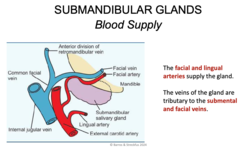
What are the arteries and veins for the submandibular gland?
Facial and lingual arteries
Submental and facial veins
What are the lymph nodes of the Submandibular gland?
Submandibular lymph nodes

Sublingual Gland
Smallest. Mixed secretion but predominantly mucous
What is the shape, weight, and dimensions of the sublingual gland?
Almond shape
2-3 g
3-4 cm
What are the ducts of the Sublingual gland
Duct of Rivinus (~15 ducts that drain the sublingual gland)
Duct of Bartholin (Largest sublingual gland excretory duct and joins Wharton's duct near the sublingual caruncle)

Where is the sublingual gland located?
Under the mucous membrane of the floor of the mouth between the mandible and the genioglossus muscle

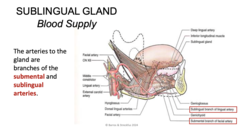
What are the arteries of the Sublingual gland?
Submental and Sublingual arteries
What are the lymph nodes for the sublingual gland?
Submental and Submandibular lymph nodes

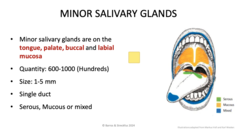
Where are minor salivary glands located?
tongue, palate, buccal, and labial mucosa
Properties of the minor salivary glands
600-1000 minor salivary glands
1-5 mm
Single duct
Serous, Mucous, or mixed
What are the 3 minor salivary glands we should know?
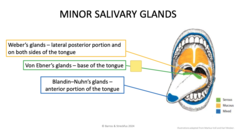
Weber's glands
Von Ebner's glands
Blandin-Nuhn's glands
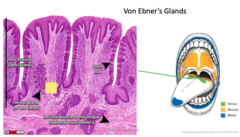
Von Ebner's Glands
Only SEROUS minor gland
Helps cleaning between papilla when food or debris gets stuck
both sides of oral cavity toward the back of your tongue
Glands of Blandin-Nuhn
anterior portion of the ventral portion of the tongue
mixed secretion
Weber's Glands
Lateral posterior portion and on both sides of the tongue.
MUCOUS
Gingival Cervical Fluid
-serum exudate NOT glandular secretion
-contributes to total composition of whole saliva
-inflammatory exudate derived from periodontal tissue and to cleanse material from the crevice

What components make up GCF?
Serum and locally generated materials such as tissue breakdown products, inflammatory mediators, and antibodies directed against dental plaque.
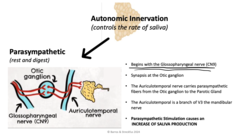
Parasympathetic System and Saliva
-Begins with Glosspharyngeal nerve (CN9)
-Synapsis at the Otic ganglion
-The Auriculotemporal nerve carries parasympathetic fibers from Ottic ganglion to the Parotid Gland
-The Auriculotemporal is a branch of V3 of the mandibular nerve
-Parasympathetic stimulation causes and INCREASE OF SALIVA PRODUCTION
Sympathetic System and Saliva
-Originates from the Superior Cervical Ganglion
-Part of the Sympathetic Chain
-Fibers from the ganglion travels along with the external carotid artery to reach the PAROTID gland
-Increase activity of the SYMPATHETIC NS INHIBITS THE SALIVARY PRODUCTION via vasoconstriction.

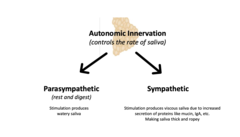
Parasympathetic vs. Sympathetic
Parasympathetic: Stimulation produces watery saliva
Sympathetic: Stimulation produces viscous saliva due to secretion of proteins like mucin, IgA, etc. Making saliva thick and ropey.
Sensory Innervation (Not in lecture, but maybe still know it)
-The Sensory Innervation is supply for Auriculotemporal nerve for the gland itself
-The great auricular nerve (GA) for the fascia
