AP Calculus AB Flashcards
 Studied by 4 people
 Call Kai
 Learn
Learn Practice Test
 Spaced Repetition
 Match
Match Flashcards
 Knowt Play
1/22

Earn XP
Description and Tags
Add on as you learn more!
Name | Mastery | Learn | Test | Matching | Spaced | Call with Kai |
|---|
No analytics yet
Send a link to your students to track their progress
23 Terms
Another way to write csc(x)
1/sin(x)
Another way to write sec(x)
1/cos(x)
Another way to write cot(x)
1/tan(x) or cos(x)/sin(x)
f(x) is continuous at x = c if what 3 things happen?
1) limx→c f(x) exists
2) f(c) is defined
3) limx→c f(x) = f(c)
When taking limits as x→∞ or x→-∞, the y-values approach the….
Horizontal Asymptote (HA)
BOBO (Bigger on bottom, HA = 0)
BOTN (Bigger on top, NO HA)
EATS DC (Exponents are the same, divide coefficients)
limx→0 sin(x)/x =
1
limx→0 1 - cos(x)/x =
0
Intermediate Value Theorem - IVT (verbally and graphically)
If f(x) is continuous on the closed interval [a,b] and c is in that interval, the IVT guarantees that f(c) is also in between f(a) and f(b).
![<p><span>If f(x) is continuous on the closed interval [a,b] and c is in that interval, the IVT guarantees that f(c) is also in between f(a) and f(b).</span></p>](https://knowt-user-attachments.s3.amazonaws.com/a9be250e-3893-469e-b120-a1135c1bddab.png)
Point-Slope Form of a line
y - y1 = m(x - x1)
Limit Definition of the Derivative
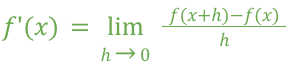
d/dx[ln(x)] =
1/x
d/dx[ex] =
ex
d/dx[√x] =
1/2√x
d/dx[ax] =
axln(a)
d/dx[sin(x)] =
cos(x)
d/dx[cos(x)] =
-sin(x)
d/dx[tan(x)] =
sec2(x)
d/dx[sec(x)] =
sec(x) * tan(x)
d/dx[csc(x)] =
-csc(x) * cot(x)
d/dx[cot(x)] =
-csc2(x)
d/dx[xn] =
nxn-1
d/dx[f(x) * g(x)] =
f(x) * g’(x) + f’(x) * g(x)
d/dx[f(x)/g(x)] =
(g(x) * f’(x) - f(x)
 Note
Note  Flashcards (43)