Unit 2: Antigens and Antibodies
 Call Kai
 Learn
Learn Practice Test
 Spaced Repetition
 Match
Match Flashcards
 Knowt Play
1/101

Earn XP
Description and Tags
MMSC 415
Name | Mastery | Learn | Test | Matching | Spaced | Call with Kai | Chat |
|---|
No analytics yet
Send a link to your students to track their progress
102 Terms
Antigen (Ag)
any substance that has the ability to interact with a B-cell receptor (BCR), T-cell receptor (TCR), or antibody (Ab)
Immunogen (all are antigens)
substance capable of inducing an immune response
Hapten
a molecule that is too small alone to be immunogenic
When does Hapten elicits immune response
only when attached to a carrier molecule (e.g. protein)
What is an epitope
an antigenic determinant, the site on a complex antigenic molecule that combines with an antibody (Ab), B-cell receptor (BCR), or T cell receptor (TCR)
What receptors or molecules can an epitope bind to
An antibody (Ab), B-cell receptor (BCR), or T-cell receptor (TCR)
How small are epitopes
Epitopes are very small, typically consisting of 6-12 amino acids or monosaccharide molecules
Where are epitopes located on an antigen
They are specific sites on a larger, complex antigenic molecule where immune receptors or antibodies bind.
What does it mean when an antigen is multivalent
it carries two or more different epitopes or has multiple copies of the same epitope
What is an epitope
The specific part of an antigen that is recognized and bound by an antibody
Can an antigen have multiple copies of the same epitope
Yes, the same epitope can be repeated several times on one antigen
What is valency
The number of epitopes per molecule
What does a multivalent antigen contain
Multiple epitopes, which can be different epitopes or repeated copies of the same epitope
What is the relationship between an epitope and an antibody
an antibody recognizes and binds to a specific epitope on an antigen
Antigen binding
two parts interaction, Epitope and Paratope
Epitope on antigen
binds to Ab paratope
Paratope (antigen-binding site)
region on antibody that binds to an epitope (only to a specific epitope)
What is immunogenicity
The inherent ability of an immunogen to stimulate an immune response
what can immunogenicity result in
the formation of antibodies or activation of immune lymphocytes
What are examples of immune lymphocytes that can be activated
T cells
What is an immunogen
A substance that can stimulate an immune response
Antigenicity
capacity of Ag or hapten to bind to Ab BCR, or TCR (specific reactivity)
what are heterologous (Heterophile) antigens
Related antigens from another species
What can heterologous antigens stimulate
The production of antibodies
What can the antibodies produced by heterologous antigens react with
cells or tissues of other animals or plants
Physical nature of immunogens
Foreignness
Size/ degradability
Complexity
Foreignness
Degree recognized as non-self, the greater the phylogenetic difference, the greater the immune response
Size/ Degradability
Large antigens must be able to be processed
Must be stable in vivo (sufficient retention time) to stimulate immune response
Complexity
larger molecules are better immunogens
must contain amino acid or monosaccharide sequence variation
Why are larger molecules better immunogens (antigens)
have more antigenic sites (multivalent), the more complex a molecule is the more effective it will be as an immunogen
Immunoglobulins
also known as antibodies and gamma (y) globulins
What are Immunoglobulins produced
produced by B cells (B lymphocytes, plasma cells)
Immunoglobulins Electrophoretic separation
most antibodies, but not all, are isolated in the gamma globulin fraction of serum
Proteins in electrophoresis
larger molecules to the right and smaller molecules to the left
Antibodies
produced in response to immunogenic stimulation
Five human classes (isotypes) of antibodies:
IgG, IgM, IgA, IgD, and IgE
Chemical structure of Immunoglobulins
Monomer
Two light chains
Two heavy chains
Monomer
basic 4-polypeptide chain structure that resembles the letter Y
Two light chains (L chains)
k (kappa) & lambda
Two heavy chains (H chains)
gamma,
Variable (V) region: amino-terminal region (N-terminus)
On Fab fragments (fragment antigen binding)
Sequence differences on both chains VH and VL
Three small hypervariable regions:
HV1 (CDR1), HV2 (CDR2), & HV3 (CDR3)
Constant (C) region: carboxy-terminal region (C-terminus)
Includes Fc fragment (fragment crystallizable)
Biological activity, mediates effector functions
How many FAB does each monomer have
2 FAB
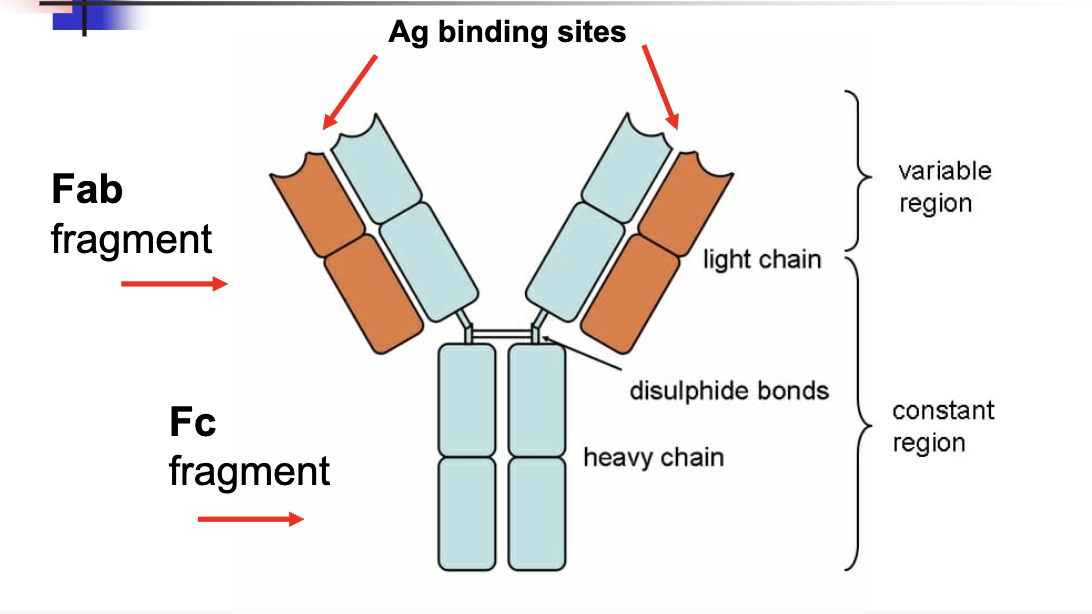
what is FAB made up
partial heavy chain and partial light chain

Fc fragment
consisting entirely on heavy chains
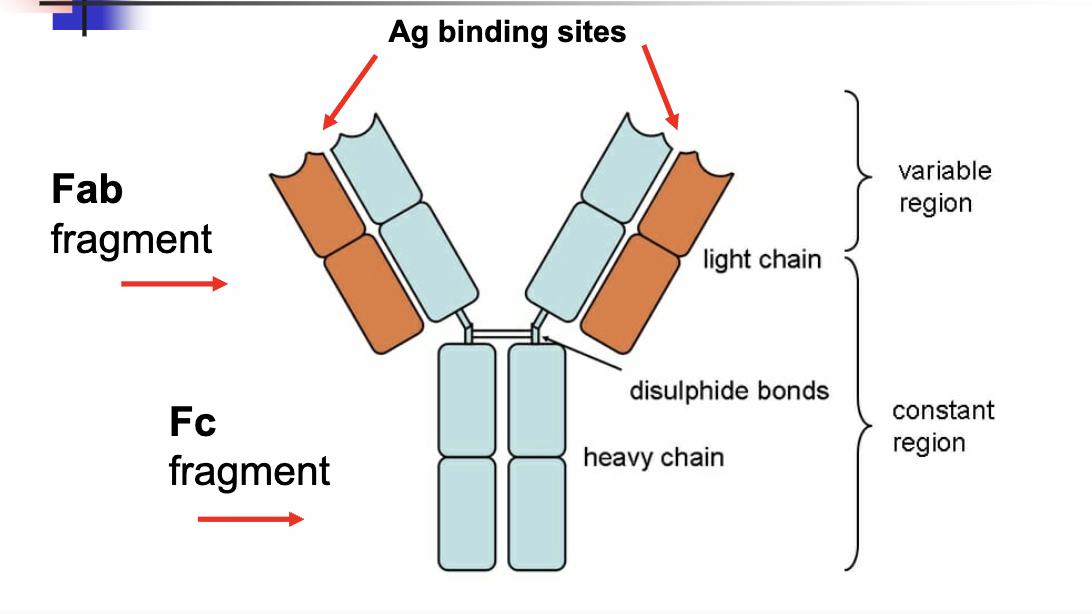
Ag binding sites
where antigens will bind to

light chain
found on the outside (in orange), identical on both sides
disulphide bonds
keep two heavy chains connected
hinge region
allows antibodies to flex + bend to bind with antigens
variable region
upper most domain consist of the 4 top blocks, made up of heavy + light chains
constant region
rest of the body, lost of Domain of heavy chain and some light chain
J chain (joining chain)
IgM and dimeric (meaning 2) IgA only
Secretory component:
IgA only
what is the process of Secretory component
wraps around the dimeric IgA to protect it from proteolytic enzymes
How does IgA stays
associates itself with mucus, embed or loosely bind to mucus so it’s not moved out or cleared by our mucus injection
J Chain functions
used to secrete the antibodies into the mucosa
help protect it when its in the mucosa
very small power peptide usually just used for linking
IgA
highest antibody, or the most frequent antibody in mucosal sites
there to protect us in our respiratory tract, genital tract, and in our gut from pathogens
Determinants on Immunoglobulins
Isotypes
Allotypes
Idiotypes
Isotypes
Five main types or classes and some subclasses
Allotypes
genetic variations in antibodies that differ between individuals of the same species
Idiotypes
Unique amino acid sequence of VH and VL domains
Classes (Isotypes) of Antibodies
IgG
IgM
IgA
IgD
IgE
IgG
Most abundant (75%), longest half-life, monomer, best anamnestic (memory) Ab
IgG Activates complement
IgG3 is most effective, then IgG1 & IgG2
IgG4 does not activate complement
C1q must cross-link two or more IgG
What is something only IgG can do
Crosses the placenta (at birth human babies haev IgG levels as high as their mothers
IgG - Very good neutralizing Ab
Neutralizes pathogens and particles so they are no longer infectious (e.g. viruses)
Opsonization in IgG
IgG1 and IgG3 have high affinity for FcR on phagocytes
What does the Fc portion binds to in IgG
Staphylococcus aureus
protein A
IgG1, IgG2, & IgG4
IgM
5-10% of total serum, a pentamer (highest possible valence of all antibodies)
Why is IgM generally confined to intravascular spaces
because of large size due to it being pentamer
J chain role in IgM
enhance transport across mucous membranes
IgM
First Ab produced, early after antigenic exposure (primary response), little anamnestic response
why is IgM better than IgG for activating and fixing complement pathway
a single IgM can activate C1 bonding to the pathogen causing the monomers to bind to it and their FC receptors stick up, only requiring one molecule
IgA
10-15%, monomers and dimers
Most predominant Ab in secretions IgA
tears, saliva, breast milk, intestinal secretions, genital secretions, and other mucous membranes
Secretory component IgA
protects against proteolytic enzymes
IgD
1%, found on the surface of b lymphocytes (as a BCR)
IgD functions in the activation of B Cells
exists as a monomer, as a receptor on a B cell (just like IgM)
When B cell is maturing early on what does it express
both a monomer of IgM and IgD on the surface of the B cell as a receptor
When IgD binds to a specific antigen what will it cause
a pathway to activate that b lymphocyte which will then allow it to mature into a plasma cell
IgE
0.01%, very potent activator of allergic reactions
Mast cells and Basophils have high affinity receptor for who
IgE
If exposed to an allergen
produce IgE antibodies against that allergen
IgE
does not disassociate once its bound to that epsilon receptor it will remain there for weeks to months time
Hydrogen bonding
hydrogen atom shared between two electronegative atoms
electrostatic forces
oppositely charged groups attract
Van der Waals forces
positive or negative charged regions of molecules
Hydrophobic bonds
Association of hydrophobic groups
Affinity
the strength of a single antigen-antibody interaction
how is affinity determined
by the summation of the attractive and repulsive forces described previously
Avidity
the strength with which a multivalent antibody binds a multivalent antigen
what is avidity
the accumulated strength of multiple interactions
Between IgM and IgG which one has greater avidity
IgM rather than IgG because it has 10 binding sites, it has a higher capacity for binding that makes it have higher avidity
Two antibodies with different antigenic specificities usually
have different amino acid sequences in their hypervariable regions
Monoclonal Antibody
rationale for use in diagnosis and treatment of disease
Hybridoma Technology Principle
Purification of mAb from heterogeneous mixture not feasible
Normal B cells
Expose to immunogen
Fuse B cells (plasma cells) with myeloma cells
creates a hybrid cell called a hybridoma
Uses of Monoclonal Antibodies (mAbs)
labeled mAbs detect Ags in vitro
mAb immunotherapy