Biology topic 3
 Studied by 0 people
 Call Kai
 Learn
Learn Practice Test
 Spaced Repetition
 Match
Match Flashcards
 Knowt Play
1/51

There's no tags or description
Looks like no tags are added yet.
Name | Mastery | Learn | Test | Matching | Spaced |
|---|
No study sessions yet.
52 Terms
What is the nucleus and the function of it?
It is enclosed by an envelope composed of two membranes perforated by pores. It contains chromosomes and a nucleolus. Chromosomes are made of DNA containing genes that control the synthesis of proteins.
What is nucleolus?
A dense body within the nucleus where ribosomes are made
What is the rough endoplasmic reticulum?
A system of interconnected membrane bound, flattened sacs. Ribosomes are attached to the outer surface and proteins are made on these ribosomes then are transported to other parts of the cell.
What are ribosomes?
They are made of RNA and protein, these small organelles are found free in the cytoplasm or attached to an endoplasmic reticulum. They are the site of proteinsysthesis.
What is the cell surface membrane?
Phospholipid bilayer containing proteins and other molecules forming a partially permeable barrier.
What is the smooth endoplasmic reticulum?
Same as the rough endoplasmic reticulum but without ribosomes attached. It makes lipids and steroids eg reproductive hormones.
What is the Golgi apparatus?
Stacks of flattened membrane bound sacs formed by the fusion of vesicles from the ER. Modified proteins and packages them into vesicles.
What are lysosomes?
Spherical sacs containing digestive enzymes and bound to a single membrane. Involved in the breakdown of unwanted structures within the cell, and in destruction of whole cells when old cells are to be replaced during development. The acrosome is a specialised lysosome.
What are the centrioles?
Every animal has a pair of centrioles - hollow cylinders made of a ring of nine protein microtubules. They are involved in the formation of spindle fibres during nuclear division and in transport within the cell cytoplasm.
What are microtubules (within centrioles)?
Polymers of globular proteins arranged in a helix to form a hollow tube.
What are mitochondria?
The inner of its two membranes are folded to form finger like projections called cristae. The mitochondria are the site of later stages of aerobic respiration.
What is the route, through the cell, of the production of proteins?
Transcription of DNA to mRNA
mRNA leaves the nucleus
Protein made on ribosomes (free ribosomes or rER ribosomes)
Protein moved through ER assuming a three dimensional shape
Vesicle pinched off rER containing the protein
Vesicle fuses to from flattened sacs of Golgi apparatus
Proteins modified in Golgi
Vesicles pinched off Golgi containing modified protein
Vesicle fuses with cell surface membrane releasing protein eg extracellular enzymes
What are the structures of an ovum?
Cytoplasm
Haploid nucleus
Lysosomes
Cell surface membrane
Lipid droplets
Zona pellucida (jelly-like coating)
Follicle cells from the ovary
What are the structures of a sperm cell?
Acrosome
Haploid nucleus
Mitochondria
Flagellum
Head and middle
What is the acrosome reaction?
The acrosome in the head of sperm swells, fuses with the sperm cell surface membrane and releases digestive enzymes. This breaks down the zona pellucida of the ovum.
What is the cortical reaction?
Once the sperm fuses with and penetrates the membrane surrounding the egg, chemicals released by the ovum cause the zona pellucida to thicken, preventing any further sperm entering the egg.
What is the pathway of the sperm meeting the ovum?
Sperm reaches ovum
Chemicals released from cells surrounding the ovum, triggering acrosome reaction
Acrosome swells, fusing with sperm cell surface membrane
Digestive enzymes in acrosome released
The enzymes digest trough follicle cells
Digest zona pellucida as well
Sperm fuses with ovum membrane
Sperm nucleus enters ovum
Cortical reaction - chemicals released from lysosomes
Nuclei of ovum and sperm fuse
How does meiosis result in genetic variation?
Independent assortment and crossing over
What is independent assortment?
Homologous chromosomes line up randomly, leading to different combinations of chromosomes in the daughter cells.
What is crossing over?
During first melodic division, homologous chromosomes come together as pairs and all four chromatids come in contact.
At these points of contact the chromatids break and rejoin, exchanging DNA between non sister chromatids.
This point of breakage is called a chiasma.
This causes genetic variation and several of these will happen along the length of each pair of chromosomes.
What is linkage?
Any two genes with the same locus on the same chromosome are linked together and will tend to be passed as a pair to the same gamete.
What is sex linkage?
Genes located on sex chromosomes causing traits to appear more frequently in one sex than another.
(Females - XX
Males - XY)
Are men or women more likely to have colour blindness?
As the gene that controls colourblindness is on the X chromosome and is a recessive condition, men need to only inherit it once for it to be present as they only have 1 X chromosomes. However, women need to inherit it twice on each X chromosome for it to be present and actually affect them.
What is interphase?
It is the time of intense and organised activity during which the cell synthesises new cell components such as organelles and membranes and new DNA
What are the components of interphase?
G1 - DNA replication
S - Synthesis, replication of chromosomes and they begin to condense and form chromatids
G2 - Growth. The cell prepares for replication and the organelles replicate.
What is the organisation of DNA in chromosomes?
DNA double helix
DNA winds around histone proteins
DNA and histone proteins coil to form chromatin fibre
Chromatin fibre attaches to a protein scaffold forming loops
Folding the protein scaffolding produces the condensed chromosome structure seen during nuclear division.
What happens to the chromosomes during interphase?
They get unravelled allowing access to the genetic material, enabling new proteins to be synthesised.
What happens during prophase?
Chromosomes condense, becoming shorter and thicker - become 2 visible chromatids. They are usually identical produced through replication and are joined at the centromere.
Microtubules form spindles. The centrioles move around the nuclear envelope and position themselves at opposite poles.
The nuclear envelope breakdown occurs at the end of prophase and the start of metaphase.
What happens during metaphase?
The chromosomes’ centromeres attach to spindle fibres at the equator.
What happens during anaphase?
The centromeres split and the spindle fibres shorten, pulling two halves of the centromeres in opposite directions.
One chromatid of each chromosome is pulled to each pole.
What happens in telophase?
The chromosomes unravel and the nuclear envelope reforms so the genetic material/ information becomes enclosed in separate nuclei.
What is cytokinesis?
Cytoplasmic division.
the cell surface membrane constricts around the centre of the cell.
A ring of protein filaments bound to the inside surface of the cell surface membrane is throughly to contract until the cell has divided into two new cells.
Actin and myosin may also be the proteins responsible for cytoplasmic division.
What is mitosis used for?
Asexual reproduction
Growth and repair
What is totipotency?
It can develop into a whole human being.
What is a pluripotent cell?
Specialised cells that can differentiate into any cell in the adult body but not any cells in the placenta or embryonic cells.
What are mutipotent cells?
Type of stem cell that can differentiate into a limited number of specialised cell types within an specific organ or tissue.
What are the uses of human stem cells in medicine?
Regenerative medicine - branch of medicine concerned with replacing, engineering or regenerating human cells, tissues or organs to achieve normal function.
Embryonic stem cells would be most useful as they are pluripotent unlike adult stem cells which are multipotent.
How do we get embryonic stem cells?
From ‘spare embryos’ from IVF. Parents must be clear consent.
This can be controversial for some people.
How are embryonic stem cells isolated?
Embryos being used for research are allowed to grow to from blastocysts (a hollow ball of cells made after 5 days of conception)
They are cultured for a further period of time to see if stem cells are formed.
The stem cells are isolated from each embryo and the rest of the embryo is discarded.
Stem cells are cultured and can be used to develop tissues that can be used for routine transplantation.
What is therapeutic cloning?
The process of creating a cloned early-stage embryo (blastocyst) to produce embryonic stem cells that are genetically identical to the patient.
They embryos must be destroyed after 14 days by the law.
What are the roles of regulatory authorities eg the Human Fertilisation and Embryonic Authorities (HFEA)?
To promote advances in the treatment of fertility
To increase knowledge about the causes of congenital diseases
To increase knowledge about the causes of miscarriage
To develop more effective methods of contraception
To develop methods for detecting gene or chromosome abnormalities in embryos before implantation
Explain the acetabularia experiment
Acetabularia mediterranea and Acetabularia crenulata with hat, stalk and rhizoid containing nucleus
The hats were removed and stalks swapped (contained cytoplasm with mRNA)
The plants developed hats with features of both species
The stalks were swapped back and original hats grew back
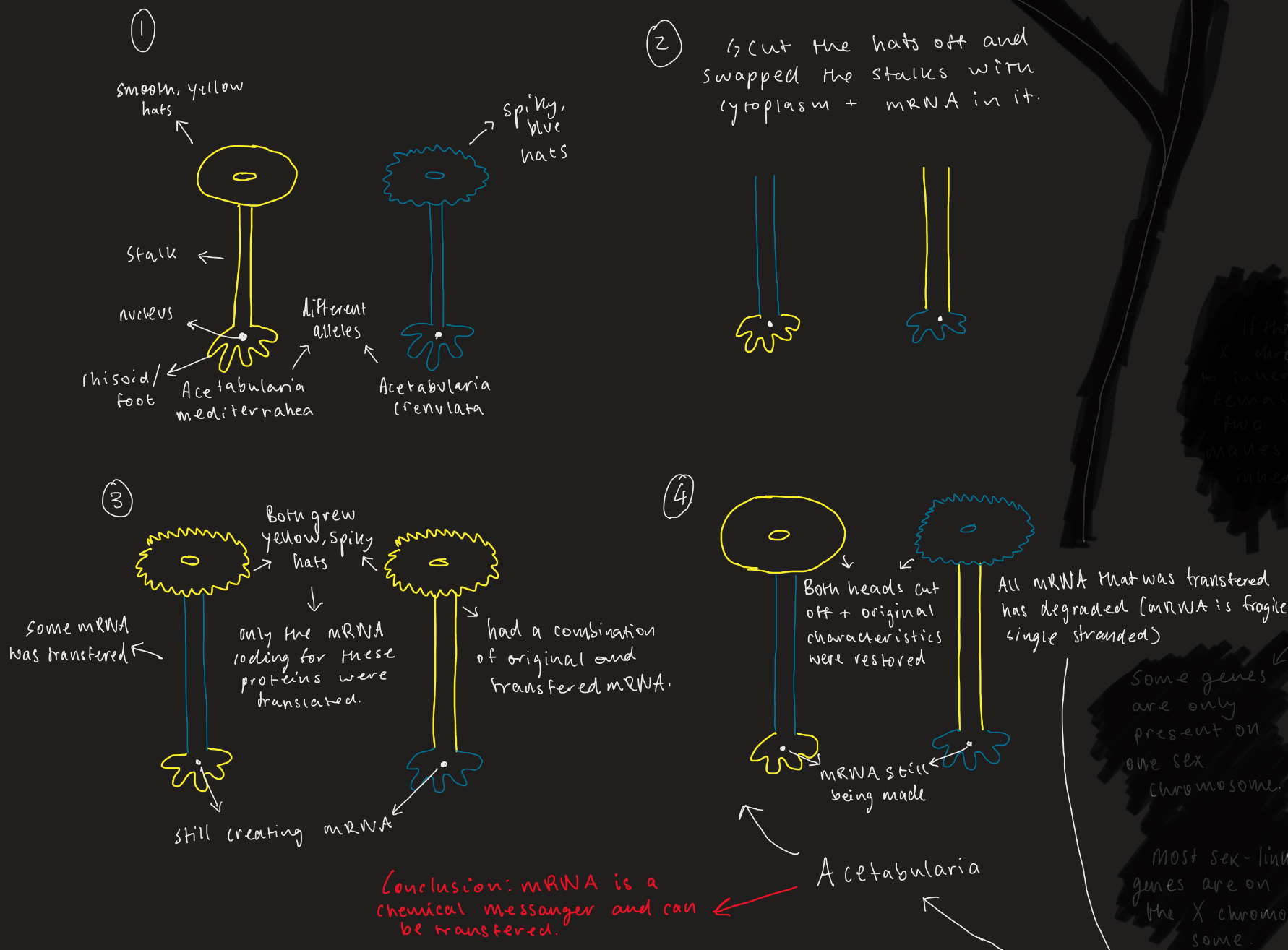
What was the conclusion of the acetabularia experiment?
mRNA is a chemical messenger that can be transferred
Explain Dolly the Sheep
A diploid nucleus from a donor (extracted from udder of sheep) and an extracted egg cell membrane is fused.
They are fused by an electric shock.
They divide by mitosis.
Inserted into a surrogates uterus.
This sheep gives birth and is genetically identical to the sheep that donated the diploid nucleus - this was Dolly the Sheep.
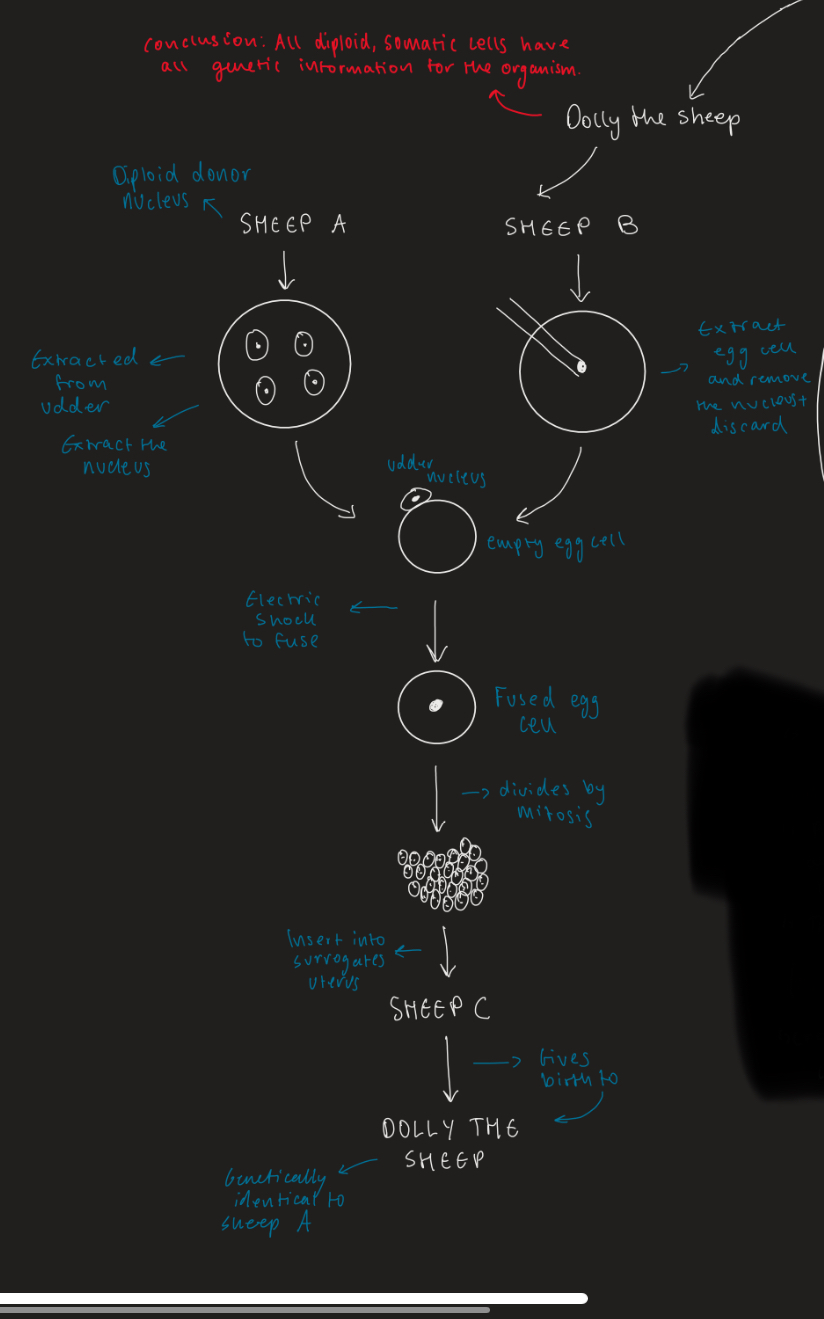
What was the conclusion of Dolly the Sheep?
All diploid, somatic cells have all genetic information for the organism.
Explain the David and Sargent experiment
Extracted bastrula (undifferentiated) and gastrula (differentiated) mRNA separately.
The gastrula mRNA was reverse transcribed to create cDNA (copied DNA)
The cDNA was mixed with the mRNA from the bastrula
Some hybridised and some didn’t
What was the conclusion of the David and Sargent experiment?
Different genes become active at different stage of development, more genes are switched on later on in development.
What is the epigenome?
The epigenome influences which genes can be transcribed in a particular cell. They are chemical markers on the DNA and histones.
What are the types of attachments of the epigenome?
Methylation - attachment of a methyl group, usually to a cytosine, prevents transcription of mRNA by stopping RNA polymerase from binding.
Histone modification can be methylation or acetylation - affects how tightly wound the DNA is around the histones. When tightly wound, the gene is inactive and mRNA cannot be produced - switched off.
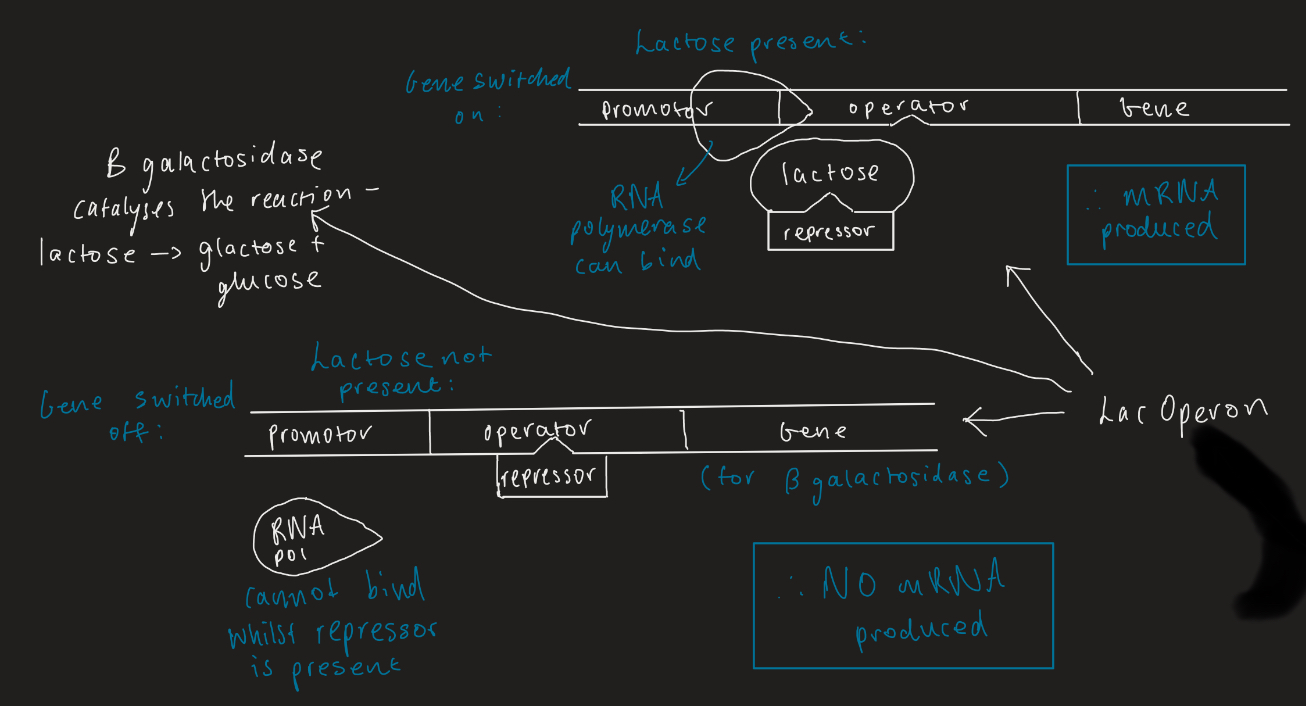
Explain the lac operon model
When lactose is not present, a lactose repressor molecule binds to the DNA and prevents transcription of B-galactosidase gene.
If lactose is present, it binds to the repressor and the RNA polymerase can bind to the DNA and transcription can happen.
What switches transcription of an individual gene on or off in eukaryotes?
The RNA polymerase binds to the promoter region on an adjacent DNA to the gene transcribed. The gene remains switched off until the enzyme attaches to the promotor region successfully. The attachment of a regulator protein is usually also required to start transcription.
How are cells organised into tissue?
Specialised cells can group themselves together into clusters - working together as tissue.
Cells have specific recognition proteins known as adhesion molecules on cell surface membranes.