Dosimetry & Treatment Planning: Key Concepts and Calculations
 Call Kai
 Learn
Learn Practice Test
 Spaced Repetition
 Match
Match Flashcards
 Knowt Play
1/111

There's no tags or description
Looks like no tags are added yet.
Name | Mastery | Learn | Test | Matching | Spaced | Call with Kai | Chat |
|---|
No analytics yet
Send a link to your students to track their progress
112 Terms
What is Mayneord's factor used to convert?
The percentage depth dose (PDD) with a change in source to surface distance (SSD) from the standard.
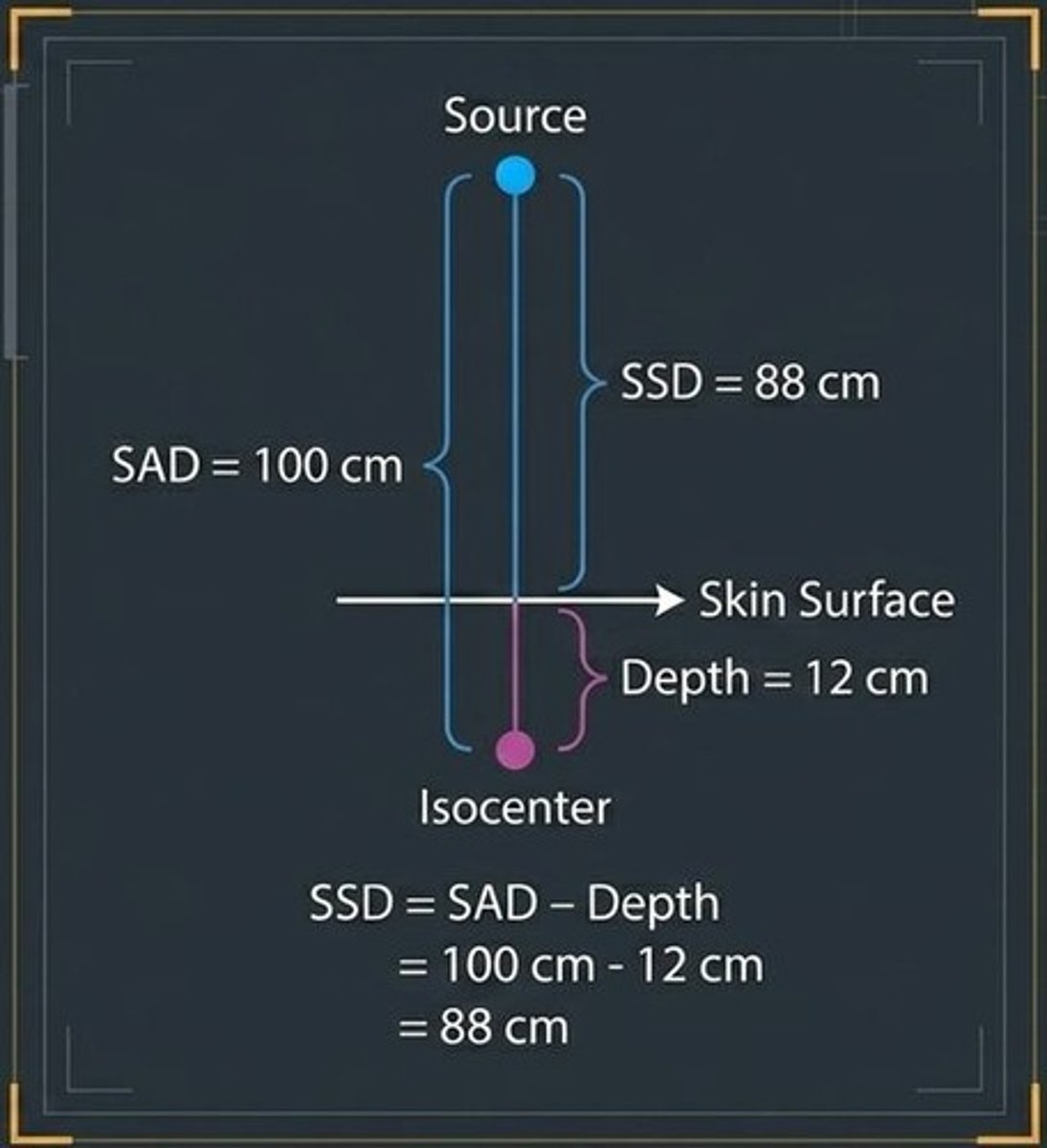
What would the source to surface distance (SSD) be when treated with a source to axis distance (SAD) at a depth of 12 cm?
88 cm
Percentage depth dose curve (PDD) is dependent on all of the following factors except for?
SAD.
What is the field size at isocenter with a target-skin distance (TSD) of 92 cm if the isocenter distance is 100 and the field width is 14 cm?
15.2 cm
What treatment distance is needed to treat a whole femur in one field if the maximum field size at 100 cm is 40 × 40 cm and the length is 52 cm?
130 cm
What happens to the field size at an extended distance setup?
Field size increases.
As source to surface distance (SSD) increases, what happens to the percent depth dose?
Increases.
Tissue-to-air ratio (TAR) is independent of?
Distance.
What is the dose to the target when the 103 cm SSD is used for a patient planned to deliver 8 Gy in 1 fx?
7.5 Gy
What would the field size be at 110 cm TSD if the maximum field size dialed is 40 cm × 40 cm?
44 cm × 44 cm
What would the TSD read on the patient's skin if the right lateral TSD is 92 cm and the left lateral TSD is 90 cm?
91 cm on both sides
Which statements about percentage depth dose (PDD) are correct?
PDD increases with an increase in beam energy, PDD increases with an increase in source to surface distance (SSD), PDD decreases as the depth in tissue increases.
Why does percent depth dose (PDD) increase with an increase in distance?
The backscatter factor increases.
What happens to the source to surface distance (SSD) as the gantry rotates around the patient?
It continually changes.
What device is used to measure the distance from the source of photons to the patient's skin surface?
ODI (Optical Distance Indicator)
What is the purpose of the optical distance indicator?
Project the number scale onto the patient's skin.
What is the depth if the anterior source to surface distance (SSD) for a chest treatment is 89 cm with a SAD of 100 cm?
11 cm
Which statement is TRUE about the source to skin distance when daily image guidance is used?
It is a value that may change from day to day.
Which of the following is not displayed at the linear accelerator console?
Actual source to surface distance (SSD).
Which factor is independent of field size?
Tissue-to-air ratio (TAR).
When calculating extended distance treatment setting, where is the patient scatter factor calculated?
At the calculation depth.
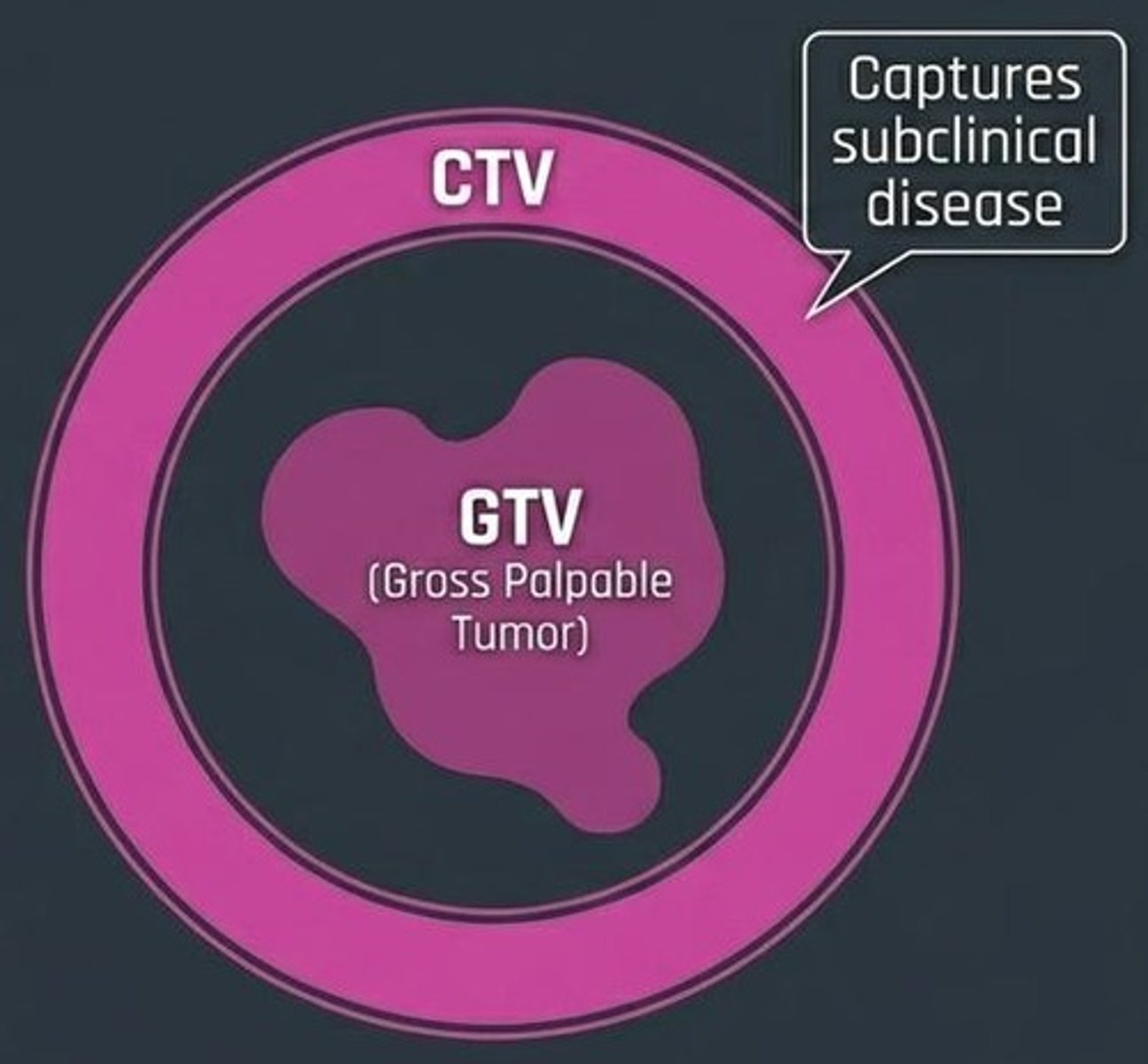
What is the treatment area that includes the gross palpable tumor and surrounding volume of tissue containing subclinical disease called?
The clinical target volume (CTV).
What must a treatment prescription contain all of the following except for?
Set up instructions.
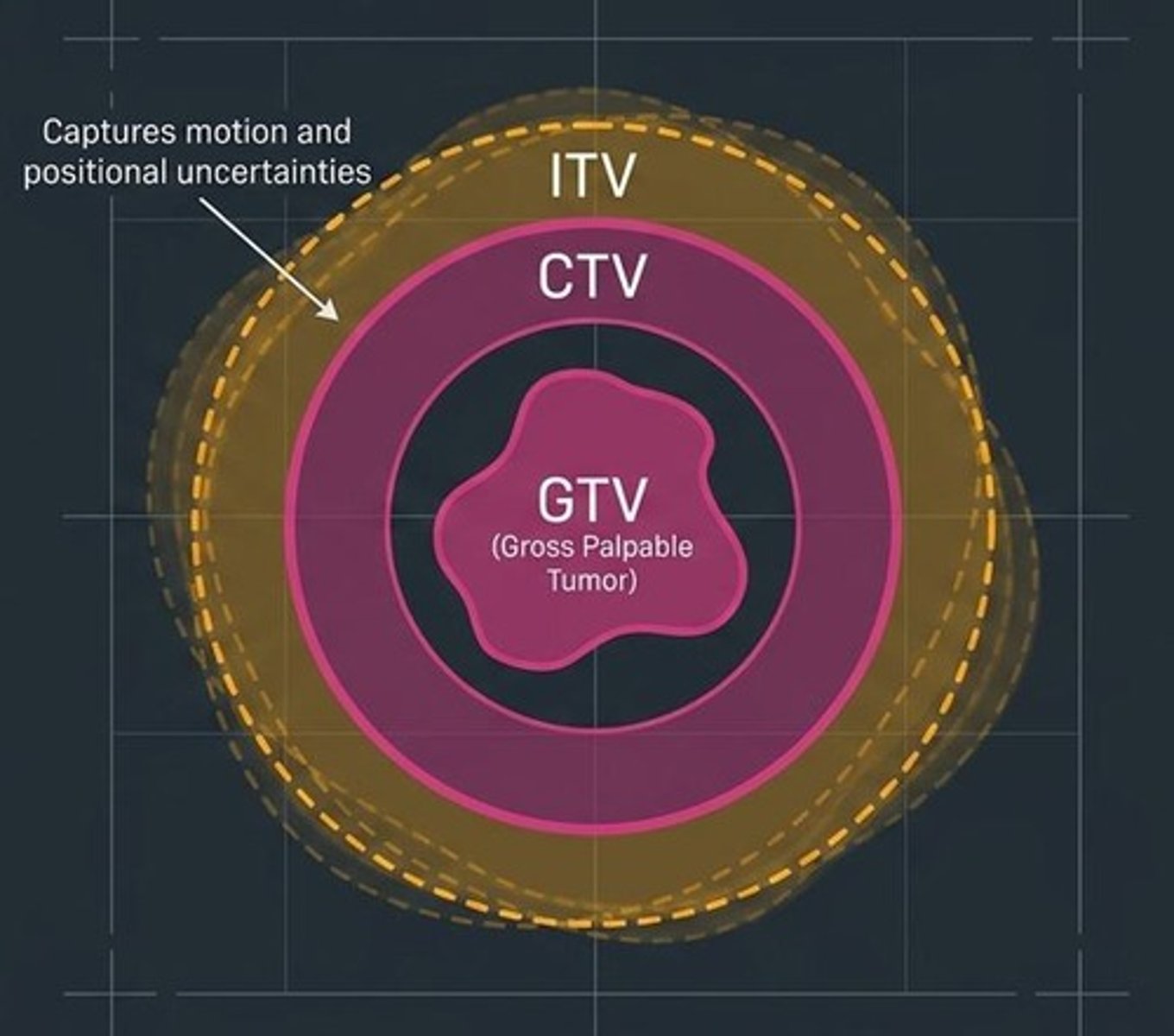
What does the Internal Treatment Volume (ITV) include?
Clinical Target Volume (CTV) and Gross Tumor Volume (GTV).
A PA only treatment field is an example of what type of treatment?
2D.
In an isodose distribution, what is the point where the dose is set at 100% called?
Normalization point.
What refers to a two-dimensional image reconstructed from CT data that shows a beam's eye view of the treatment field?
Digitally reconstructed radiograph.
Which statement is TRUE regarding multileaf collimator (MLC) leaves?
Transmission is less than that through a cerrobend block.
Stereotactic body radiation therapy (SBRT) is best suited for cancer of which organ?
Lung.
What is TRUE regarding beam weighting when treating with multiple fields?
Beam weighting is useful when treating through a sensitive structure.
Which treatment delivery method spares healthy tissue the LEAST?
2D.
Intensity modulated radiation therapy (IMRT) uses what type of planning?
Inverse.
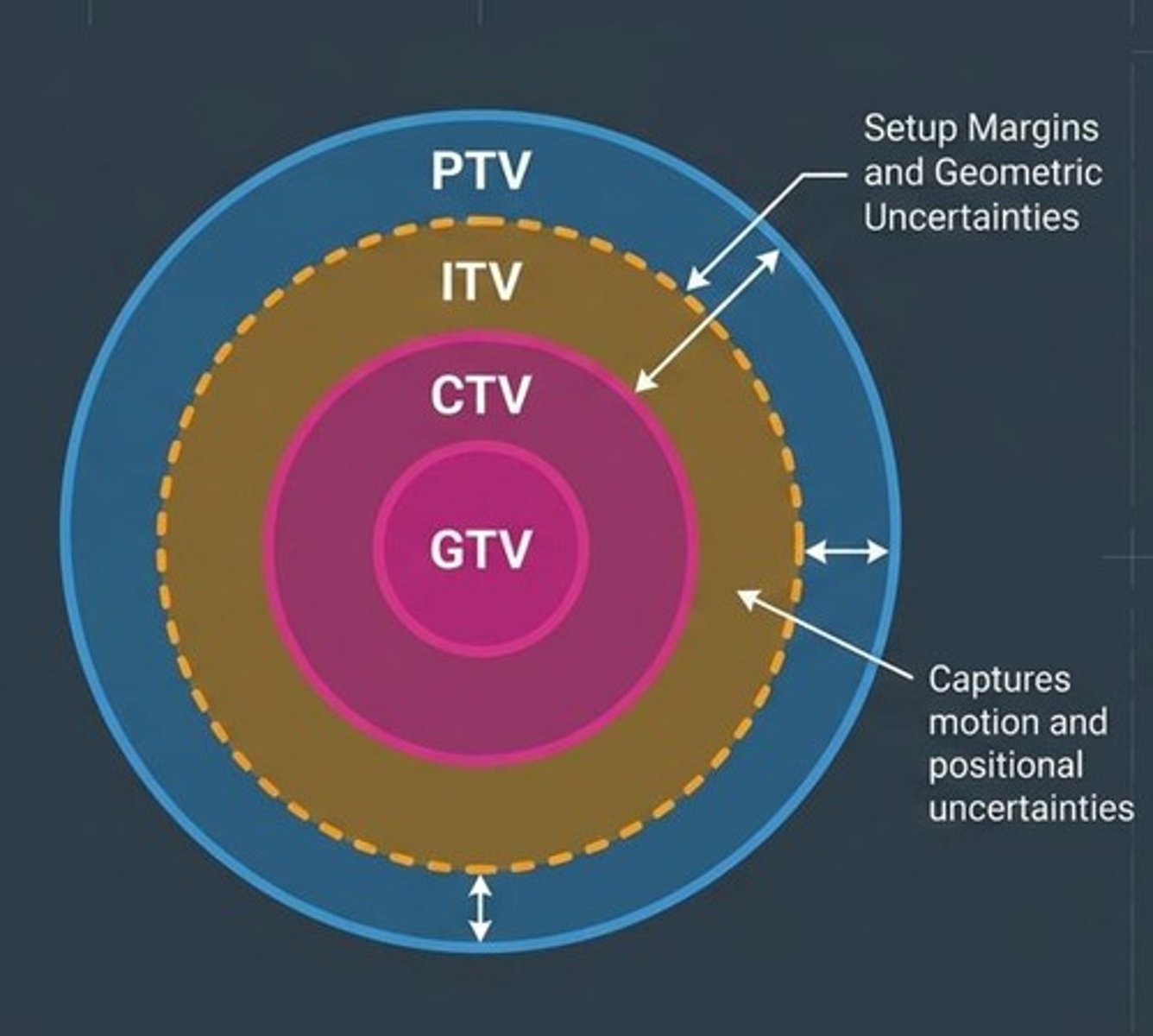
In 3D treatments, which volume takes geometric uncertainties into consideration?
Planning target volume (PTV).
Which treatment modality delivers treatment while dose rates and field sizes change?
Volumetric modulated arc therapy (VMAT).
What is a two-dimensional image created from reconstructed CT data often referred to as?
Digitally reconstructed radiograph.
Which of the following is an example of noncoplanar beam arrangement?
Stereotactic radiosurgery.
How do conformal arcs differ from standard arc treatments?
Jaws change while the gantry is moving.
What vehicle is used to send data to the dosimetry treatment planning system after CT simulation?
DICOM.
Which of the following is NOT considered localization for isocenter placement method?
Placement based on linac type.
What do portal images verify?
Beam shape and position, projection of the beam's central axis.
When treating pancreatic cancer, what target volume does not have to be routinely identified?
Rectum.
CT simulation uses what display to view the anatomy from the perspective of the treatment beam?
Beam's eye view.
How do laser systems assist in treatment setup?
Providing visual reference to the location of isocenter, projecting asymmetric alignment, facilitating alignment of machine coordinates with external patient landmarks.
What enhances treatment accuracy, reproducibility, and integrity of patient position?
Immobilization devices.
What are disadvantages of using the shift method for CT simulation planning?
Inexact remarking of patient, exact corrections can be difficult if there are any incorrect shifts.
What do dose-volume histograms represent?
Dose received by the organ.
What are topograms?
Imaging tools used for patient alignment and to define the CT scan range.
What is the standard format used to transfer information between imaging systems?
DICOM.
What is image fusion?
Combining digital CT, MRI, and/or PET images directly to provide increased data.
What is a beam profile?
One dimensional spatial representation of beam intensity variation.
How do Verify and Record systems aid in radiation therapy delivery?
Identifying correct setup, autosequencing of treatment fields, preventing initiation of the beam if treatment settings fall outside of a range.
What is the Verify and Record system?
A system that validates treatment setup and delivery to the treatment plan.
What does the planning target volume indicate?
The clinical target volume plus margins for patient motion, beam penumbra, and treatment setup differences.
What is the clinical tumor volume (CTV)?
The true extent and location of the tumor.
What is the gross tumor volume (GTV)?
The gross demonstrable extent and location of the tumor.
What is IGRT?
A method that combines online verification with precise target localization.
How are treatment setup instructions recorded?
Using photographs, anatomic measurements, and illustrations.
What does digitally reconstructed radiography (DRR) contain?
Critical structures, beam aperture definition, outlined target area.
What is the primary purpose of the record and verify system?
To compare treatment plan parameters to actual values in the treatment room.
What are fiducial markers?
Fixed reference points located at the skin surface, internally or externally fixed to the patient.
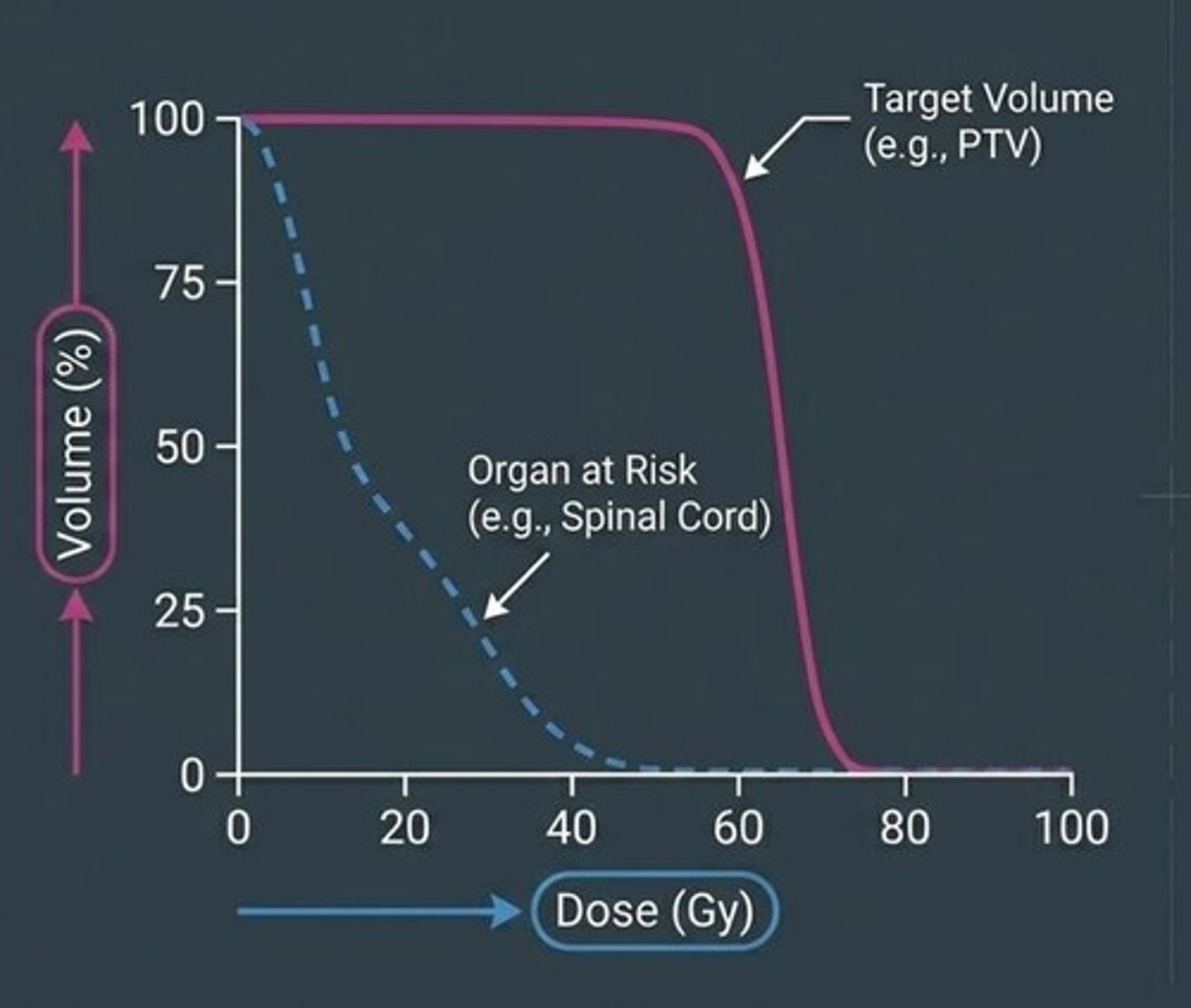
How is the dose-volume histogram (DVH) described?
As a plot of volume versus the minimum dose absorbed within that volume.
What is the purpose of immobilization devices in radiation therapy?
To keep the patient comfortable, ensure reproducible setup, prevent patient motion.
What can be used to correct for missing tissues or internal homogeneities?
Compensators.
What can changes in a patient's weight affect?
Position of underlying anatomy, patient-beam alignment, dose calculations.
What is the ratio of the dose rate of a given field size to the dose rate of the reference field size called?
Output factor.
What is the purpose of the scattering foil in a linear accelerator?
To broaden and flatten the electron beam.
What are the two power sources used to generate electromagnetic waves for the linear accelerator?
Magnetron and klystron.
What part of the linear accelerator is responsible for the production of electrons?
Electron gun.
What is used in high-energy linear accelerators to angle the beam within the head of the gantry?
Bending magnet.
What are the two types of microwave power sources used in linear accelerators today?
Klystrons and magnetrons.
What is the maximum field size in cm of a linear accelerator?
40×40.
What daily mechanical checks are performed on the linear accelerator?
Localizing lasers.
What tools are used when checking light field and radiation field agreement?
Ready pack film, Solid water.
What is a measure of machine output from a linear accelerator defined as?
Monitor unit.
What are examples of safety features in linear accelerators?
Emergency off buttons, dose rate monitoring, use of coded wedge filters, collision avoidance systems.
How often should collision interlocks of the on-board imagers be checked?
Daily.
When is the scattering foil placed in the path of the beam?
When electrons are used for the patient's treatment.
What is the source to axis distance (SAD) for linear accelerators and cobalt units?
100 cm for linear accelerators, 80 cm for cobalt units.
What does the beam of a 6 MV linear accelerator consist of?
Photons having an average energy of 6 MV.
What type of jaws are used to block off a part of the field without changing the position of the isocenter?
Asymmetric jaws.
What component prevents the backflow of microwaves into the klystron or magnetron in a linear accelerator?
The circulator.
What type of collimation systems do electron therapy and stereotactic techniques use?
Tertiary collimation systems.
Which statements are TRUE of the Multileaf Collimator (MLC) technique?
Modulation of beam intensity, automation of field shaping, reduction of set up time.
What does the console of a linear accelerator display and contain?
Monitor units, fault indicators, treatment calculations, emergency stop button.
What causes field size changes with distance from the radiation source?
Beam divergence.
Who sets the action levels for machine quality check measurements in a linear accelerator?
The responsible authority or regulatory body.
What needs to be adjusted when machine quality check measurements fall outside of the allowed deviation?
The linac
What creates high dose or 'horns' near the surface in the edges of a linear accelerator field?
Flattening filter
What causes a change in beam intensity by movement of an independent jaw across the field during treatment?
Dynamic wedge
What does the field light on the linear accelerator represent?
Dimensions of the radiation field on the patient
Which would NOT alert the radiation therapist that the linac is NOT ready to have the beam go on?
Bolus not placed on patient
What is the most common method of producing an electron beam wide enough for clinical use?
Scattering foil
What is the main purpose of a machine interlock on a linear accelerator?
Protect the equipment from damage
How many flattening filters do dual energy photon linacs require?
Two
Which of the following is a backup system on the linear accelerator?
Secondary ion chamber
What assists in the transfer of energy in a linear accelerator to accelerate electrons?
Klystron, magnetron
What produces different beam paths for different energies above 6 MeV?
Bending magnet
What may result if the target or flattening filter does not divert the radiation beam?
Abnormally high dose rates
What consists of two independent sealed chambers that monitor beam dosimetry in a linear accelerator?
Ion chamber
What is used to prevent a hot spot at the junction of two treatment fields with a small hinge angle?
Wedge