chapter 18: practical applications of immunology
 Call Kai
 Learn
Learn Practice Test
 Spaced Repetition
 Match
Match Flashcards
 Knowt Play
1/19

There's no tags or description
Looks like no tags are added yet.
Name | Mastery | Learn | Test | Matching | Spaced | Call with Kai | Chat |
|---|
No analytics yet
Send a link to your students to track their progress
20 Terms
introduction: practical applications of immunology
test “applications” = “uses”
use of substances (Ag) that trigger immune response (humoral/CMI)
ex. vaccines: inject Ag → make Ab → dz PREVENTION
testing/analysis of pt’s blood (serum) sample
ex. serological testing: look for Ag’s or Ab’s in blood (pt sample) → accurate + timely dx
history of immunity & vaccination
inoculation of Cowpox virus to prevent Smallpox (1st vaccine)
vaccine
injection of substances (antigens) into the body → induce immune response
ex. make Ab’s (humoral immune response)
vaccination
(“vacca” = cow)
provokes a primary immune response → leads to formation of memory B cells and Ab’s (b/c just completed clonal selection & clonal expansion)
produces a rapid & intense secondary immune response
immunogen
a substance (Ag) that stimulates the immune system
herd immunity
protection for most of the population
desirable criteria for an ideal vaccine
vaccine safety: never pathogenic or toxigenic
vaccine effectiveness: strong immunogen & stimulate immune system
vaccine w/ oral administration: preferred over injectable vaccine
vaccine requires only one injection or combination preferred
vaccine is affordable & easy access
types of vaccines (live, inactivated, toxoid)
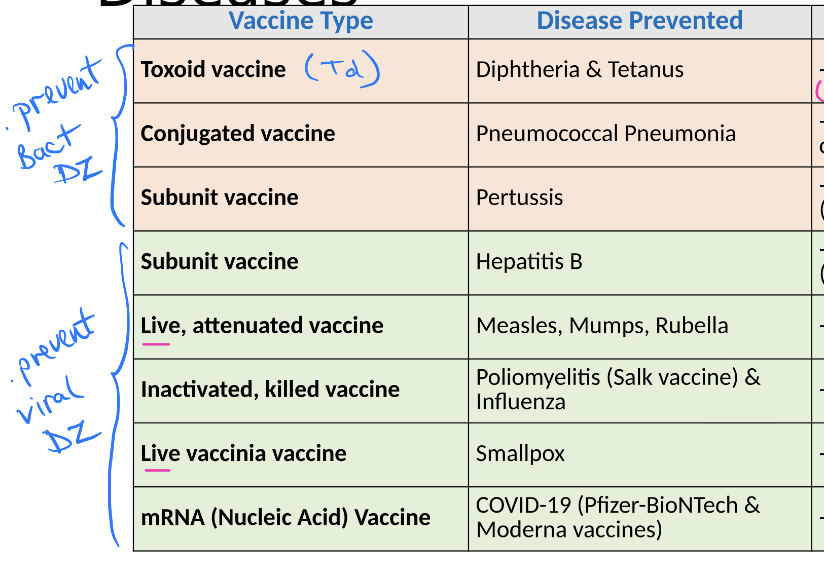
live, attenuated (weakened) vaccines: weakened pathogens, closely mimic actual infection (mild SE)
ex. MMR vaccine
inactivated, killed vaccines: killed pathogens, safer than live vaccines
ex. polio & influenza vaccines
toxoid vaccines: inactivated toxin, immune response will target toxin (make Ab → antitoxin)
ex. Td vaccine
types of vaccines (conjugated, subunit, mRNA)
conjugated vaccines: main vaccine component combined w/ strong immunogen (protein) → strong immune response
ex. pneumococcal vaccine (capsule + protein)
subunit vaccines: use antigenic fragments to stimulate immune response
ex. hep B & pertussis vaccines (DTaP)
mRNA (nucleic acid) vaccines: inject only bacterial/viral nucleic acid
inject mRNA into host cells → make protein Ag’s → stimulate (STRONG) host immune response
ex. COVID-19 vaccines
common vaccines and preventable diseases (summary)
serological testing
serology: study or diagnostic examination of blood serum (see how immune system responds to pathogens or substances introduced into body)
tested: serum w/ no clotting factors (vs. plasma w/ clotting factors)
look for Ag (pathogen) or Ab (IgM)
purpose: accurate & timely diagnosis
positive test: yes Ag or Ab → yes dz
negative test: no Ag or Ab → no dz
desirable criteria for an ideal serological test
high specificity/accuracy: unambiguous (1 interpretation → 100% +/-), reliable (no false +/-)
ex. pregnancy test, HIV test, athlete drug doping test
high sensitivity: use small sample size; detect small quantities Ag’s or Ab’s
easy set-up & interpretation: simple, easy to read
high throughput: ability to simultaneously test hundreds or thousands of samples (many @ one time d/t machine automation)
affordable cost & easy access: available to most & reasonable cost
serological tests: direct vs indirect testing methods
direct serological test: look for Ag (pathogen)
lab test (Ab) + pt. sample (Ag)
indirect serological test: look for Ab (IgM)
lab test (Ag) + pt. sample (Ab)
some exist as both direct/indirect tests (4 outcomes)
patient serum sample → lab test → make diagnosis
common examples of serological tests
Precipitation Reactions & Agglutination Reactions
Neutralization Reactions
Fluorescent-Antibody Techniques
Compliment-Fixation Reactions
ELISA
precipitation reactions
involve