CHEM 1220 Unit 3
 Call Kai
 Learn
Learn Practice Test
 Spaced Repetition
 Match
Match Flashcards
 Knowt Play
1/51

There's no tags or description
Looks like no tags are added yet.
Name | Mastery | Learn | Test | Matching | Spaced | Call with Kai | Chat |
|---|
No analytics yet
Send a link to your students to track their progress
52 Terms
Ligands
are Lewis bases
Metal center
Lewis acid
Tetrahedral complexes have ligand-metal-ligand bond angles of _____
109.5o
square planar complexes have bond angles of ___ and _____.
90o and 180o
Stereoisomers:
same formula, same connectivity, different spatial arrangement
Geometric isomers:
ligands of the same kind are arranged with different bond angles. Figure 19.21 shows great examples of cis-trans isomerism in octahedral complexes. This kind of isomerism also is possible for square planar complexes.
Optical isomers:
These are molecules that are nonsuperimposable mirror images of each other, like your two hands. Skip this bit on optical isomers entirely. If you go on to take organic chemistry, you'll learn a lot about optical isomers involving carbons bound to four different groups. Optical isomerism happens in coordination complexes, too, but the examples are either trivial or esoteric or both.
Structural isomers:
same formula, different connectivity
Coordination isomers:
different molecules/ions are connected directly to the metal center.
Linkage isomers…
are different in the atom that forms the bond to the metal.
Octahedral
Coordination number = 6
Square Planar
CN = 4
octahedral splitting energy (Δo)
The difference in energy between the lower and upper sets of orbitals
This energy difference accounts for the colors of most octahedral coordination complexes
Strong-field ligands
large Δo values
weak-field ligands
small Δo values
relative ligand field strengths
I– < Br– < S2– < Cl– < NO3– < F– < OH– < C2O42– < O2– < H2O < NH3 < en < CN– < CO
Everything from NH3 to the right is generally considered to be strong-field; everything to the left of NH3 is generally considered to be weak-field.
Strong-field ligands lead to ________ complexes, where we have the minimum number of unpaired electrons.
low-spin; This is because Δo is greater than the electron pairing energy.
Weak-field ligands lead to _________ complexes, where we have the maximum number of unpaired electrons.
high-spin; This is because Δo is smaller than the electron pairing energy.
When the complex Ti(H2O)63+ absorbs light at ~499 nm, the single electron in the lower set of d-orbitals transitions to the upper set of d-orbitals, and we can use ______ to figure out the value of Δo.
E = hc/λ **actually doing this won’t be on exam
Degenerate
Same energy level
spontaneous process
is one that happens without the input of energy from outside the system
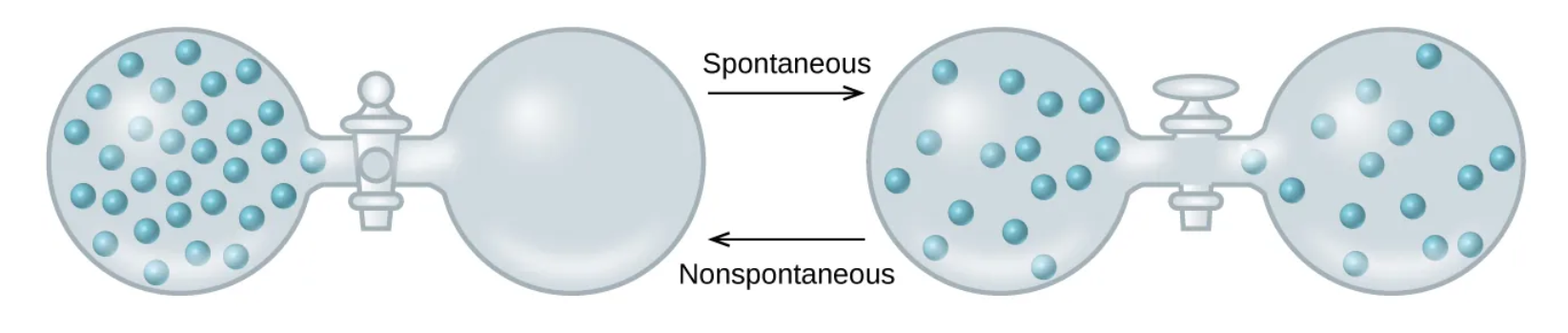
As the state gets more disordered (entropy increases), ΔS is ________
positive
0th Law of Thermodynamics
If A is in equilibrium with B, and B is in equilibrium with C, then A is in equilibrium with C
1st law of Thermodynamics
In an isolated system, the total amount of energy is constant. ΔE = q + w
2nd Law of Thermodynamics
For every spontaneous reaction or process, the total entropy of the universe increases
3rd Law of Thermodynamics
The entropy of a perfect crystal lattice at 0 Kelvin is 0
What is the ΔS for the reaction?: 3H2 (g) + N2 (g) —> 2NH3 (g)
ΔS = negative
This is because there are 4 moles on the reactant side and 2 on the product side; the number of moles decreased
Find ΔSo of the system: 3H2 (g) + N2 (g) —> 2NH3 (g)
(3H2 (g) @191.6, N2 (g) @130.7 & 2NH3 (g) @192.8)
ΔS = 2(NH3) - [1(N2) + 3(H2)]
ΔS = 2(192.8) - [1(130.7) + 3(191.6)]
ΔSosys = -198.1 J/mol*K
ΔGo = ΔHo − TΔSo
analyze reaction spontaneity
When ΔG < 0
the reaction is spontaneous in the forward direction
When ΔG > 0
the reaction is nonspontaneous in the forward direction
When ΔG = 0
the reaction is at equilibrium
The three ways to calculate the standard free energy change for a reaction
ΔGo = ΔHo − TΔSo, where we first calculate the standard enthalpy change and the standard entropy change using a table of thermodynamic data
Use the equation [equation with sigmas], where ΔGfo is the free energy of formation of the particular substance. This equation can only be used when T = 298 K
combine other reactions with known standard free energy changes to get an overall reaction. Here, the rules are the same as for manipulating reactions and their ΔHo and/or ΔSo values
Expanded on the third way to calculate the standard free energy (combining reactions)
If a chemical equation is multiplied by some factor, ΔGo is also multiplied by the same factor.
If a chemical equation is reversed, ΔGo changes sign.
If a chemical equation can be expressed as the sum of a series of steps, ΔGo for the overall equation is the sum of the free energies of reactions for each step.
The free energy change for a process may be viewed as a measure of its driving force
ΔG
the free energy change under any conditions
ΔGo
the free energy change under standard conditions
ΔG = ΔGo + RT·ln Q
calculates the non-standard Gibbs free energy change of a chemical reaction, allowing you to determine its spontaneity under any given set of conditions
ΔGo = −RT·ln K
Q = K
ΔG = RT*ln(Q/K)
is an alternative to ΔG = ΔGo + RT·ln Q
Oxidation
loss of electrons, increase in oxidation state
Reduction
gain of electrons, decrease in oxidation state
spontaneous redox reaction
Electrons are spontaneously flowing from the neutral Cu atoms to the Ag+ ions, resulting in neutral Ag atoms and Cu2+ ions
calculate the standard potential for a redox reaction
Eo = Eocat – Eoan
where Eocat is the standard reduction potential for the cathode half-cell and Eoan is the standard reduction potential for the anode half-cell.
the standard reduction potential for the reduction actually taking place and the standard oxidation potential for the oxidation
Eo = Eored + Eoox
Anode
oxidation
cathode
reduction
ΔG = −nFE
where n is the number of moles of electrons transferred and F is Faraday's constant
Faraday's constant (F)
can be written as 96,485 C/mol or 96,485 J/mol·V. (F is just Avogadro's number multiplied by the charge of 1 electron in coulombs.)
−nFEo =
ΔGo = −RT·ln K
ΔG = ΔGo + RT·ln Q
free-energy change under non-standard conditions
n =
the number of electrons transferred