Econ 3.5 - Labour markets
 Call Kai
 Learn
Learn Practice Test
 Spaced Repetition
 Match
Match Flashcards
 Knowt Play
1/49

Earn XP
Description and Tags
A set of vocabulary flashcards covering key definitions, market structures, immobility issues, and government interventions in Theme 3.5 Labour Markets.
Name | Mastery | Learn | Test | Matching | Spaced | Call with Kai | Chat |
|---|
No analytics yet
Send a link to your students to track their progress
50 Terms
Demand for labour
The quantity of labour that employers would wish to hire at each possible wage rate.
How is demand for labour determined
Marginal revenue product, the extra revenue generated by an indiviual worker. The higher the MRP, the higher the demand for workers
The law of diminishing marginal productivity
Increasing the numer of workers whilst all other units are fixed, is likely to increase the MRP at first but then it will decline
Demand for labour curve is downwards sloping because
in the long run wage rates vary so high wage rates will incentivise businesses to use machinery instead of human capital
in the short run firms have limited capital so diminishing marginal productivity means adding extra workers givers a lower returnso to employ these workers the wage rate has to fall
Derived demand
Demand for a factor of production, such as labour, that occurs as a result of the demand for the product that the labour produces. Businesses only want workers as long as people are willing and able o buy their products
Factors influencing demand for labour
Demand for the product - labour is derived demand - Increased demand for the produc increases the demand for labour
Change in technology - Labour is a substitute for captial, if new tech becomes available it can lead to a fall in demand for labour
Price of other inputs - if price of inputs such as raw materials increase, hen COP increases, might reduce demand for labour
Productivity - If productivity increases, then this will make the firm more profitable so increase in demand for labour
Increases in NMW - if it is easier to fire workers then DOL would increase
Wage rate - fall n wage rates would increase DOL
Price elasticity of demand for labour
The responsiveness of the quantity demanded of labour to changes in the wage rate.
Factors influencing PED of labour
Substitutes - if there is many subs like machines then dol will be elastic
Elasticity of product - rise in wages - rise in price - elastic good will fall in demand - businesses fire workers
Cost of labour as a proportion of total COP - if wages are a huge proportion of costs then an increases in wages will effect costs massively so then there will be a fall in demand for labour
Time - in the long run it is more elastic because machinery can be developed
Supply of labour
Number of peolpe that are willing and bale to supply working hours at a given wage rate/time
Financial factors affecting SOL
wage rate
pension schemes
opportunity to work over time
possibility of bonuses
Non financial factors effecting SOL
qualifications/skills
pleasantness
status
flexibility of location
job security
frigne benefits
possession of a rare skill - increased skills - increased MRP
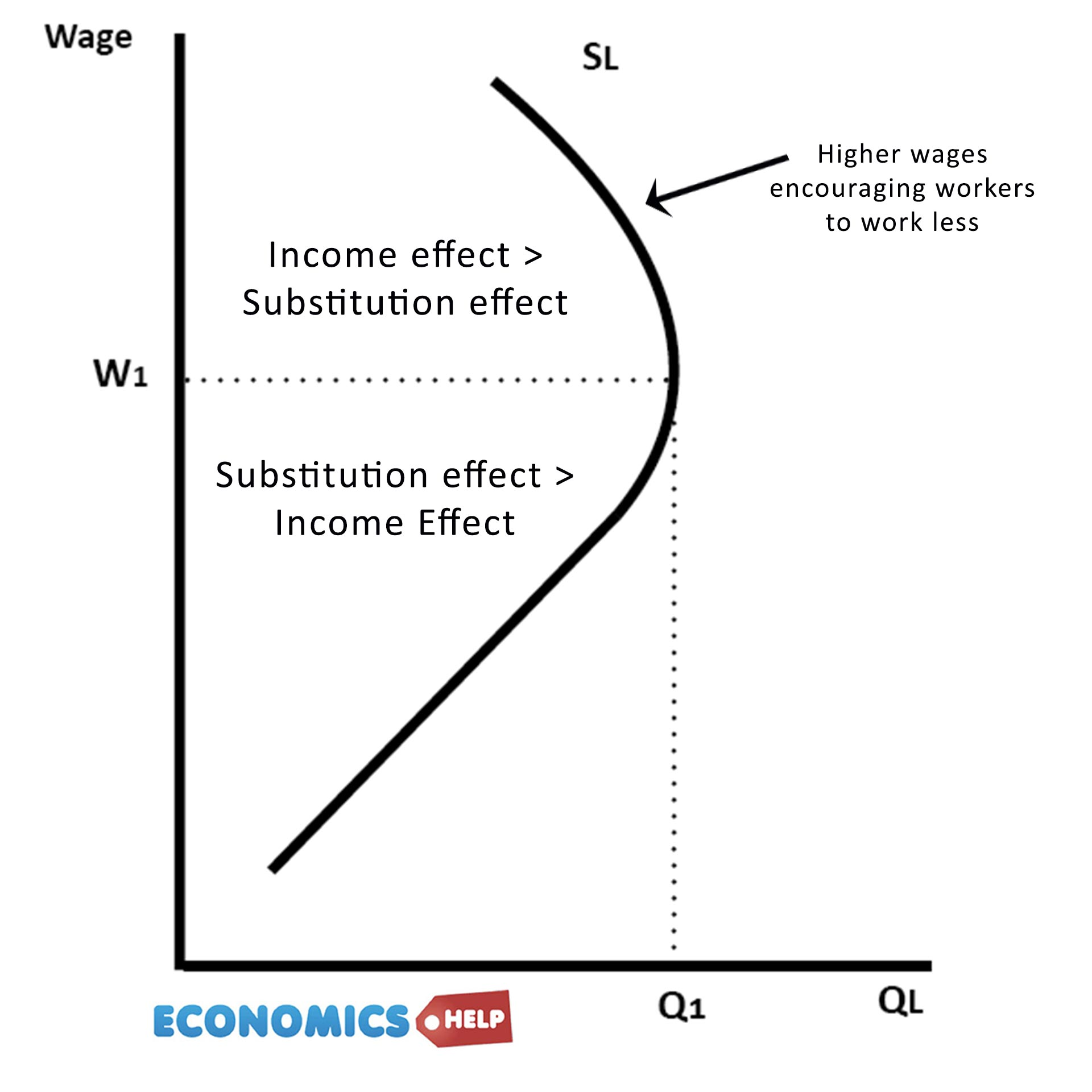
Backward bending supply curve
An individual worker's supply curve where an increase in wages leads to an increase in hours worked at first, but beyond a certain point leads to a decrease in hours worked.
Income effect
Positive income effect - we work more as wages go up
Negative income effect - target income is met so workers will work less
Substitution effect
higher wages incentivise people to work longer as the opportunity cost of staying home has increase
Factors influencing the elasticity of supply of labour
Nature of skills required - eg length of training
Nature of job - Teaching - vocational element, passion
Time - jobs have notice periods so SR - Inelastic
Occupational immobility
A form of labour market failure where workers find it difficult to move from one job to another due to a lack of transferable skills.
Causes of occupational immobility
Deindustrialisation
Insufficient education and training
Policies for occupational immobility
Training schemes
Increasing provision of frther education - vocational coaurses so school leavers are more employable
Increasing provision of higher education
Geographical immobility
A form of labour market failure where workers find it difficult to move from one place to another due to factors such as moving costs, family ties, and housing price differences.
Causes of geographical immobility
House prices
Family and social ties
High percentage of home ownership
Policies for geographical immobility
Improving transport links
Relaxation of planning laws - increases the supply of homes - decrease price of homes
increasing the construction of social housing
housing subsidies for key workers where house prices are high
improving the operation of job centres
Right to buy scheme
Elasticity of supply of labour
The responsiveness of the supply of labour to a change in wage rates.
How are individual firms price takers
They have to accepts the wage rate set by the market that workers are being paid in the industry
Why do age rates differ within an occupation
age
educaion
training
work experience
skill
demand elasticity
Current labour market issues
Skills gap and labour shortages
Rising operational costs
Increased unemployment and economic activity
Brexit and visa changes
long term sickness
employer confidence declining
National living wage
Transport connectivity
Labour market issues stats
Skills shortage - In December 2021, over 50% of firms found difficulty in finding skilled workers. Meaning firms have to increase wage rates to attract labour
April 2022 - Unemployment for 26-24 year olds was at 10.8% compared to general unemployment at 3.8% - Firms tend to hire workers with more experience/ Education and skills gap
More pensioners - Retirement age switched from 60 - 68
School leaving age states that students cannot leave education until they are 16
In 2022, 1 million workers were on zero hour contracts. This is beneficial to employers but not workers
Increase in flexible working/ Temporary working

Government intervention in the labour market
By imposing a NMW, this creates an excess supply of labour = unemployment.
Advantages of gov intervention
Provides incentive to work
Increases productivity
Reduces poverty and inequality
Increases MPC with positive multiplier effect
Disavantages of gov intervention
Increase in umemployment
Firms will have to increase their prices which will lead to a fall in profit
Wage spiral -
Reduced working hours
Long run decrease in employment as it decreases job creation
Factors affecting the effect the NMW on firms
Proportion of total costs taken up by those being paid below the NMW
Proportion of total costs taken up by labour costs - depends if firm is more labour/capital intensive
PED of product - whether firms can pass on extra costs to consumers
Maximum wages
Leads to an excess demand for labour
creates labour shortage
increases unemployment
The Uk may suffer from brain drain which will lead to a decrease in quality of goods and serivces
Advantages of maximum wage
Helps decrease inflation rates
limits inequality
reduces labour costs for firms
decreases unemployment
Disadvantages of maximum wage
Brain drain - leaving country with overall reduced skill set
reduction in productivity
Public sector wage setting
Since trade unions in he UK are weak, in the short run, the government can make whatever wage decisions they want to improve the budget
Perfect conditions
wages are purely determined by demand and supply
all workers are paid the same
all workers are similarly skilled
if one area pays more that another then workers are allowed to move o that place
then supply of labour in the weak paying area will decrease which will incentivise employers to increase wages
Monopsony in the labour market
A type of market structure dominated by one main buyer of labour or product
Problems with monopsonies
Wage setting power
Exploitation
Poor working conditions
restricts job availability
Trade union
An organisation of workers or employees that protects the rights and pay of its members through collective bargaining.
Trade Union Act 2016
UK legislation that introduced restrictions on trade unions, including a clause requiring a minimum of 50% voting turnout in strike action ballots.
Benefits to the trade union act in the labour market
increase in wages
increase in standard of working conditions
encourages training and development
counters monopoly power (bilateral monopoly)
disadvantages of the trade union act
Inflation rose to 25%
Unemployment rose and got close to 15%
firms are forced to be wage takers which increases COP
Wage increase is not in line with MRP
decreased productivity due to strikes
How was trade union power reduced
Trade union membership fell
Government policies limited the legal powers of trade unions
It was made illegal to enforce a closed shop trade union
made illegal to dismiss any workers participating in strikes
structure of economy altered in ways that restricted unions being able to determine wages
Bilateral monopoly
A labour market structure characterized by the presence of both a monopsony buyer of labour and a monopoly seller of labour (a trade union).
Zero-hour contracts
Employment contracts under which employees receive little notice of when they will be required to work and have no guarantee of weekly earnings.
Gig economy
An economic segment where individuals are self-employed and undertake short-term contracts for businesses such as Uber and Deliveroo.
National Minimum Wage
A legal wage floor introduced in the UK in April 1999 to prevent worker exploitation and set minimum standards in the workplace.
Unemployment trap
A situation where state welfare benefits are higher than the wages an individual would receive from working, disincentivising employment.
Wage spiral
A scenario where a rise in the minimum wage prompts higher-paid employees to demand pay increases to maintain existing wage differentials.
Maximum wage
A legal ceiling placed on worker earnings, used by governments in public sectors or proposed as pay ratios for chief executives to reduce inequality.