Lecture 25: Neoplasia Terms and Cell Cycle
 Call Kai
 Learn
Learn Practice Test
 Spaced Repetition
 Match
Match Flashcards
 Knowt Play
1/73

There's no tags or description
Looks like no tags are added yet.
Name | Mastery | Learn | Test | Matching | Spaced | Call with Kai | Chat |
|---|
No analytics yet
Send a link to your students to track their progress
74 Terms
how many stages are in a cell cycle?
5
1st stage of cell cycle
G1 phase
describe G1 phase (1st stage of cell cycle)
cell growth to prep for DNA synthesis
2nd stage of cell cycle
S phase
describe S phase (2nd stage of cell cycle)
DNA synthesis occurs
3rd stage of cell cycle
G2 phase
describe G2 phase (3rd stage of cell cycle)
second growth phase, preparing for mitosis
4th stage of cell cycle
M phase
describe M phase (4th stage of cell cycle)
mitotic phase (pro, meta, ana, telophases)
5th stage of cell cycle: 2 options:
re-enters cycle and divides again, or exits cycle and enters quiescence
quiescence
inactivity
2 major checkpoints inside the cell cycle
G1/S checkpoint, G2/M checkpoint
first cell cycle checkpoint
G1/S
describe G1/S checkpoint
controlled by kinases, checks for DNA damage
2nd cell cycle checkpoint
G2/M
describe G2/M checkpoint
controlled by kinases, checks for DNA damage/completeness of replication
3 divisions of cells
labile, stable, senescet
labile cells
always dividing (enterocytes/skin/marrow)
stable cells
quiet, but can divide when needed (hepato/renal cells)
senescent cells
permanentely non-dividing (neurons/myocardiocytes/myocytes)
what do telomeres do?
DNA caps that regulate how many divisions a cell can undergo
what mediates cell cycle arrest (senescence)?
p53 and retinoblastoma (Rb) - tumor suppressor genes
what is the most important tumor suppressor gene and is considered the guardian of the genome?
p53
what does p53 do?
causes cell cycle ARREST at BOTH G1/S and G2/M checkpoints
what does retinoblastoma (Rb) do?
allows cell to PROCEED through G1/S checkpoint
what triggers apoptosis when DNA damage has occurred?
p53
how does neoplasia occur?
when cells evade checkpoints/mutate, begin replicating uncontrolled
2 types of neoplasia
benign and malignant
latency
time before tumor is detectable
1 cm tumor present, how many cells are inside?
1 million
3 steps of tumor development
initiation, promotion, progression
initiation of tumor development
IRREVERSIBLE DNA damage, cells remain quiet
histology of initiation phase
increase in # of cells, but BM remains INTACT
promotion of tumor development
tumor growth advantages occur, can be REVERSIBLE
histology of promotion phase
enlarged/mass like, but not aggressive
progression of tumor development
IRREVERSIBLE stage, tumor now malignant
tumor cells
parenchyma
supporting structure of tumor
stroma
scirrhous response
formation of fibrous CT on histology, comes from tumor cells

factors produced by tumors to promote blood supply to the area
pro and anti-angiogenic factors
pro-angiogenic factor
vascular endothelial growth factor (VEGF)
anti-angiogenic factor
thrombospondin
describe vessels in neoplasms
tortuous, irregular, unstable, leaky
tumor invasion MECHANISM
tumor cells penetrate BM using proteases -> migrate through ECM -> invade vessel lumen
why is invasion NOT metastitis?
the cells are invading vessels in the CURRENT tumor
tumor metastasis MECHANISM
tumor cells circulate -> colonize in metastatic site
metastasis
spread of neoplasm from primary to secondary site, ENDING communication with the primary site
metastasis has occurred. what does this mean?
TUMOR IS MALIGNANT
mass
any proliferation of cells forming a gross lesion
cancer
implies malignant behavior
neoplasm is occurring. describe chronicity/severity
chronic and severe
capsule is present. is it malignant or benign?
benign
capsule is NOT present. is it malignant or benign?
malignant
anaplastic cells
poorly differentiated cells (cell organization/morphology lost)
immunohistochemistry (IHC)
brown pigment present on antigen of neoplastic tissues, uses to identify anaplastic cells
low magnification histology of neoplasm
looking for overall pattern
high magnification histology of neoplasm
looking at individual cells
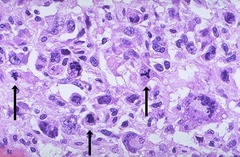
what are these?
mitotic figures
anisocytosis
variation in cell size (looks at cytoplasm)
anisokaryosis
variation in nuclear size
pleomorphism
variation in cell shape
increased anisocytosis is present. what does this mean?
more cytoplasm is present, making cell larger
immunosurveillance
process of immune system attacking foreign cells (transplants/microbes/tumor cells)
what do tumor cells express that signal the immune system?
tumor specific/associated antigens
cells involved in INNATE immune response (1st line of defense)
NK cells and macrophages
describe adaptive immune response (2nd line of defense)
cell mediated (most-effective) and humoral
4 ways tumor cells inhibit/manipulate immune responses
alter MHC expression, mask antigens, tolerance, immunosupression
mechanism of tumors altering MHC expression
down regulates MHC2, so no CD4 response occurs. MHC 1 expressed to evade NK cells
how do tumors antigen mask?
don't express tumor antigen on cell surface
how do tumors become tolerant?
express self-antigens to avoid immune system
what do tumors use to cause immunosupression?
TGF-a and FasL
what does TGF-a do?
inhibits growth/activation of macrophages
what does FasL do?
triggers apoptosis of nearby T lymphs
2 types of tumors KNOWN to regress
papillomas and histiocytomas