Physio 3: Cell Signaling

0.0(0)
Studied by 0 people
call kaiCall Kai
Locked
learnLearn
examPractice Test
spaced repetitionSpaced Repetition
heart puzzleMatch
flashcardsFlashcards
GameKnowt Play
Card Sorting

1/44

encourage image

There's no tags or description

Looks like no tags are added yet.

Last updated 11:36 PM on 9/16/26
Name
Mastery
Learn
Test
Matching
Spaced
Call with Kai
Chat

No analytics yet

Send a link to your students to track their progress

45 Terms

1
New cards

What are receptors

  • specialized area of the cell membrane that are sensitive to chemicals

    • cause cell to change its behavior


2
New cards

what are the four types of chemical messengers

  • neurotransmitters

  • hormones

  • paracrine agents

  • autocrine agents


<ul><li><p>neurotransmitters</p></li><li><p>hormones</p></li><li><p>paracrine agents</p></li><li><p>autocrine agents</p></li></ul><p></p>
3
New cards

what are the most common type of receptors

  • hydrophilic messengers

    • transmembrane proteins

  • hydrophobic messengers (steroids)

    • nuclear receptors


4
New cards

what are the 4 features that affect ligand-receptor binding

  • affinity

  • specificity

  • saturation

  • competition


5
New cards

describe how specificity affects ligand-receptor binding

  • the binding site of a receptor has a specific shape that only fits specific messengers


<ul><li><p>the binding site of a receptor has a specific shape that <span style="color: red;">only fits specific messengers</span></p></li></ul><p></p>
6
New cards

describe how affinity affects ligand-receptor binding

  • strength of chemical attraction between messenger and receptor
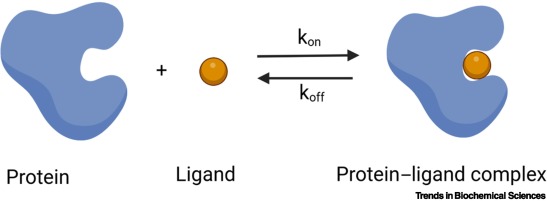

<ul><li><p><span style="color: green;">strength of chemical attraction</span> between messenger and receptor</p></li></ul><p></p>
7
New cards

describe how saturation affects ligand-receptor binding

  • the degree to which the receptors on a cell are fully occupied by a messenger


<ul><li><p>the degree to which the receptors on a cell are fully occupied by a messenger</p></li></ul><p></p>
8
New cards

describe how competition affects ligand-receptor binding

  • different molecules with similar structure compete for the same binding site


<ul><li><p>different molecules with similar structure compete for the same binding site</p></li></ul><p></p>
9
New cards

what is an agonist chemical messenger

  • binds to a receptor and triggers the normal response

    • mimics the action of the normal messenger


<ul><li><p>binds to a receptor and triggers the normal response</p><ul><li><p>mimics the action of the normal messenger</p></li></ul></li></ul><p></p>
10
New cards

what is the antagonist chemical messenger

  • molecule that binds to a receptor but does not elicit a response

    • block a response


<ul><li><p>molecule that binds to a receptor but does not elicit a response</p><ul><li><p>block a response</p></li></ul></li></ul><p></p>
11
New cards

describe down-regulation of a receptor

  • when there is so much extracellular concentration of a messenger that the number of receptors decrease

    • cell sensitivity DECREASES


<ul><li><p>when there is so much extracellular concentration of a messenger that the number of receptors decrease</p><ul><li><p>cell sensitivity DECREASES</p></li></ul></li></ul><p></p>
12
New cards

describe up-regulation of a receptor

  • when there is a low extracellular concentration of a messenger that the number of receptors INCREASES

    • cell sensitivity INCREASES


<ul><li><p>when there is a low extracellular concentration of a messenger that the number of receptors INCREASES</p><ul><li><p>cell sensitivity INCREASES</p></li></ul></li></ul><p></p>
13
New cards

what is the general signal transduction pathway

  1. Receptor recognition

    1. ligand binds to receptor

  2. Receptor activation

    1. receptor undergoes conformational shape

  3. Receptor transduction

    1. triggering of signaling cascade with secondary messengers

  4. Receptor modulation

    1. secondary messengers change activity of effector molecules

  5. cell response

  6. termination


14
New cards

in signal transduction, the extracellular signal via receptor is converted to…

intracellular message

15
New cards

describe the types of molecules that change effector activity

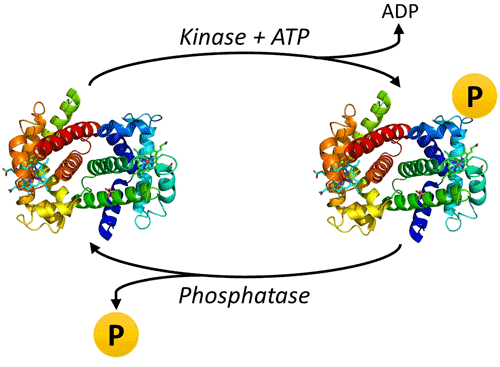
  • intracellular kinases

    • add a phosphate group to intermediates of the cascade

  • intracellular phosphatases

    • remove phosphate groups


<ul><li><p><strong>intracellular kinases</strong></p><ul><li><p>add a phosphate group to intermediates of the cascade</p></li></ul></li><li><p><strong>intracellular phosphatases</strong></p><ul><li><p>remove phosphate groups</p></li></ul></li></ul><p></p>
16
New cards

can receptors be used for different responses?

true

17
New cards

can a single message be used to produce multiple responses?

  • yes

    • acetylcholine can…

      • increased contracts skeletal muscles

      • decreased contract cardiac muscle

      • increased exocytosis of secretory vesicles


18
New cards

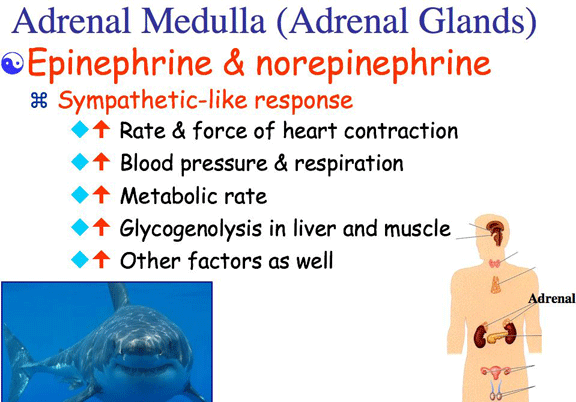
describe whole-body integrated response

  • a single messenger molecule can orchestrate an integrated, whole-body response

    • molecule binds to receptors on multiple cell types

    • each cell type has its own response

  • (ex: epinephrine effects from stress)


<ul><li><p>a single messenger molecule can orchestrate an integrated, whole-body response</p><ul><li><p>molecule binds to receptors on multiple cell types</p></li><li><p>each cell type has its own response</p></li></ul></li><li><p>(ex: epinephrine effects from stress)</p></li></ul><p></p>
19
New cards

what is an example of whole-body integration in relation to stress and the release of epinephrine

  • when stressed, adrenal glands release epinephrine into blood

    • liver cells

      • breaks down stored glycogen

    • blood vessels

      • relax and widen to increase blood flow

    • blood vessels in digestive system

      • constrict and narrow to decrease blood flow


<ul><li><p>when stressed, adrenal glands release <strong>epinephrine </strong>into blood</p><ul><li><p>liver cells</p><ul><li><p>breaks down stored glycogen</p></li></ul></li><li><p>blood vessels</p><ul><li><p>relax and widen to increase blood flow</p></li></ul></li><li><p>blood vessels in digestive system</p><ul><li><p>constrict and narrow to decrease blood flow</p></li></ul></li></ul></li></ul><p></p>
20
New cards

how can signaling cascades be terminated

  • decreasing the concentration of the chemical messenger

    • reuptake, degradation, diffusion

  • downregulation of the receptor


<ul><li><p>decreasing the concentration of the chemical messenger</p><ul><li><p>reuptake, degradation, diffusion </p></li></ul></li><li><p>downregulation of the receptor</p></li></ul><p></p>
21
New cards

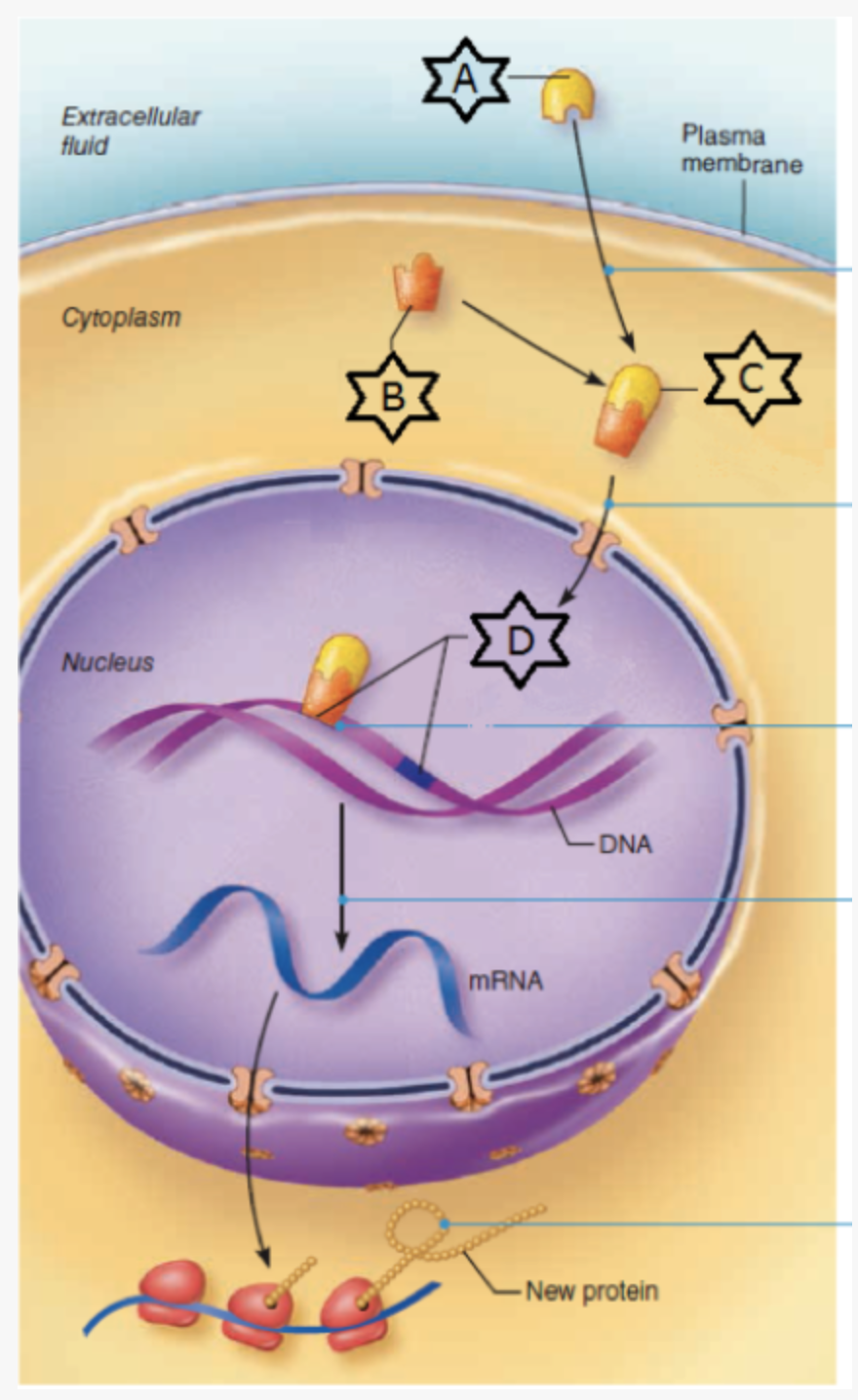
describe lipid-soluble primary messengers

  • move through lipid bilayer of the cell

  • receptors are intracellular in cytosol or nucleus


<ul><li><p>move through lipid bilayer of the cell</p></li><li><p>receptors are intracellular in cytosol or nucleus</p></li></ul><p></p>
22
New cards

how do lipid-soluble primary messengers initiate cell response

  • receptor in combined receptor-messenger complex alters gene transcription and protein synthesis


<ul><li><p>receptor in combined receptor-messenger complex alters gene transcription and protein synthesis</p></li></ul><p></p>
23
New cards

where are the receptors of lipid-soluble primary messengers

  • intracellular

    • cytosol

    • nucleus


<ul><li><p>intracellular</p><ul><li><p>cytosol</p></li><li><p>nucleus</p></li></ul></li></ul><p></p>
24
New cards

what’s another name for lipid-soluble primary messengers

  • genomic messengers


<ul><li><p>genomic messengers</p></li></ul><p></p>
25
New cards

what kind of messengers are lipid-soluble primary messengers

  • steroid hormones, vitamin D, and thyroid


26
New cards

describe water soluble primary messengers

  • lipid-soluble, hydrophilic messengers that easily pass in blood

  • cannot pass through lipid bilayers


<ul><li><p>lipid-soluble, hydrophilic messengers that easily pass in blood</p></li><li><p>cannot pass through lipid bilayers</p></li></ul><p></p>
27
New cards

where are the receptors of water-soluble primary messengers

  • plasma membrane proteins


<ul><li><p>plasma membrane proteins</p></li></ul><p></p><p></p>
28
New cards

how to water soluble primary messengers initiate cell response

  • bind to receptor on plasma membrane

  • activated receptor initiates secondary messenger cascade


<ul><li><p>bind to receptor on plasma membrane</p></li><li><p>activated receptor initiates secondary messenger cascade</p></li></ul><p></p>
29
New cards

what are the four types of water-soluble primary messengers

  1. function as ligand-gated ion channels

  2. function as enzymes

  3. interact with cytoplasmic enzymes

  4. interact with G-proteins


30
New cards

describe ligand-gated ion channels as receptors

  • AKA ionotropic

  • primary messenger binds to receptor

  • receptor undergoes conformation change

  • receptor opens ion channel

    • results in change in membrane potential

  • immediate cell immediate response


<ul><li><p>AKA <strong>ionotropic</strong></p></li><li><p>primary messenger binds to receptor</p></li><li><p>receptor undergoes conformation change</p></li><li><p>receptor opens ion channel</p><ul><li><p>results in<span style="color: red;"><strong> change in membrane potential</strong></span></p></li></ul></li><li><p>immediate cell immediate response</p></li></ul><p></p>
31
New cards

give an example of an ionotropic receptor

Calcium

  • glutamate binds to receptor

  • conformational change of channel

  • calcium influx inside the cell

    • calcium acts as a secondary messenger


32
New cards

describe receptors that function as enzymes

  • receptor with outer ligand binding domain and inner enzymatic domain

    • binding of ligand causes enzyme to phosphorylate itself

    • secondary messenger interacts with phosphate on activated receptor
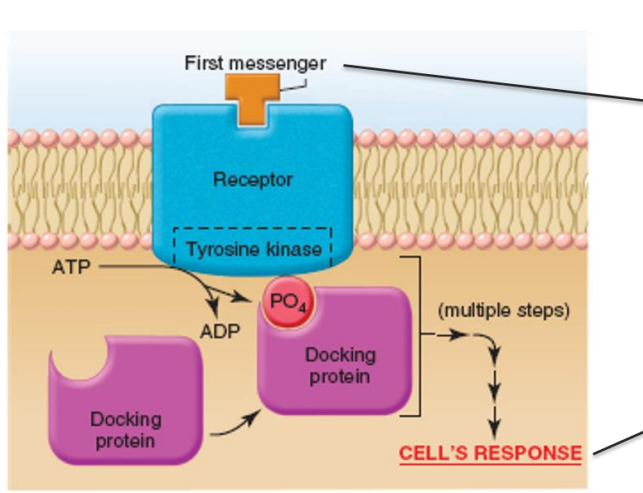

<ul><li><p>receptor with outer ligand binding domain and inner enzymatic domain</p><ul><li><p>binding of ligand causes enzyme to phosphorylate itself</p></li><li><p>secondary messenger interacts with phosphate on activated receptor</p></li></ul></li></ul><p></p>
33
New cards

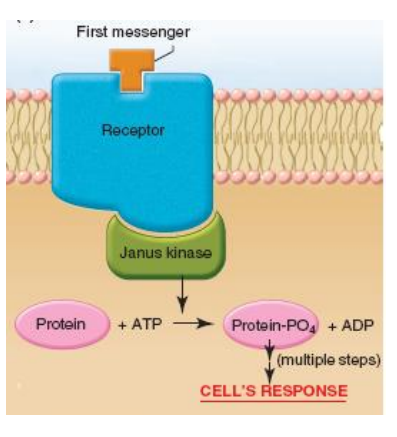
describe receptors that interact with cytoplasmic enzymes

  • activated receptor binds to intracellular Janus kinases (JAK)

  • JAK kinases phosphorylate intracellular proteins in cascade

    • cytokines released in cell

    • increased protein synthesis


<ul><li><p>activated receptor binds to intracellular Janus kinases (JAK)</p></li><li><p>JAK kinases phosphorylate intracellular proteins in cascade</p><ul><li><p>cytokines released in cell</p></li><li><p>increased protein synthesis</p></li></ul></li></ul><p></p>
34
New cards

describe G-protein coupled receptors

  • large

  • receptor is linked through G-proteins to effecter proteins

    • heterotrimeric

      • contain several subunits (alpha, beta, gamma)

      • bound to the inside of the membrane


<ul><li><p>large</p></li><li><p>receptor is linked through G-proteins to effecter proteins</p><ul><li><p><strong>heterotrimeric</strong></p><ul><li><p>contain several subunits (alpha, beta, gamma)</p></li><li><p>bound to the inside of the membrane</p></li></ul></li></ul></li></ul><p></p>
35
New cards

describe the function of the different units in G-protein

  • alpha subunit (active unit)

    • binds GDP when inactive

    • swaps GDP for GTP when active

  • beta and gamma subunits

    • remain bound as BY dimer

    • anchor protein in the membrane


<ul><li><p><strong>alpha subunit (active unit)</strong></p><ul><li><p>binds GDP when inactive</p></li><li><p>swaps GDP for GTP when active</p></li></ul></li><li><p><strong>beta and gamma subunits </strong></p><ul><li><p>remain bound as BY dimer</p></li><li><p>anchor protein in the membrane</p></li></ul></li></ul><p></p>
36
New cards

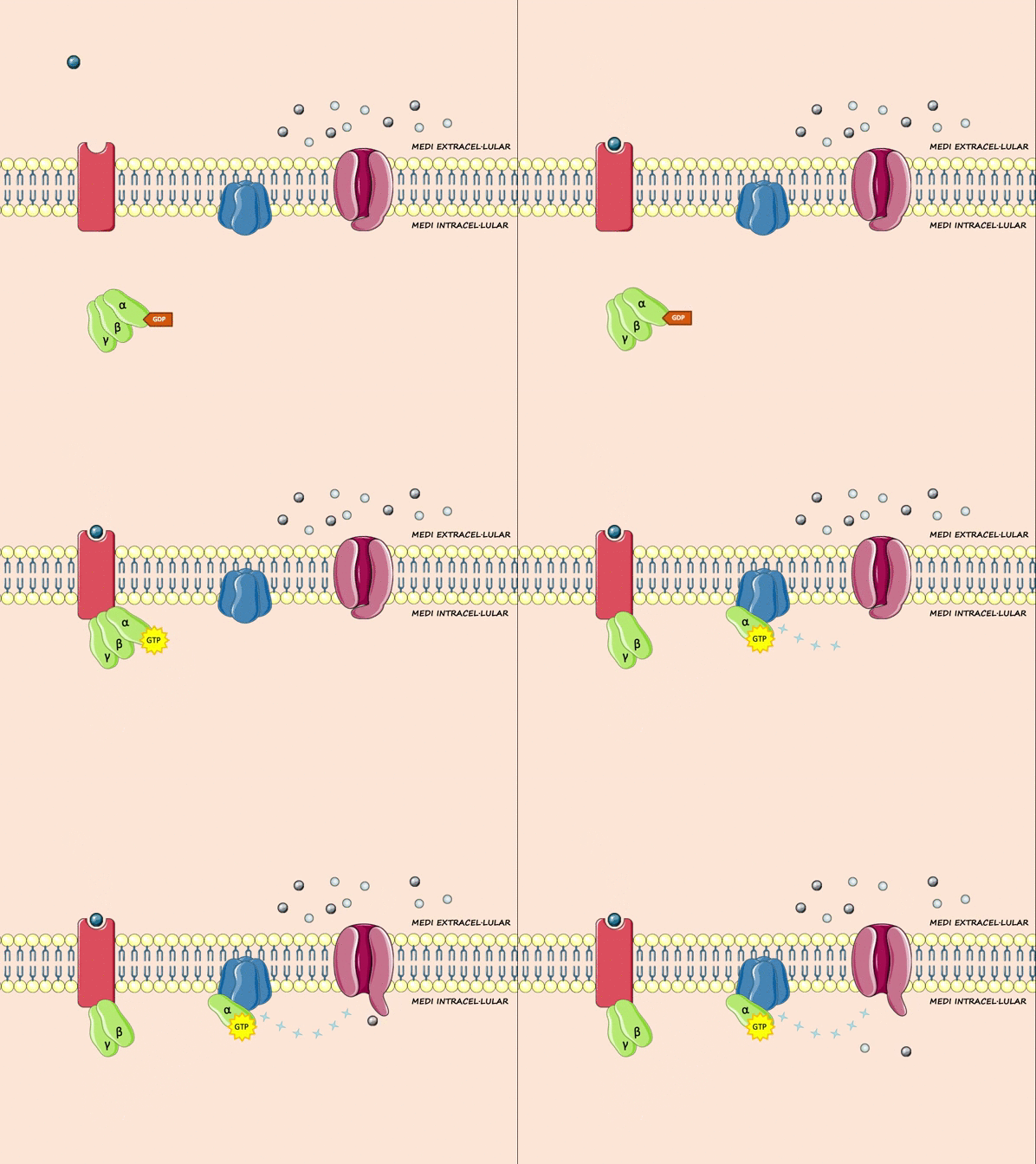
describe the 6steps of G-protein coupled receptor

  1. in inactive state

    1. GDP bound to alpha subunit of G-Protein

    2. inactive G-protein bound to receptor

  2. Chemical messenger binds to receptor

    1. conformational change that increases alpha-unit affinity to GTP

  3. GTP replaces GDP

    1. activated alpha-subunit splits from BY dimer

  4. Alpha-subunit activates an effector

    1. begins cascade

  5. Alpha-subunit hydrolyses GTP to GDP

    1. inactivates itself

  6. Alpha-subunit goes back to dimer and receptor


<ol><li><p>in inactive state</p><ol><li><p>GDP bound to alpha subunit of G-Protein</p></li><li><p>inactive G-protein bound to receptor</p></li></ol></li><li><p>Chemical messenger binds to receptor</p><ol><li><p>conformational change that <span style="color: red;"><em>increases alpha-unit affinity to GTP</em></span></p></li></ol></li><li><p>GTP replaces GDP</p><ol><li><p>activated alpha-subunit <span style="color: blue;"><em>splits from BY dimer</em></span></p></li></ol></li><li><p><strong>Alpha-subunit activates an effector</strong></p><ol><li><p>begins cascade</p></li></ol></li><li><p>Alpha-subunit hydrolyses GTP to GDP</p><ol><li><p>inactivates itself</p></li></ol></li><li><p>Alpha-subunit goes back to dimer and receptor</p></li></ol><p></p>
37
New cards

describe the effector protein from G-protein coupled receptors

  • activated by alpha-subunit

    • if channel

      • will cause it to open or close

    • if enzyme

      • produces a massive wave of secondary messengers

      • spread the message to trigger final response


<ul><li><p>activated by alpha-subunit</p><ul><li><p><strong>if channel</strong></p><ul><li><p>will cause it to open or close</p></li></ul></li><li><p><strong>if enzyme</strong></p><ul><li><p>produces a massive wave of secondary messengers</p></li><li><p>spread the message to trigger final response</p></li></ul></li></ul></li></ul><p></p>
38
New cards

describe 6 steps of cAMP as a secondary messenger

  • G-protein → adenylyl cylase → cAMP → PKA → effector → cell response → phosphodiesterase

  1. first messenger binds to receptor

    1. receptor undergoes conformational change

      1. activates G-protein

  2. activated G-protein activates activates enzyme adenylyl cyclase

  3. adenylyl cyclase converts ATP to cAMP

  4. cAMP activates cAMP-dependent protein kinases (PKA)

  5. PKA phosphorylate and activate target effectors

    1. cell response

  6. termination of cascade by converting cAMP to linear AMP


<ul><li><p>G-protein → adenylyl cylase → cAMP → PKA → effector → cell response → phosphodiesterase </p></li></ul><ol><li><p>first messenger binds to receptor</p><ol><li><p>receptor undergoes conformational change</p><ol><li><p>activates G-protein</p></li></ol></li></ol></li><li><p>activated G-protein activates activates <span style="color: red;"><strong>enzyme adenylyl cyclase</strong></span></p></li><li><p>adenylyl cyclase converts <span style="color: blue;"><strong>ATP to cAMP</strong></span></p></li><li><p>cAMP activates<span style="color: blue;"><strong> cAMP-dependent protein kinases (PKA)</strong></span></p></li><li><p>PKA phosphorylate and activate target <span style="color: blue;"><strong>effectors</strong></span></p><ol><li><p>cell response</p></li></ol></li><li><p>termination of cascade by converting cAMP to linear AMP</p></li></ol><p></p>
39
New cards

G-protein gating via cAMP is… direct/indirect

indirect

  • utilized second messenger pathway


40
New cards

how is cAMP inactivated

  • converted to linear AMP by phosphodiesterase’s


<ul><li><p>converted to linear AMP by phosphodiesterase’s </p></li></ul><p></p>
41
New cards

what does adenylyl cylase convert ATP to

  • cAMP


42
New cards

what does cAMP activate

  • c-AMP dependent protein kinases (PKA)


43
New cards

what do c-AMP dependent protein kinases (PKA) activate

  • effector protein that activates cell response


44
New cards

differentiate between direct and indirect G-protein gating

  • indirect

    • require second messenger pathway and cascade

    • more energy and time

  • direct

    • G-protein activates effecter immediately

    • less energy and time


45
New cards

The activation of adenylyl cyclase initiates an “____” of events

The activation of adenylyl cyclase initiates an “amplification cascade” of events.

<p>The activation of adenylyl cyclase initiates an “amplification cascade” of events.</p>