Chapter 5.1: ATP and Reduced Coenzymes Are the Energy Currency for Biosynthesis
 Call Kai
 Learn
Learn Practice Test
 Spaced Repetition
 Match
Match Flashcards
 Knowt Play
1/18

Name | Mastery | Learn | Test | Matching | Spaced | Call with Kai | Chat |
|---|
No analytics yet
Send a link to your students to track their progress
19 Terms
Metabolic pathway
A series of reactions that converts molecules from one form to another via controllable enzymes
Often compartmentalized in certain cytoplasmic regions, organelles (eukaryotes), or microcompartments (prokaryotes)
Organelles
Regions where certain metabolic pathways are performed, in eukaryotes
Microcompartments
Regions where certain metabolic pathways are formed, in prokaryotes
Energy
What is needed for many of a cell’s processes, often obtained through organic molecule breakdown, photosynthesis, or inorganic compounds

Endergonic reactions
Reactions that require energy to proceed, often obtained from coupled exergonic reactions or stored energy from ATP or NADH; these include active transport, cell movements, and anabolism

Exergonic reactions
Reactions that release energy; these include cell respiration and metabolism
ATP and NADH
The two most common energy-storing coenzymes used to power endergonic reactions; these couple to each other through oxidative phosphorylation in order to provide energy for the cell

Adenosine triphosphate (ATP)
The main energy currency of the cell that stores energy in a phosphate bond (Pi) linked to ADP, used to power endergonic reactions like active transport, molecule synthesis, and cell movement after hydrolysis
Weak bond
A bond that is less stable and stores high levels of energy for later use, seen in ATP, decreasing free energy after hydrolysis
Pyrophosphate (PPi)
An ion that can be released from ATP through the breaking apart of two phosphate groups; this can release more energy if further broken down into Pi
Substrate-level phosphorylation
The transfer of a phosphate group to another molecule via enzymes; used with ADP to form ATP
Oxidative phosphorylation
How most ATP is produced outside of substrate-level phosphorylation, coupling the oxidation of NADH to the synthesis of ATP from ADP and Pi

Redox reaction
A reaction where electrons are transferred from an oxidized atom to a reduced atom

Oxidation
The loss of one or more electrons; this is associated with less energy storage as electrons are transferred away from the unit in the bond for the release of energy
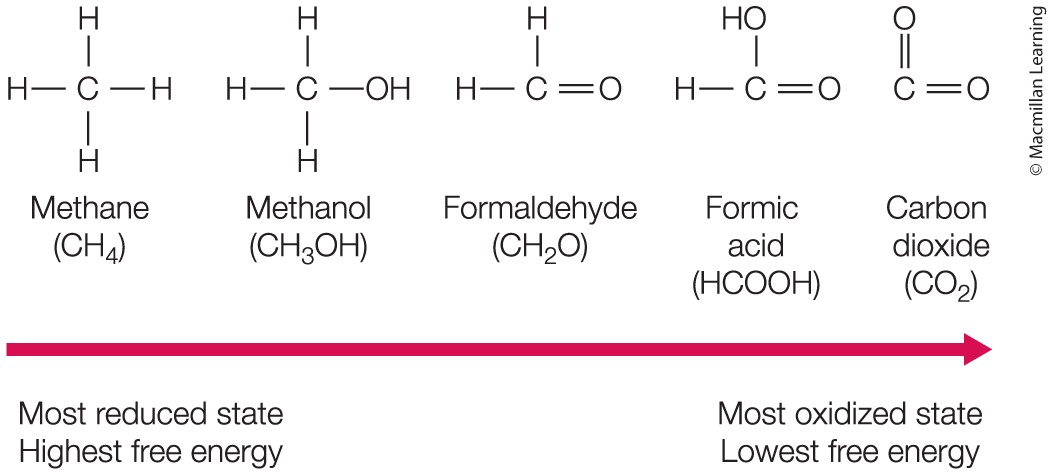
Reduction
The gain of one or more electrons; this is associated with more energy storage as electrons are transferred towards the unit in the bond
Electronegativity
The ability to attract electrons

Nicotinamide adenine dinucleotide (NAD)
An electron carrier in redox reactions that exists in oxidized (NAD+) and high-energy reduced (NADH) forms, achieved through the transfer of hydrogen and two electrons from an oxidized molecule
This then transfers electrons to O2, releasing high levels of energy
Flavin adenine dinucleotide (FAD)
An electron carrier that acts similarly to NAD during glucose metabolism
Nicotinamide adenine dinucleotide phosphate (NADP)
An electron carrier that acts similarly to NAD during photosynthesis