ECO 2023 Exam 1
 Call Kai
 Learn
Learn Practice Test
 Spaced Repetition
 Match
Match Flashcards
 Knowt Play
1/39

There's no tags or description
Looks like no tags are added yet.
Name | Mastery | Learn | Test | Matching | Spaced | Call with Kai | Chat |
|---|
No analytics yet
Send a link to your students to track their progress
40 Terms
Economics
The study of how society allocates resources and makes choices give scarcity
Scarcity
concept that there is less of a good freely available than what individuals would like
Opportunity cost
The value of opportunities lost; next best alternative
If Florida decides to restrict building condos on a strip of beach to protect the coast, housing prices will increase. Identify the Alternatives, Choice, and Trade-off.
Alternatives- {restrict building (and by how much), not restrict building}, Choice- restrict building condos, Trade-off- lower housing prices
What is a model?
A simplified representation of real and complex situations
Why are models useful in Economics?
It helps uncover causal relationships (Ex: Does X cause Y?)
How does scarcity informs choices from a set of alternatives?
The presence of scarcity means we must make choices- act of selecting among alternatives
Resources
Inputs used to produce economics goods
Different categories of Resources
Human capital, Labor, Capital, Natural
Economic theory
a set of definitions, postulates, and principles assembled in a manner that makes clear the cause-and-effect relationships between variables.
Econometrics
a set of statistical tools used to identify causal relationships in data
How does changes in incentives change decision making?
Changes in incentives (monetary of otherwise) influence behavior in a predictable way. (higher the costs, the lower that people want that good)
Utility
The subjective benefit or satisfaction a person expects from a choice or course of action
Economic good
Item or service when consumed utility increases
Economic bad
Item or service when consumed utility decreases :(
How does trades make people better off?
It allows them to consume goods and services they may not be able to otherwise. Individuals should trade if the benefits from trade exceed the costs.
Unintended consequences
Economic actions often have indirect effects known as secondary effects, which can lead to unintended consequences.
Positive economics
Economics that describes the way things are (positive statements are refutable, testable, or falsifiable; not necessarily true). Ex: Large businesses earn too much profit.
Normative Economics
Economics that describes the way things ought to be (Involves value judgements, not refutable). Ex: Large businesses earn too much profit
Ceteris Paribus and why is it important?
Means all other things constant, it is important for uncovering and describing casual relationships.
What Microeconomics focus on?
It focuses on studying the behavior of individuals or groups of individuals (households, firms, etc.) and the effects of their behavior
What does Macroeconomics focus on?
It focuses on how aggregate human behavior affects highly aggregated outcomes like inflation, GDP, etc.
Division of labor
Separation of tasks in production to different people to improve efficiency.
Division of knowledge
Separation of knowledge across different individuals.
What are the assumptions of the model of a PPF?
Only two goods
Fixed amounts of productive resources
Fixed technical knowledge (fixed technology)
Full and efficient use of resources
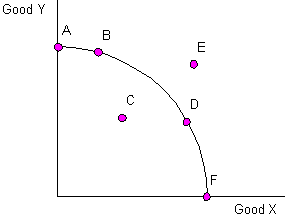
What does A, B, D, and F mean?
Attainable and efficient

What does C mean?
Attainable but inefficient

What does E mean?
Unattainable
What is the formula for opportunity cost?
give up/gain
What does a Linear slope mean in a PPF?
The opp. cost is constant.
What does a “Bowed-out” slope mean in a ppf?
The opp. cost is increasing.
What factors shift the PPF?
Changes in Resource quantity and quality
Technological improvements
Changes in Rules, Institutions, or Environment
Changes in Availability of Inputs
An outward shift means?
More ability to produce
An inward shift means?
Less ability to produce
What is absolute advantage?
Who can produce more with the same resources.
What is comparative advantage?
Who can produce something at a lower opportunity cost.