Lymphoid System Basics & Lymph Flow
 Call Kai
 Learn
Learn Practice Test
 Spaced Repetition
 Match
Match Flashcards
 Knowt Play
1/31

There's no tags or description
Looks like no tags are added yet.
Name | Mastery | Learn | Test | Matching | Spaced | Call with Kai | Chat |
|---|
No analytics yet
Send a link to your students to track their progress
32 Terms
What is the lymphoid system
system of organs and network of vessels that recover fluid from body , inspects it , activates immune responses, and returns fluid to bloodstream
Basic map/process of lymphoid system (4 steps)
Some fluid from plasma leaves blood capillaries entering space between tissue cells (interstitual fluid)
Intersitutal fluid enters lymphatic vessel → fluid = lymph
lymphoid system inspects and activates immune response
lymph is returned to blood streams
Interstitual fluid vs lymph
interstitual fluid = fluid between tissue cells
lymph = fluid after entering lymphatic vessel
What are the three major functions of the lymphoid system
Fluid recovery, immune surveillance, lipid absorption
Lymphoid system function - fluid recovery - what happens if this doesn’t happen
returns interstitial fluid back to blood stream → if this drainage is bad or not enough → lymphedema
Lymphedema
bad drainage/ fluid recovery → interstitial fluid doesn’t return to blood stream and buildup between tissue cells → swelling
Lymphoid system function - immune surveillance
Excess filtered fluid picks up foreign cells & chemicals while moving through tissues → brings it to lymph nodes, which activates immune response

Lymphoid system function - lipid absorption (use the image)
Inside small intestines → tiny projections called villi → contains blood capillaries and lacteals (the green)
lacteals = lymphatic capillary that absorbs fat/lipids
when fat is absorbed into lacteals →the lymph inside the lacteal becomes lipid-rich = chyle
What are the 4 components of the lymphoid system
Lymph, lymphatic vessels, lymphoid tissue, lymphoid organs
What is lymph + where does it originate + appearance
Lymph is the fluid that gets recovered by lymphatic vessels
originates from body tissue, and before that, filtered out of blood capillaries
clear and colorless
What does Chemical composition of lymph depend on
location
Lymphatic vessels
Also called lymphatics → network/ system that lymph flows through
Pathway of vessels (4)
Lymphatic capillaries → collecting vessels → lymphatic trunk → collecting duct of bloodstream
smallest → largest
Lymphatic capillaries - also called what
terminal lymphatics → where interstitial fluid initially enters lymphatic system

Intercellular clefts
openings in lymphatic capillaries that allow surrounding tissue fluid to enter
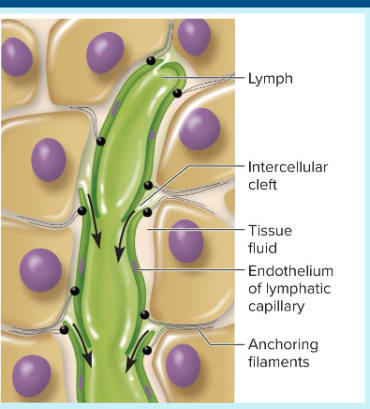
Anchoring filament
Help attach lymphatic capillary to surrounding tissue
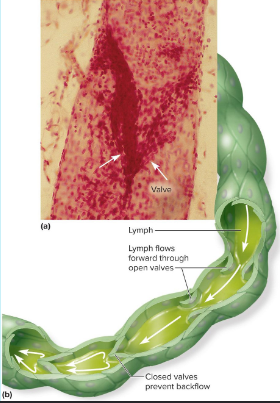
Collecting vessels - and what do they contain
Bigger lymphatics than capillaries and where the lymph from lymphatic capillaries go
They contain valves (one way door) → prevents lymph from going backwards → only one direction

Lymphatic trunk
Larger than collecting vessels → where the lymph from collecting vessels get drained into
drain major regions of the body → empty towards collecting ducts
jugular trunks
subclavian trunks
bronchomediastinal trunks
intestinal trunk
lumbar trunks
where are these located/ the area that they drain from
jugular trunks → head/ neck
subclavian trunks → upper limbs
bronchomediastinal trunks → thoracic/ chest
intestinal trunk → digestive organs
lumbar trunks → lower body/ abdominopelvic
Collecting ducts and what are they divided into
largest lymphatic vessels
right lymphatic duct & thoracic duct
Right lymphatic duct vs thoracic duct
right lymphatic duct drains upper right quadrant
thoracic duct drains remainder of body

Cisterna chyli
beginning of thoracic duct that sends lymph from lower body into thoracic duct
Where does lymph ultimately end up
Back to the blood stream through venous angles (subclavian vein/ internal jugular vein)
Fluid Exchange Between the Circulatory & Lymphoid Systems
Circulatory system → blood capillaries → interstitial fluid → lymphatic capillaries → collecting vessels → lymphatic trunks → collecting ducts → subclavian vein → back to cardiovascular system & repeat

How does lymph move / the flow of lymph
similar to venous return but slower and lower pressure
Forward flow of lymph is reliant on ________ , which comes from (what 5)
Forward flow of lymph is reliant of vessel stretching, which comes from
Lymphatic vessel contractions
squeezing of skeletal muscles
pulsations from nearby arteries
Thoracic pump
Pull of subclavian veins
Lymphatic vessel contractions
Lymphatic vessels can contract → squeeze the lymph forward while the valves prevent the lymph from going backwards
Skeletal muscle pump
When skeletal muscles contract, it compresses lymphatic vessels which pushes the lymph forward
Pulsation from nearby arteries
arteries expand and recoil as blood pulses through them
this pulsation compresses lymphatic vessels nearby which pushes lymph forward
Thoracic pump
changes in pressure from breathing helps move lymph
Pull of subclavian vein
subclavian vein = where the fluid returns back into the bloodstream
glymphatic system
brain’s drainage system using Cerebral spinal fluid and interstitial fluid around brain blood vessels to remove waste and fluid with help of astrocytes
veins drain CSF and ISF into lymphatic vessels in meninges
