L02 - Power Systems
 Call Kai
 Learn
Learn Practice Test
 Spaced Repetition
 Match
Match Flashcards
 Knowt Play
1/73

There's no tags or description
Looks like no tags are added yet.
Name | Mastery | Learn | Test | Matching | Spaced | Call with Kai | Chat |
|---|
No analytics yet
Send a link to your students to track their progress
74 Terms
★What is a "system" according to Rechtin (1991)?
A set of different elements so connected and related as to perform a unique function not performable by the elements alone
★What are the key properties of a system definition?
Common goal/objective,
Elements with attributes/functions/inputs/outputs,
Hierarchical structure,
Interaction between elements creating surplus value,
Definitions may change with viewpoint
★What are the two main segments of a space system (global view)?
Ground Segment (Command/Control/Comms architecture, Mission Operations, Ground Stations)
Space Segment (the spacecraft itself, connected via Launcher)
★List the 10 subsystems of a spacecraft.
Electrical Power System,
Payload,
Communication System,
Command & Data Handling System,
Propulsion System,
Structure & Mechanisms System,
Thermal Control System,
Attitude & Orbit Control System,
Extra Vehicular Activity System,
Environmental Control & Life Support System
★What role does the EPS play relative to other subsystems?
It supplies electrical power to every other subsystem (Payload, Comms, C&DH, Propulsion, Thermal, AOCS, EVA, ECLS)
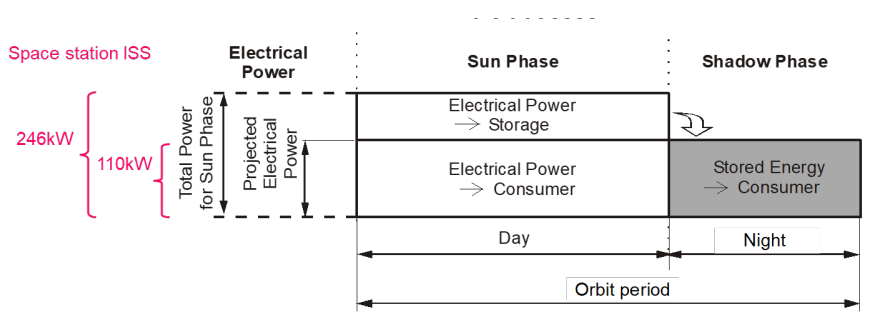
What is the ISS solar array area and peak generation power?
3050 m² of photovoltaic array (75 m span) generating 246 kW, with 110 kW usable output power
Name the main components of the ISS EPS chain from array to distribution.
SSU (Sequential Shunt Unit) → Beta Gimbal → DCSU (DC Switching Unit) → Alpha Gimbal → MBSU (Main Bus Switching Unit) → DDCU (DC-to-DC Converter Unit) → RPCM (Remote Power Controller Module); BCDU (Battery Charge/Discharge Unit) handles the battery
★List the six generic tasks of an EPS.
Generate electrical power,
Store electrical power,
Control and distribute power to spacecraft components,
Provide converters for regulated DC power buses,
Manage average and peak electrical loads,
Protect spacecraft against EPS failures
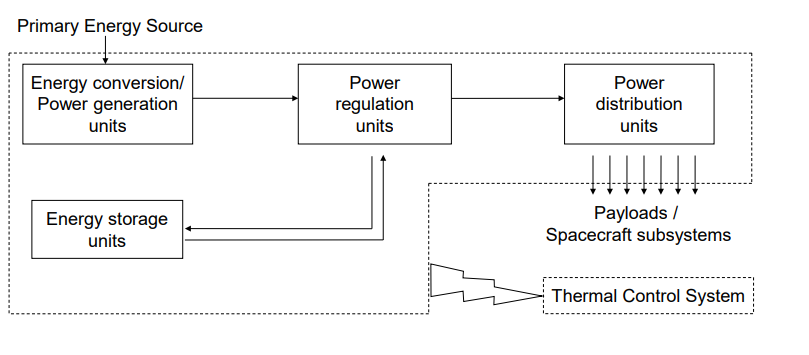
★Draw/describe the four functional blocks of a power supply system.
Primary Energy Source → Energy conversion/Power generation units → Power regulation units → Power distribution units → Payloads/Spacecraft subsystems; Energy storage units sit alongside conversion and feed into regulation; Thermal Control System interfaces with distribution
★List the six general requirements on an EPS.
Availability (design maturity/risk/timeline),
"Space proof" (space environment & integration),
Reliability (failure modes, safety, maintenance),
Designed for mission lifetime,
Specific power/energy (W/kg, Wh/kg, W/m³, Wh/m³),
Cost
★Name the six relevant orbital environment factors affecting EPS design.
Solar Radiation & Thermal Environment,
Atmospheric Drag,
Atomic Oxygen,
Particle Radiation,
Space Debris,
Solar Eclipse
What is the formula for solar flux at a distance r from the sun?
M_Sun(r) = M0 (R0/r)^2, where M0 = 1371 ± 10 W/m² (solar constant at 1 AU) and R0 = 1 AU
What is the average Earth albedo and its typical range?
Average albedo ≈ 0.35; ranges from 0.10-0.80 (clouds), 0.05-0.45 (ground), 0.03-0.20 (water)
What is Earth's infrared radiation value used in slide calculations?
M_E = 237 W/m²
How does atmospheric drag vary with solar cycle?
Drag increases significantly during solar maximum vs solar minimum because higher solar activity heats and expands the upper atmosphere, increasing density at a given altitude
What two effects does atmospheric drag cause on a spacecraft?
Deceleration/loss of altitude, and a moment shift due to the offset between center of pressure (CP) and center of mass (CM)
How is atomic oxygen (AO) formed and where is it most abundant?
UV radiation dissociates O2 into atomic O; it becomes the dominant species in the mole fraction of the atmosphere roughly between 200-600 km altitude (Low Earth Orbit)
What are the two main effects of atomic oxygen on spacecraft materials?
Erosion (surface material loss, e.g. on Teflon, Kapton, Silver) and "Shuttle Glow" (glow effect from surface interaction with ram-facing surfaces)
Which material has the highest AO erosion rate and which has the lowest (at 500 km, solar max)?
Silver has the highest erosion rate (220 µm/year); Aluminium has the lowest (0.0076 µm/year)
★What are the three main sources of particle radiation in space?
Galactic cosmic rays (heavy ions, almost constant),
Solar flares (electrons/protons/X-rays/plasma, variable in time),
Radiation belts (trapped electrons & protons, variable by orbit)
What is the South Atlantic Anomaly (SAA) and why does it matter for EPS?
A region where the inner Van Allen belt dips closest to Earth's surface due to the offset magnetic field, causing higher radiation exposure and Single Event Upsets (SEUs) in electronics passing through it
★List the five induced effects of particle radiation on spacecraft.
Charging of external parts,
breaking of chemical links in materials,
atom displacements,
charge deposit in depth of materials,
long-term cumulative dose effects
★What design mitigations address particle radiation damage to solar cells?
Material selection & protection (cover glass), electrical conductivity of external skin (for discharges), part tests/selection/shielding/hardening/redundancy (for performance drift and SEUs)
★What are the two damage regimes for space debris impacts?
Low size particles cause limited damage (erosion, small perforation - mitigated by design margins/redundancy);
Medium/large debris causes major/deadly damage (mitigated by tracking and collision-avoidance maneuvering)
★Why is Sun-Synchronous Orbit (SSO) a special case for solar eclipses?
In near-polar SSO, the orbit plane maintains a roughly constant angle to the sun, which can produce eclipse-free ("dawn-dusk") periods depending on the local time of the ascending node, unlike near-equatorial LEO which experiences eclipses every orbit
What is the formula for eclipse (shadow) time fraction in a circular orbit?
t_E / t_u = 2α / 360°, where t_E = time in Earth's shadow, t_u = total orbital period, α = half shadow angle
What is the orbital period formula given on the slides?
t_u = 2π √[(R0/g0)(R0
How does eclipse duration change with altitude (200 km to GEO)?
Shadow period decreases from about 42% of the orbit at 200 km to only about 5.6% at GEO, because higher orbits spend more time out of Earth's shadow cone
★Why does an EPS need energy storage even though solar arrays generate power?
Because during the eclipse/shadow phase there is no solar illumination, so stored energy (from batteries charged during the sun phase) must supply the loads
★List the four primary energy categories in the "Potential Energy Sources and Conversion" taxonomy.
Solar, Nuclear, Chemical, Kinetic
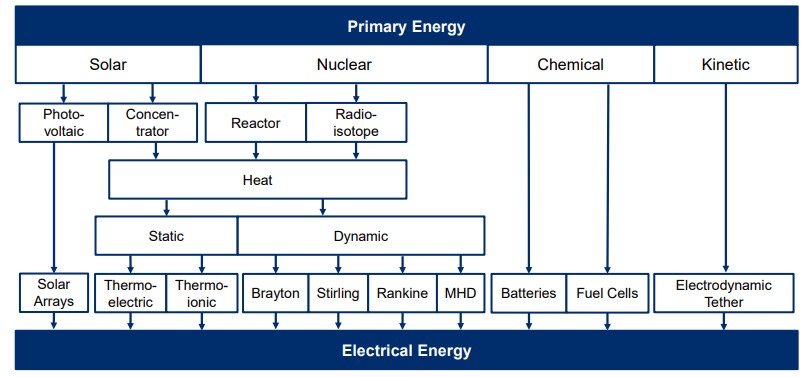
★Which energy conversion paths are actually "used in space" per the taxonomy diagram?
Photovoltaic (solar arrays),
Radioisotope (RTG, via thermoelectric/Seebeck),
Reactor (Nuclear)
Batteries and Fuel Cells (chemical), and
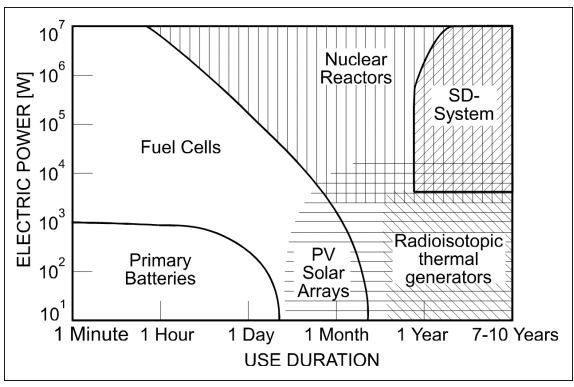
What two sizing regimes does the "Options for Electrical Power Supply" chart show?
Primary batteries/fuel cells dominate for short-duration, high-power missions (minutes to days); PV solar arrays, radioisotope generators, and nuclear reactors dominate for long-duration missions (months to years)
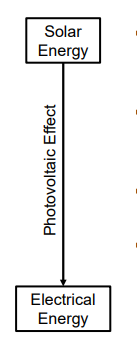
★Explain the photovoltaic operating principle.
Absorption of radiation in a semiconductor crystal generates electron-hole pairs;
these are separated by the electric field of a p/n-junction,
producing a photocurrent in the external circuit;
cells are connected in series ("strings") for voltage and strings in parallel for current
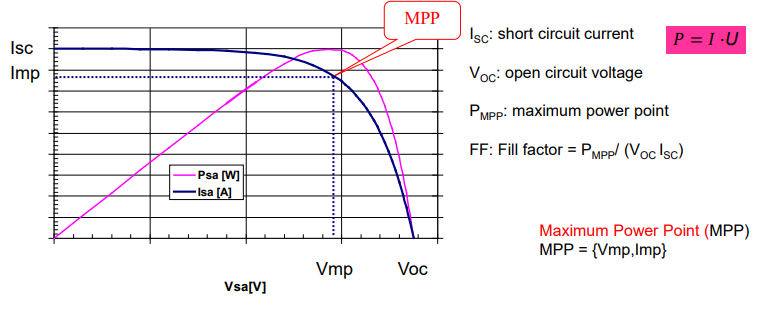
Define Isc, Voc, Pmpp, and Fill Factor (FF) for a solar cell.
Isc = short circuit current; Voc = open circuit voltage; Pmpp = maximum power point (highest P=I·U on the I-V curve); FF = Pmpp / (Voc · Isc), a measure of I-V curve "squareness"
What is the Maximum Power Point (MPP)?
The specific voltage/current pair (Vmp, Imp) on the I-V curve at which the solar cell delivers maximum electrical power output
★How does temperature affect solar cell performance?
Higher temperature reduces voltage output (and thus power); efficiency drops with a power loss of about 0.5%/K at the maximum power point
★How does illumination intensity affect solar cell current?
Current scales roughly linearly with illumination intensity (suns); higher illumination (e.g., concentrators) increases current output
How does particle irradiation affect solar cell I-V curves over time?
Increasing radiation fluence (electrons/protons) progressively degrades both voltage and current output, shrinking the I-V curve compared to Beginning of Life (BOL)
★What determines a solar cell material's usable wavelength range?
Incident radiation must exceed the band gap energy to generate an electron-hole pair, setting a maximum usable wavelength (minimum photon energy); very short wavelengths are absorbed near the surface and less efficiently
What is a typical efficiency range for space solar cells and which type performs best?
Efficiencies range from about 8% (thin-film) to over 30%; triple-junction (GaInP/GaAs/Ge) cells are currently the best-performing type used in space
★What is the trade-off between spin-stabilized and 3-axis stabilized solar array implementation?
Spin-stabilized: no separate structure needed, but only part of the cells are illuminated at any time and array area is limited by spacecraft shape/size.
3-axis stabilized: high efficiency (sunlight always perpendicular) but requires constant sun-tracking
★What is the difference between alpha-tracking and beta-tracking of solar arrays?
Alpha-tracking compensates for spacecraft rotation relative to the sun (single axis, usually continuous);
Beta-tracking compensates for orbit inclination and obliquity of the ecliptic (seasonal adjustment)
★Why might a solar array be intentionally off-pointed from the sun?
To reduce atmospheric drag, or when the batteries are already fully charged and no more power storage is needed
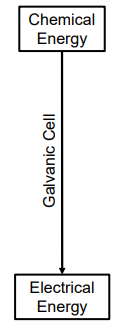
★Explain the operating principle of a galvanic cell (battery) vs. a fuel cell.
Batteries: charge separation via two different electrodes and an electrolyte, using chemical energy stored in metals/oxides within the cell structure.
Fuel Cells: redox reaction between an externally supplied fuel and oxidizer (e.g. H2/O2), with reactants added from outside the cell structure
What is the key structural difference between batteries and fuel cells that drives their trade-offs?
Batteries store reactants internally (finite energy, degrades over cycles); fuel cells receive reactants from external tanks (no degradation from cycling, but need extra tank mass)
★Define primary cell vs. secondary cell.
Primary cell: chemical reaction is not reversible, cannot be recharged, single use.
Secondary cell: chemical reaction works both ways, can be recharged, usable as rechargeable energy storage
Define Depth of Discharge (DoD) and State of Discharge (SoD).
DoD = percentage of full battery capacity actually removed/used in a cycle;
SoD = the complement; DoD
How does DoD affect battery cycle life?
Higher DoD dramatically reduces the number of expected charge/discharge cycles (e.g., ~100,000 cycles near 0% DoD dropping to a few hundred near 100% DoD) - there's an inverse relationship
Compare Lead Acid, NiCd, NiMH, and Li-Ion battery energy densities.
Lead Acid: 30-50 Wh/kg; NiCd: 45-80 Wh/kg; NiMH: 60-120 Wh/kg; Li-Ion: 150-250 Wh/kg - Li-Ion has by far the highest specific energy
Why must Li-Ion cells have "cell protection" while NiCd/NiMH tolerate discharge better?
Li-Ion has low overcharge tolerance and cannot tolerate trickle charge, requiring protection circuitry; NiCd/NiMH are more tolerant of full discharge and overcharge conditions
★List two advantages and one disadvantage of fuel cells vs. batteries.
Advantages: no degradation (reactants aren't part of the cell structure), and reaction products (e.g. H2O from H2/O2 fuel cells) can be used for synergetic subsystems.
Disadvantage: need additional tanks for reactant storage, adding mass
What was a real fuel cell application on the Space Shuttle?
Three alkaline H2/O2 fuel cell units, 12 kW each, system power density 275 W/kg, generating over 100 L of H2O per day for crew use
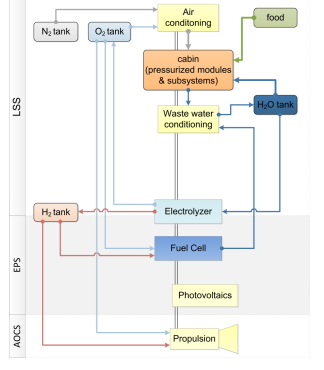
★What is the concept of "Synergetic Subsystems"?
Combining different subsystems (EPS, AOCS, ECLS) to share resources for technical/operational advantage - e.g. fuel cell power generation, electrolyser for energy storage and propellant generation, and water purification via fuel cell reaction products - resulting in
better reliability,
lower system mass, and
lower resupply mass
★Explain the RTG (Radioisotope Thermoelectric Generator) operating principle.
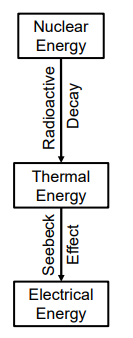
Nuclear energy is released via spontaneous radioactive decay of an isotope (e.g. Pu-238), emitting high-energy particles that are absorbed in surrounding material, heating it up; this heat is converted to electricity via the Seebeck effect (thermoelectric conversion using two semiconductors at different temperatures)
★List two advantages and two disadvantages of RTGs.
Advantages:
small/compact/robust (no moving parts),
no maintenance,
high energy density,
consistent power independent of distance to sun or eclipses.
Disadvantages:
high cost vs batteries,
radiation hazard to spacecraft/handling,
public concern over launch failure dispersal,
high operating temperature affects thermal design
★What is the difference between nuclear fission and fusion, and why is fusion theoretically more efficient?
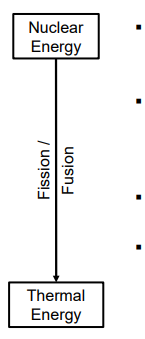
Fission splits heavier elements into lighter ones;
Fusion combines lighter elements into heavier ones.
Both release energy equal to the mass defect (E = Δmc²); fusion theoretically releases about 10x more energy than fission per reaction
★Compare Photovoltaics and Nuclear Power for spacecraft (shadow periods, safety, degradation, cost).
PV: needs energy storage for eclipse, no safety issues, relatively high degradation (radiation/debris exposure), power depends on panel area, low cost (800-3000 $/W).
Nuclear: independent of shadow periods, requires radiation shielding and long-term reentry prevention, low degradation, very high power possible but needs a thermal-to-electric converter, high cost (400K-700K $/W)
★Explain how an electrodynamic tether generates power.
A long conducting wire moving through Earth's magnetic field at orbital velocity generates a current via the Lorentz force interaction, converting orbital (kinetic) energy into electrical power; running current the opposite direction instead produces a propulsive thrust force
★What is the trade-off of using an electrodynamic tether for power generation?
It generates power at the expense of orbital energy (causing orbital decay/deceleration - a retarding force), unlike propulsion mode where current direction reversal creates an accelerating force
★What does the Power Control and Distribution Unit (PCDU) do?
Controls and distributes power throughout the spacecraft and protects against overcurrent; manages both unregulated bus (direct connection to battery/solar array) and regulated bus (to on-board units, commonly 5V/28V) via voltage converters
What is a Maximum Power Point Tracker (MPPT) used for in EPS?
To keep the solar array's operating point at its maximum power point continuously, and to terminate the battery charging process once the battery is full
What is a "shunt" in power regulation and why is it used?
A cheaper power control option that decouples individual strings of the solar array and dissipates excess power as heat once the battery is full - simpler and lower cost than active regulation
★List the four EPS operation phases and their goals.
Preparation Phase: build/design EPS for spacecraft.
LEOP: bring spacecraft to nominal operating state ASAP (deploy panels, test units).
Routine Phase: keep spacecraft running as long as possible (monitor degradation, manage DoD cycles).
EOL: extend mission as long as possible and ensure proper disposal (avoid EPS failure before de-orbit/passivation)
What is the recommended approach for diagnosing multi-failure EPS contingency scenarios?
Begin analysis with the failure most "upstream" in the power chain, then identify all elements that could have generated the observed failure and test them systematically
★What does the EPS design procedure (steps A-E) consist of, and is it a linear or iterative process?
A) Define Requirements & Constraints,
B) Define Basic Concepts,
C) Select and Size Power Source,
D) Select and Size Energy Storage,
E) Define Power Regulation & Control
it is an ITERATIVE process, not strictly linear, looping between design steps before final implementation
How is Orbit Average Power (OAP) calculated?
Sum the energy (Wh) each load consumes over one orbit (Power x Duration x Duty Cycle), sum all contributions, then divide the total energy by the orbital period to get an average power in Watts
In the OAP worked example, if Housekeeping draws 20W continuously for the full 90-minute orbit, what is its OAP contribution?
20W, since it runs 100% duty cycle for the entire orbit - Energy = 30 Wh, and OAP contribution equals the constant power itself
What is the "design by analogy" rule of thumb linking payload power to total power?
P_PL (payload power) is approximately 0.45 x P_Total for spacecraft, based on historical mission data (early MIR, Skylab, MIR 1996, SSF, ISS) plotted against spacecraft mass
What two things does the solar array collector surface formula (A_c) depend on?
Required output power (P/OAP), solar flux, cell-to-blanket and conversion efficiencies, BOL/EOL degradation factor, and the ratio of eclipse time to sun time factored by storage efficiency - essentially it must supply both direct loads during sun phase AND recharge the battery for eclipse use
What is the formula for required battery energy content (E_Batt)?
E_Batt = (P_OAP · t_ecl) / (DoD · η_store · η_conv), where P_OAP is orbit average power, t_ecl is eclipse duration, DoD is depth of discharge, and η_store/η_conv are storage and conversion efficiencies
How do you convert required battery energy (Wh) to required capacity (Ah)?
C = E_Batt / U_cell, dividing the required energy content by the cell voltage
Define "C-rate" for battery charge/discharge.
The rate expressed relative to nominal cell capacity - e.g. 1C means the battery is fully charged/discharged in 1 hour; 2C means 30 minutes; C/5 means 5 hours; formula: I = ΔQ/Δt
Why does LEO require a lower DoD limit than GEO for batteries?
LEO has ~16 eclipses/day (short ~0.5h eclipse, 1.5h orbit) leading to thousands of cycles over the mission (e.g. 2920 cycles/5yr), so DoD must be limited to ~20-25% for lifetime. GEO has far fewer eclipses (max ~1.2h, twice yearly near equinox) totaling only ~1620 cycles over 18 years, allowing DoD up to 80%
What is the difference between Peak Power Tracking (PPT) and Direct Energy Transfer (DET) architectures?
PPT: uses a DC/DC converter in series with the solar array (tracks MPP, but incurs 4-7% conversion loss). DET: uses a shunt regulator in parallel with the solar array instead (fewer parts, lower mass, more efficient, but doesn't actively track MPP)