A&P1 Chapter 3 Study Guide
 Call Kai
 Learn
Learn Practice Test
 Spaced Repetition
 Match
Match Flashcards
 Knowt Play
1/118

There's no tags or description
Looks like no tags are added yet.
Name | Mastery | Learn | Test | Matching | Spaced | Call with Kai | Chat |
|---|
No analytics yet
Send a link to your students to track their progress
119 Terms
Cells
Are structural units of all living things
Plasma membrane
Flexible outer boundary
Cytoplasm
Intracellular fluid containing organelles
Nucleus
DNA containing control center
Extracellular (ECF)
Fluids outside the cell
Interstitial fluid
Cells are submersed (bathed) in this fluid
Blood plasma
Fluid of the blood
Cerebrospinal
Fluid surrounding nervous system organs
Extracellular matrix
Substance that acts as glue to hold cells together
Plasma membrane
Acts as an active barrier separating intracellular (ICF) from extracellular (ECF)
Membrane protein
Allow cell communication
Integral proteins
Inserted into membrane

Peripheral proteins
Loosely attached to integral proteins or anchored to the membrane

(a) transport
Allow cells to control which substance enter and exit the cell
(b) receptors for signal transduction receptors
Allow a cell to receive information from other cells
(c) enzymic activity
The membrane allows cells to transform one substance into another
(d) cell-cell recognition
Some proteins in the membrane of adjacent cells allow them to recognize eachother through direct physical contact
(e) cell-to-cell joining
Membrane proteins of adjacent cells may be hooked together in various kinds of long-lasting intercellular junctions
(f) attachment to the cytoskeleton and extracellular matrix (ECM)
Some membrane proteins anchor elements of the cytoskeleton and the other extracellular matrix
Tight junctions
Waterproof boundary (prevents water from moving in between cells)
Desmosomes
(anchoring junctions) neighboring cells interlock like a teeth of a zipper
Anchored through plaques
Gap junctions
Transmembrane proteins (connexons) form tunnels that allow molecules to pass from cell to cell
Passive transport
No energy needed
Active transport
Energy (ATP) required
Glycocalyx
Consist of sugars (carbs) sticking out of cell surface
Glycolipids
Some glycocalyx are attached to lipids
Glycoproteins
Some glycocalyx are attached to proteins
Simple diffusion
Diffuse directly through lipid bilayer

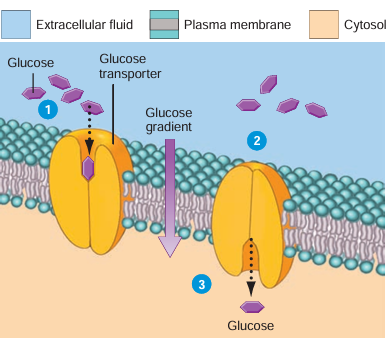
Facilitated diffusion
Large molecules require assistance crossing plasma membrane with carrier or channel proteins
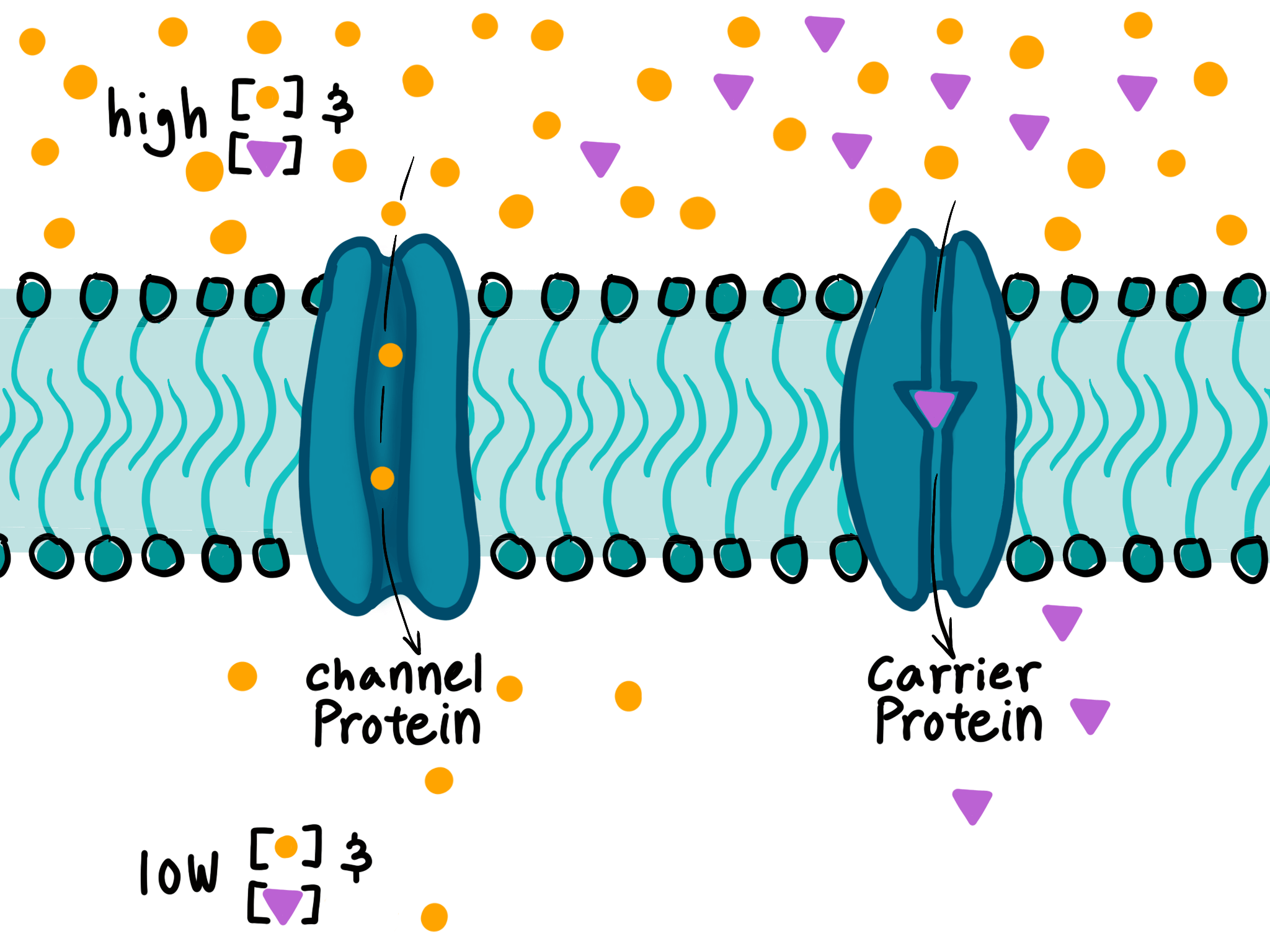
Carrier mediated facilitated diffusion
Transport specific polar molecules that are to large
Channel mediated facilitated diffusion
Transport molecules down concentration gradient

Leakage channels
Always open, molecules drift through
Gated channel
Controlled by chemical or electrical signals (only opened when triggered)
Osmosis
Movement of water through selectively permeable membrane

Osmolarity
Total concentration of all solute particles in a solution
Tonicity
Ability of a solution to change shape, or plasma membrane tension of cells by altering the cells internal water

Isotonic solution
Same, balanced - happy cell
Hypertonic solution
Higher (more) , water exits - shriveled cell
Hypotonic solution
Lower (less) , water exits - swollen cell
Equilibrium
Same concentration of solutes and water molecules on both sides
Proteins cannot
They cannot diffuse through cell membrane
Vesicular transport
Moves larger molecules or larger amounts across cellular membrane inside sacs called vesicles(ATP required)
Active transport primary
Energy to do work comes from hydrosis of ATP by transport proteins called pumps
Active transport secondary
Energy stored on concentration gradients on ions created by primary active transport pumps
Sodium-potassium pumps
Exchanges 3 extracellular sodium ions and 2 extracellular potassium ions (3 in 2 out)
K+
Na+
Ca+
Sodium always goes out
Symporters
Transport two different substance to same place
Antiporters
Transport one cell while transporting another out the cell
Vesicle
The inside of a phospholipid bilayer
Intracellular fluid (ICF)
The fluid inside the vesicle of the phospholipid bilayer
Transcytosis
Moves substance in, across, then back out

Vesicular trafficking
Move substance from one area in the cell to another
Endocytosis
Transport into cell
Phagocytosis
“cell eating” (takes in large particles like bacteria or dead cells by wrapping them in a vesicle
Pinocytosis
“cell drinking” (takes in fluid and dissolved substances from ECF
Receptor mediated endocytosis
Lets the cell take in specific molecules from ECF using receptors like a cell only opening door for invited guest
Exocytosis
Transport out of cell
Resting membrane potential (RMP)
In their resting point
Contact signaling
Cells that touch recognize each other by each cell unique surface membrane receptors
Chemical signaling
Interaction between receptors and ligands (chemical messenger) cause changes in cellular activities (cells talk to each other throwing chemicals at each other. the chemical is the matter its the receptor, without the receptors they cant catch the chemicals)
Na+/K+ keep balance
K+ sets the resting membrane potential (RMP) and Na+ also influences
Cytoplasm
Cellular material that is located between the plasma membrane and the nucleus

Cytosol
(cytoplasm) gel like solution of water and soluble molecules
Inclusion
(cytoplasm) insoluble molecules (nonliving materials stored in cytoplasm, they are stored substances)
Organellles
(cytoplasm) metabolic machinery structures of cell (tiny structures floating in the cytosol that performs specific jobs)
Membrane organelles
Mitochondria
Endoplasmic reticulum
Golgi apparatus
Peroxisomes
Lysosomes
Nonmembrane organelles
Ribosomes
Cytoskeleton
Centrioles
Mitochondria
“power plans” of cell, produce most of cells energy molecules (contain their own DNA, RNA, and ribosomes)

Ribosomes (cells protein factories)
Nonmembranes that are the site of protein synthesis
Free ribosomes
Free floating in cytosol

Membrane bound ribosomes
Attached to rough membrane of endoplasmic reticulum
Endoplasmic reticulum (ER)
Series parallel, interconnected cisterns - flattened tubes that enclose fluid filled interiors

Rought ER
(protein workshop) (ribosomes build proteins, ER folds, refines, and ships them out)
Smooth ER
(cells lipid factory) network of looped tubules continuous with rough ER
Golgi apparatus
Everything goes here. manages all vesicles (consist of stacked flattened cisterns)

Lysosomes
(clean up crew) filled with digestive enzymes

Peroxisomes
Membranous sacs containing powerful detoxifying substances neutralize toxins

Free radicals
Toxic, highly reactive molecules that are natural by products of cellular metabolism, can have cell to cell if not detoxified

Cytoskeleton
Elaborate network of rods that run through cytosol
Act as cells “bones, ligaments, and muscle” by playing a role in movement of cell components
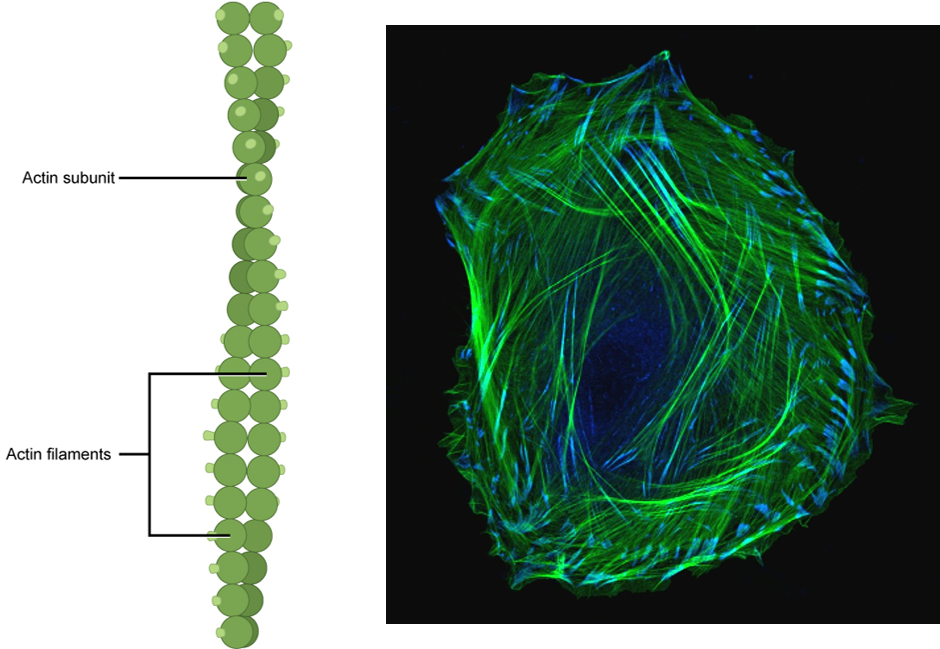
Microfilaments
(thinnest) semi flexible strands of protein actin
Intermediate filaments
Tough, insoluble, rope like fibers
Help cell resist pulling forces

Microtubules
Largest one, hollow
Determines overall shape of cell and distribution of organelles

Centrosome
Microtubule organizing center

Centrioles
Generates microtubules and organize mitotic spindle for cell division
Also form the bases of cilia and flagella

Cilia
Whiplike, mobile cellular extensions on surface of certain cells

Flagella
Longer extensions that propel the whole cell (only human cell type with this is sperm)

Basal bodies
Centrioles forming the bases of cilia and flagella

Microvilli
Finger like projections that extended from the surface of the cell to increase surface area

Nucleus
(control center of cell) largest organelle and contains genetic library of blueprints for synthesis of nearly all cellular proteins

Nuclear envelope (membrane)
2 layers

Nuclear pores
Go through the two layers of nuclear envelope. they allow substances to pass into and out of the nucleus

Nucleoli
(singular nucleolus) dark staining spherical bodies within nucleus
Where rRNA is formed (where were making ribosomes)
More than other cells making a lot of proteins
Chromatin
Arranged in fundamental units called nucleosomes which is DNA wrapped around histones'
30% DNA
60% gobular histone protein
10% RNA chains newly formed or forming

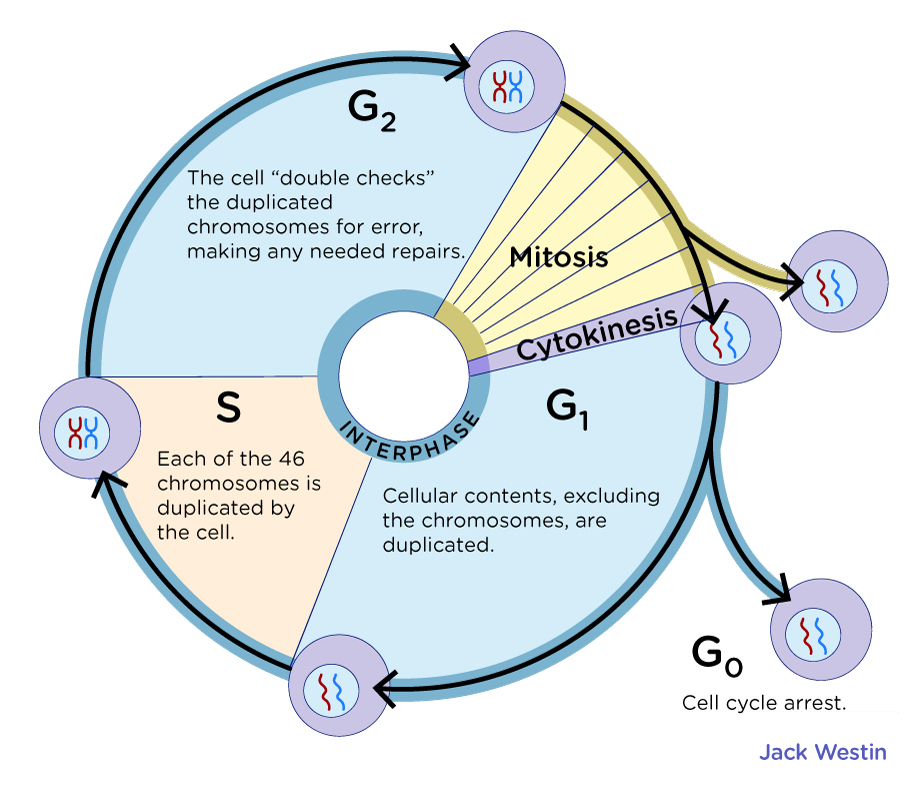
Cell cycle
Series of changes cell undergoes from the time it is formed until it produces
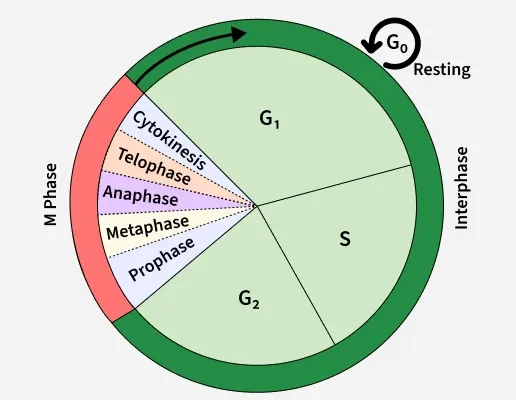
Interphase
(between mitosis events) cell grows and carries on its unusual activities

Mitotic phase
Cell divides into two cells (working on the body)
G1 (gap 1)
Vigorous growth and metabolism, the cell is preparing to copy its DNA

G0 phase
Cells that cease dividing are in this phase. some cells never stop dividing, some cells cant ever do mitosis again. other cells most of the time just dont divide for reasons
S (synthesis)
DNA replication occurs

G2 phase (gap 2)
Preparation for division (cytokinesis)