8/27 5221 Mechanisms of Receptor Regulation
 Call Kai
 Learn
Learn Practice Test
 Spaced Repetition
 Match
Match Flashcards
 Knowt Play
1/18

There's no tags or description
Looks like no tags are added yet.
Name | Mastery | Learn | Test | Matching | Spaced | Call with Kai | Chat |
|---|
No analytics yet
Send a link to your students to track their progress
19 Terms
Competitive inhibitor
Increases Km without changing Vmax
Reversed by increasing substrate concentration [S]
E.g., statins (competitively inhibit HmG CoA reductase)
![<p>Increases Km without changing Vmax</p><p>Reversed by increasing substrate concentration [S]</p><p>E.g., statins (competitively inhibit HmG CoA reductase)</p>](https://assets.knowt.com/user-attachments/1e196fcc-06ea-4442-92bf-d98addbac898.png)
Uncompetitive inhibitor
Decreases Vmax and Km
Binds to ES complex
Adding more substrate gives the inhibitor more ES complex to bind to and more opportunities to inhibit the enzyme

Difference between uncompetitive inhibitor and competitive inhibitor
Uncompetitive competes for ES, not E
Uncompetitive binds to ES, while competitive binds to E
Mixed inhibitor
Decreases Vmax
Either increases Km (if prefers E) or decreases Km (if prefers ES)
Noncompetitive inhibitor
Decreases Vmax while Km is unchanged
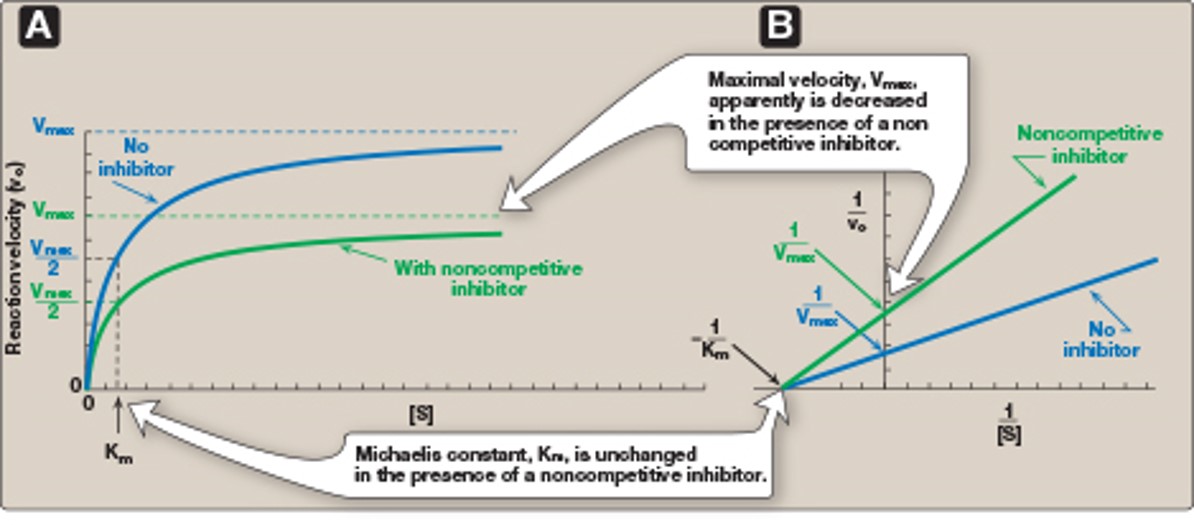
Difference between noncompetitive and competitive inhibitor
Adding more S cannot overcome noncompetitive inhibition
on the other hand, competitive inhibition can be reversed by adding S
Difference between mixed inhibitor and noncompetitive inhibitor
Mixed has different affinity for E vs ES
Noncompetitive has same affinity for E + ES
Homotropic effectors: the substrate itself acts as the allosteric regulator (homotropic)
By one substrate binding, it changes protein structure and makes it easier or harder for other substrates to bind (known as cooperativity)
Positive cooperativity:
Negative cooperativity: Binding of a ligand to one site decreases affinity of other sites for ligand
Positive cooperativity
Ligand binding to one site enhances ligand binding to other sites
A ligand binding to the enzyme makes it easier for subsequent ligands to bind
Homologous vs. heterologous desensitization
Homologous: desensitization on the receptor itself (receptor-level; impacts just the receptor)
Heterologous: desensitization on the signaling pathway level (impacts multiple receptors)