Infections and Disease
 Call Kai
 Learn
Learn Practice Test
 Spaced Repetition
 Match
Match Flashcards
 Knowt Play
1/54

There's no tags or description
Looks like no tags are added yet.
Name | Mastery | Learn | Test | Matching | Spaced | Call with Kai | Chat |
|---|
No analytics yet
Send a link to your students to track their progress
55 Terms
what is the chain of transmission?

what is a pathogen
a microbe that causes disease
what is bacteria?
single cells / simple structure
cell wall structure determines which stains bacteria takes up (gram +/-)
Colonising microbes live on the body for days-months (microbiome)
Contaminants are not part of the microbiome (normal flora) and can be removed by washing
what is viruses?
only replicate inside cells.
Made up of DNA or RNA contained in an envelope → has proteins that enable virus to attach to cells and insert genetic material by combining with cell receptors.
what are other types of microbes?
Fungi: in patients undergoing chemotherapy or long- term antibiotic treatment due to debilitated state = opportunistic pathogen e.g. Candida albicans
Protozoa e.g. giardia, crystosporidium
Prions = strands of protein, rare
what are 3 modoes of infectious transmission?
Communicable Infections | Contagious Infections | Non-Communicable Infections |
Infection that transmits from one person to another (either directly / indirectly) | Easily transmitted from one person to another
| Requires ANOTHER vector to transmit the infection between people E.g malaria using the mosquitoes |
what is a microbiome?
The microbes in our microbiome are permanent residents of the body → inhabit our body without causing disease (in individuals who are not immunocompromised)
Present in most areas of the body in contact with the outside environment e.g., oral microbiome, skin microbiome, urogenital microbiome, respiratory microbiome, gastrointestinal microbiome
Microbial communities at each site are very different from each other
Internal organs, tissues, and fluids are microbe-free
Function: supports immunity, prevents overgrowth of pathogens, produces vitamins + chemicals
what are factors that impact microbiome?
age
maternal diet
gestational diabetes
environmental exposures
what are reseroivrs of infectious microbes (3)?
Endogeneous | Congenital | Exogenous ‼ |
Pathogens come from a person’s own microbiome = “self infection” | Pathogens passed from mother → child either
| Pathogens come from a source external from the patient = “cross infection” |
what are 3 types of exogeneous sources of infectious microbes?
People | Symptomatic
Asymptomatic → no symptoms present
|
Inanimate Sources | Fomites: Clothing, Medical equipment and devices Vehicles (common): Medications, Food, water, air |
Animals / Insects (Arthropods) | Zoonoses: Any disease/ infection that is naturally transmissible from vertebrate animals to humans
Insect/arthropod bites (Vectors)
|
what are carriers of infectious microbes? and the 2 types?
“Carriers” = person who harbours infectious pathogens without discernable clinical disease → are a potential source of infection
Asymptomatic Carrier: temporary (<6months) OR chronic (6>months)
Passive (Contact) Carrier: healthcare worker, visitor, patient contaminated w/ infectious agents
compare between the innate and adatptive immune system? what is its definition? function? response? specificity? memory? cells involved?
Innate | Acquired/Adaptive (3) | |
Definition | A type of simple immunity which is inbuilt at the time of birth (genetically determined) | A type of complex immunity which is developed through a lifetime. |
Main function |
|
|
Response | Fast | Slow |
Specificity | Non-specific | Specific |
Memory | No memory | Stores memory |
Cells involved | Neutrophils, macrophages, dendritic cells, natural killer cells | T cells, B cells, antibodies, immune memory |
what is an antigen?
molecule on the surface of a cell that an organism recognises as foreign→ triggers an immune response
On the surface of cells in the body, there are ‘marker’ molecules that identify the cell as belonging to the body (‘self’) = protects the body from attacking itself.
Particular lymphocytes will recognise a particular epitope (the part of an antigen molecule to which an antibody attaches itself) as they have complementary binding sites = antigen receptors
what is the 1st line of defence?
natural barriers (mechanical / chemical / reflexes)
Physical Barriers: skin, mucous membranes, hairs, cilia, secretions, flushing
Reflexes: blink, sneeze, vomiting, defecation
Normal Microbiome → will inhibit growth of pathogen (competition)
what is the 2nd line of defence? its steps in general?
rapid innate = non-specific immune response
activation: Detection of a pathogen = the pathogen’s antigens are detected by WBCs using PRR (pattern recognition receptors) that recognise PAMPS (pathogen-associated molecular patterns) on a pathogen’s surface
inflammation
immune recruitment
pathogen removal
explain inflammation: what is it triggered by? aim? actions? signs?
Triggered: tissue damage/presence of pathogens
Aim: eliminate pathogen, clear necrotic cells from infection, initiate tissue repair
Actions:
mast cells and basophils release histamine
Macrophages release cytokines = activate other cells of the immune system
Signs: redness, heat, swelling, pain = isolate and eliminate pathogen + begin tissue repair

what are the steps for immune recruitment?
Neutrophils = first phagocytes involved
Macrophages = always present in tissues → phagocytoses any foreign materials (eats them)
Monocytes circulate blood until attracted to inflamed tissue → transform into phagocytic cells: dendritic cells or macrophages
detection of pathogen = PAMPS (pathogen associated molecular patterns) on pathogen surface are recognised by pattern recognition receptors (PRRs) on phagocytes
Effect: release of soluble molecules (complement proteins, cytokines, chemokines) = recruits immune cells
what are the steps for pathogen removal / phagocytosis?
engulfment (ingestion) = phagocyte engulfs the pathogen into a vesicle - phagosome
forms phagolysosome = phagosome fuses with lysosome (contains digestive enzymes)
digestion = enzymes + acids break pathogen into non-infectious components
exocytosis = waste materials are expelled from cell
in APCs (i.e macrophages/dendritic cells) fragments of the antigen are presented on the MHC II molecules = activate adaptive immune system
what are the 2 types of inflammations?
Acute inflammatory response: recognition → recruitment → elimination → resolution + repair
Chronic Inflammation → autoimmune disease (asthma, inflammatory bowel disease, neurodegeneration …)
Constant inflammation is bad → immune system produces persistent cytokine production = tissue damage
what is the 3rd line of defence? and its general steps
adaptive immunity = specific + has a memory
antigen presentation
anti-body mediated immunity / humoral
cell-mediated immunity
what are the steps in antigen presentaiton?
Antigen Presentation Controlled by: T cells and B cells → act against the specific invader to destroy it at a cellular level
| Antigen presenting cells (APC) = dendritic cells (most common) or macrophages Pathogens engulfed by APC > broken down > antigen fragment produced > loaded onto MHC II molecule (inside APC) > MHC-II antigen complex migrates to cell surface > APC migrates to lymph nodes > activates specific naive helper T-cells (TH) = has a specific receptor to that antigen > TH cell divides to activate antibody-mediated and cell-mediated immunity |
what are the steps required in anti-body mediated immunity?
Antibody-mediated immunity (humoral) For: pathogens in body liquid (blood, tissue fluid) By: B Cells | TH cells secrete cytokines → activates B-cells → undergoes differentiation + proliferation→ produces many plasma B-cells and some memory cells → plasma cells produce huge quantities of antibodies → float in liquid → recognise antigen on pathogen → bind to it → inactivate it → mark it for destruction by phagocytosis Antibodies: Y-shaped molecules that consist of 4 chains of protein (2 long/2 small)
|
what are these types of antibodies:
IgM
IgG
IgA
IgE
IgD
IgM = produced early + effective at activating complement system
IgG = abundant in blood + tissues → is the memory // supports opsonisation
IgA protects mucosal surfaces
IgE helpful for allergy
IgD = a receptor on naive B cells
what are the steps in cell-mediated immunity?
Cell-Mediated Immunity For: infected host cells By: T Cells |
|
compare a human’s immnue primary and secondary response using antibody exposures?
Primary Response | Secondary Response |
Antibody levels rise gradually, with early IgM followed by class-switched antibodies such as IgG, IgA or IgE depending on the context |
Antibodies are usually higher affinity because B cells have undergone affinity maturation, and (Ig G) class-switched antibodies are produced quickly. |
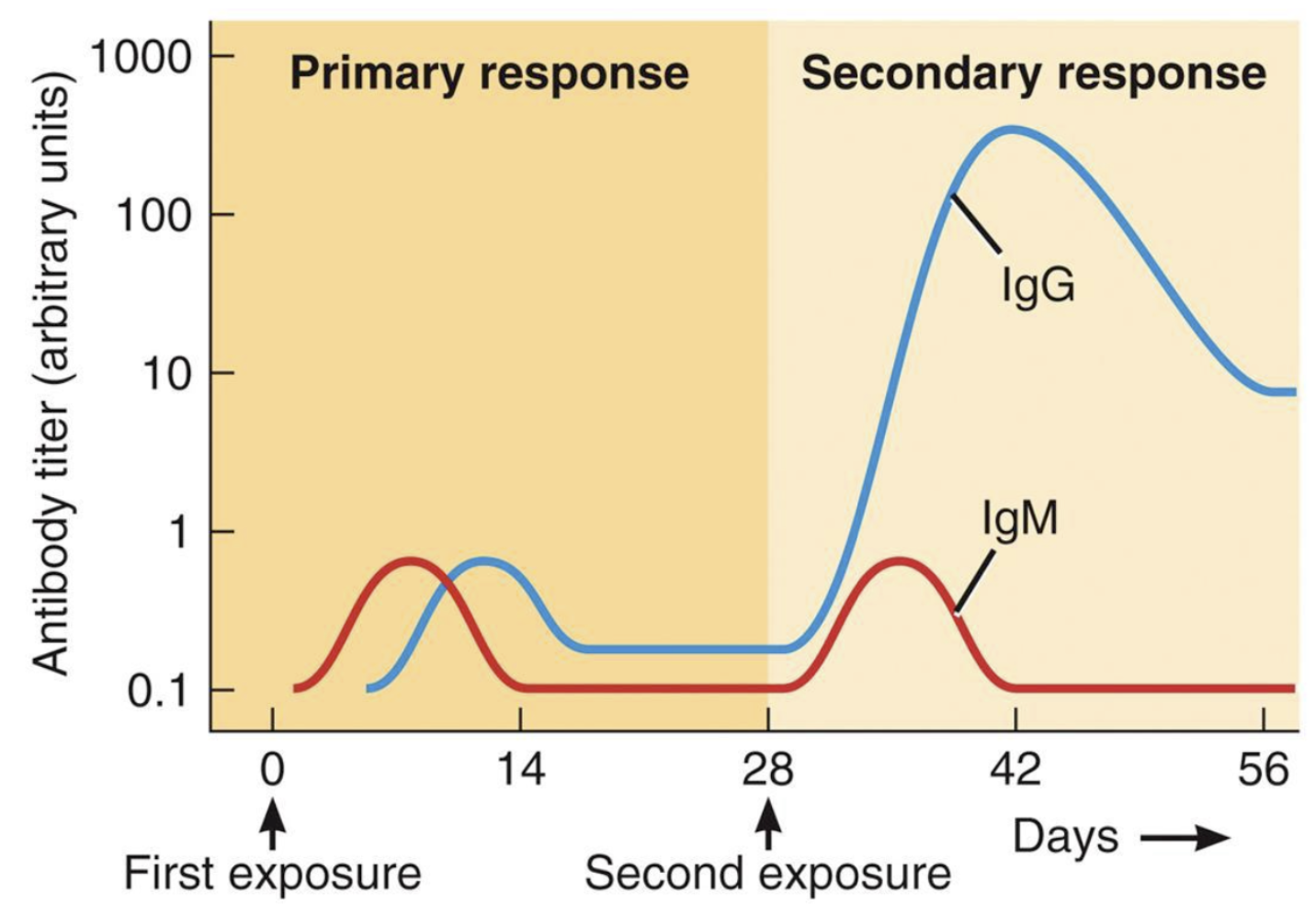
what is the purpose of vaccinations?
A substance used to stimulate the immune system’s response to a certain pathogen
Antigen introduction to initiate primary response and store memory
Vaccines allow for Herd Immunity: most people get immunised so those who cannot (old, sick) will still be protected
Booster vaccines are used to stimulate the stronger secondary immune response for longer-lasting immunity
what do allergies require prior? what antibody is involved?
requires prior sensitization to the allergen (= any substance that can elicit an allergic immune response → antibody IgE)
what is autoimmunity?
Self-tolerance: normal unresponsiveness of the immune system to self antigens
The immune system loses tolerance for self antigens → tissue destruction.
Cause is often unknown but may be: Genetic, Traumatic (Infections, drugs, diet, environmental), Immune dysregulation (e.g., with ageing)
what is anaphylactic reaction
antigen / allergen —> production of IgE antibodies —> IgE binds to surface of mast cell / basophils
subsequent exposure to allergen —> antigen attatches to antibody molecules = releases histamines + other mediators
what is hearing loss? caused in?
A partial or complete decrease in the ability to perceive sound in one or both ears.
Mechanism: Caused by pathology (issue) in
the external/middle ear (conductive)
the inner ear/auditory nerve (sensorineural).
what is otalgia? classified as?
Pain originating within or referred to the ear.
Mechanism: Classified as
primary (pathology within the ear itself)
referred (pain originating from cranial nerves innervating the ear, such as the trigeminal or glossopharyngeal nerves).
what is aural fullness? associated with?
A subjective sensation of pressure, clogging, or stuffed feeling inside the ear.
Mechanism: Commonly associated with Eustachian tube dysfunction, middle ear effusion (accumulation of fluid), or endolymphatic hydrops.
what is tinnitus? symptoms?
The conscious perception of sound in the absence of a corresponding external acoustic
stimulus.
Mechanism: Typically presents as ringing, buzzing, or hissing, often resulting from aberrant neural activity in the auditory pathway.
what is otorrhea? symptoms?
Any discharge or drainage exiting the external auditory canal.
Mechanism: May consist of serous fluid, pus, or blood → indicating pathology in the external ear canal or a perforated tympanic membrane in middle ear disease.
what is vertigo? cause?
A false sensation of movement or spinning of oneself or the surrounding environment.
Mechanism: A specific type of dizziness resulting from an asymmetry or dysfunction within
the vestibular system (peripheral or central)
what is otitis media?
an inflammation or infection of the middle ear, the air-filled space located directly behind the eardrum.
what are the 4 types of diseases of the External Auditory Canal? explain each ones symptoms
1. Earwax Plug | Earwax (epithelia debris) accumulation that blocks EAC → Complete obliteration of EAC
|
2. Foreign Body |
|
3. Acute External Otitis | Cause: mostly bacterial infection
|
4. Otomycosis (fungal external otitis) | Symptoms: itchiness and otorrhea
|
name 3 diseases of the middle ear?
acute otitis media
otitis media with effusion
chronic otitis media
explain acute otitis media? causes? symptoms?
Inflammation of the middle ear < 3 wk of duration
Cause: Bacterial infection from
Streptococcus pneumoniae
Haemophilus influenzae.
Symptoms: Severe otalgia and fever
Reddened tympanic membrane + under tension.
Problem: Recurrent acute otitis media: children > 3 AOM in 6 mo
explain otitis media with effusion (OME)? causes? other names? risk factors? symptoms? treatments?
“Glue ear; Serous otitis media”
Most common otitis in infants and children
Non-purulent infection = doesn’t produce pus etc
Risk factors (same as AOM)
Eustachian tube dysfunction: Failure in middle ear ventilation that generates chronic negative pressure.
Adenoid hypertrophy: Physical obstruction in the nasopharynx that prevents normal ear drainage.
Symptoms
Chronic inflammatory process with intact tympanic membrane
Metaplastic transformation of the respiratory epithelium of the middle ear → into secretory glandular epithelium with thick mucus (glue ear)
Treatment
Saline nasal rinses
If adenoid hypertrophy = Adenoidectomy
If hearing loss or glue ear >6 months = chronic issue → myringotomy (makes hole to drain ear canal) and ventilation tubes
explain chronic otitis media (COM)? what are the 2 clinical forms? their symptoms?
Septic (bacterial) or inflammatory process of the middle ear of long-standing evolution with periods of remission and relapse (>6months)
2 clinical forms > It presents with permanent injury to the middle ear
Inflammatory COM (SOM - Serous Otitis Media) → proliferation of mucosa BUT no infection
Retraction pockets: thin layers cannot maintain the shape of the tympanic membrane
Tympanosclerosis: calcification of tympanic membrane (more whiter)
Adhesive otitis: the retraction pockets keep growing
Suppurative Chronic Otitis Media (COM) → bacterial infection
Tympanic perforation (central, marginal): due to thin tympanic membrane
Disruption of the ossicular chain
Tympanosclerosis
Symptoms:
Otorrhea
conductive hearing loss (if hearing loss > 60 dB)
perforation / granulation of tissues (either central or marginal)
aural polyp obliterating EAC
name the otitis media with severe infections that are intratemporal?
acute mastoiditis
acute petrositis
labryinthisis
facial palsy
name the otitis media with severe infections taht are intracraneal?
otogenic meningitis
brain abscess
sigmoid sinus / lateral sinus thrombophlebitis (really severe)
explain acute mastoiditis? diagnosis? treatment?
Definition: Bacterial infection will extend to the mastoid process
Most common complication esp for children 3mo-3 years old
Diagnosis
Fever + Severe ear pain
Retroauricular oedema ( swelling from fluid buildup)
erythema (skin redness)
erasing of retroauricular crease with pinna displacement
Otoscopy= acute otitis media (AOM)
Treatment: abscess drainage, Myringotomy, ventilation tube,
explain acute petroitis? cause? symtoms? treatment?
Definition: the inflammation of mastoiditis extends to the petrous apex of the mastoid process
Rare condition
Cause: Streptococcus pneumoniae, Haemophilus influenzae, Staphylococcus aureus
Children: AOM/ Adults: COM
Symptoms: otorrhea, severe pain, fever, poor general condition
Confirmed by a CT diagnosis: petrous apicitis are erosive lysis with ill-defined irregular edges
Treatment:
IV antibiotics
Mastoidectomy: surgical procedure that removes diseased air cells from the honeycomb-shaped mastoid bone located just behind the ear.
explain labryinthitis? the types? symptoms? treatment?
Acute OM/Chronic OM extended to inner ear towards anterior (cochlea) and posterior (vestibular organs) labyrinth
Serous Labyrinthitis: sensorineural hearing loss + vertigo = Mild, reversible.
Purulent Labyrinthitis: Sudden sensorineural hearing loss + vértigo intense = Severe, irreversible
Perilymphatic fistula: Cholesteatoma erodes horizontal semicircular canal
Symptoms
History of middle ear effusion (serous otitis media, chronic otitis media –otorrhea–)
Sensorineural hearing loss due to cochlear involvement
Vertigo: spontaneous nystagmus or nystagmus induced by increased pressure in the middle ear (Valsalva, ear aspiration)
CT scan of the middle ear to assess middle ear and labyrinth effusion (or opacification)
Treatment
Hospitalization + IV antibiotic therapy
Surgery: myringotomy and possible mastoidectomy if COM is present
Vestibular rehabilitation
explain facial palsy’s relation to OM?
Facial palsy due to otitis media
caused by AOM in children
COM with/without cholesteatoma in adults.
Treatment:
due to AOM: myringotomy, antibiotics, hospital admission?
due to COM: mastoidectomy with facial nerve decompression
what is the weber test?
using a tuning fork on the midline to see where it lateralises (where it is heard):
normal = heard in midlline
conductive hearing loss = heard in worse ear
sensorineural hearing loss = heard in better ear

what is the rinne test?
tuning fork placed on the mastoid bone directly behind your ear = bone conduction
When you stop hearing the sound, they move the fork just outside your ear canal = air conduction
ask you which position sounds louder.
Understanding the Results
Positive Rinne Test (Normal or Sensorineural Loss): You hear the sound louder next to your ear canal than on your bone (Air Conduction > Bone Conduction). This means your outer and middle ear work normally.
Negative Rinne Test (Conductive Loss): You hear the sound louder or longer on your bone than next to your ear (Bone Conduction ≥ Air Conduction). This means something is blocking sound from traveling through your ear canal or eardrum (like earwax, fluid, or an infection).
compare between the conductive hearing loss and sensorineural hearing loss for: definition / ear structure affected / weber test results / rinne test results / air-bone gap / stapedial reflex / common treatment?
Features | Conductive Hearing Loss (CHL) | Sensorineural Hearing Loss (SNHL) |
Definition | A barrier to sound transmission through the outer or middle ear.
| Pathology localized to the inner ear (cochlea), auditory nerve (CN VIII), or central auditory pathways. |
Anatomical Site Affected | Outer / middle ear | Inner ear / auditory nerve |
Weber Test (uses tuning fork) | Heard in worse/affected ear | Heard in better/unaffected ear |
Rinne Test | Negative (BC ≥ AC) | Positive (AC > BC) |
Air-Bone Gap | Present (≥ 15dB)
| Absent (< 15dB) |
Stapedial Reflex | Absence of acoustic reflex | Typically present (except in severe / retrocochlear loss) |
Common Fix |
| Amplification (hearing aids, cochlear implants) |
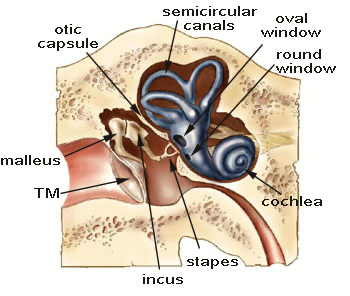
what is otosclerosis? relevance? symptoms? diagnosis? genetic cause? treatment?
Definition | Bone dysplasia (abnormal growth of bone) of the human otic capsule and stapes footplate
 |
Relevance | Leading treatable cause of adult-onset progressive hearing loss |
Pathology (issue) | abnormal bone remodeling of normal endochondral bone resorbed → replaced by vascular, hypercellular otosclerotic bone = fixation of the stapes footplate = conductive or mixed hearing loss. |
Symptoms | Onset early 30s
|
Diagnosis | Otoscopy = normal Audiometry
|
Genetic Condition | Autosomal Dominant
|
Treatment |
|
what is ototoxicitiy? its clinical consequences? relevance? genetic relevance? prevention methods? risk factors?
Define | Drug-induced injury to cochlear and/or vestibular structures
|
Clinical Consequences |
|
Relevance | damage may be permanent
|
Genetic Susceptibility to mitochondrial-mediated ototoxicity | Disruption of Protein Synthesis (Genetic Susceptibility)
|
Risk Factors |
|
Prevention |
|
what are the main ototoxic drugs?
Platinum chemotherapy: cisplatin, carboplatin, oxaliplatin.
Aminoglycosides: gentamicin, amikacin, tobramycin.
Loop diuretics: furosemide, bumetanide, ethacrynic acid.
Other agents: macrolides, vancomycin, salicylates, quinine and antimalarials.
CALM EAR:
Cisplatin / Carboplatin
Aminoglycosides
Loop Diuretics
Malaria Drug - Quinine
Erythromycin
Aspirin / Salicylates
Rare reaction of Vancomycin
what is autoimmune ear disease? key players? activation? clinical profile? symtpoms? therapy?
Autoimmune Inner Ear Disease | |
Definition | Adaptive immune system mistakenly attacks specific self-antigens within the inner ear tissues |
Key Players |
|
Activation | Slow, targeted response
|
Clinical Profile | Rapidly progressive, fluctuating Bilateral sensorineural hearing loss |
Key Symptoms |
|
Therapy | Medication / drugs e.g immunosuppressants |
what is autoinflammatory inner ear disease? key players? activation? clinical profile? symtpoms? therapy?
Autoinflammatory Inner Ear Disorder | |
Definition | Tissue damage caused by overactive innate immune system = fails to regulate the inflammatory response |
Key Players |
|
Activation | Immediate, non-specific response |
Clinical Profile | Pro-inflammatory Cytokines → destroys cochlear hair cells
|
Key Symptoms | progressive deterioration of hearing loss / imbalance / tinnitius / aural fullness |
Therapy | Frequent biologic agents |