Technology and Innovation Management
 Call Kai
 Learn
Learn Practice Test
 Spaced Repetition
 Match
Match Flashcards
 Knowt Play
1/194

There's no tags or description
Looks like no tags are added yet.
Name | Mastery | Learn | Test | Matching | Spaced | Call with Kai | Chat |
|---|
No analytics yet
Send a link to your students to track their progress
195 Terms
What is the OCCD?
Organization for Economic Co-operation and Development
What is creative destruction?
term by Schumpeter
competition that leads to a cost or quality advantage, which strikes not at the margins of the profits and outputs but at their foundations and their very lives
Why is innovation important?
essential to economic growth
under capitalism innovation is mandatory as it is a life-and-death matter for the firm
What is the turnover time of a patent?
20 years (+ 5 years for pharma due to long testing time)
fees need to be paid yearly
Why was prozac so profitable?
anti-depressant drug
one of the biggest-selling drugs ever
third of the total turnover of the company
13 years of patent after release on the market
Why did the Iridium phone lead to losses?
satellite-based mobile phones
phone connections anywhere at any time
successful technology but extremely expensive
wrong marketing → tried to sell it to the average public who did not need it, instead of businesses
What is innovation?
new products or processes
commercialized
new to the adopting organization
new combination of needs and technical solutions
What is innovation management?
Creation of processes that aim at creating and exploiting new things.
What are the steps of innovation (and invention)?
(Idea
Discovery
Research
Development
Invention)
Market launch
Exploitation
How are innovation strategies related to the newness of the market and the solution?
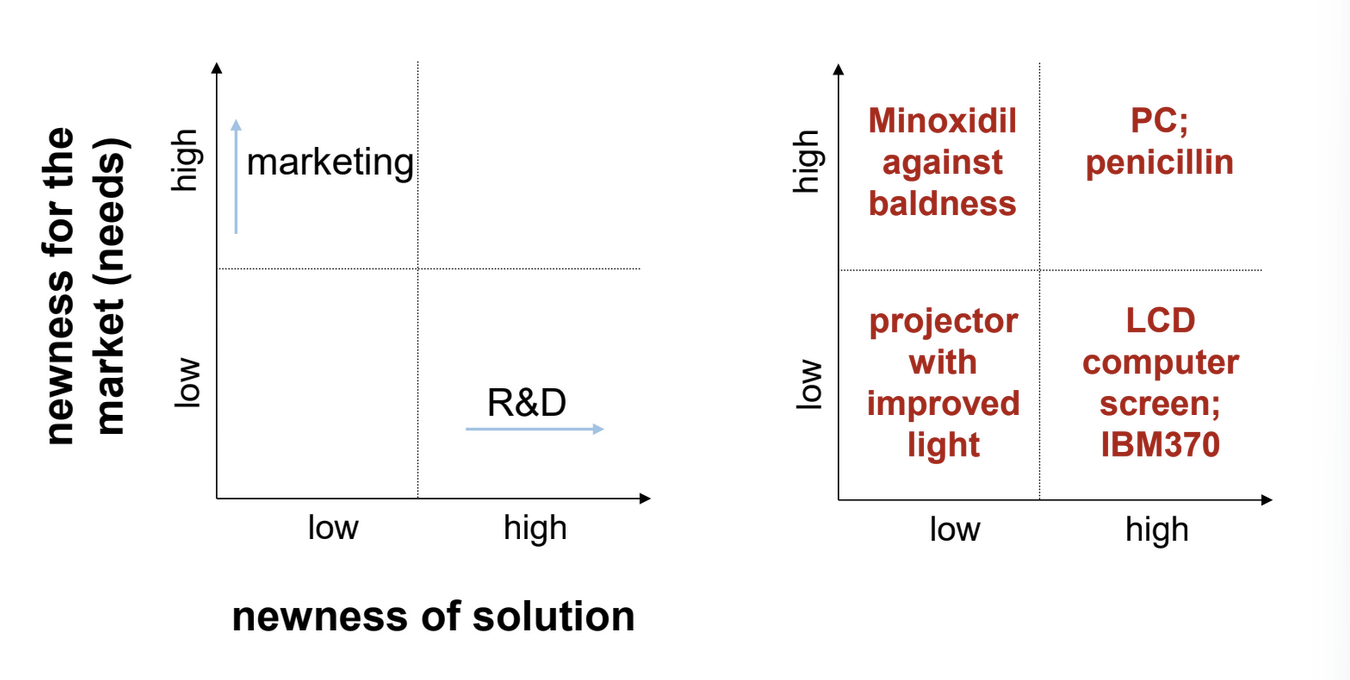
What are the three different types of innovation?
product/service
generate/increase sales
must be sold on the market
process
enable/improve production of goods/services
must be established inside the organization
business model
new ways to generate revenues
define value propositions for customers, suppliers, and partners
but it can be difficult to distinguish even without the business model complication
production and process innovation go together
production innovation for supplier can be process innovation for buyer
Why might low-tech solutions be better than high-tech?
e.g. mouse trap - most inventions never made money
most common design patented in 1899 and has remained unchanged since
if a solution works effectively, it doesn’t need to be changed
What is basic research?
experimental and theoretical work
to acquire new knowledge underlying foundations of phenomena and observable facts
without any particular application or use in view
What is applied research?
to acquire new knowledge
directed towards a specific practical aim
What is experimental development research?
based on existing knowledge
directed to producing, improving, and installing new materials, products, and services
Why does R&D matter?
economic and societal importance
OECD countries spend over a trillion dollars annually
3 million people work in R&D
products <5 years old account for 30% profits in high-performing firms, nearly half of all sales
total R&D expenditures
5-20% basic
funded by government
15-25% applied
65-85% experimental
funded by industry
concentrated in large firms
small firms → informal
What is the principal-agent problem?
extrinsic motivation: boss
intrinsic motivation: culture, interest
assymetric motivation between principal and agent leads to conflict of interest
inefficiencies and agency costs
agents may prioritize their own self-interest
solutions
performance-based compensation
monitoring & auditing
signaling & screening (agents provide proof of capability)
Why did the Vasa sink?
two gun decks
began to keel over as the center of mass was very high, making the ship unstable
nobody was condemned as the ship builder died meanwhile
nobody dared to voice concerns
What are the properties of technological change?
cumulative (minor changes stacked together) & evolutionary (incremental changes)
cumulative: electric car
evolutionary: mobile phone
discrete (single, standalone product) vs. complex (interconnected systems) technologies
discrete: pharmaceuticals
complex: penicillin → its invention lead to other antibiotics
not a smooth, automatic process (fits, spurts, and jumps)
e.g. electric lighting, AI technology
revolutionary → technological revolutions/ techno-economic paradigms (not all changes)
Why was the printing press a communication revolution?
Johannes Gutenberg (1452)
reading became accessible to common people
first use: Bible
consequences
mass education
loss of power of clergy
reformation
authorship
How did the spinning jenny lead to the industrial revolution?
James Hargreave (1765)
10x productivity improvement
mass production
industrialization
social upheaval → fear of unemployment
emergence of factories → mass production
new social class → factory workers
emergence of the idea of capitalism and communism
What is a general purpose technology?
a profound innovation so transformative that it disrupts and reshapes virtually every sector of the economy
examples
steam ships, railways
Cross-Atlantic transportation
telegraph, telephone, radio
Haber-Bosch process (ammonia from H & N → fertilizer)
internet
defense, universities, research BUT social effects?
How are the innovation shifts of techno-economic paradigms described?
Kondratiev long-waves (~50 years)
accelerating waves
capitalist development on technological change
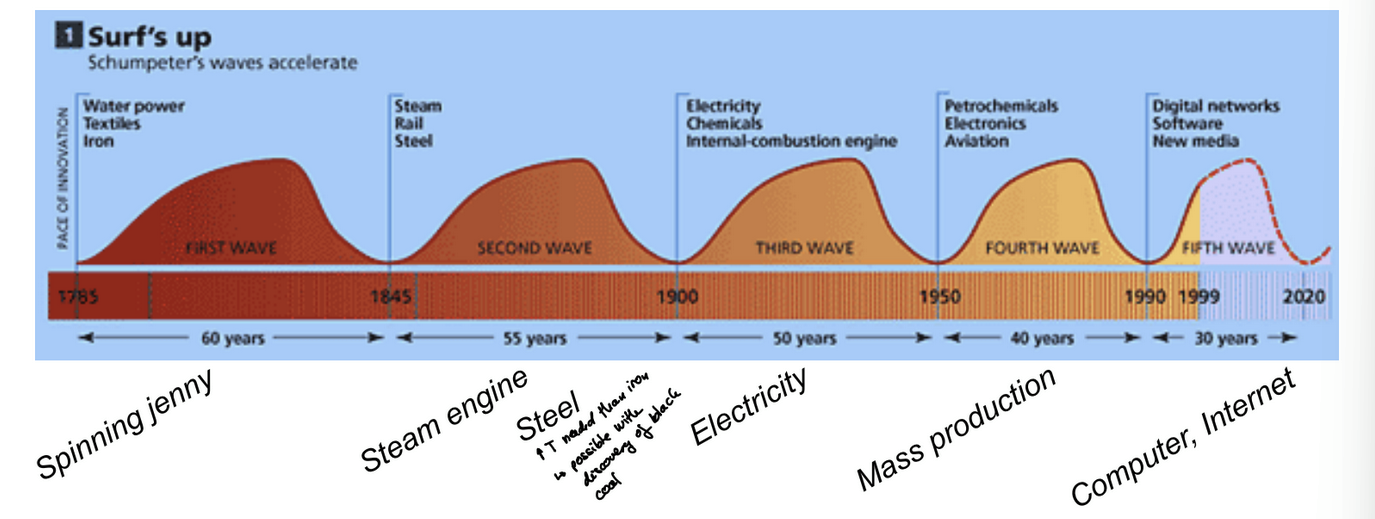
What are the consequences of techno-economic paradigms?
winners & losers: nations and firms
changes
capital stock
industrial relations
regulations, standards
(support universities)
new skill profile in the labor force
role of state: investment in strategic sectors (e.g. renewables) vs. profit
incentive using externalities or subsidies
goal: develop certain sectors to lay foundations for other innovations → spillover effect
competitiveness is based on
knowledge, creativity, learning → people
innovation, R&D → firm
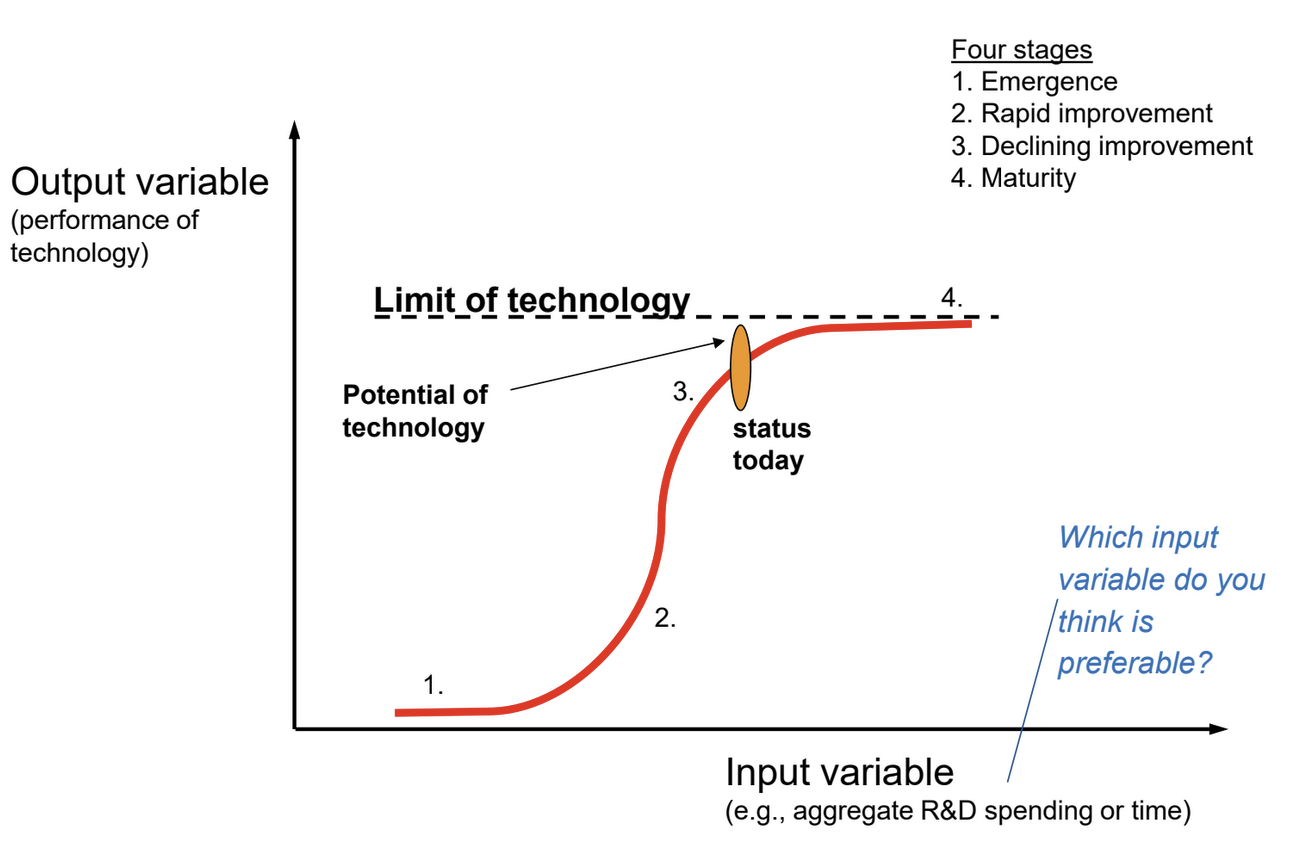
What does the S-curve describe?
lifecycle of a new technology, product, or industry
steps
emergence
rapid improvement
declining improvement → potential of technology
maturity
How does the development of two technologies relate to each other?
as one reaches its limits, the new one emerges
switch from the old technology to the new one as the old reaches the limits of its potential → requires monitoring
What are CVCs?
venture capitals from a firm with interests other than financial gains
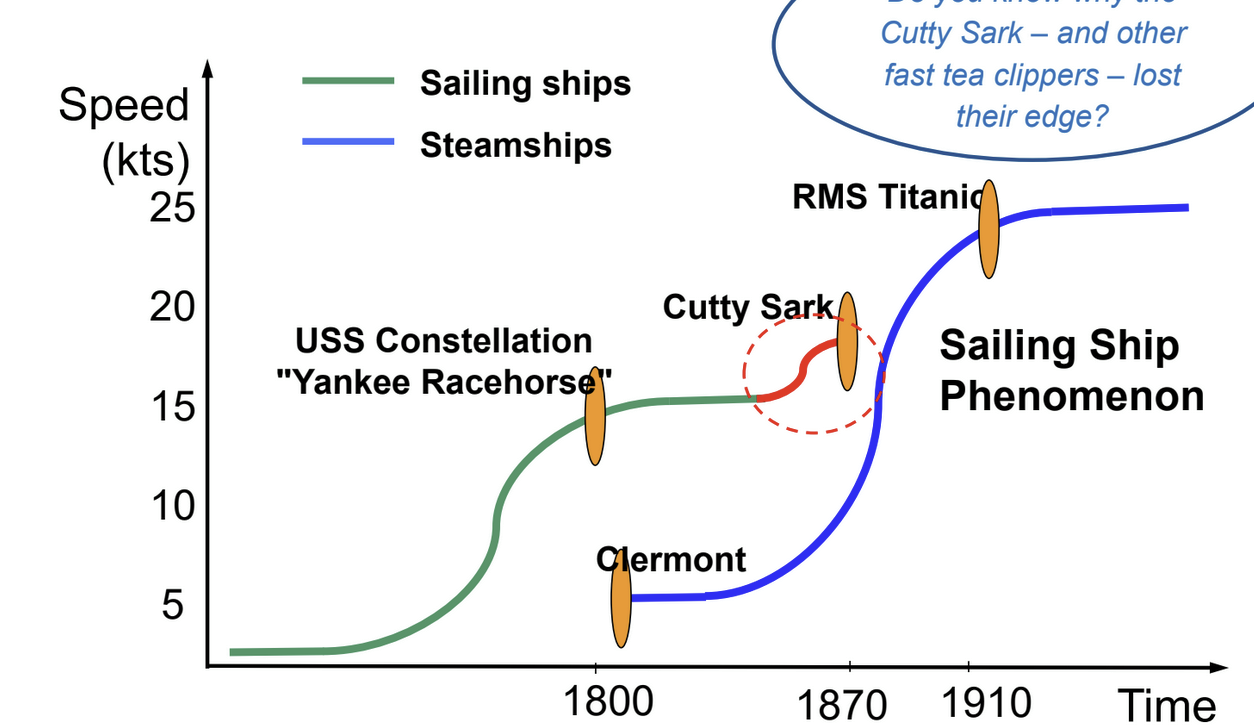
What is the sailing ship phenomenon?
sailing ships got replaced by steamships, but tea trader ships were still sailing ships known for their speed → last advantage for sailing ships
they became useless after the Suez Canal opened as they couldn’t go through
final spring: last attempt at improving a technology as a reaction to facing competition from a new technology
What are some typical problems of established companies?
currently used technology is over-estimated
R&D budgets are linked to revenues
misinterpretation of market signals due to biased attitude
lack of flexibility of historically grown organizational structures and cultures
How did the utilization of conveyor belts by Ford reshape the automobile industry?
process innovation
made it difficult for small firms to compete
high fixed costs for Ford gave them motivation for mass production → consolidation in the industry → ultimately car manufacturers dropped only to 9 until the 1940s
similar: space, large aircrafts, pharma
What are the three stages of the product life cycle?
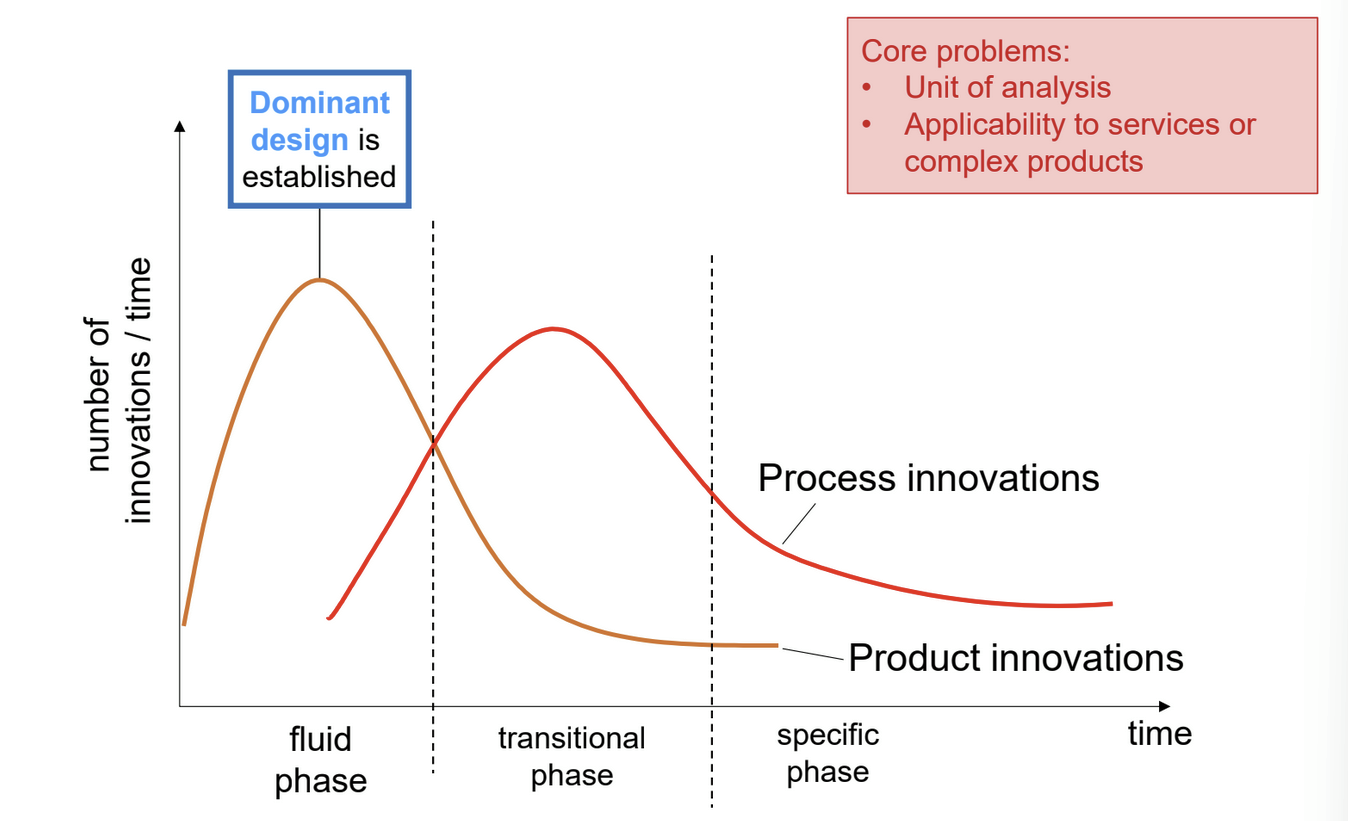
What are the properties of the first stage of the PLC?
fluid phase
Innovation: major product changes
Products: diverse design, often customized
R&D: unspecified focus, uncertainty
Plant: small, near users
Costs of process change: low
Basis for competition: product performance; more entries than exits
Vulnerabilities: imitators, successful breakthrough
Organizational control: informal, entrepreneurial
What are the properties of the second stage of the PLC?
transitional phase
Innovation: major process changes - rising demand
Products: one product, in volume → efficiency = higher fixed costs
R&D: focus on specific product features
Plant: general purpose, specialized locations
Costs of process change: medium
Basis for competition: product variation; exits = entries
Vulnerabilities: more efficient, higher-quality producers
Organizational control: project and task groups
What are the properties of the third stage of the PLC?
specific phase
Innovation: product - incremental, improvements - cumulative
Products: undifferentiated, standard
R&D: focus on incremental product technologies
Plant: large-scale, specific to product
Costs of process change: high
Basis for competition: price; more exists than entries
Vulnerabilities: innovations - superior product substitutes
Organizational control: structure, rules, goals
What are the 5 categories of Rogers’ Adopters?
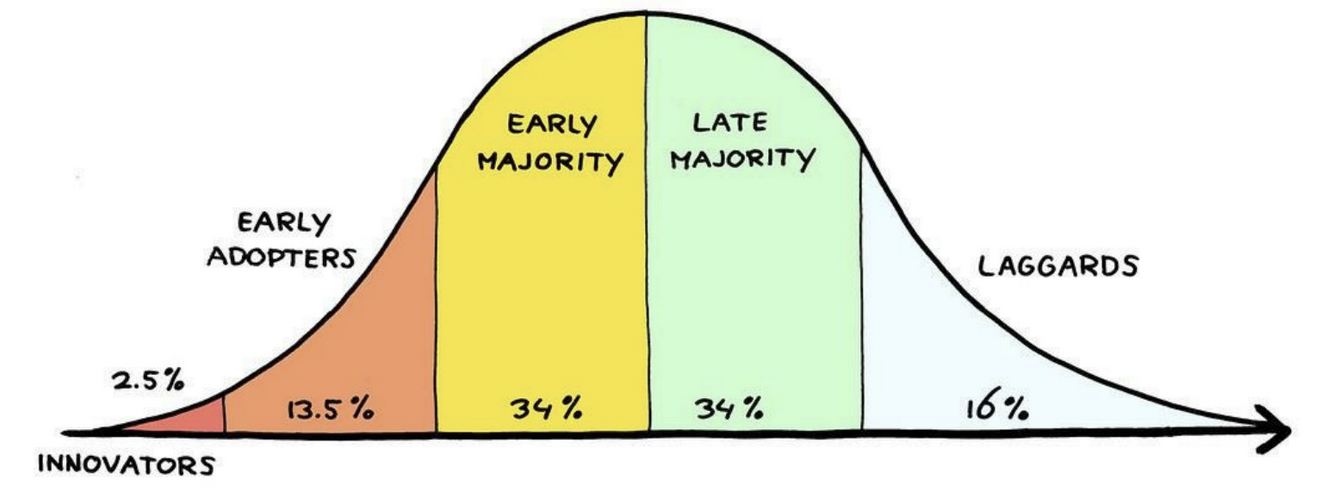
What describes innovators?
“venturesome”
active information seekers
cosmopolite (intercultural) social relationships
able to cope with a high degree of uncertainty
gatekeeping role in the flow of new ideas into a system
What describes early adopters?
opinion leaders
more integrated part of local social system than innovators
sought by change agents as a “local missionary”
decreases uncertainty about a new idea by adopting it (put “stamp of approval” on new idea)
What describes the early majority?
frequent interaction with peers
rarely hold positions of opinion leadership
third of all members
What describes the late majority?
adoption may be an economic necessity
or increasing peer pressure
system norms must favor the innovation
What describes the laggards?
near isolates in social network
the past is point of reference
limited resources
tend to be skeptical of innovations and change agents
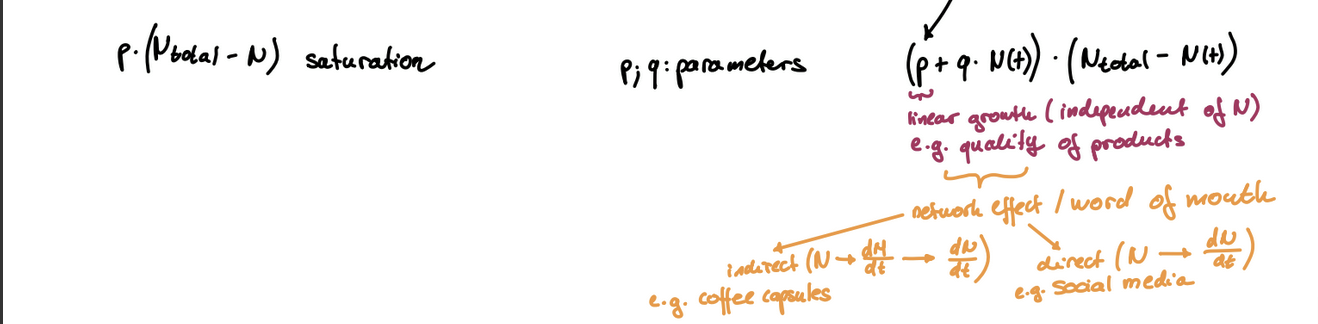
What model describes diffusion of innovations?
adoption behavior: N as a function of time: N(t) → differential equation
Why is there an issue with digital sovereignty in Europe?
very few companies from Europe
trade deficit between EU & US
US exploitation in ICT policy
Microsoft - Germany pays half a billion euros federally
What is sovereignty washing?
where non-EU Big Tech companies advertise themselves with European data centers → European legal immunity
companies headquartered in the US/China remain subject to foreign laws regardless of physical location
false sense of security for European organizations
What is Eurostack?
initiative for the EU to build its own sovereign digital infrastructure
cloud computing, AI, digital platforms
brings together tech, governance and funding
Why is the US and China in a better position for tech innovation?
US: many innovators, large capital
China: robotics
What halts the EU from technological innovation?
many regulations, but no vision on building
no hardware stack owned by Europe
Why are US solutions the standard?
easier to use, better ecosystem → better use experience
better financing systems → competitiveness in the global market
more push through demand and funding
“American by American” act
How can we incentivize the use of European solutions?
tenders: drive demand, find sovereign products
public good problem: enforce public institutions to buy local solutions → subsidies
What is the EU’s solution for a fragmented market?
Europe is one market but setting up companies across the EU is difficult for small companies
laws not aligned with entrepreneurial reality
“helplessness culture” → the EU Commission is slow
solution:
EU-INC → making one pan-European standard
state as anchor customer
What are the determinants of innovative activity?
costs and benefits
whoever stands to gain the most is more likely to innovate
whoever has the lowest cost
How can innovative activity be measured?
R&D expenses/ head count (pure imput)
number of patents
BUT: innovative success doesn’t equal activity
What does Schumpeter I describe?
entrepreneurs and new firms drive innovation
fragmented markets
What does Schumpeter II describe?
large firms drive innovation
markets with some monopoly power
Why are monopolies not beneficial for innovation?
no challenge for innovation
high prices exclude people from consumption
restricted output for profit maximization
What is Arrow’s basic neoclassical model?
competitive firms have a stronger incentive to innovate than monopolies
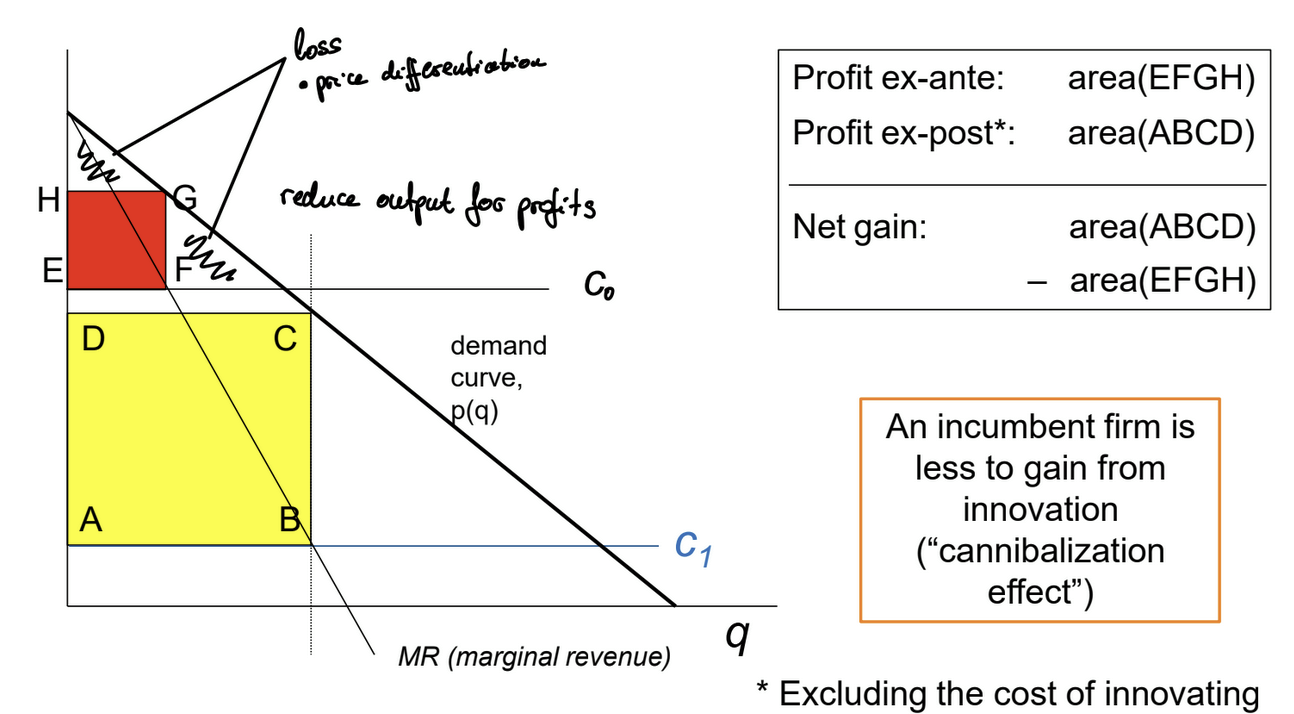
replacement effect: monopolist risks cannibalizing its own existing profits → weakens drive to invent
linear demand curve
constant marginal cost (c)
radical innovation reduces marginal cost to c1
only the innovator benefits (no spillover)
What happens in case of perfect competition (Arrow’s model)?
ex-ante perfect competition → ex-post monopoly
firms sell at marginal cost (c0) → no firm makes any profit
after innovation, the innovator has a lower marginal cost (c1) → can charge price below c0 → unrestricted monopoly
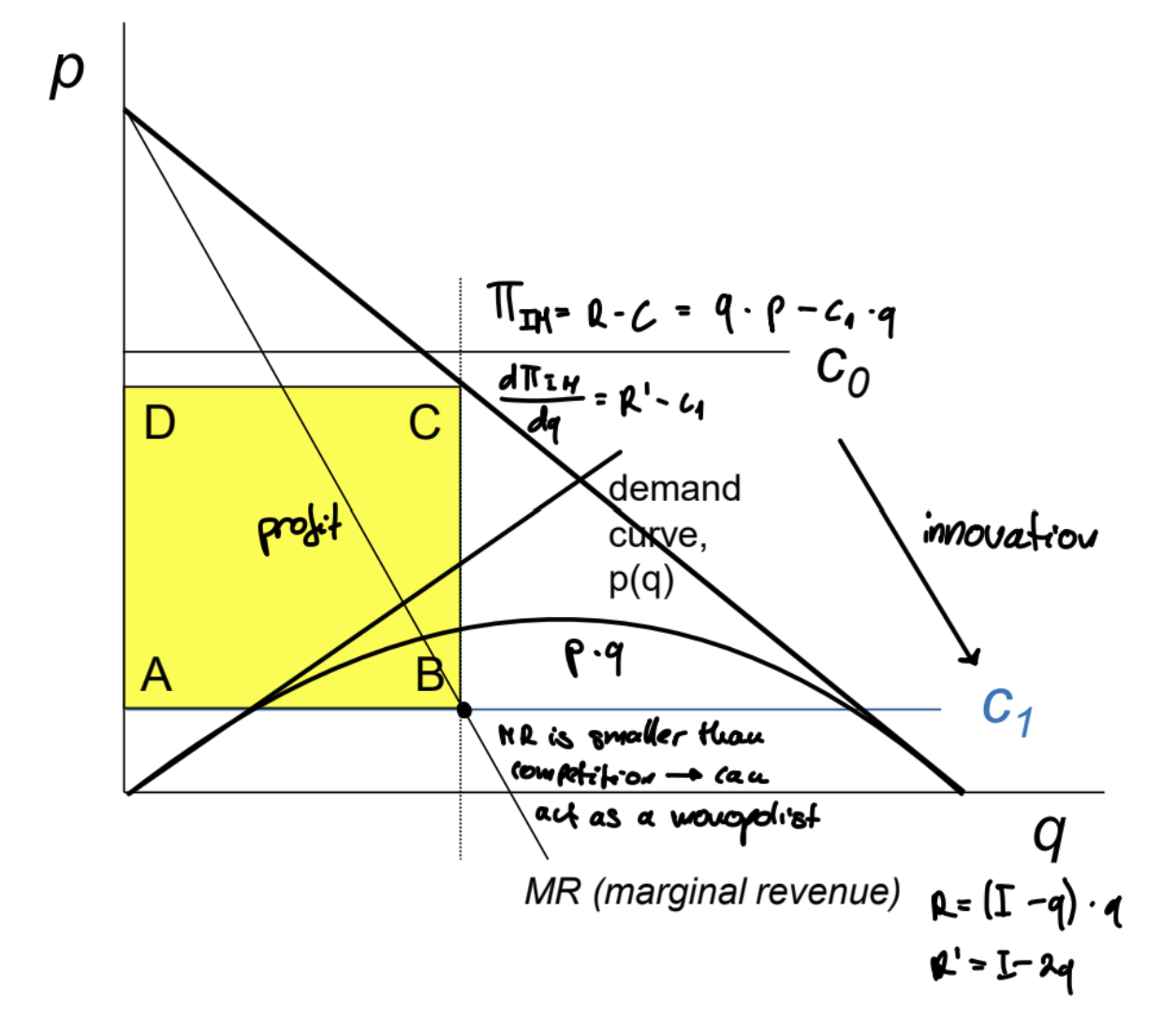
What happens in case of a monopoly (Arrow’s model)?
ex-ante monopoly → ex-post monopoly
monopolists reduce output for higher profits
a monopolists gains less from innovation than a competitive firm as it already has profits ex-ante → cannibalization effect
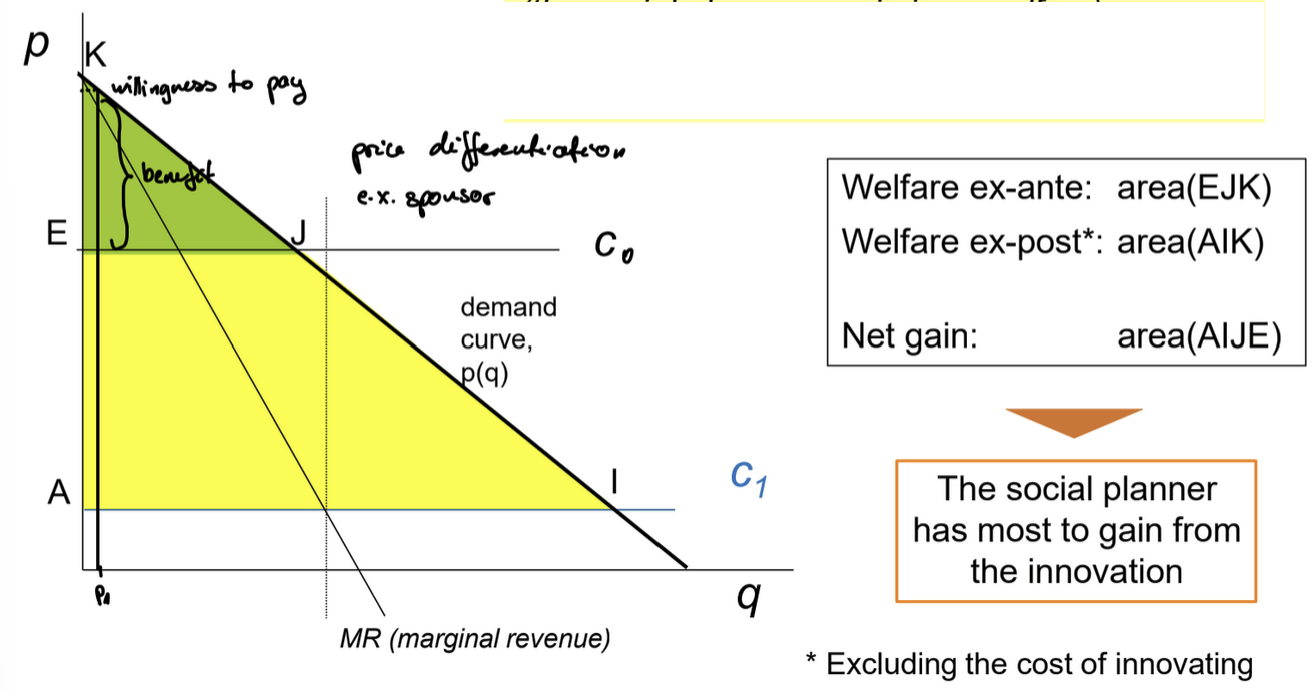
What happens in the perspective of a social planner (Arrow’s model)?
a social planner only cares about the welfare of a customer
Pareto-efficient outcomes
total welfare: only consumer surplus (including firm profits after innovation)
a social planner has the most to gain from innovation (their gain is welfare, not profit)
What is the Digital Markets Act about?
EU regulation that ensures fair and contestable (no competition but could be) digital markets
prevents large platforms from abusing their market power - gatekeepers
allows startups to compete fairly
provides consumers with more choices
What is the Digital Services Act about?
comprehensive regulation to make online platforms safer, more transparent, and more accountable
rules against illegal content
protect minors
ad transparency
content moderation → lower misinformation
non-personalized feeds have to be allowed
verified sellers
What is the efficiency effect?
the innovation is only slightly better than the existing products → incremental innovation
more attractive to remain a monopolist than to become a second player in a duopoly
What is the cannibalization effect?
the innovation is radical or drastic
by innovating, an existing firm would lose profits from an existing product
dastric innovations often come from new entrants, not incumbents
What are the liabilities of newness?
increased failure rates
roles & tasks have to be assigned (time, inefficiencies, conflicts)
lack of reputation and experience
relationships have to be established
rely on interactions among “strangers”
What are the advantages of new firms?
no path-dependence → willing to pursue new approaches
flexible company structure
open & flexible culture
can hire people that exactly match the tasks → no need for re-training
more flexible employees (younger, more entrepreneurial)
What are the liabilities of smallness?
larger failure rates
limited resources (financial, personnel)
low variety of skills in the firm → critical skills may be lacking
no buffer to survive times of crisis
disadvantage on the job market
low market power
little “organizational slack” for innovation/training
What are advantages of smallness?
more flexible processes
company structure easier to identify
direct communication
fast decision-making
higher job satisfaction
What are the market challenges of incumbents?
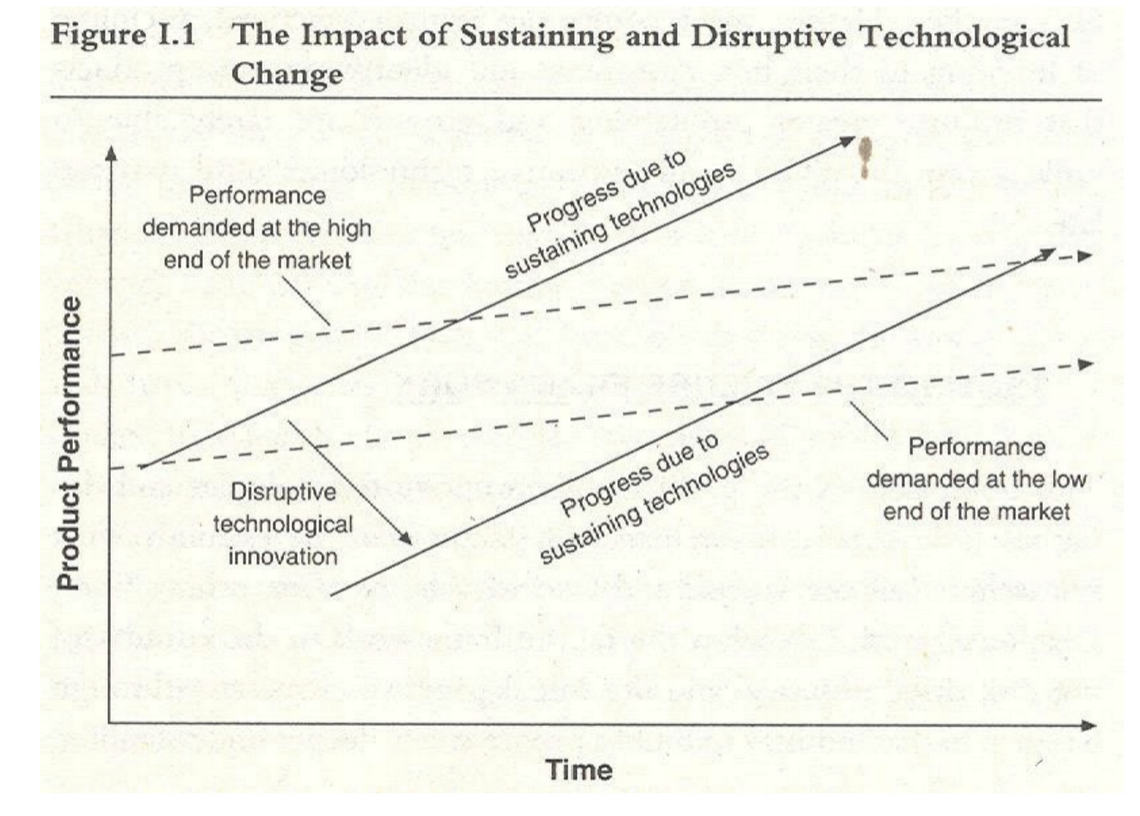
disruptive innovation by Clayton Christensen
innovations technologically straightforward
initially they do not satisfy customers in established markets → niche/new markets
performance of both established and new technology grows faster than market needs → new technology supplants the old even in the established, main market → disruptive technology
What are the advantages of incumbents against disruptive innovations?
complementary assets
distribution
complementary technologies
reputation, brand
What is a disruptive innovation?
where a smaller company with fewer resources successfully challenges established incumbent businesses
stem from structural gaps left by established incumbents
establishment from low-end or new-market footholds
if an innovation is disruptive, it can only be found out afterward
initially inferior products
What is strategy?
determination of long-term goals
allocation of resources to attain them
goal: establish long-term competitive advantage
taking reactions of competitors and other players into account
change of a strategy is very costly & not possible in the short run
What is economies of scale?
Produce 2x but not with 2x costs (e.x. machine was not at full capacity)
How are corporate strategies developed?
resource-based view (internal)
market-based view (external)
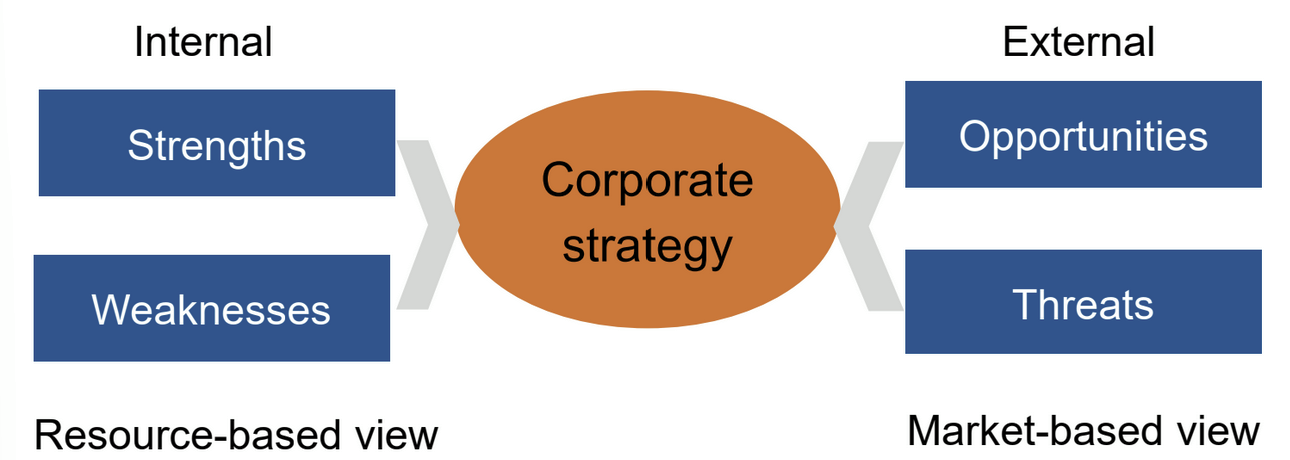
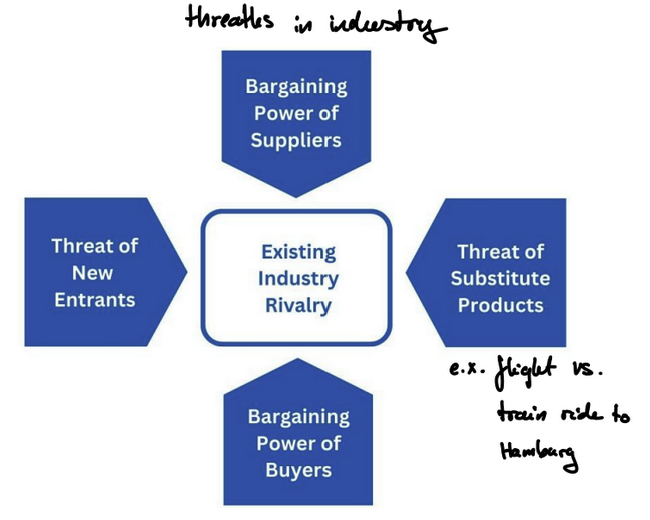
What is the market-based view according to Porter?
external perspective
firm success = function (environment)
strategic positioning to be developed based on the market environment
competitive advantage can be achieved by…
cost leadership
quality leadership → differentiation
focus (combination of both)
What is the resource-based view?
what properties do the resources and capabilities have to have
competitive advantage
valuable
rare
sustainable competitive advantage
+ inimitable (otherwise not long-lasting)
+ non-substitutable (e.x. method of production)
resources/capabilities are difficult to imitate when they are
tacit (understood/implied without being directly stated)
path dependent
socially complex
casually ambiguous (can’t determine causality)
protected by effective intellectual property rights
secrecy
unique by their nature
What resources are needed for innovation?
financial resources
human resources
technological resources (tangible & intangible)
marketing resources (ownership, value, markets)
organizational resources (routines, procedures and practices)
networking resources (partners, trust)
What are the core capabilities for sustainable competitive advantage?
organizational and managerial skills → resource organization & deployment
VRIN capabilities (valuable, rare, inimitable, non-substitutionable)
What are innovative capabilities?
searching: find opportunities
selecting
configuring: coordination & integration of innovation efforts
deploying: delivering on time & budget
learning: improving performance
What is dynamic capability?
capability to purposefully create, extend, modify existing resource base and capabilities
Why can extremely varying products be produced by the same company?
the underlying skills needed for production are relevant
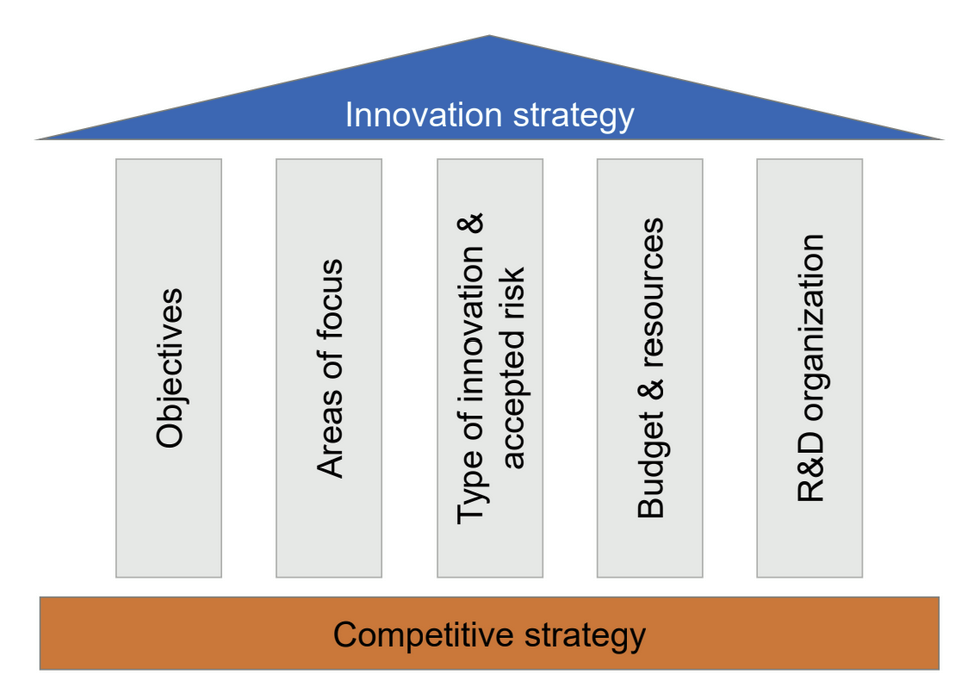
What are the key pillars of a successful innovation strategy?
tangible
cover all relevant dimensions
What are the three basic positions a firm can take under uncertainty?
take big bets → radical innovation
hedging bets → various investments, incremental innovation
wait & see → imitate others later
What is the benefit to decentralization of R&D?
innovation base close to market
access to local experts
competition among business units
What are the properties of a proactive innovation strategy?
objective: technological & market leadership
type of innovation: radical & incremental
risk acceptance: high-risk, big bets
knowledge sources: science, R&D, collaborations
Examples: Apple
What are the properties of an active innovation strategy?
objective: not first to innovate, but prepared to follow
type of innovation: mostly incremental
risk acceptance: medium to low-risk, hedge bets
knowledge sources: in-house R&D, collaborations
Examples: Microsoft, Dell
What are the properties of a reactive innovation strategy?
objective: wait & see, follow way behind
type of innovation: incremental
risk acceptance: low-risk
knowledge sources: competitors, customers
Examples: Ryanair
What are the properties of a passive innovation strategy?
objective: do what customers want
type of innovation: occasionally incremental
risk acceptance: no risk, no bets
knowledge sources: competitors, customers
Examples: Ratiopharm (generic drugs)
What are the advantages of being a first mover?
technology leadership
preemption of scarce assets (right to buy first)
switching costs - customers
network effects
buyer’s choice under uncertainty
What are the disadvantages of being a first mover?
free-rider effects
resolution of technical/market uncertainty
shifts in technology/customer needs
incumbent inertia (mature firm might struggle to adapt to a new environment)
What is a technology push?
develop a technology, then find ways to market it
create new demand
result of basic research
focus on what can be easily researched
problem of researchers, not the public → mismatch between innovation and corporate interest
e.x. AI in everyday life
What is market pull?
identify a need, then develop a solution
triggered by market
focus on easily identifiable needs, but with minor potential
market can only think of incremental improvements
attempts to solve a given problem
might be too focused on this particular application → obvious needs
e.x. larger battery life
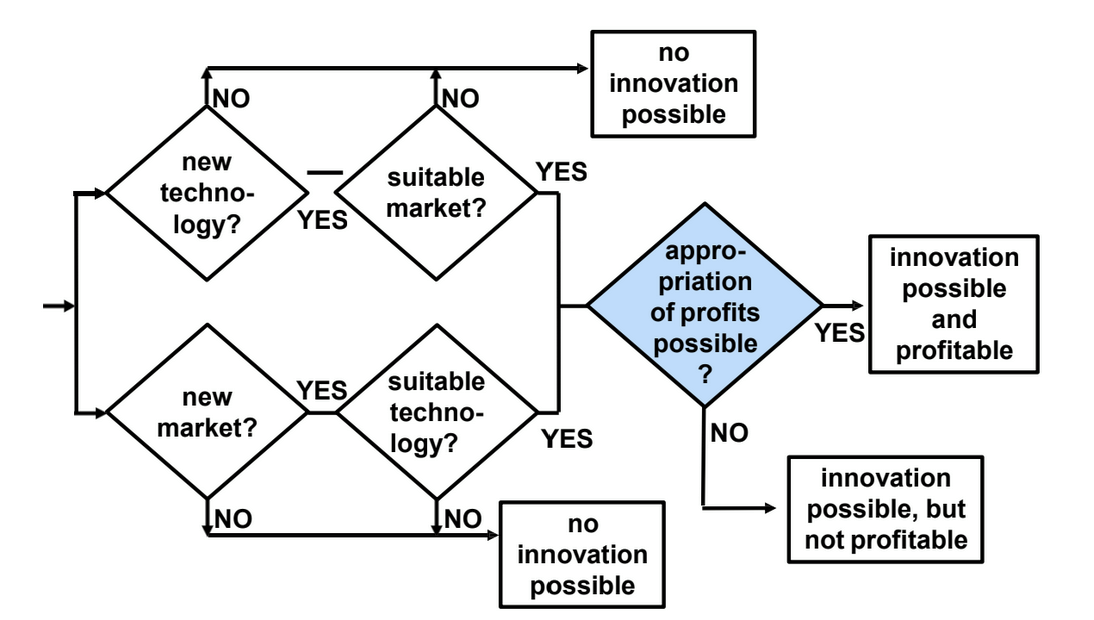
What are the generic conditions necessary for a profitable innovation?
Who benefits from innovation?
customers: when valuation of product exceeds its price
innovator: selling
imitators: saving on R&D
suppliers, complementors: selling large quantities
How do suppliers benefit from selling goods to innovators (simple model)?
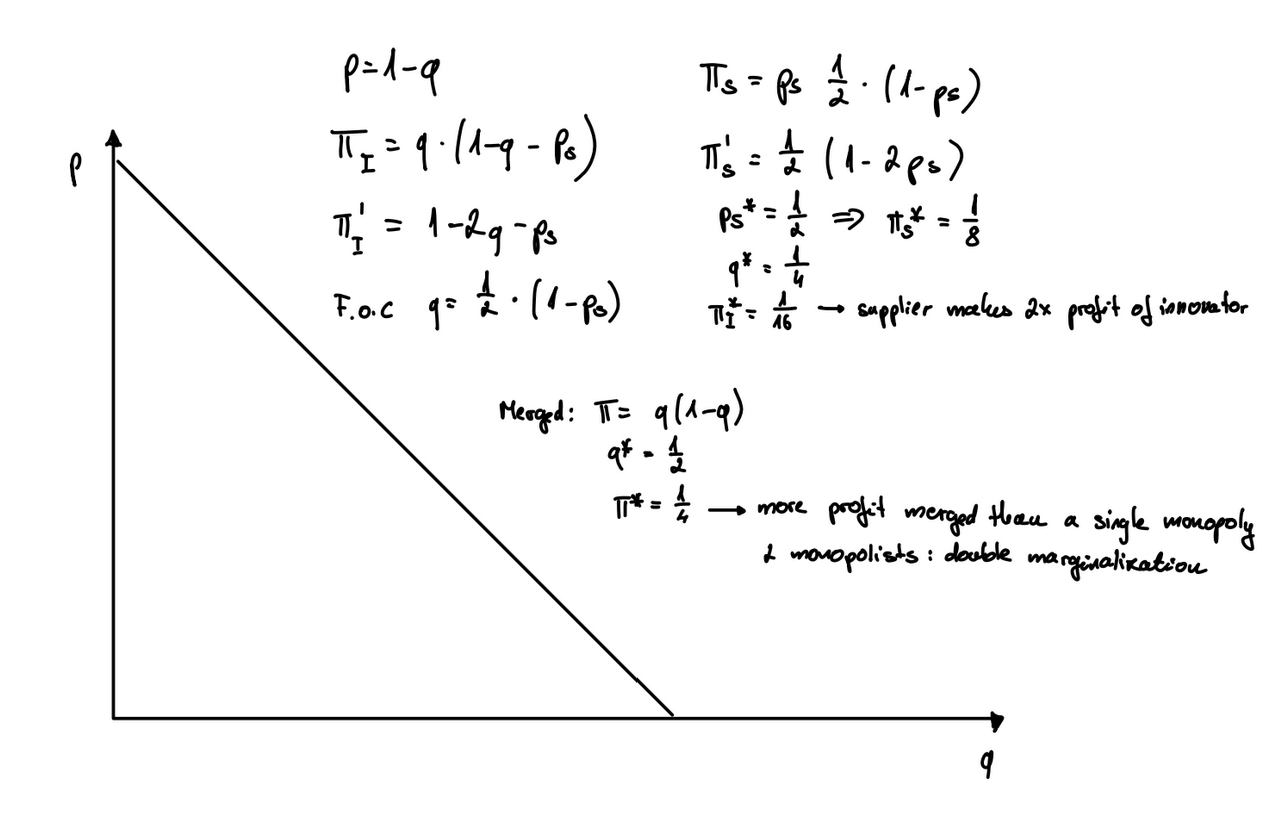
What are benefits of a customer in a monopoly and in competition?
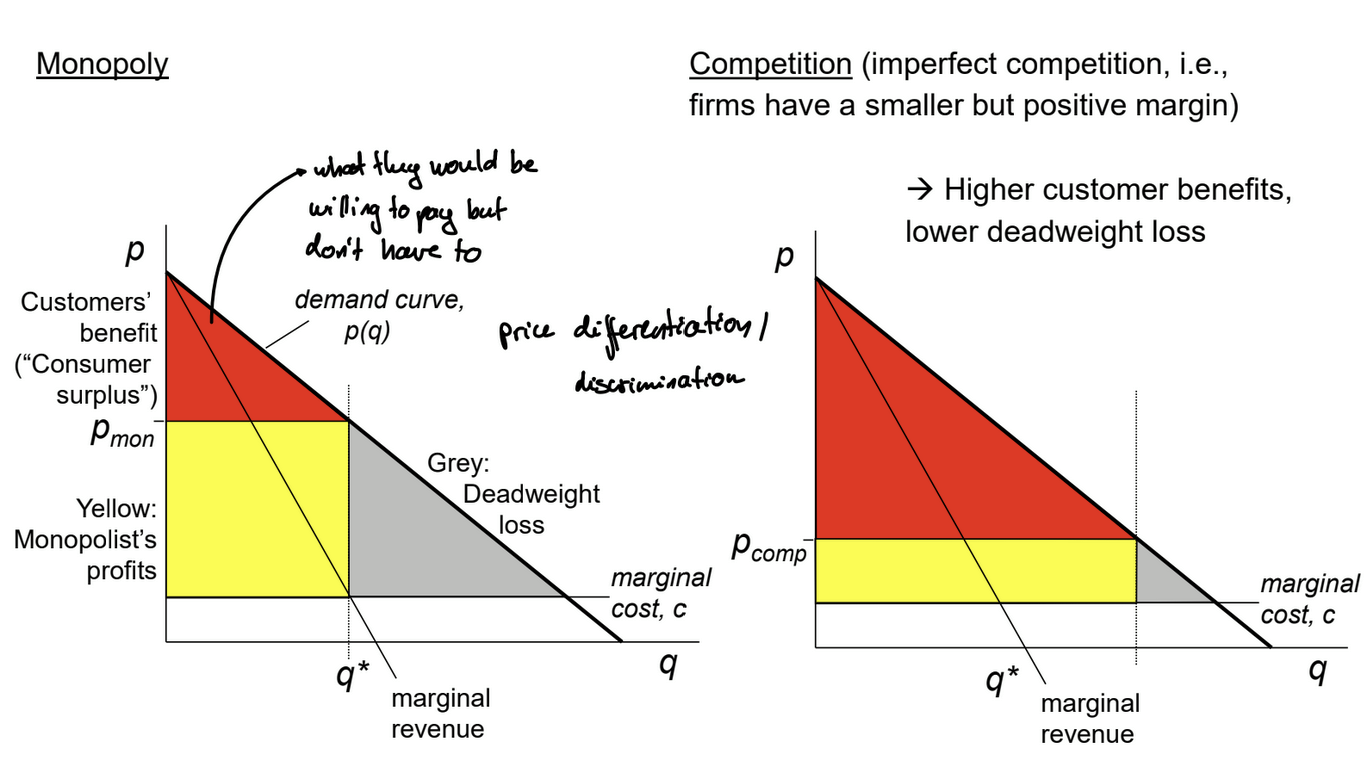
What three factors does the profitability of an innovator depend on?
appropriability regime (strong/weak)
life-cycle phase (pre-paradigmatic, paradigmatic - before & after universal framework)
complementary assets (generic, specialized, co-specialized)
What are appropriability conditions?
availability & strength of legal protection (pharma!)
viability of secrecy
characteristics of underlying technology (complexity)
network effects
switching costs
scale effects
ease of market entry
What are the three appropriability conditions, and what are some industries that it applies to?
Strong, patent protection (pharma, petrochemicals)
Strong, secrecy (tire, beverage, chemicals, ceramics, biotech)
Weak (software, apparel)
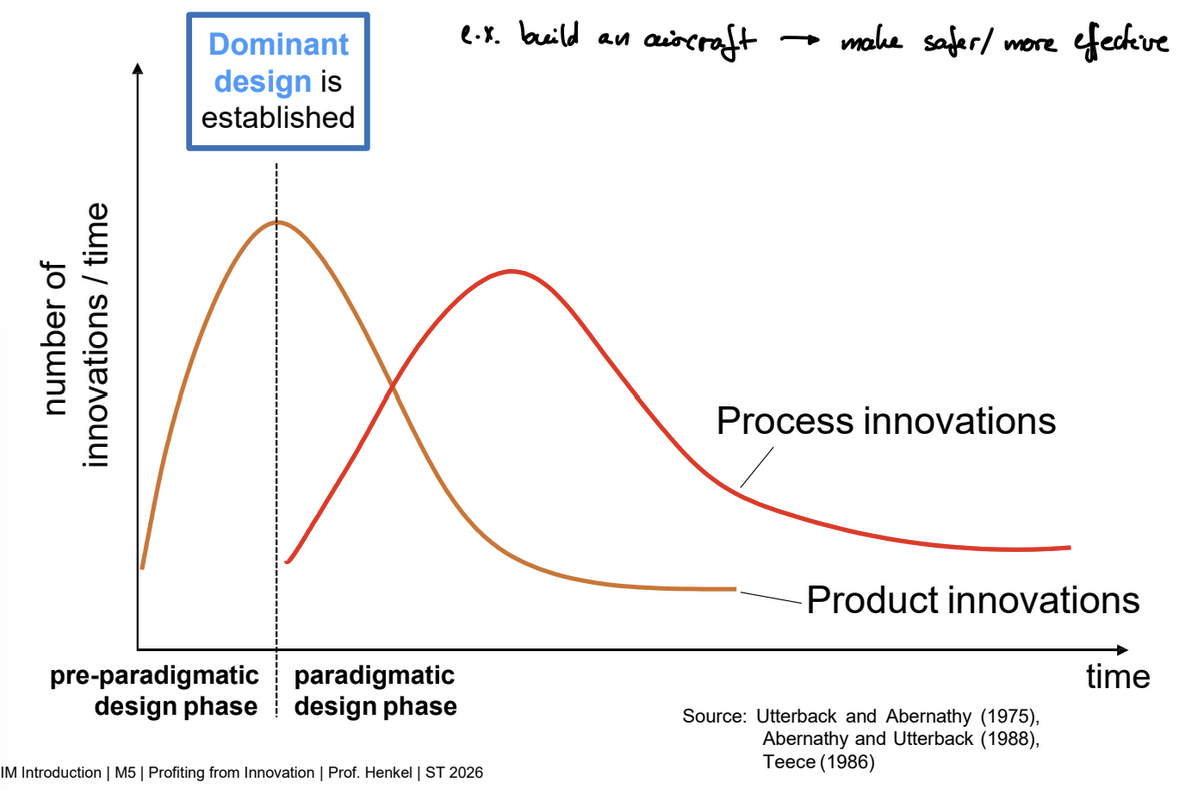
What is the difference between pre-paradigmatic, and paradigmatic design phases?
Pre-paradigmatic
dominant design not yet established
success depends on the ability to make the technology dominant
Paradigmatic
dominant design established
control complementary assets
What is the difficulty with appropriating profits from an expensive development?
large developmental and prototyping cost → limitation on design modifications
easy concept → easy to imitate for cheaper than development
failure: loss of reputation
What are the 5 most important complementary assets?
competitive manufacturing
distribution
service
complementary technologies
brand
core technological know-how