Derm FINAL Exam: Yamaki DMARD and RA (bolded+underlined)
 Call Kai
 Learn
Learn Practice Test
 Spaced Repetition
 Match
Match Flashcards
 Knowt Play
1/23

There's no tags or description
Looks like no tags are added yet.
Name | Mastery | Learn | Test | Matching | Spaced | Call with Kai | Chat |
|---|
No analytics yet
Send a link to your students to track their progress
24 Terms
Epidemiology of Rheumatoid Arthritis
Onset is 3rd to 4th decades of life, and prevalence increases with advancing age (Usually manifests ~______).
50 years
Etiology of RA
Immune cells, pro-inflammatory cytokines, and signaling pathway:
T cells (______ mediated)
B cells (______ mediated)
______, ______ and ______
______
cell, humoral, TNF, IL-1, IL-6, JAK
Rheumatoid Arthritis (RA)
Inflammatory polyarthritis, especially the ______ of the hands and feet.
Untreated chronic inflammation → joint erosions and joint destruction.
Need to treat to prevent ______
RA is characterized by:
autoantibody production [______, ______]; highly specific for RA
smaller joints, progression on destruction, RF, ACPA
Clinical S/Sxs
Slow but progressive
Stiffness is ______
Can decrease stiffness in the ______ with ______
worst in AM, AM, activity
S/Sxs
Untreated RA can go beyond joints and ultimately affect ______
organs
Diagnosis of RA
Score of ______ indicates RA
High Specificity for RA diagnosis: ______ and ______
6 or greater, RF, ACPA
General Principles in the Treatment of RA
______ treatment for ALL patients diagnosed with RA. (More aggressive than previous approaches decades ago)
Baseline testing before starting ______:
______ with differentials (cell counts)
______ (liver function tests)
______ (renal function)
Selection of ______ based on:
severity of RA & stage of RA (DMARDs naïve or experienced)
patient’s preference
insurance coverage
presence of adverse prognostic findings (______, other factors)
Anti-inflammatory (NSAIDS) or glucocorticoid therapy for ______ only (gap of onset)
______: Achieve and maintain tight control of disease activity, defined as remission or a state of low disease activity
Treatment failure defined as lack of ______, following ______ of ______ at optimal dosing
DMARD, DMARD, CBC, LFTs, BUN/SCr, DMARDs, comorbid conditions, bridging therapy, Treat to Target, remission/low disease activity, 3-6 months, DMARDs
DMARD naïve - Low vs High RA Activity
Level of RA activity will guide how to start treatment for patients ______ to patient specific factors
in addition
DMARDs
Non-Biologics
______ (______)
Hydroxychloroquine (Plaquienil)
Sulfasalazine (Azufidine)
Leflunomide (Arava)
ok to combine with each other, up to ______ therapy (non-b + non-b and non-b + biologic)
Biologics
-mab and -cept
Tofacitinib & Baricitinib (JAK/STAT kinase inhibitors) → technically not a biologic
do not combine biologic DMARDs with each other
Methotrexate, Trexal, triple
Methotrexate (MTX)
Anti-inflammatory and immunosuppressive action (______)
Given ______ PO or SQ, start with PO
SEs
LFT ______ (monitor for liver dysfunction)
______ of blood counts (monitor CBC)
Decreases ______ (take supplemental ______ 1mg PO daily)
Leucovorin (folinic acid) can be used if folic acid does not help
Potential to decrease MTX efficacy with ______ (avoid ______ administration PO/IV)
Contraindicated
Liver disease (severe)
______
Precautions
______ (AKI or CKD)
______
1st Line DOC for moderate/high, weekly, increases, suppression, folic acid, folic acid, Leucovorin, same day, Pregnancy, renal elimination, liver dysfunction
Hydroxychloroquine (HCQ)
Moderately effective ______
______
Side effects (well tolerated in general)
Rare (but serious): ______ (retinopathy) with long-term use with doses greater than 5 mg/kg
Patients should have a complete ______ done at baseline and every 5 years thereafter
alone for mild RA, Safe in pregnancy, retinal toxicity, eye exam
Sulfasalazine (SSZ)
______ (______)
______
SEs
GI upset (nausea and vomiting) may limit use, rash development
Serious:
Hepatitis- monitor LFTs
Leukopenia- monitor CBC
Agranulocytosis
onset, takes a long time, Safe in Pregnancy
Leflunomide (LEF)
SEs
Diarrhea is most commonly the limiting effect in treatment
______
______
Rash
Reversible alopecia
Rare but serious - ______ and ______
C/I
______ and carcinogenic in animal studies (______)
Liver toxicity, myelosuppression, interstitial lung disease, peripheral neuropathy, teratogenic, do not use in pregnancy
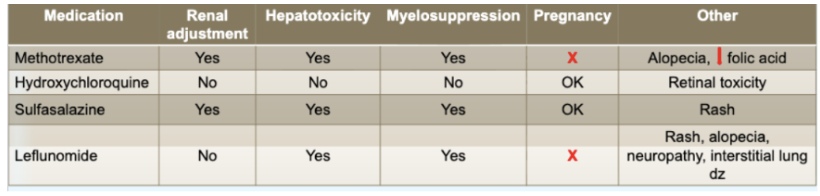
KNOW IMAGE
Do NOT combine ______ with each other
biologic DMARDs
TNF Inhibitors (EIACG) → Anti-TNF Biologics
TNF inhibitors: Etanercept, Infliximab, Adalimumab, Certolizumab, Golimumab
Common SEs (boxed warning):
______: URTI, pneumonia, UTI, skin and soft tissue infection
______: ______ (reactivation of latent disease), invasive fungal infections, reactivation of hepatitis B. ______ BEFORE STARTING!
______: lymphoma, nonmelanoma skin cancer
Warnings, precautions:
Not recommended in patients with ______, transient ______, and ______ dyscrasias
Infection, Opportunistic Infection, TB, must treat TB completely, Cancer, CHF, neutropenia, blood
T-Cell Co-Stimulatory Blockade
Abatacept Adverse Effects
Increased risk of ______ (mild to severe)
Pneumonia (esp. in patients with ______), opportunistic infections (less risk than TNFi’s)
TB cases have been ______, but screening is still recommended. (Can start if being treated currently for ______, preferred over ______)
infections, COPD, few, TB, TNFi
Interleukin-6 Inhibition
Tocilizumab (Actemra®) SEs
Increase risk of ______. (Can start if being treated currently for ______)
Increased risk of ______
infection and serious infection, TB, GI perforation
B-Cell Depletion
Rituximab Adverse Effects
Infections: ______ (______)
reactivation of viral infections, HepB
JAK Inhibitors
Precautions: ______
Warnings
______, serious infections (______, bacteria, invasive fungal, viral and opportunistic infections), lymphoma, ______, viral reactivation EBV & HSV.
______
Infections, Thrombosis, TB, malignancies, Do not use in pregnancy
Comparison of Biologics (and JAK/STATi) + ADRs
Infliximab, adalimumab, etanercept, etc. (TNF Inhibitors) → ______, ______ ______
Tocilizumab (IL-6 inhibitor) → ______
Tofacitinib / Baricitinib (JAK inhibitors) → ______
cancer, HF, exacerbation, GI perforation, Boxed Warning of VTE/PE
Treatment Goals
______ approach
Evaluate ______ for treatment success
Treatment Approach
Combo Traditional DMARDs → DMARD non-biologic
Preferred ______ over combo traditional DMARDs
TNF Inhibitors +/- MTX
Non-TNF Biologic +/- MTX
At this point >6 months
Treat to target, every 3 months, Now
Still Lack of Response/Improvement, Not at Target
______ (e.g., ______) or ______ added to ______ (1st line)
Still Lack of Response/Improvement, Not at target
Change to a different class of ______ e.g, ______ → ______ or ______
Add biologic DMARD, TNFi, JAK/STAT-i, MTX, Biologic, TNFi, non-TNFi, JAK/STAT-i
RA Remission/Low Activity
Approach if only on MTX → ______
If on MTX + biologic or JAKi, can start to gradually discontinue ______
Decrease dose (taper), MTX