Stage 1 visit 1 competencies
 Call Kai
 Learn
Learn Practice Test
 Spaced Repetition
 Match
Match Flashcards
 Knowt Play
1/51

There's no tags or description
Looks like no tags are added yet.
Name | Mastery | Learn | Test | Matching | Spaced | Call with Kai | Chat |
|---|
No analytics yet
Send a link to your students to track their progress
52 Terms
Glaucoma risk factors
-Older than 65 y/o, family history
-African, Asian, Hispanic descent
-Diabetes, myopia, ocular hypertension, sickle cell anaemia, hypertension, thin central cornea, had eye injury/surgery, taking corticosteroids for long time
Cataract risk factors
-Age, environmental, e.g: trauma, sun exposure, Heredity, diabetes mellitus, smoking & heavy alcohol, diet/obesity, infections drugs, down syndrome, disorders related to lipid metabolism, use of hyperbaric oxygenation, UV light, X-ray, obesity, poor nutrition, corticosteroids esp. high doses & long term.
-Hypertension, previous eye injury/surgery
Diabetes risk factors
-genetics, autoimmune problems, pregnancy, prolonged periods of stress, obesity
-lack of exercise, family history, smoking, hypertension, smoking, high cholesterol, South Asian/African descent
AMD risk factors
-Older individuals (over 60)
-White Americans/Caucasians
-Females
-Smoking
-Obesity
-Family history
-Cardiovascular disease
-Light coloured eyes
-Sun exposure
-Hypertension
Diabetic retinopathy risk factors
-Having diabetes for a long time
-Poor control of blood sugar level
-High blood pressure
-Pregnancy (gestational)
-Tobacco use
-Black, Hispanic, Native American
-Hyperlipidemia
-Nephropathy
Cataract treatment
-Referral considered if lifestyle impaired, not meeting driving standards etc.
-Update glasses
-Tints/sunglasses
-Lifestyle advice
-Magnifiers
-Surgery e.g. phacoemulsification
Cataract surgery
-Phacoemulsification
-Small surgical incision around the edge of the cornea, creating an opening through the membrane surrounding the lens.
-Inserting a small ultrasonic probe into the opening to break up the cloudy lens into tiny fragments using sound waves. An attachment on the probe tip is then used for suction of broken down cataract fragments.
-Once lens particles are removed, an intraocular lens is implanted in the natural lens capsule. A hollowed out tube is used to insert the IOL through a tiny corneal incision.
-include risks and benefits, make sure expectations aren't too high, still require glasses post operation
-takes around 20 mins, local anaesthetic numbs the eye, lots of drops to use 4-6 weeks after operation, may wear shield over eye for first night, px have company for first night
AMD treatment (mainly wet)
-Laser surgery (to destroy the fragile and leaky blood vessels)
-Photodynamic therapy (to destroy new blood vessels)
-Intraocular injection of anti-VEGF (Vascular Endothelial Growth Factor) e.g. Lucentis
AMD treatment
-Monitor closely- Amsler chart
-Determine risk for progression
-Healthy eating- kale, AREDS 2 formula, oily fish, red/green/yellow coloured foods, anti-oxidant rich foods
-Low vision aids/support groups
-Non optical aids/electronic aids
-Exercise
-UV protection- sunglasses
-Smoking cessation
AMD referral NICE
-Early AMD
-Confirm a diagnosis of early AMD using slit-lamp biomicroscopic fundus examination alone.
-Do not refer people with asymptomatic early AMD to hospital eye services for further diagnostic tests.
-Late AMD (dry)
-Confirm a diagnosis of late AMD (dry) using slit-lamp biomicroscopic fundus examination.
-Refer people with late AMD (dry) to hospital eye services only:
•for certification of sight impairment or
•if this is how people access low-vision services in the local pathway (see recommendation 1.6.5) or
•if they develop new visual symptoms that may suggest late AMD (wet active) or
•if it would help them to participate in research into new treatments for late AMD (dry).
-Late AMD (wet active)
-Urgent referral for people with suspected late AMD (wet active) to a macula service, whether or not they report any visual impairment. The referral should normally be made within 1 working day but does not need emergency referral.
-Offer optical coherence tomography (OCT) to people with suspected late AMD (wet active).
-Do not offer fundus fluorescein angiography (FFA) to people with suspected late AMD (wet active) if clinical examination and OCT exclude neovascularisation.
-Offer FFA to people with suspected late AMD (wet active) to confirm the diagnosis if OCT does not exclude neovascular disease.
-For eyes with confirmed late AMD (wet active) for which antiangiogenic treatment is recommended (see the section on pharmacological management of AMD), offer treatment as soon as possible (within 14 days of referral to the macular service).
Glaucoma treatment
-COAG- usually routine referral, referral refinement scheme, hospital eye service
-Urgent referral when clinical circumstances indicate (IOP >= 32mmHg), some advise 28
-Treatment options- Drops (as OHT), prostaglandin analogue drops, beta-blockers, carbonic anhydrase inhibitors, alpha agonists, miotics
-Surgery- selective laser trabeculoplasty, trabeculectomy, deep sclerectomy, tube surgery, cyclodiode laser
-POAG- generic prostaglandin analogue drops- advanced offer surgery (lower eye pressure and reduce sight loss risk)
-NTG- treat if evidence of progression or risk of symptomatic sight loss
-Same treatment as POAG but avoid beta blockers
-OHT- offer tx when IOP >= 24mmHg and at risk of visual impairment in lifetime (not at risk, monitor annually)
-Reduce eye pressure- eye drops, surgery, laser tx
PXF glaucoma treatment
-Optometric management- no sign of OHT or glaucoma- monitor annually
-IOP>=24 routine referral to specialist
-Signs of glaucoma (ONH changes, VF loss) refer to glaucoma specialist
-Secondary care- treated as COAG
-Higher IOP than COAG, tends to require surgery
Pigment dispersion glaucoma treatment
-Optometric- no sign of OHT or glaucoma- monitor annually
-Require ongoing monitoring due to increased risk of glaucoma
-IOP >= 24mmHg routine referral to specialist (low threshold for referral)
-Any sign of glaucoma (ONH changes, VF loss) refer to glaucoma specialist
-Secondary- treated as COAG
-IOP spikes accelerate progression
-Review more than COAG as higher risk of sight loss
Steroid induced glaucoma treatment
-Discuss with px cessation of steroids or alternative treatment
-Treat as per COAG
-Monitoring on start of steroids- baseline IOP prior to steroid use 2/52, then every 4/52 for 2/3 months, then 6/12 until cessation of therapy
Angle closure glaucoma treatment
-Acute angle closure-emergency referral- consider first aid treatment with G.Pilocarpine 1% (blue eyes) or 4% (brown E ye s) to cause pupil mitosis
-Subacute and chronic angle closure- urgent referral
-Van Herick Grade 1 or 2 refer for gonioscopy assessment
-Shallow anterior chamber and sx- haloes or blurring of vision (often in dim light conditions)
Angle closure glaucoma secondary care treatment
-PAC suspect- diagnosed on gonioscopy, annual gonio, YAG laser peripheral iridotomy, or iridectomy (less common)
-PAC/PACG- peripheral iridotomy, cataract/lens extraction, +/- pharmalogical therapy to reduce IOP
-Acute angle closure- oral acetazolamide (diamox) 500mg STAT dose (intravenous)- can cause nausea and other side effects
-YAG laser as soon as possible
-+/- mitotic, topical antihypertensives
-Px may be seen and discharged without tx- watch IOP, signs, sx
-Px may have PI and be discharged- low proportion go on to have angle closure- monitor routinely
Congenital glaucoma treatment
-surgery to open the aqueous humor outflow channels
-urgent referral- ON can recover after IOP stabilised
Diabetic retinopathy treatment
-Prevent hemorrhaging and resulting scarring (laser photo coagulation) and/or removal of cloudy vitreous humor due to hemorrhaging (vitrectomy)
-Control diabetes, eye injections for maculopathy, surgery to remove blood or scar tissue if too advanced for laser
-No DR- annual screening
-Background diabetic retinopathy- MA's, small dot/blot haems, exudates- annual screening/inform diabetes care
-Non-proliferative diabetic retinopathy- moderate to severe/multiple/deep dot/blot haems, venous beading, loop, re duplication, IRMA- refer to HES
-Proliferative diabetic retinopathy- new vessels disc (NVD), new vessels everywhere (NVE), pre-retinal or vitreous haem, pre-retinal fibrosis +/- fractional retinal detachment- fast track to HES
Maculopathy management DR
-No maculopathy- no exudates with MA's or haems within 1DD of fovea, VA> 6/12- annual screening
-Maculopathy- exudates within 1DD, group of exudates within the macula _ 2.5DD, VA < 6/12 + MA's within 1DD of centre of the macula (500 micrometres), retinal thickening within 1DD of fovea- refer to HES
Diabetic retinopathy secondary care
-General- px education, diabetic control optimised, control of other risk factors (systemic hypertension, hyperlipemia, smoking cessation)
-DMO- anti-VEGF, laser photocoagulation (focal or grid), pars plans vitrectomy
-Proliferative DR- panretinal photocoagulation, anti-VEGF
Blepharitis treatment
-wipe deposits with cotton wool or lid wipes
-lid scrub with baby shampoo
-lid massage to empty meibomian glands
-drops/ointment(make vision smeary but last longer)
-omega 3/fish oils
-remove contacts and disinfect/DDs advised
-2-3 weeks consistent
-Refractory cases
-topical antibiotics/steroids
-oral antibiotics- tetracycline
MGD treatment
-TX: topical abx, flaxseed/fish oils (improve oil consistency), hot compress + lid massage, artificial tears, lid scrub once a day (mild soap), effect of environment on tear evaporation
Dry eye treatment
-Stage 1- px education (condition, management, tax, prognosis)
-Modification of environment- desiccating conditions (car heater, lower screen height) and digital device use
-Omega-3 essential fatty acids (oily fish, nuts and seeds)
-Consider oral supplements (omega-3 and omega-6)
-Systemic and topical meds
-ocular lubricants- preservative free
-Lid hygiene- warm compress, massage and clean
-Stage 2- tear conservation, punctual occlusion, moisture chamber spectacles/goggles
-Overnight treatments- ointment, moisture chamber devices
-MGD treatment- meibomian gland expression, intense pulsed light therapy
-Prescription drugs- topical steroid course, oral tetracycline antibiotics
Stage 3- oral secretagogues, autologous/allogeneic serum eye drops, soft bandage CL, rigid scleral CL
Stage 4- long term corticosteroids, amniotic membrane grafts, surgical punctal occlusion, other surgical approaches (tarsorrhaphy, salivary gland transplantation)
Viral conjunctivitis treatment
-Cool compresses (symptomatic relief), ocular lubricants, painkillers
-Highly contagious- hand hygiene, clean equipment, temporarily avoid CL, contact lens cleaning, or disposal.
-Teach and change pillowcases daily, dispose of eye cosmetics. Do not share towels or hankerchiefs.
-Self limiting condition, 8-10 weeks to clear, usually no referral
-Refer urgently if pain, sight compromising corneal involvement, pseudomembrane
-Secondary care- viral culture (if antiviral found, then can be offered but not routinely)
-Topical antihistamines- severe itching
-Weak topical steroid- used with care (membranous or risk of scarring)
-Adenovirus necessitates 2 weeks off work/school
Bacterial conjunctivitis treatment
-Self limiting condition resolves 5-7 days for majority
-Highly contagious so give advice to reduce spreading it
-Bathe/clean the eyes with sterile wipes, lint, or cotton wool
-Cease CL wear until resolved
-May not need tx but chloramphenicol drops or ointment (drops 2 hourly for first 48 hours then 4 hourly for 5 days)
-CL wearers-risk of acanthamoeba- needs to be checked
-Conjunctival swab if resistant to treatment or recurrent
-Refer to clinic if severe
Chlamydia conjunctivitis treatment
-Optometric management- advice against CL wear
-Ocular lubricants
-Liase with GP/ophthalmologist
-GP/secondary care- lab tests to confirm diagnosis
-Systemic antibiotics- tetracyclines, macrolides, and some of the fluoroquinolones
-May need referral to Genitourinary clinic
Allergic Conjunctivitis treatment
-Allergen avoidance, cold compress, advise against rubbing
-Refer when corneal involvement, sight threatening disease, poor symptomatic relief
-Treatment- ocular lubricants (flush away antigens)
-Topical mast cell stabilisers e.g. Sodium Cromoglicate, lodoxamide
-Topical antihistamines e.g. antazloine
-Topical antihistamine (eyedrops that reduce histamine) + mast cell stabiliser (can take 2 weeks to be effective so use daily) e.g. olopatadine, ketotifen
-Topical NSAID e.g. diclofenac sodium
-Systemic antihistamine (more immediate and last 24H) e.g. cetirizine, loratadine
Diabetes
-A condition in which the body is unable to produce enough insulin, the hormone required for the metabolism of sugar
-Type 1- Generally younger than 40 years
-Caused by reduced or absent insulin production (autoimmune condition)
-Treatment: Insulin injections to sustain life
-Autoimmune destruction of pancreas beta cells
-Usually abrupt onset - classic symptoms (3 P's)
-Polyuria - increased urination, Polyphagia - increased appetite, Polydipsia - increased fluid intake
-Type 2- Usually over 40 years of age
-Caused by defect in beta cells of pancreas; reduced number of beta cells; insulin resistance
-Diet controlled - tablets - insulin
-Strong genetic predisposition
-Obesity common
-Onset insidious
-Type 3- specific type
-Secondary pancreatic disease, drugs and chemical agents
-Associated with insulin receptor abnormalities, genetic syndromes, miscellaneous conditions
-Type 4- Gestational
-Glucose intolerance during pregnancy
-Subsequently resolves in the great majority of cases
-Women with gestational diabetes have a higher risk of later developing diabetes
Diabetes complications
•Resulting rise in blood sugar levels leads to damage
•Blood vessels
•Nerves
•Serious if uncontrolled
•Complications: Heart disease, stroke, blindness, kidney disease and foot amputations
Cardiovascular disease
-A general term for all diseases of the heart and blood vessels.
-Stroke, heart failure, arrhythmia, heart valve complications, coronary heart disease.
-Effects the eyes by increasing risk of vision loss
-High blood pressure- can cause retinopathy, or damage to the eye's main blood supply. This can lead to bleeding in the eye, blurred vision, swelling, blood clots, damage to the nerve or even stroke in the retina with complete loss of vision.
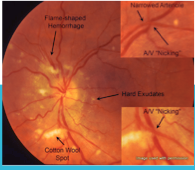
-Artery smaller than the vein, or the vein is a lot bigger and dilated, may indicate high blood pressure or cardiovascular risk factors.
-Blocked arteries- small emboli in the eye- can be coming either from an arteriosclerotic plaque in the carotid artery, which is the main artery that brings blood to the head and neck, or they can come from emboli in the heart.
-An arterial embolism occurs when an embolus has traveled through the arteries and become stuck in small vessels or organs like the brain or the retina. This can either restrict or block blood flow, which can result in tissue damage, a stroke, blindness or even death.
-Diabetes- high blood sugar can bring about problems in the small blood vessels. If this occurs, a patient is at risk for developing diabetic retinopathy, which can lead to blindness and issues of the heart and kidneys. Diabetes also is linked to heart disease
Inflammatory disease
-Disease that results from the body's reaction to a localized injurious agent
-Systemic inflammatory diseases that cause arthritis and inflammation in other parts of the body can also be detected. Many of these conditions can cause eye inflammation and can result in pain and redness and vision loss. Dry eye, for example, is commonly associated with these conditions. If severe and left untreated, it can cause damage to the cornea, the dome-shaped, clear surface of the eye.
-Examples of inflammatory diseases include allergy, asthma, autoimmune diseases, coeliac disease, diabetes, arthiritis, glomerulonephritis, hepatitis, inflammatory bowel disease, preperfusion injury and transplant rejection
Data Protection Act (2018)
-This law regulates how personal information is used and protects against misuse of personal details.
-Facilitate the secure transfer of information within the European Union.
-Prevent people or organisations from holding and using inaccurate information on individuals. This applies to information regarding both private lives or business.
-Give the public confidence about how business's can use their personal information.
-Provide data subjects with the legal right to check the information businesses hold about them. They can also request for the data controller to destroy it.
-Give data subjects greater control over how data controllers handle their data.
-Place emphasis on accountability. This requires businesses to have processes in place that demonstrate how they're securely handling data.
-Require firms to keep people's personal data safe and secure. Data controllers must ensure that it is not misused.
-Require the data user or holder to register with the Information Commissioner.
Data Protection Act 1998
-The UK law that tells organisations how they must protect the personal data of real people.
· Principle 1 - Fair and Lawful
· Principle 2 - Purposes
· Principle 3 - Adequacy
· Principle 4 - Accuracy
· Principle 5 - Retention
· Principle 6 - Rights
· Principle 7 - Security
· Principle 8 - International transfers

General Data Protection Regulation of the European Union (GDPR)
-Toughest privacy and security law in the world. Though it was drafted and passed by the European Union (EU), it imposes obligations onto organizations anywhere, so long as they target or collect data related to people in the EU.
-Lawfulness, fairness and transparency — Processing must be lawful, fair, and transparent to the data subject.
-Purpose limitation — You must process data for the legitimate purposes specified explicitly to the data subject when you collected it.
-Data minimization — You should collect and process only as much data as absolutely necessary for the purposes specified.
-Accuracy — You must keep personal data accurate and up to date.
-Storage limitation — You may only store personally identifying data for as long as necessary for the specified purpose.
-Integrity and confidentiality — Processing must be done in such a way as to ensure appropriate security, integrity, and confidentiality (e.g. by using encryption).
-Accountability — The data controller is responsible for being able to demonstrate GDPR compliance with all of these principles.
Specsavers roles
-Optometrist- correct sight, detect eye diseases, abnormalities or problems related to general health. Make a health assessment, offer clinical advice, prescribe spectacles or contact lenses and refer patients for further treatment, when necessary
-Pre-reg optometrist- conducting eye examinations, contact lens assessments and aftercare appointment and dispensing spectacles under supervision.
-Shop floor manager- Manage people on shop floor, manage customer service, in charge of financial progress, inspiring staff and leading
-Optical assistant/advisor- Advise on frames and lenses, dispensing glasses, pre-screening, explaining offers. Works under supervision in an optical practice to assist people with choosing frames and lenses.
-Dispensing optician- fits and supplies the most appropriate spectacles after taking account of each patient's visual, lifestyle and vocational needs. Also advising and dispensing low vision aids to those who are partially sighted as well as advising on and dispensing to children where appropriate. They are also able to fit and provide aftercare for contact lenses after undergoing further specialist training
-CL optician- trained and qualified to fit, and provide aftercare for, patients with contact lenses. Assess whether contact lenses meet the needs of the person, resolving clinical and tolerance issues
-Assistant store manager- works with the store manager to organize, plan and implement strategies. They also coordinate retail store operations and ensure employees meet store schedules and objectives
CCG
-Have a statutory responsibility for commissioning most NHS services including urgent and emergency care, acute care, mental health services and community services.
-Commissioning organisations formed from general medical practices and fundamentally old Primary Care Trusts (PCTs).
LOC
-Formed to be the official representatives for all GOS contractors and practitioners within their area and to work with their local CCGs on matters relating to NHS optical services. A well-run LOC is a major asset to the local optical community, NHS and local authorities and the public alike.
GOC Standards
1 Listen to patients and ensure that they are at the heart of the decisions made about their care
2 Communicate effectively with your patients
3 Obtain valid consent
4 Show care and compassion for your patients
5 Keep your knowledge and skills up to date
6 Recognise, and work within, your limits of competence
7 Conduct appropriate assessments, examinations, treatments and referrals
8 Maintain adequate patient records
9 Ensure that supervision is undertaken appropriately and complies with the law
10 Work collaboratively with colleagues in the interests of patients
11 Protect and safeguard patients, colleagues and others from harm
12 Ensure a safe environment for your patients
13 Show respect and fairness to others and do not discriminate
14 Maintain confidentiality and respect your patients' privacy
15 Maintain appropriate boundaries with others
16 Be honest and trustworthy
17 Do not damage the reputation of your profession through your conduct
18 Respond to complaints effectively
19 Be candid when things have gone wrong
Hypertension
-Abnormally high blood pressure- pressure against the blood vessel walls in your body is consistently too high. The heart has to work harder to pump blood.
-Measurement of the pressure or force of blood pushing against blood vessel walls.
-Sx can go unnoticed or experience headaches, shortness of breath etc.

Hypertension risk factors
-Have family members who have high blood pressure, cardiovascular disease or diabetes.
-Are of African descent.
-Are older than 55.
-Are overweight.
-Don't get enough exercise.
-Eat foods high in sodium (salt).
-Smoke or use tobacco products.
-Are a heavy drinker
How hypertension damages the eye?
-Damage to the blood vessels in the retina (retinopathy). Damage to the blood vessels in the light-sensitive tissue at the back of the eye (retina) can lead to bleeding in the eye, blurred vision and complete loss of vision. Having diabetes in addition to high blood pressure increase the risk of retinopathy.
-Fluid buildup under the retina (choroidopathy). Choroidopathy can result in distorted vision or sometimes scarring that impairs vision.
-Nerve damage (optic neuropathy). Blocked blood flow can damage the optic nerve, leading to bleeding within the eye or vision loss.
Hypertensive retinopathy
-Hypertensive retinopathy is retinal vascular damage caused by hypertension. Signs usually develop late in the disease. Funduscopic examination shows arteriolar constriction, arteriovenous nicking, vascular wall changes, flame-shaped hemorrhages, cotton-wool spots, yellow hard exudates, and optic disc edema
-Sx- double vision, headaches, reduced vision, blood vessel bursting
-Tx- regular BP checks and control HBP
Artherosclerosis
Hardening and narrowing of the arteries due to buildup of cholesterol plaques
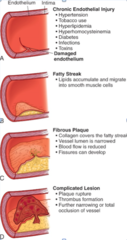
Arteriosclerosis
Abnormal hardening of the walls of an artery or arteries

Arthirits
-Common condition that causes pain and swelling (inflammation) in the joints
Keratometry
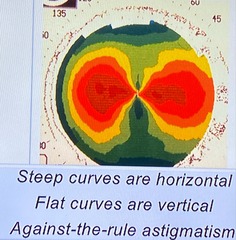
-Measurement of the corneal curvature (steepness or flatness); corneal curvature determines the power of the cornea.
-Differences in power across the cornea (opposite meridians) results in astigmatism; therefore, keratometry measures astigmatism.
-Measures front surface corneal radii.
-Assesses integrity of cornea and tear film.

With the rule astigmatism
The vertical corneal meridian has the steepest curvature

Against the rule astigmatism
The horizontal meridian has the steepest curvature
Prescription only medicine
These can only be supplied on the authority of a prescription signed by an authorised prescriber e.g. doctor, nurse independent prescriber, vet, supplementary prescriber or pharmacist independent prescriber.
Pharmacy medicine
These medicines aren't included in the GSL or POMS list. Only available from registered pharmacists and can only be sold under the supervision of a pharmacist. They'll ask questions before supplying them.
General Sales List
-Medication which may be bought from retail shops, such as a newsagent, a supermarket, or a vending machine in a shop
-Where the hazard to health, the risk of misuse, or the need to take special precautions in handling is small and where wider sale would be a convenience to the purchaser
Freeform lenses