Neurons
 Studied by 1 person
 Call Kai
 Learn
Learn Practice Test
 Spaced Repetition
 Match
Match Flashcards
 Knowt Play
1/13

Name | Mastery | Learn | Test | Matching | Spaced |
|---|
No study sessions yet.
14 Terms
Explain the parts of a neuron
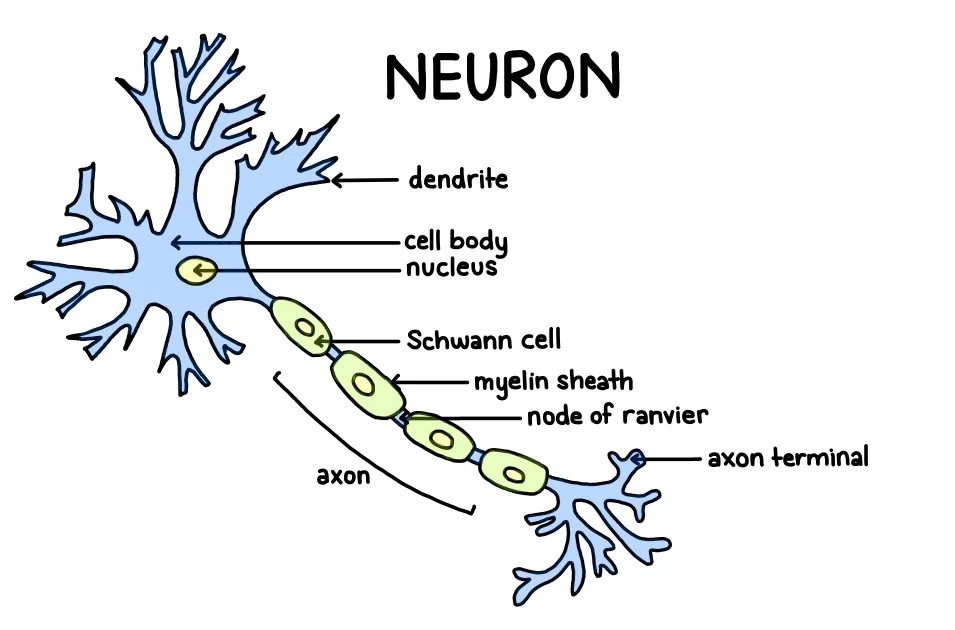
Sensory input
Transmits information about external stimuli and internal conditions
Interneurons
integrate sensory input they form the local circuits that connect neurons in the brain or ganglia
Motor neurons
transmit signal to muscle cells causing them to contract
How is resting potential maintained?
by having a polarized cell. the Cell body is negatively charged and the outside is positively charged. the sodiumpotasium pump removes 3 Na and brings in 3 K maintain the insdie negative. Potassium is the main source of resting potential since ther is a constant outflow of it
What are the five stages of action potential
resting
Reaching thershold
rising phase of action potential
fall phase of action potential
undershoot
Resting
sodium and potassium gated ion channels are close
Reaching Thershold
depolirizing membrane sodium ion gated channel opens up potassium channels stay closed. Sodium rushes in once enough rushes in thershold is reached and triggers an action potential.
Rising Phase of Action Potential
more sodium gated ion channels open causing more sodium to rush in causing the cell body to become positive
Falling Phase of Action Potential
sodium gated ion channels inactivated, preventing sodium from flowing through. Most potassium channels open letting potassion outflow making the inside of the cell negative again
Undershoot
Sodium channels close, potassium channels are still opening. As potassium channels close sodium channels unblock. sodium potassium pump returns neuron to resting potential
How does action potential rush down the axon?
It creates a wave of depolarization don the axon with Na rushing in and potassium rushing out.
What speeds up action potential?
Larger diameter allows the signal to move faster. There is a myeline sheath that increases its diameter which causes the signal to jump between nodes.
How do neurons communicated with each other?
The action potential at the end of the synaptic terminal causes chemical changes. These changes open up calcium-gated ion channels that secrete calcium into the synapse. The calcium goes into the axon, causing the vesicle to fuse with the membrane and diffuse neurotransmitters across the synapse and attach to a receptor on the other side (another cell body). This may induce an action potential in the receiving cell