Astrophysics
 Call Kai
 Learn
Learn Practice Test
 Spaced Repetition
 Match
Match Flashcards
 Knowt Play
1/21

There's no tags or description
Looks like no tags are added yet.
Name | Mastery | Learn | Test | Matching | Spaced | Call with Kai | Chat |
|---|
No analytics yet
Send a link to your students to track their progress
22 Terms
Unit for Gravitational Field Strength
Newton per Kilogram (N/kg)
Universe
large collection of billions of galaxies
Galaxy
large collection of billions of stars
Our Solar System
Milky Way Galaxy
Explain Variations in Gravitational Field Strength
earth's gravitational field strength is different than that on other planets and the moon
larger mass → greater gravitational field strength
smaller radius → greater gravitational field strength at surface
Gravitational Force causes:
moon to orbit planets
planets to orbit the sun
artificial satellites to orbit the Earth
comets to orbit the Sun
Differences in Orbits
comet: very elliptical
planets: elliptical
moon: circular
Orbital Speed Equation
orbital speed = (2 x π x orbital radius)/ time period
v = (2 x π x r)/ T
Classification of Stars According to Colours
star's colour is related to its surface temperature
hot stars looks blue, medium stars looks yellow, cooler stars look red.
OBAFGKM (hottest to coldest) - Oh Be A Fine Guy, Kiss Me
Evolution of Stars of Similar Mass to Sun
Nebula → Main Sequence Star → Red Giant → White Dwarf Star
Process of Evolution of Stars from Nebula to Main Sequence Star
nebula is cloud of dust
gravity causes cloud to collapse
temperature of cloud increases
hydrogen atoms in nebula move towards each other due to gravitational force
KE store increases, increase temperature
nuclear fusion of hydrogen starts
becomes main sequence star
Process of Evolution of Stars from Main Sequence Star to White Dwarf
fuses H into He in core
outward pressure from fusion balances inward gravitational force — star is stable
hydrogen in core runs out
core contracts and heats up
outer layers expand and cool
becomes a red giant
helium fuses into heavier elements in core
core becomes white dwarf
Evolution of Stars with Mass Larger than Sun
Main Sequence Star → Red Supergiant → Supernova
Nebula → Neutron Star or Black Hole
Process of Evolution of Stars with Mass Larger than Sun
fusion stops in core of main sequence star
core collapses (increases temp in layer surrounding core)
restarts fusion in core
star contracts, surface temp decreases
star becomes red supergiant
fusion of heavier elements stops in core
star explodes as supernova
core collapses to form a neutron star or black hole
Absolute Magnitude
brightness of star at standard distance
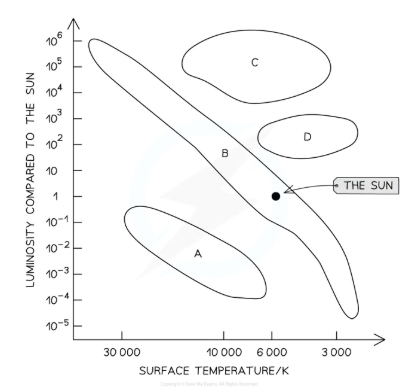
Hertzsprung-Russel Diagram
A → White Dwarfs
B → Main Sequence
C → Giants
D → Supergiants
Big Bang Theory
expansion (of space)
continuing (expansion)
from very hot/dense start
from a point
origin of Universe
Evidence Supporting Big Bang Theory
Red-Shift
Cosmic Microwave Background (CMB) Radiation
Red-Shift of Galaxies
change in frequency or wavelength of radiation
wavelength increased/ frequency decreased
as star moves away (from us)
big bang has expanding universe
with galaxies moving away (from each other)
further the galaxy is (from Earth), the greater the red-shift;
larger redshift means faster movement of galaxies
the further away, the faster the galaxy moves away
galaxies moving apart from each other implies expansion from a single point or since the Big Bang;
CMB Radiation
radiation that comes from all over the sky
the Big Bang theory has a initial explosion
that releases radiation
CMBR appears to be the same in all directions / is everywhere
(which) implies all parts of the Universe were in contact a long time ago
wavelength has increased (as the universe has expanded);
Universe was (significantly) hotter long ago;
Doppler Effect
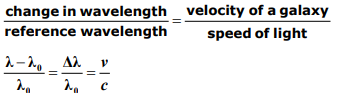
Relationship between Change in Wavelength and Reference Wavelength
Red-Shift in Light Received from Galaxies at Different Distances
light shifted to red end of specctrum
light waves stretched so wavelength increases
black lines move to red end