Bio Quiz 1 Multiple Choice
 Call Kai
 Learn
Learn Practice Test
 Spaced Repetition
 Match
Match Flashcards
 Knowt Play
1/63

There's no tags or description
Looks like no tags are added yet.
Name | Mastery | Learn | Test | Matching | Spaced | Call with Kai | Chat |
|---|
No analytics yet
Send a link to your students to track their progress
64 Terms
peer review
What is the name for the formal process through which scientific research is checked for originality, significance, and quality before being accepted into scientific literature?
They are not made of cells (They are made up of DNA or RNA surrounded by a protein coat.)
Why are viruses not considered living?
a nucleus containing DNA
What is a characteristic that is NOT present in all living things?
biosphere, ecosystem, community, population, organism
Which of the following sequences represents the hierarchy of biological organization from the most inclusive to the least complex level?
hydrogen atom, water molecule, skin cell, liver, elephant, wolf pack, tropical rainforest, planet Earth
Consider the levels of organization of the biological world and place each of these items in order from smallest level of organization to most encompassing: skin cell, elephant, water molecule, planet Earth, tropical rainforest, hydrogen atom, wolf pack, liver.
2, 1, 5, 4, 6, 3
Although the scientific method is used by most of the sciences, it can also be applied to everyday situations. A situation is given below. Using the scientific method try to arrange the given steps in the correct order. Situation:

A sequence of rRNA
What scientific evidence was used by Carl Woese to determine there should be a separate domain for Archaea?
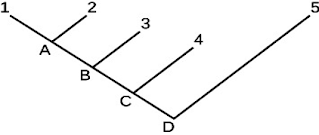
5 (5 diverged from the main branch much earlier than the rest of the organisms)
In the phylogenetic tree shown, which organism is most distantly related to 2?

No (prokaryotes do not contain mitochondria or any other membrane-bound organelles)
Do all living things (or organisms) contain a mitochondria?
Yes
Are all prokaryotes unicellular?
Yes
Can eukaryotes be either unicellular or multicellular?
An open area in the cytoplasm called the nucleoid that has no protective membrane
What do prokaryotes have instead of a nucleus?
All living organisms store genetic material in DNA/RNA.
What structure/function is conserved in all organisms (in other words, found in all living things) and points to a common origin?
B (because B is the base of 1 and 3)
In the diagram shown which is the most recent common ancestor of 1 and 3?
Isotopes (they have the same number of protons but differ in the number of neutrons)
What are atoms that vary in the number of neutrons found in their nuclei called?
ions with opposite charges
What forms ionic bonds?
nonpolar covalent bonds
Atoms that share electrons equally create what bonds?
ion
An atom or molecule that has a net electrical charge because it has an unequal number of protons and electrons (could be either positive or negative charge)
polar covalent bonds
Atoms that share electrons unequally create what type of bonds?
mass number - atomic number
neutrons is calculated by
54
If xenon has an atomic number of 54 and a mass number of 108, how many neutrons does it have?
Shells 1, 2 and 3 are full, and shell 4 has one electron
Potassium has an atomic number of 19. What is its electron configuration?
In aqueous HCl, the hydrogen atom acquires a partial positive charge, and the chlorine atom acquires a partial negative charge.
(higher electronegativity=partial negative charge; lower electronegativity=partial positive charge)
Based on the information provided, which of the following statements is true?

covalent bonds (life is built on carbon, which forms 4 covalent bonds)
Are covalent bonds or ionic bonds more common in living organisms?
hydrogen bonds
Relatively weak non-covalent chemical bonds driven largely by electrostatic forces. (weak because the slight positive charge is only loosely attracted to a nearby negative region, making the bond much easier to pull apart)
Hydrogen bonds and van der Waals interactions form weak associations between and/or within molecules, providing the necessary shape and structure of DNA and proteins to function in the body.
Why are hydrogen bonds and van der Waals interactions necessary for cells?
The mass number and atomic number of carbon-13 is 13 and 6, while that of carbon-12 is 12 and 6, respectively.
List the mass number and atomic number of carbon-12 and carbon-13, respectively.
mass numbers and amount of neutrons
isotopes have differing what
atomic number
number of protons equals the
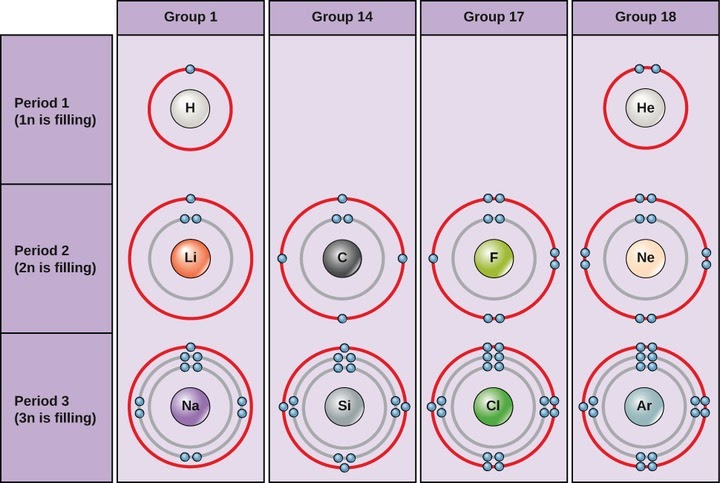
Group 1 and Group 17 (Group 1 has one valence electron, so to obtain a stable configuration, it will donate the electron readily. Group 17 has 7 electrons in its valence shell. In order to obtain a stable configuration, it will accept one electron readily.)
Looking at the figure, can you infer which two groups together will form a strong ionic bond? (the atoms in the columns are separate, think of them as each individuals)
the pH of the solution decreases
What happens to the pH of a solution when acids are added?
base
In a solution, what kind of molecule BINDS TO excess hydrogen ions?
H+ ions
Do acids increase H+ or OH- ions in a solution?
OH- ions
Do bases increase H+ or OH- ions in a solution?
adhesion
the attraction between water molecules and other molecules (such as when water is exposed to charged surfaces it forms a strong adhesive force)
have no partial charges at all
nonpolar covalent bonds
Oxygen is more electronegative than hydrogen, generating a partial negative charge near the oxygen atoms.
Why do hydrogen and oxygen form polar covalent bonds within water molecules?
Yes
Can acids and bases neutralize each other?
Yes
Can both acids and bases change the pH of a solution?
No (gases like nitrogen and oxygen are much more prevalent)
Is water the most abundant molecule in the Earth’s atmosphere?
The pH scale ranges from 0 to 14, where anything below 7 is acidic and above 7 is alkaline. The bicarbonate system in the human body buffers the blood.
Describe the pH scale and how it relates to living systems. Give an example of how drastic pH changes are prevented in living systems.
Buffers absorb excess hydrogen and hydroxide ions to prevent increases or decrease in pH. An example is the bicarbonate system in human body.
Discuss how buffers help prevent drastic swings in pH.
First, the lower density of water as a solid versus a liquid allows ice to float, forming an insulating surface layer for aquatic life (the water molecules are pushed farther apart compared to liquid water). Second, the high specific heat capacity of water insulates aquatic life or bodily fluids from temperature changes. Third, the high heat of vaporization of water allows animals to cool themselves by sweating (While a single hydrogen bond is weak, the massive, constant network in liquid water requires a large amount of thermal energy to break and pull the molecules apart into gas or vapor)
What are three examples of how the characteristics of water are important in maintaining life?
cohesion
the attraction between the water molecules, which helps create surface tension
heat of vaporization
the amount of energy required to convert liquid into gas.
specific heat capacity
the amount of heat one gram of a substance must absorb or lose to change its temperature by 1 °C
Its high specific heat capacity (warm-blooded animals use water to more evenly disperse heat in their bodies. It takes a large amount of energy to heat or cool water.)
Why can water be a good insulator within the body of endothermic (warm-blooded) animals?
protons (atomic number)
electrons=
mass number - atomic number
neutrons=
No, viruses contain either DNA or RNA
Do viruses contain both DNA and RNA?
4
What is the maximum number of atoms or molecules a single carbon atom can bond with?
True
To be enantiomers, a molecule must have at least four different atoms or groups connected to a central carbon

True
Molecules need a double bond - not a single bond -to form cis-trans isomers
carbons are on opposite sides of a double bond
trans configuration
carbons are on the same side of a double bond
cis configuration
methyl
Which of the following functional groups is nonpolar?
enantiomers
Molecules that share the same chemical bonds but are mirror images of each other
sodium (Sodium is not a functional group; it is an element. Thus, it does not bond with carbon as a functional group.
Which of the following is not a functional group that can bond with carbon?
Saturated triglycerides contain single bonds and are solids at room temperature, while unsaturated triglycerides contain double bonds and are liquids at room temperature.
Compare and contrast saturated and unsaturated triglycerides.
Carbon can form up to four covalent bonds, allowing it to form long chains.
What property of carbon makes it essential for organic life?
Carboxyl groups release H^+, making its parent molecule hydrophilic, because release the positive H ions leaves behind a negative electrical charge. It is found amino acids and fatty acids.
What property of carboxyl makes carboxyl containing molecules hydrophilic? Which macromolecules contain carboxyl?
hydrophilic (water-loving)
polar =
hydrophobic (water-repellent)
nonpolar =