AP Bio Unit 1- Chemistry of Life
 Call Kai
 Learn
Learn Practice Test
 Spaced Repetition
 Match
Match Flashcards
 Knowt Play
1/62

There's no tags or description
Looks like no tags are added yet.
Name | Mastery | Learn | Test | Matching | Spaced | Call with Kai | Chat |
|---|
No analytics yet
Send a link to your students to track their progress
63 Terms
matter
anything that has mass and occupies space. made of elements.
what elements does the macromolecule carbohydrates contain?
C, H, O
what elements does the macromolecule protein contain?
C, H, O, N
what elements does the macromolecule nucleic acids (DNA) contain?
C, H, O, N, P
what elements does the macromolecule lipids contain?
C, H, O
atom
smallest part of an element. building block of matter. contains P+, N=, and E-.
valence electrons
outermost electrons in an atom that interact with other atoms.
octet rule
outermost shell of an atom is the most stable with 8 electrons. atoms are always searching for a complete outer level.
cation vs anion
cation = positively charged, metals, lose electrons. anion = negatively charged, non-metals, gain electrons
molecule vs compound
molecule= two or more elements bonded together. compound= two or more different elements bonded together.
chemical reaction
bond forming/breaking
ionic bond
electrons transferred from one atom to another. oppositely charged ions are attracted to one another.
covalent bonds
when two atoms share electrons. nonmetals.
in polar covalent bonds, electrons are shared ____ between atoms.
unequally. ex: water is polar because oxygen and hydrogen don’t want the electrons the same amount.
in nonpolar covalent bonds, electrons are shared ____ between atoms
equally. ex: O2
electronegativity
the ability of an atom to attract electrons towards itself. some atoms want electrons more than others (to satisfy the octet rule)
_____ tend to be electronegative. (metals or nonmetals)
nonmetals
pH
measure of hydrogen concentration in a solution
acids
acids dissociate in water, releasing hydrogen. hydrogen increases.
bases
bases either take up hydrogen or release hydroxide (OH-)… hydrogen decreases.
buffer
a chemical or combination of chemicals that keeps pH in normal limits. the health of organisms requires maintaining pH of body fluids.
blood buffer- how does it work?
when extra hydrogen ions enter the blood, bicarbonate binds to them. this forms carbonic acid, which removes free hydrogen and prevents pH from dropping (becoming too acidic). when blood is too basic, carbonic acid breaks apart to release hydrogen ions.
hydrogen bond
when a hydrogen that is already bonded to one highly electronegative atom gets attracted to another electronegative atom nearby. H+ of one molecule and O- of the other, for example.
cohesion
when two like molecules are hydrogen bonded together, (think water to water, rain drops picking up other drops on the window)
adhesion
when two unlike molecules stick together. water’s partial charges allow it to attract other polar molecules.
capillary action
adhesion lets water attract to sides of a tube, and cohesion allows water to stick to itself. these things work together and allow water to travel up small tubes.
in comparison to other molecules, water absorbs ____ heat before it become measurably hotter. (more/less)
more
in comparison to other molecules, water takes _____ time to heat up and evaporate. (more/less)
more; water has a higher specific heat and higher heat of vaporization
why is ice less dense than liquid water?
water molecules fill a larger space during freezing. more space + same amount of molecules = lower density.`
substances that can dissolve in water must be ______.
hydrophillic
water can dissolve _____ or _____, cannot dissolve _____. (covalent, ionic, non-polar).
ionic, covalent, non-polar. “like dissolves like”
what is an example of surface tension?
leaves on water plants float on the surface. w
why is water being a powerful solvent important to life?
water dissolves material allowing for easy access to cells of organisms that obtain key nutrients from the environment.
why is ice floating important to life?
ice floats on the surface of bodies of water, allowing for aquatic organisms to live under it.
what is an example of water having a high heat capacity/why is it impotant to life?
farmers spray water to absorb frost, which protects crops.
what is an example of capillary action?
water moves up roots, which gives life to plants.
organic molecules
molecules that contain carbon. living things are mainly composed of C, H, O.
monomers v polymers
monomers are molecules used as sub units to build larger molecules (polymers).
dehydration synthesis
a chemical reaction that joins monomers. one molecule gives up a hydrogen, and the other gives up hydroxide. the H and OH combine to form a water molecule which is released as a strong covalent bond forms between the two smaller molecules. (opposite of hydrolysis). water is made but also leaves the body.
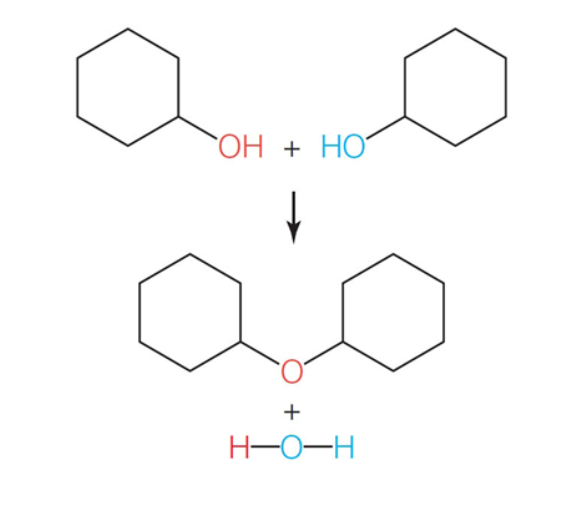
what type of covalent bond connects carbs?
glycosidic
what type of covalent bond connects lipids?
ester
what type of covalent bond connects protein?
peptide
what type of covalent bond connects nucleic acids?
phosphodiester
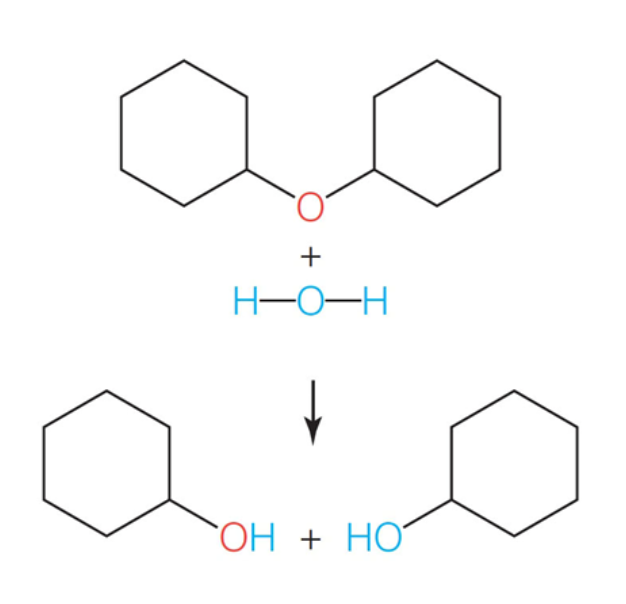
hydrolysis
water in your body breaks molecules into energy. a water molecule breaks a covalent bond from a polymer and breaks it into smaller pieces. (opposite of dehydration synthesis)
what is the ratio of carbohydrates?
carbon, hydrogen, oxygen; 1:2:1 ratio
what are carbs essential for?
energy, structure, storing/transportation energy
what is a monosaccharide?
a carb monomer. quick energy; think sugars. soluble in water.
what is a disaccharide
a carb made of two monosaccharides.
what is a polysaccharide?
complex carbs that contain many monomers. these take longer to break down for energy
what are lipids made of
C, H, O. significantly less oxygen than a carb (no specific ratio)
function of lipids
long term energy storage, and every cell is wrapped in lipids for protection.
what are fatty acids?
the tail of phospholipids. 4-36 carbon atoms.w
what is glycerol?
the carboxyl group (head) of a fatty acid. POLAR unlike lipids!

what is the structure of a saturated fatty acid?
single bond, straight, solid at room temperature.

what is the structure of an unsaturated fatty acid?
double bond, can be bent, liquid at room temperature.
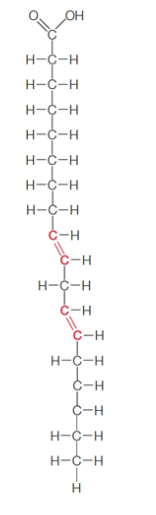
what does a carboxyl group contain?
carbon, 2 oxygen, hydrogen. POLAR unlike rest of lipids!!
what are amino acids?
the monomers of a protein. All have an anime group, carboxyl group, and R group, which gives the amino acid its properties.
primary structure (protein)
the unique amino acid sequence of a protein (polypeptide chain). they form through dehydration synthesis.
secondary structure (proteins)
the polypeptide chain folds and forms hydrogen bonds between the amino acids
tertiary structure (protein)
depending on how the R-groups (variable groups) interact with each other. can create hydrogen bonds, hydrophobic interactions, disulfide bridges, ionic bonds.
quaternary structure (protein)
some proteins consists of two or more folded chains.
nucleic acid
a polymer made of repeating nucleotides (monomer)wa
what is a nucleotide made of (3 parts)
phosphate groups, deoxyribose sugars (RNA has a ribose), and nitrogen bases (A, C, T, G)