orgo exam 1 PP1
 Call Kai
 Learn
Learn Practice Test
 Spaced Repetition
 Match
Match Flashcards
 Knowt Play
1/137

There's no tags or description
Looks like no tags are added yet.
Name | Mastery | Learn | Test | Matching | Spaced | Call with Kai | Chat |
|---|
No analytics yet
Send a link to your students to track their progress
138 Terms
molecular formula
tells us what kind and how many atoms are present in a compound
C4H10O
constitution of a molecule
captured by a structural formula showing how atoms are connected

constitutional or structural isomers
compounds that have the same molecular formula but differ in their connectivity
constitutional isomers
have the same composition (molecular formula) but differ in how their atoms are connected
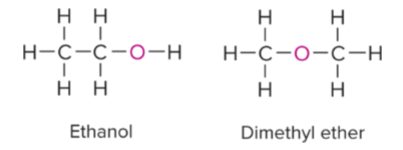
do constitutional isomers have different physical and chemical properties?
yes!
condensed formulas
textual and list atoms in order of their connectivity

bond-line formulas
omit labels for carbon atoms and omit hydrogens where they are implied (assume the octet rule is satisfied)\

expanding a bond-line formula into a full lewis structure (1)
add in all implied carbons, hydrogens, and lone pairs
1. Draw carbon atoms at each vertex and at the end of each line
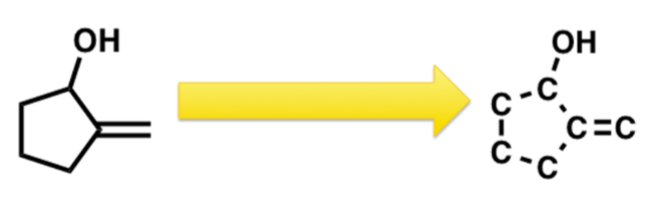
expanding a bond-line formula into a full lewis structure (2)
Add implicit hydrogens to the carbons such that the octet rule is satisfied (consistent with formal charges as well)
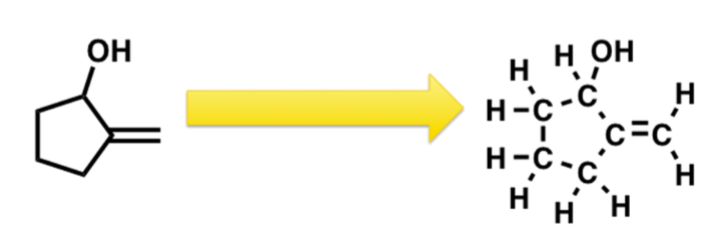
expanding a bond-line formula into a full lewis structure (3)
If missing, add implicit lone pairs on heteroatoms and/or carbons
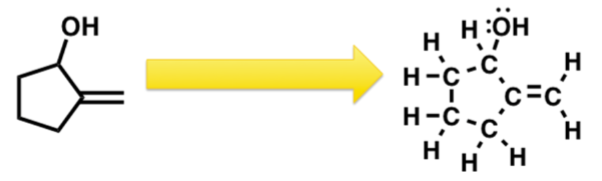
resonance
The assumption of electron localization built into Lewis structures is not always true!
Molecules containing delocalized electrons have multiple Lewis-structural representations called resonance structures
For example, protonated formaldehyde has two important resonance forms
The compound does not convert between A and B; it is in reality a weighted sum of structures A and B!
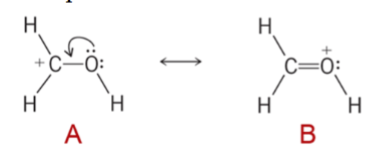
Molecules containing delocalized electrons have multiple Lewis-structural representations called
resonance structures
What is resonance in chemistry?
Resonance occurs when one Lewis structure cannot adequately represent the electron distribution in a molecule or ion. Instead, multiple valid Lewis structures, called resonance structures, are used to represent the molecule. The actual molecule is a resonance hybrid of these structures.
Why do resonance structures occur?
Resonance occurs because electrons can be delocalized over multiple atoms rather than being confined to one specific bond or atom. Lewis structures assume electrons are localized, but this assumption is not always accurate.
What are delocalized electrons?
Delocalized electrons = electrons spread over multiple atoms instead of being confined to one atom or bond.
What are resonance structures?
Resonance structures are multiple Lewis structures for the same molecule or ion that differ only in the location of electrons. The atoms themselves remain in the same positions and maintain the same connectivity.
Does a molecule switch back and forth between resonance structures?
No. The molecule does not alternate between the resonance structures. The actual molecule exists as a single resonance hybrid, which is a weighted combination of the contributing resonance structures.
What is a resonance hybrid?
A resonance hybrid is the actual structure of a molecule, representing the combined effect of all significant resonance structures. It often has partial bond orders and partial charges rather than the full bonds and charges shown in individual Lewis structures.
What does "weighted sum" mean when describing a resonance hybrid?
t means that some resonance structures contribute more strongly to the actual structure than others. The more stable resonance structure is usually the major contributor, while less stable structures contribute less.
What does a single Lewis structure of ozone (O3) suggest about its two O–O bonds?
A single Lewis structure suggests that one O–O bond is a single bond and the other is a double bond. Therefore, it would predict that the two bonds have different lengths and strengths.
What does experimental evidence show about the two O–O bonds in ozone?
Experiment shows that the two O–O bonds are equivalent. They have the same bond length and the two outer oxygen atoms have the same partial negative charge.

Why are the two O–O bonds in ozone equivalent even though the Lewis structures show one single and one double bond?
Ozone has resonance. The two possible Lewis structures contribute to the actual molecule, causing the electrons to be delocalized across both O–O bonds.

What is the approximate bond order of each O–O bond in ozone?
Each bond has a bond order between 1 and 2, because the actual structure is a resonance hybrid of a single bond and a double bond.
How is negative charge distributed in ozone?
The negative charge is delocalized between the two outer oxygen atoms. Neither outer oxygen carries the entire negative charge in the actual resonance hybrid.
How does resonance affect molecular stability?
Resonance generally stabilizes molecules and ions because delocalizing electrons and charge spreads electron density over multiple atoms, lowering the overall energy of the species.
More electron delocalization →
greater stabilization.
What is Rule 1 for resonance structures?
The connectivity and positions of the atoms must remain exactly the same in every resonance structure.
What is allowed to move when drawing resonance structures?
Electrons can move, including:
π electrons
lone pairs
formal charges resulting from electron movement
But atoms cannot move.
Can a hydrogen atom move when drawing resonance structures?
No. Movement of atoms is not allowed in resonance. If a hydrogen or another atom changes position, you are not drawing resonance structures.
How can you tell if two structures are constitutional isomers instead of resonance structures?
If the connectivity of the atoms changes, they are constitutional isomers rather than resonance structures.
Same atoms + same connections + different electrons =
resonance
Different connections =
constitutional isomers.
What is Rule 2 for resonance structures?
Every resonance structure must have the same total number of electrons and the same overall net charge.
Can formal charges on individual atoms change between resonance structures?
Yes. Individual formal charges can move or change as electrons move, as long as the overall net charge stays the same.
If one resonance structure has a +1 formal charge on one atom and another has a +1 charge on a different atom, can they still be resonance structures?
Yes. The location of the formal charge can change as long as the total net charge of the molecule remains the same.
What is Rule 3 for resonance structures?
All contributing resonance structures must contain the same number of unpaired electrons.
Why can't a structure with two unpaired electrons generally be a resonance form of a structure with zero unpaired electrons?
Because resonance only involves redistributing electrons, not changing the number of unpaired electrons. The structures must maintain the same electron-pairing pattern.
What happens if a proposed resonance structure has a different number of unpaired electrons?
It is not a valid resonance structure of the original structure.
What is Rule 4 for resonance structures?
Atoms of second-row elements must not violate the octet rule in a valid resonance structure.
Which elements are considered second-row elements?
The second period of the periodic table contains:
B, C, N, O, F
These elements generally cannot have more than 8 electrons around them.
Why is violating the octet especially important for second-row elements?
Second-row elements do not have available d orbitals and generally cannot expand their valence shell beyond eight electrons.
If a proposed resonance structure gives nitrogen 10 electrons around it, is it valid?
No. Nitrogen is a second-row element and cannot exceed an octet in these resonance structures.
Can a resonance structure have a different formal-charge arrangement while still obeying the octet rule?
Yes. Formal charges can change between resonance structures as long as the overall rules are satisfied.
Are all resonance structures equally important?
No. Some resonance structures are more stable and therefore contribute more strongly to the resonance hybrid. These are called major contributors.
What is a minor resonance contributor?
A minor contributor is a less stable resonance structure that contributes less to the resonance hybrid.
What is Rule 5 for determining the most important resonance structure?
Resonance structures containing more covalent bonds are typically more important than structures containing fewer covalent bonds.
Why is a resonance structure with more covalent bonds generally more stable?
More covalent bonds generally means the atoms have more complete bonding and greater electron sharing, which tends to make the structure more stable.
If one resonance structure has a double bond and another has only a single bond between the same atoms, which is usually the major contributor?
The structure with the double bond is typically the major contributor because it has more covalent bonding.
What is Rule 6 for resonance structures?
Resonance structures with minimal separation of opposite charges are generally more important.
Which is usually more stable: a resonance structure with no formal charges or one with separated positive and negative charges?
The structure with fewer formal charges is usually more stable, assuming the other resonance rules are satisfied.
Why is charge separation generally unfavorable?
Separating positive and negative charges creates a higher-energy arrangement. Therefore, structures that avoid unnecessary charge separation are generally more stable.
If Structure L has no formal charges and Structure M has both a positive and negative formal charge, which is usually the major contributor?
Structure L, because it has less charge separation.
What is Rule 7 for determining the most important resonance structure?
Resonance structures are more important when negative charge is placed on the most electronegative atom and positive charge is placed on the most electropositive atom.
Why is negative charge more stable on an electronegative atom?
Electronegative atoms are better at attracting and stabilizing electron density, so they are better able to accommodate a negative charge.
Why is positive charge more stable on an electropositive atom?
Electropositive atoms are less attracted to electrons, so they are better able to tolerate having less electron density, which corresponds to a positive charge.
Which atom would generally be better at stabilizing a negative charge: oxygen or carbon?
Oxygen, because oxygen is more electronegative than carbon.
If one resonance structure places a negative charge on oxygen and another places it on carbon, which is generally more important?
The structure with the negative charge on oxygen because oxygen is more electronegative and better stabilizes negative charge.
What happens to bond lengths when resonance occurs?
Resonance can make bonds equivalent or intermediate in length. For example, in ozone, both O–O bonds have lengths between what would be expected for a pure single bond and a pure double bond.
What happens to bond order when electrons are delocalized?
Bond order can become fractional or intermediate. For example, a bond that appears as single in one resonance structure and double in another may have an actual bond order between 1 and 2.
Two structures have the same atoms in the same positions, but a double bond moves from one location to another. Are they resonance structures?
yes, assuming the structures also have the same net charge, same total electrons, same number of unpaired electrons, and obey the octet rule.
Two structures have the same atoms but one has a hydrogen attached to a different atom. Are they resonance structures?
No. An atom moved, so the connectivity changed. They are different constitutional structures rather than resonance structures.
A proposed resonance structure has a different overall charge from the original. What does that tell you?
It cannot be a resonance structure because resonance structures must have the same overall net charge.
A proposed resonance structure gives carbon 10 electrons. Is it valid?
No. Carbon is a second-row element and cannot exceed an octet.
Two valid resonance structures exist. One has more covalent bonds and no charge separation, while the other has fewer bonds and separated charges. Which is the major contributor?
The structure with more covalent bonds and less charge separation is the major contributor.
Why can't we say that ozone has one single O–O bond and one double O–O bond?
Because the two Lewis structures are only contributors. The actual ozone molecule has two equivalent intermediate bonds because the electrons are delocalized over both O–O bonds.
Does the resonance hybrid look exactly like any one of its resonance structures?
Not necessarily. The resonance hybrid represents the actual electron distribution and may have partial charges and fractional bond orders that aren't shown in any individual Lewis structure.
A resonance structure has a negative charge on oxygen, while another has the negative charge on carbon. Which is generally more important?
The structure with the negative charge on oxygen, because oxygen is more electronegative.
Does a resonance structure represent the actual molecule by itself?
❌ No. Individual resonance structures are hypothetical contributors. The resonance hybrid represents the actual molecule.
Does resonance mean the molecule rapidly switches between structures?
❌ NO. The molecule exists as a resonance hybrid.
Why is recognizing resonance important in chemistry?
Resonance is important because it helps us understand molecular stability and chemical reactivity. Resonance shows how electrons and charge can be delocalized, which can stabilize a molecule and reveal locations where reactions are likely to occur.
What are the two major reasons resonance is important?
Resonance stabilizes molecules by delocalizing charge over multiple atoms.
Resonance structures can reveal reactivity, including atoms that may act as Lewis acids or bases.
How does resonance stabilize a molecule or ion?
Resonance stabilizes a molecule by delocalizing electrons or charge over multiple atoms. Instead of concentrating a charge in one location, the charge is spread out, which lowers the energy of the species.
Spread-out charge = more stable
Why is spreading out a charge stabilizing?
Concentrating a charge on one atom creates a high concentration of electron density or electron deficiency. Delocalization allows the charge to be distributed across several atoms, making the overall species lower in energy.
Does resonance eliminate the overall charge of an ion?
No. Resonance does not change the overall charge. Instead, it distributes the charge among multiple atoms.
For example, carbonate still has an overall charge of −2, but that negative charge is distributed among its oxygen atoms.
What is the overall charge of the carbonate ion, CO₃²⁻?
Carbonate has an overall charge of −2.
Why is carbonate relatively stable despite having an overall −2 charge?
Carbonate is relatively stable because the negative charge is delocalized over three oxygen atoms through resonance.
Instead of having all of the negative charge concentrated on one oxygen, the charge is distributed throughout the ion.
How many important resonance structures does carbonate have?
Carbonate has three equivalent major resonance structures. In each one, the C=O double bond is located between carbon and a different oxygen.
The negative charge is therefore distributed among the three oxygen atoms.
What happens to the C–O bonds in the actual carbonate ion?
The actual carbonate ion has three equivalent C–O bonds. They are intermediate between a pure single bond and a pure double bond because of electron delocalization.
What is the key stability idea demonstrated by carbonate?
A species can be relatively stable even with a significant overall charge if that charge is delocalized over several atoms.
How can resonance structures help predict chemical reactivity?
Resonance structures can reveal formal charges and electron-deficient or electron-rich atoms that may not be obvious from the most important resonance structure alone.
Why should we pay attention to minor resonance contributors?
Even though minor contributors contribute less to the resonance hybrid, they can reveal important chemical properties or reactive sites.
A minor contributor may show that an atom can behave as an electrophile or Lewis acid, for example.
Does a minor resonance contributor have no importance?
No. "Minor" means it contributes less to the resonance hybrid; it does not mean it is chemically useless.
A minor structure can reveal reactivity that isn't obvious from the major contributor.
What is a Lewis acid?
A Lewis acid is an electron-pair acceptor.
Easy memory trick:
Lewis Acid = Accepts electrons
What is a Lewis base?
A Lewis base is an electron-pair donor.
Easy memory trick:
Lewis Base = Gives electrons
How can a resonance structure reveal that an atom can act as a Lewis acid?
A resonance structure may show an atom with a positive formal charge or electron deficiency. This indicates that the atom may be able to accept an electron pair, making it a potential Lewis acid.
Why might a carbon atom be able to act as a Lewis acid?
If a resonance contributor places a positive charge on carbon, that carbon is electron deficient. Because it needs electron density, it can potentially accept an electron pair, which is the behavior of a Lewis acid.
Does the carbon have to permanently carry a positive charge for it to be reactive?
No. Even if the positively charged carbon appears only in a minor resonance contributor, that structure can reveal that the carbon has some degree of electron deficiency in the resonance hybrid.
What is an expanded octet?
An expanded octet occurs when an atom has more than 8 electrons in its valence shell while participating in covalent bonding.
Which atoms can commonly have expanded octets?
Third-row (third-period) and lower elements can commonly have expanded valence shells.
Important examples include:
Phosphorus (P)
Sulfur (S)
Can second-row elements have expanded octets?
No. Second-row elements such as:
B
C
N
O
F
are generally restricted to 8 electrons around the atom.
This is especially important when determining whether a proposed Lewis or resonance structure is valid.
Why can third-row elements have expanded octets?
Third-row elements have access to a larger valence shell and can accommodate more than eight electrons in certain covalent compounds.
For introductory chemistry, the key rule to remember is:
Period 2 → cannot expand octet
Period 3 and beyond → may expand octet
What is an example of a compound containing an expanded octet at phosphorus?
PCl₅ (phosphorus pentachloride).
Phosphorus is bonded to five chlorine atoms, giving phosphorus 10 electrons around it.
Why is PCl₅ allowed to have more than eight electrons around phosphorus?
Because phosphorus is a third-period element, so it can participate in compounds with an expanded valence shell.
What are some important examples of compounds with expanded octets?
Examples include:
PCl₅
Phosphates
Sulfates
Sulfonates
SF₄
ATP (adenosine triphosphate)
Can third-row atoms have expanded octets in resonance structures?
Yes. Third-row atoms such as phosphorus and sulfur can have more than eight electrons around them in valid resonance structures.
This is different from second-row elements such as carbon, nitrogen, and oxygen.
Why is it important to distinguish between second-row and third-row atoms when drawing resonance structures?
Because the octet rule is different.
For second-row atoms:
❌ More than 8 electrons is generally not allowed.
For third-row atoms:
✅ More than 8 electrons can be allowed.
What does VSEPR stand for?
Valence Shell Electron Pair Repulsion.
What is VSEPR theory?
VSEPR theory states that electron pairs around a central atom repel one another and arrange themselves as far apart as possible.
Why do electron pairs arrange themselves as far apart as possible?
Because electrons are negatively charged and therefore repel one another.
By maximizing the distance between electron pairs, the molecule minimizes electron-electron repulsion and becomes more stable.
What determines the geometry of a molecule according to VSEPR theory?
The molecule's geometry is largely determined by the number of electron groups around the central atom.
Electron groups include:
Single bonds
Double bonds
Triple bonds
Lone pairs