8. Internal Insect anatomy
 Call Kai
 Learn
Learn Practice Test
 Spaced Repetition
 Match
Match Flashcards
 Knowt Play
1/80

There's no tags or description
Looks like no tags are added yet.
Name | Mastery | Learn | Test | Matching | Spaced | Call with Kai | Chat |
|---|
No analytics yet
Send a link to your students to track their progress
81 Terms
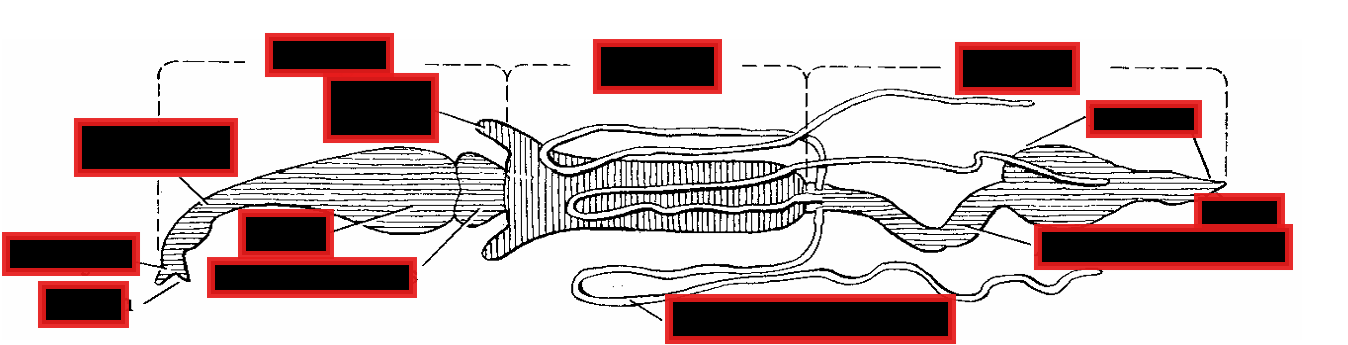
Label the parts of the Digestive and excretory system of insects
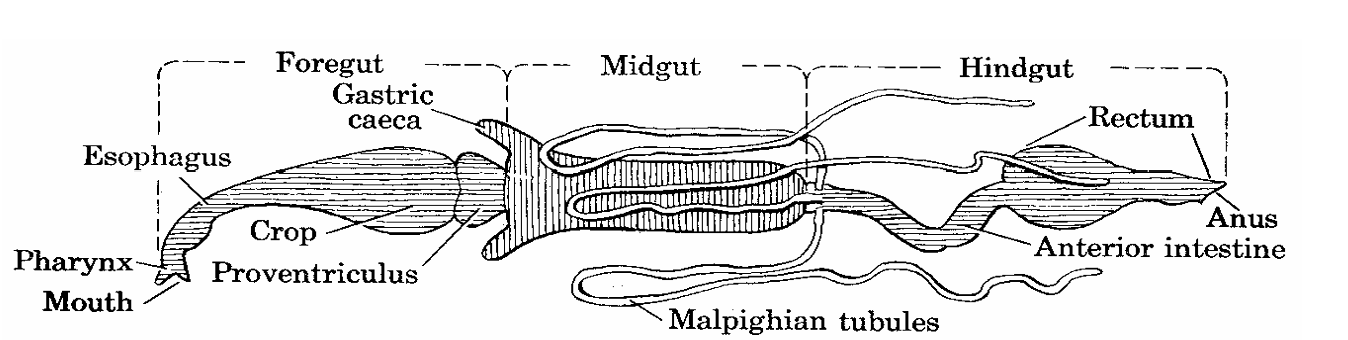
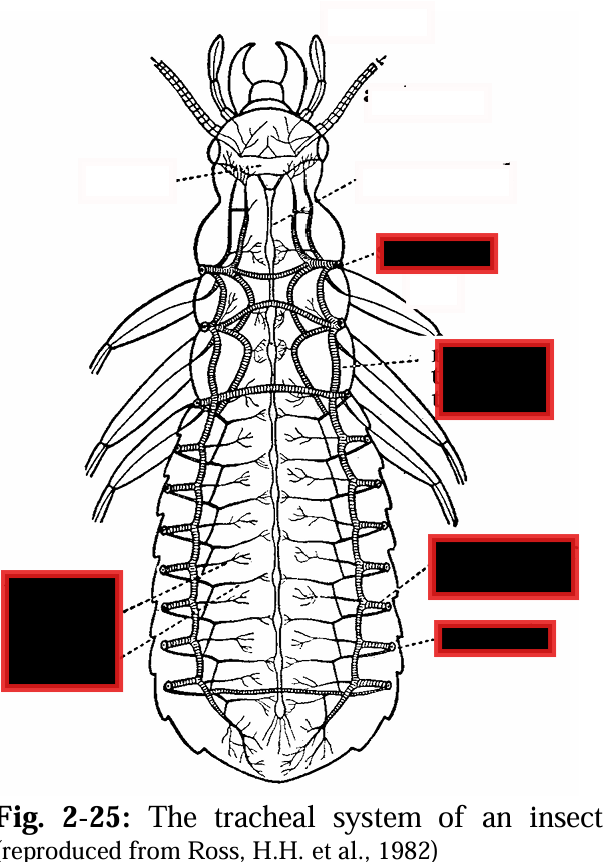
Label the Respiratory system of insects
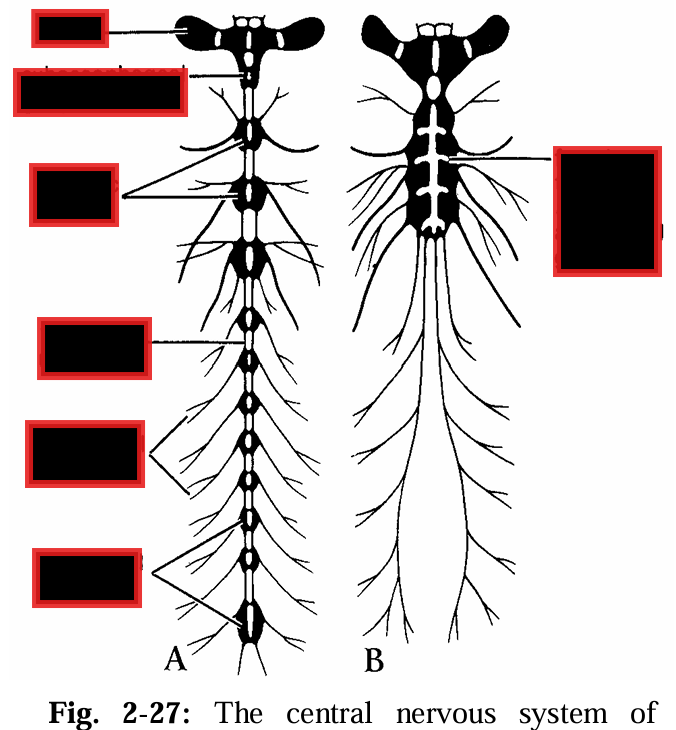
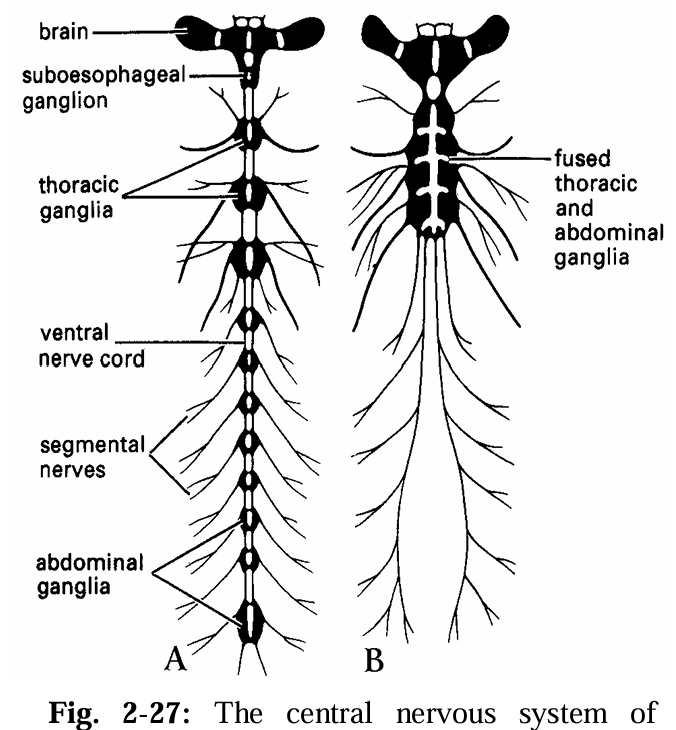
Label the Central nervous system of insects
Why are internal insect systems important in pest management?
They explain how insects circulate nutrients, digest food, breathe, move, sense the environment, reproduce, communicate and respond to insecticides.
Which internal insect systems are most important for pest control?
Circulatory system
Digestive and excretory system
Respiratory system
Muscular system
Nervous system
Glandular system
Reproductive system
Communication and behaviour
What is insect blood called?
Haemolymph.
What is the insect body cavity called?
The haemocoel.
Where does haemolymph circulate?
Throughout the haemocoel, bathing the organs and tissues.
What pumps haemolymph around the insect's body?
A dorsal blood vessel (tubular heart).
Does haemolymph mainly transport oxygen?
No.
Which system delivers oxygen in insects?
The tracheal (respiratory) system.
What does haemolymph transport?
Nutrients
Hormones
Wastes
Some insecticides
Why is it important to know that haemolymph does not carry oxygen?
Because insect respiration is completely different from vertebrates.
What is the digestive tract?
A tube running from the mouth to the anus.
What are the three major regions of the digestive tract?
Foregut
Midgut
Hindgut
What is the function of the foregut?
It receives food.
Which structures are found in the foregut?
Mouth
Pharynx
Oesophagus
Crop
What is the crop?
A food storage chamber.
What is the proventriculus?
A muscular gizzard that grinds food or controls its movement into the midgut.
What is the main function of the midgut?
Digestion and nutrient absorption.
What is the function of the hindgut?
Water reabsorption and waste handling.
Where does the hindgut end?
At the rectum and anus.
What are Malpighian tubules?
Kidney-like structures that remove wastes from the haemolymph.
Which vertebrate organ do Malpighian tubules resemble?
Kidneys.
Why is the digestive system important in pest management?
Some insecticides work as stomach poisons or oral baits.
Why is cockroach grooming important?
It causes insecticides on the body to be swallowed.
Why is termite grooming important?
It spreads insecticides throughout the colony.
How do insects breathe?
Through spiracles and tracheae.
What are spiracles?
Openings on the thorax and abdomen used for breathing.
What are tracheae?
Air tubes that carry oxygen through the body.
What are tracheoles?
Tiny branches of the tracheae that deliver oxygen directly to tissues.
Does insect blood transport oxygen?
No.
Which pesticide type mainly enters through the respiratory system?
Fumigants.
How can some contact insecticides reach the respiratory system?
They penetrate the waxy cuticle and move laterally to the spiracles
Where do insect muscles attach?
To the inside of the exoskeleton.
Why are insects so strong for their size?
Their muscles attach directly to the exoskeleton and their small size gives them a mechanical advantage.
Why can many insects fly so effectively?
Their flight muscles contract extremely rapidly.
What are the four main parts of the insect nervous system?
Brain
Sub-oesophageal ganglion
Ventral nerve cord
Ganglia
How do nerve impulses travel?
As electrical impulses along nerve cells.
What is a synapse?
The gap between two nerve cells where chemical messengers transmit signals.
Which neurotransmitter is commonly used in insects?
Acetylcholine.
What enzyme normally breaks down acetylcholine?
Cholinesterase.
Why are many insecticides called nerve poisons?
They interfere with the insect nervous system.
Which insecticide group affects nerve cells directly?
Synthetic pyrethroids.
Which insecticide groups inhibit cholinesterase?
Organophosphates
Carbamates
What happens if cholinesterase is blocked?
Nerve signals continue without stopping, leading to paralysis and death.
What are endocrine glands?
Glands that release hormones inside the body.
Give four examples of exocrine secretions.
Pheromones
Silk
Saliva
Defensive chemicals
What is ecdysone?
The moulting hormone.
What does ecdysone stimulate?
Cuticle production and moulting.
What does juvenile hormone do?
Keeps insects in their immature stages.
How do juvenile hormone analogues work?
They prevent normal development into adults.
What is chitin?
The main structural material of the cuticle.
What do chitin synthesis inhibitors do?
Prevent normal cuticle formation.
What are pheromones?
Chemical messages between members of the same species.
What are pheromones used for?
Mate attraction
Trail marking
Aggregation
Alarm signals
Caste regulation
How are pheromones used in pest management?
Monitoring traps and attracting pests.
How do most insects reproduce?
Sexually.
What is parthenogenesis?
Reproduction without fertilisation.
What is a spermatheca?
An organ that stores sperm after mating.
Why do females usually lay eggs near food?
So the larvae have immediate access to food.
What protects cockroach eggs?
An ootheca.
How do insects communicate?
Chemical signals
Visual signals
Auditory signals
What is innate behaviour?
Inherited behaviour that is not learned.
What is a reflex?
An automatic response to a stimulus.
Give an example of an insect reflex.
A fly extends its mouthparts when sugar touches its feet.
What is taxis?
Directed movement toward or away from a stimulus.
What is phototaxis?
Movement toward or away from light.
What is thigmotaxis?
Seeking close contact with surfaces.
Which major urban pest shows strong thigmotaxis?
Cockroaches.
Why is thigmotaxis important in pest management?
It explains why crack-and-crevice treatments and gel baits work better than open-area spraying.
What is learned behaviour?
Behaviour modified through experience
What can some insects learn?
Landmarks and food-source locations.
Which system carries oxygen?
Respiratory system.
Which system carries nutrients?
Circulatory system
Which system is targeted by pyrethroids?
Nervous system.
Which system is targeted by stomach poisons?
Digestive system.
Which hormone controls moulting?
Ecdysone.
Which hormone keeps insects immature?
Juvenile hormone.
Which behaviour explains why cockroaches hide in cracks?
Thigmotaxis.
Match the internal insect system to its main pest-control relevance.
Circulatory → Moves nutrients, hormones and some insecticides
Digestive → Oral baits and stomach poisons
Respiratory → Fumigants and spiracle entry
Muscular → Movement and flight
Nervous → Target of most insecticides
Glandular → Hormones, pheromones and IGRs
Reproductive → Egg laying, parthenogenesis and oothecae
Behaviour → Determines hiding places, movement and treatment placement