Business planning
 Call Kai
 Learn
Learn Practice Test
 Spaced Repetition
 Match
Match Flashcards
 Knowt Play
1/111

There's no tags or description
Looks like no tags are added yet.
Name | Mastery | Learn | Test | Matching | Spaced | Call with Kai | Chat |
|---|
No analytics yet
Send a link to your students to track their progress
112 Terms
Quantitative definition of SMEs
An enterprise that employs fewer than 199 people and has an annual turnover of less than $20 million.
Qualitative definition of SMEs
Businesses that are independently owned and operated, financed mainly by family and banks, with a high level of control exercised by the owner/operator.
List characteristics of SMEs
Personalised service, local markets, independently owned and operated, closely controlled by owner/operator, not dominant in the industry, locally based, owner responsible for most decision making, bulk of capital provided by owner.
Economic contribution of SMEs
Employs 68.3% of private sector workers, produces around 55% of Australia’s GDP, increases exports, contributes 43% of total R&D, supplies goods and services to larger businesses, and generates tax revenue for the government.
Why are SMEs economically important?
They are a major employer, drive innovation (R&D), boost exports, support larger businesses, and contribute significantly to Australia’s GDP and tax revenue.
Methods SMEs use to enter global markets
Direct exporting, using local distributors, joint ventures, and e-commerce.
What is direct exporting?
When an SME sells and sends goods directly to customers or businesses overseas.
What is a local distributor?
A business in the overseas market that purchases the SME’s product and uses its own expertise and contacts to sell it locally.
What is a joint venture?
When an SME partners with an existing business in the overseas market to share expertise, contacts, and reduce risk.
What is e-commerce in a global context?
Using websites and online platforms to sell products overseas — a low-cost method of entering global markets.
What is the Balance of Payments?
A record of all financial transactions made between Australian residents and the rest of the world.
List reasons why SMEs succeed
Strong entrepreneurial ability, access to accurate and timely information, high level of flexibility, focus on a market niche, and strong reputation through quality and personalised service.
Why is flexibility a key success factor for SMEs?
SMEs can adapt quickly to changes in the business environment because they have fewer layers of management.
Why is focusing on a market niche a strength for SMEs?
It allows them to develop deep expertise, provide better customer satisfaction, and face less direct competition.
List reasons why SMEs fail
Lack of planning, entering unknown target markets, intense competition, poor financial management, staffing problems, inability to adapt to change, and impact of new laws.
Main causes of SME failure
Lack of proper planning, poor financial management, not understanding the target market and competition, and failure to adapt to the business environment.
List common sources of information for a business owner
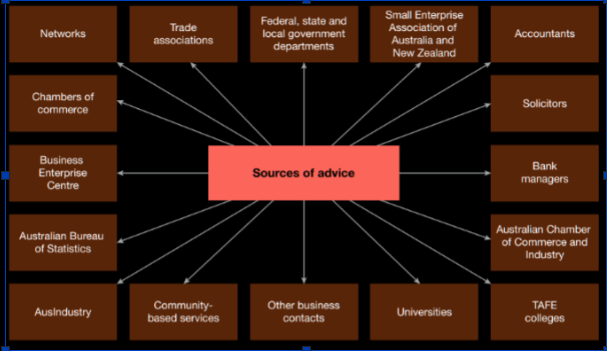
Where can business oppurtunites originate from?
Personal interests
Work experience
Tech
Consumer preferences, demographics, socials
New problems or improvements
Define competitive advantage
a feature that makes a business more attractive to a customers.
Ways to gain a competitive advantage
Pricing
Quality
Customer service
Product
Strong branding
cons of starting your business as an establishment option
- high risk
- long time to establish business
- low profits in starting period
pros of starting your business as an establishment option
Freedom to do whatever you want
no goodwill to pay for .
- If funds are limited, it is possible to begin on a smaller scale.
cons of purchasing an existing business
Hard to change business policies and reputation
Success may have depended on contacts
Difficult to assess value of goodwill
There may be hidden problems.
Some employees may resent any change to the business operation.
pros of purchasing an existing business
Sales to existing customers will generate instant income.
A proven track record makes it easier to obtain finance.
Stock has already been acquired and is ready for sale.
The seller may offer advice and training.
Equipment is available for immediate use.
Existing employees can provide valuable assistance
cons of franchising
Franchisor has total control
Profits must be shared with franchisor
Stock purchase is controlled
Contracts may be biased in favour of the franchisor.
The franchisee must share any burden of the franchisor’s business mistakes.
pros of franchising
Franchisor’s goodwill
The franchisor often provides training and management backup.
A franchisee can succeed despite having limited experience.
Equipment and premises design are usually established and operational.
Well-planned advertising often exists.
Volume buying is possible, often resulting in cheaper stock.
A business plan and proven business methods already exist.
What to consider when designing a product?
Consumer needs/wants - meeting these will
Trends
Competition
Product quality
Features
costs
Define market research
process of collecting, recording and analysing information about customers, competitors and market conditions.
Pros of market research
Identify consumer needs and wants
Assess demand for a product
Understand competitors
Identify opportunities and reduces risk
What to consider when deciding price
Production cost
Competitor price
Customer expectations and willingness to pay
Quality and perceived value
Profit objectives
What to consider when deciding location
Proximity to customers
Access to suppliers
Transport and parking availability
Exposure
Costs
Proximity to competitors
• improve decision-making
• test whether a business idea is viable
• identify strengths, weaknesses and potential risks
• encourage proactive rather than reactive management
• demonstrate commitment to lenders and investors
• save time, money and effort by reducing costly mistakes
• increase the likelihood of long-term success.