Genetics — Genome Characteristics
 Call Kai
 Learn
Learn Practice Test
 Spaced Repetition
 Match
Match Flashcards
 Knowt Play
1/27

Earn XP
Description and Tags
Notecards from the first reading "Genome Characteristics"
Name | Mastery | Learn | Test | Matching | Spaced | Call with Kai | Chat |
|---|
No analytics yet
Send a link to your students to track their progress
28 Terms
Genome
A single copy of a heritable genetic material of a virus, bacterium, archaean, protist, fungus, plant, or animal.
Genome Cartography
Mapping a genome
Endosymbiont
An organism that lives within or on another organism.
Eukaryote
An organism with a eukaryotic cell type that maps to the
Domain Eukaryota
Kingdoms: Protista (protists), Fungi, Plantae (plants), and
Animalia (animals)
(Membrane bound nucleus)
Eukaryotic Genome
The heritable genetic material of an eukaryote.
Chloroplast DNA (Chloroplast Genome)
Heritable double-stranded DNA in a chloroplast, an organelle where photosynthesis occurs.
Only photosynthetic protists and plants.
…
Chromid
Medium-sized (subjective) double-stranded DNA (dsDNA) found in some bacteria, mitochondria, and chloroplasts.
Circular and Linear; ALWAYS dsDNA
Chromosome
Complex of large (subjective) double-stranded DNA (dsDNA) and proteins.
Describe large, heritable double-stranded DNAs that encode essential genes.
Circular or Linear; ALWAYS double stranded
Circular nucleic acid
Nucleic acid with a circle-like appearance—a molecule with no recognizable ends.
ssRNAs, dsRNAs, ssDNAs, dsDNAs
ss
Single Stranded
ds
Double Stranded
Deoxyribonucleotide (dNTP)
A kind of nucleotide that makes up DNA.
Pentose sugar deoxyribose (sugar), Phosphate group, Nitrogenous
bases: adenine (A), thymine (T), guanine (G), and cytosine (C).
Note: Ribonucleotides also have adenine, guanine, and cytosine but have uracil (U) in place of thymine.
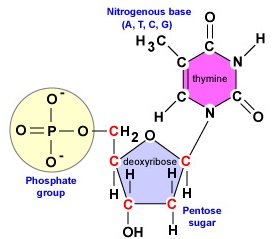
DNA (deoxyribonucleic acid)
Type of nucleic acid made up of deoxyribonucleotides joined
together in a specific sequence
Either ss or ds; circular or linear
Primary function is a repository of genetic information passed from parent cells to daughter cells and from parents to offspring.
Double-stranded (ds) nucleic acid
A nucleic acid composed of two strands.
Physically held together by hydrogen bonding between complementary nitrogenous bases
One molecule, even though both strands are themselves molecules.
Can be ds; dsDNA, dsRNA
Extrachromosomal DNA
Describe heritable double-stranded DNA that is not considered nuclear DNA, mitochondrial DNA, or chloroplast DNA. Can be in the nucleus, cytosol, or outside of the cell.
Now considered by some to be one of the four components of a eukaryotic genome.
non-segmented and linear double-stranded DNA (dsDNA), non-segmented and circular double-stranded DNA (dsDNA), segmented and linear double-stranded DNA (dsDNA), segmented and circular double-stranded DNA (dsDNA), segmented linear and circular double-stranded DNA (dsDNA)
Form (genome)
The physical structure or shape of the nucleic acid(s) that make up a genome (nucleic acid can be linear or circular, DNA or RNA, ds or ss; genomes can be composed of either nucleic acid or both)
Genetic material
Nucleic acids that are repositories of information
Genome length
Measure of genome size that is reported in bases (ss na) or base pairs (ds na) and is a measure of how many nucleotides are in a strand. Large including bp, kb or kbp, mb or map, gb or gbp
bp
base pair
kb or kip
kilobase or kilobase pair
1,000 bp or 103 bp
mb or mbp
Megabase or Megabase pairs
1,000,000 bp or 106 bp
gb or gbp
Gigabase or Gigabase pairs
1,000,000,000 bp or 109 bp
Genome mass
A measure of genome size reported in picograms (pg) and is a reflection of how many nucleotides are in a genome.
Heritable
Capable of being passed from parent to offspring
Syn: inheritance (inherit) or transmission (transmit)
Linear nucleic acid
A nucleic acid with a line-like appearance—a molecule with two recognizable ends.
Can be ssRNAs, dsRNAs, ssDNAs, dsDNAs.
Mini-chromosome
A medium-sized (relative) double-stranded DNA (dsDNA) found in some archaea.
Encode essential genes, like chromosomes, and use the same replication and segregation machinery as chromosomes.
Can be circular or linear, but ALWAYS dsDNA.
Mitochondrial DNA (a.k.a. mitochondrial genome)
Heritable double-stranded DNA in a mitochondrion, an organelle where portions of cellular respiration occur. Most, but not all, eukaryotes have mitochondria.
Very similar characteristics to bacterial genomes. Mitochondria contain chromosome(s), and sometimes chromid(s) and/or plasmid(s).
non-segmented and linear double-stranded DNA (dsDNA), non-segmented and circular double-stranded DNA (dsDNA), segmented and linear double-stranded DNA (dsDNA), segmented and circular double-stranded DNA (dsDNA), segmented and linear and circular double-stranded DNA (dsDNA)
Non-segmented genome