Lecture 1- Dental Terminology, Tooth Functions, Shape & Alignment, Tooth Numbering System
 Call Kai
 Learn
Learn Practice Test
 Spaced Repetition
 Match
Match Flashcards
 Knowt Play
1/50

There's no tags or description
Looks like no tags are added yet.
Name | Mastery | Learn | Test | Matching | Spaced | Call with Kai | Chat |
|---|
No analytics yet
Send a link to your students to track their progress
51 Terms
Deciduous Teeth
Temporary teeth that are eventually replaced by permanent teeth.
Permanent Teeth
Teeth that replace deciduous teeth and are intended to last a lifetime.
Tooth Numbering System
A method used to identify and categorize teeth.
Function of Teeth
Facilitate communication, hold, cut, and grind food to aid digestion, and contribute to esthetics.
Incisors
Teeth primarily used for cutting food.
Canines
Teeth used for holding and tearing food.
Premolars
Teeth used for holding and grinding food.
Molars
Teeth primarily used for grinding food.
Maxilla
The upper arch of teeth.
Mandible
The lower arch of teeth.
Midline
A vertical line that divides the maxillary and mandibular arches into left and right sides.
Mesial Surface
The surface of a tooth that is toward the anterior midline.
Distal Surface
The surface of a tooth that is away from the anterior midline.
Lingual Surface
The surface of all teeth that is toward the tongue.
Facial Surface
The surface of teeth that is toward the lips or cheeks.
Labial Surface
The surface of the anterior teeth that is toward the lips.
Buccal Surface
The surface of the posterior teeth that is toward the cheeks.
Quadrants
Sections of the dental arch, divided into maxillary right, maxillary left, mandibular right, and mandibular left.
Crown
The part of the tooth that is covered by enamel.
Enamel
The hardest tissue in humans, making up the outer layer of the crown.
Cementum
The tissue that covers the root of the tooth and attaches it to the bone.
Dentin
The bulk of the tooth beneath the enamel and cementum, consisting of 70% inorganic and 30% organic material.
Pulp
The innermost part of the tooth containing blood vessels, lymph tissue, nerve tissue, and odontoblasts.
Cementoenamel Junction (CEJ)
The junction where cementum meets enamel on the crown.
Dentioenamel Junction (DEJ)
The junction where dentin and enamel join.
Dentinocemental Junction (DCJ)
The junction where dentin and cementum join.
Line Angles
____ form where two tooth surfaces meet.
Point Angles
Points where three tooth surfaces meet.
Crown Depressions
Features on the crown of a tooth, including fossas, grooves, and pits.
Crown Elevations
Features on the crown of a tooth, including cusps, cingulum, tubercles, mamelons, and ridges.
Mamelons
Ridges on the incisal edges of newly erupted teeth.
Primary Dentition
The first set of teeth that are eventually replaced by permanent teeth.
Mixed Dentition
A stage where both primary and permanent teeth are present.
Permanent Dentition
The set of teeth that replaces primary teeth, also known as succedaneous teeth.
Universal System
A tooth identification system that uses numbers #1-#32 for permanent dentition.
Palmer System
A tooth identification system that uses quadrant brackets and letters for maxillary and mandibular teeth.
FDI System
A tooth identification system that uses a two-digit number for both permanent and primary dentition.
Lobes
Sections of teeth, with human teeth typically having 4 or more.
Curve of Spee
A curvature that begins at the tip of the canines and follows the cusp tips of the posterior teeth.
Curve of Wilson
A curvature that represents the medial-lateral curvature of the occlusal plane of premolars and molars.
Compensating Occlusal Curvature
A 3D curvature of the occlusal plane that complements the path of the condyles during mandibular movements.
Axial Positions
The inclination or tilt of the teeth.
Crown Form
The shape of the tooth crown from different aspects, including trapezoidal, triangular, and rhomboidal.

Contact Areas
The areas where teeth touch each other, highest in the anterior and lowest in the posterior.
Interproximal Spaces
Triangular shaped spaces located cervical to the contact area, formed by proximal tooth surfaces and alveolar bone.
Embrasures
Diverging proximal spaces around contact areas that function as a spillway for food.
Facial Line Angles
Angles formed by the junction of two crown surfaces, marking the terminal edge of facial embrasures.
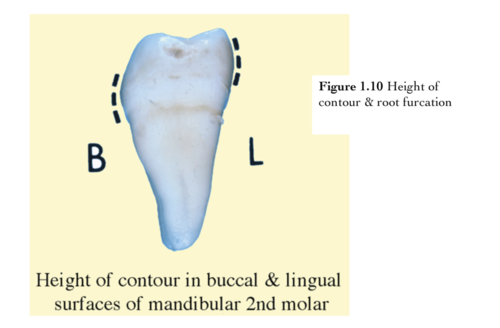
Heights of Contour
The greatest area of contour on the facial, lingual, and proximal surfaces critical to periodontal health.
Cervical Line (CEJ) Curvatures
Curvatures that curve toward the apical direction on facial and lingual surfaces and toward the incisal/occlusal on mesial and distal surfaces.

Continuity
The stable occlusion achieved through symmetrical occlusal embrasures and central grooves of posterior teeth.
Odontoblast
Cells in the outer edge of the pulp that make dentin, this helps rebuild when decay occurs.