1. Inflammatory Bowel Disease: Crohn’s Disease and Ulcerative Colitis
 Call Kai
 Learn
Learn Practice Test
 Spaced Repetition
 Match
Match Flashcards
 Knowt Play
1/13

Earn XP
Description and Tags
Chronic inflammation of the gastrointestinal (GI) tract
Name | Mastery | Learn | Test | Matching | Spaced | Call with Kai | Chat |
|---|
No analytics yet
Send a link to your students to track their progress
14 Terms
Pathophysiology
Severity varies - asymptomatic remission to mild and manageable to severe where surgeries are needed
Two hypothesis:
Primary dysregulation of the mucosal immune system resulting in excessive immunologic responses to normal microflora
Changes in the composition of the gut microflora and/or deranged epithelial barriers function that causes pathologic responses (inflammation) from the normal mucosal immune system
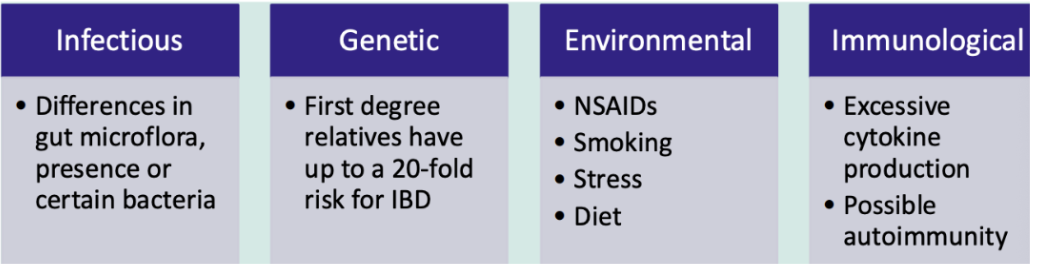
Etiology poorly understood, but potential factors include
Genetics (first degree relatives have a 4- to 20-fold greater risk), predisposing immunological factors, infection, emotional stress, environment (eg. diet, smoking, etc)
Chronic inflammation of the GI tract leading to diarrhea
Exact cause of inflammation is unknown
Inflammation is considered secondary to an antigen driven response
Etiology
Ulcerative Colitis
Location
Colon, rectum
Backwash ileitis = rare involvement of the terminal ileum
Mucosal penetration
Superficial
Distribution
Continuous
Crohn’s Disease
Location
Anywhere from mouth to anus
Terminal ileum (most common)
Mucosal penetration
Deep transmural lesions; affecting mucosa, submucosa, muscle, and serosa
Distribution
Discontinuous
Patchy “cobblestone” appearance
Signs and symptoms
Diarrhea and frequent bowel movements
Abdominal pain
Fatigue
Fever
Weight loss
UC complications
Hemorrhoids
Anal fissures
Perirectal abscess
Toxic megacolon
colonic distension of > 6 cm plus acute colitis and systemic toxicity (fever, tachycardia, elevated WBC)
CD complication
Structure
Abscess
Fistula
Nutritional deficiencies
Agents
Aminosalicylates
Drugs
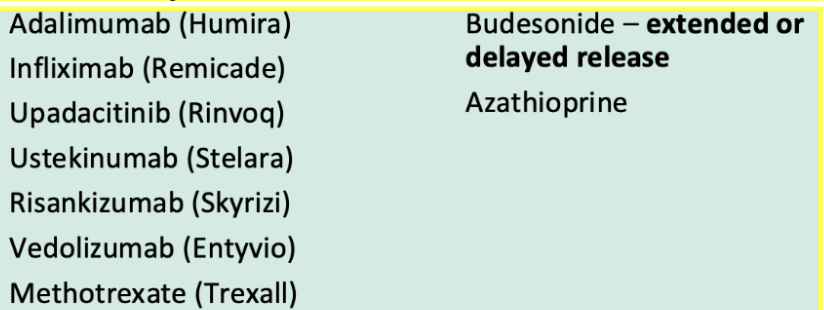
Sulfasazine (Azulfidine, Sulfazine)
Mesalamine (Canasa, Rowasa, Apriso, Asacol, Lialda, Pentasa)
Olsalazine (Dipentum)
Balsalazide (Colazal, Giazp)
MOA: unclear; likely involves inhibition of several inflammatory mediators, like leukotrienes, tumor necrosis factor (TNF), and free radicals
ADME
Mesalamine is the active drug
Prodrug formulations are designed to deliver mesalamine to various distal segments of the small bowel or colon, and are generally better tolerated
Corticosteroids
Drug:
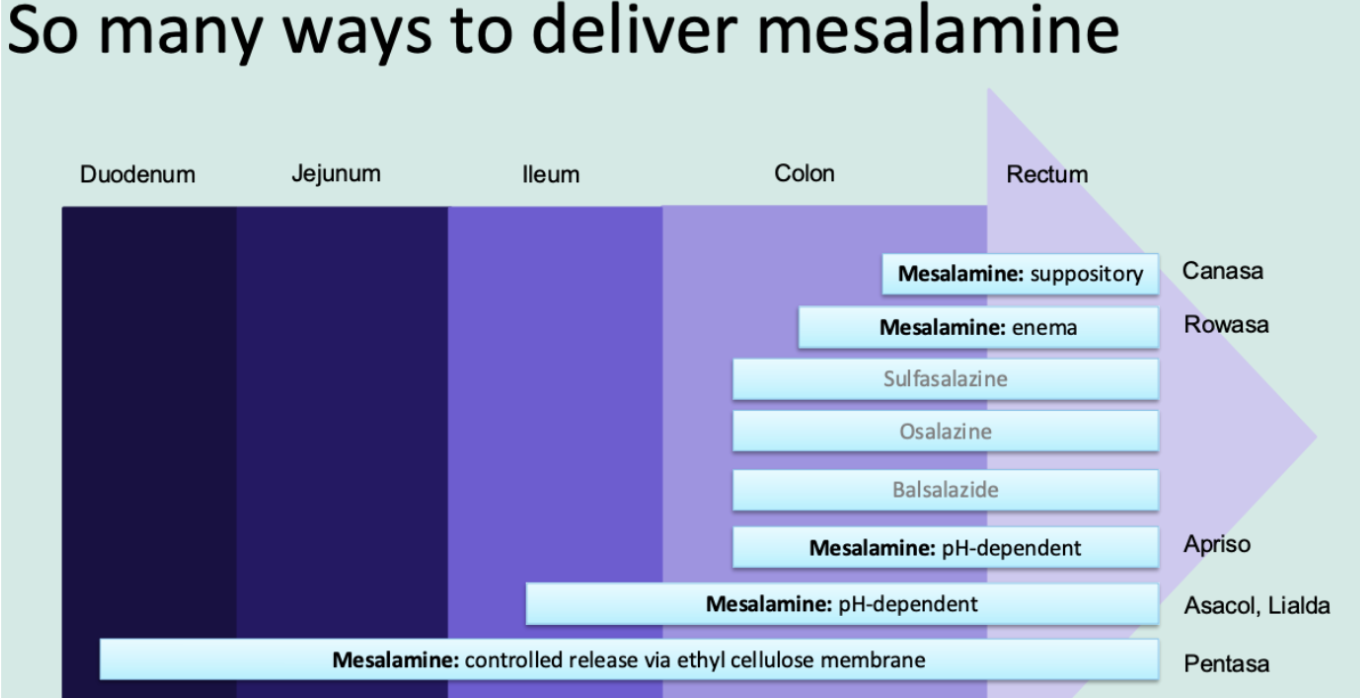
Budesonide (Entocort EC, Uceris)
Prednisone, prednisolone, and methyl prednisolone for systemic use
MOA: glucocorticoid, which depresses the captivity of endogenous chemical mediators of inflammation
Budesonide used for mild disease
Systemic steroids used for acute flares
Immunomodulators
Drugs:
Azathioprine (Azasan, Imuran)
Mercaptopurine (Purinethol)
Methotrexate (Trexall)
MOA:
Unclear with respect to immune modulators and anti-inflammatory activity; however, these agents interfere with purine nucleic acid metabolism (different mechanisms)
Known as antimetabolites
Azathioprine (AZA)/6-mercaptopurine (6-MP) metabolism
TPMT polymorphism have been shown to influence patient responsiveness to therapy - specifically, TMPT deficiency increases risk for ADE
Selective adhesion-molecules inhibitors (AKA integrin inhibitors)
Drugs:
Natalizumab (Tysabri) - MS
Vedolizumab (Entyvio) - IBD
MOA: antibody generated against integrins, which interferes with adhesion and migration cells form the vasculature into inflamed tissue
Sphingosine 1-phosphate (S1P) Receptor Modulators
Ozanimod (Zeposia), Etrasimod (Velsipity), Fingolimod (Gilenya), Ponesimod (Ponvory)
ORAL
MOA: internalization of S1P receptors leading to prevention of lymphocyte mobilization to inflammatory sites; basically prevent lymphocytes from leaving the lymph nodes
Warning: S1P receptors affect multiple organ systems which is why they cause eye and CV adverse effects