FF - Dermatomes, Myotomes, Reflexes, ULTT, SLR, Slump tests
 Call Kai
 Learn
Learn Practice Test
 Spaced Repetition
 Match
Match Flashcards
 Knowt Play
1/93

There's no tags or description
Looks like no tags are added yet.
Name | Mastery | Learn | Test | Matching | Spaced | Call with Kai | Chat |
|---|
No analytics yet
Send a link to your students to track their progress
94 Terms
Dermatomes
C1
Vertex of skull
C2
Temple, forehead, occiput
C3
Entire neck, posterior cheek, temporal area, prolongation forward under mandible
C4
Shoulder area, clavicular area, upper scapular area
C5
Deltoid area, anterior aspect of entire arm to base of thumb
C6
Anterior arm, radial side of hand to thumb and index finger
C7
Lateral arm and forearm to index, long, and ring fingers
C8
Medial arm and forearm to long, ring, and little fingers
T1
Medial side of forearm to base of little finger
T2
Medial side of upper arm to medial elbow, pectoral and midscapular areas
T3-T6
Upper thorax
T5-T7
Costal margin
T8-T12
Abdomen and lumbar region
L1
Back, over trochanter and groin
L2
Back, front of thigh to knee
L3
Back, upper buttock, anterior thigh and knee, medial lower leg
L4
Medial buttock, lateral thigh, medial leg, dorsum of foot, big toe
L5
Buttock, posterior and lateral thigh, lateral aspect of leg, dorsum of foot, medial half of sole, first, second, and third toes
S1
Buttock, thigh, and leg posterior
S2
Same as S1 (Buttock, thigh, and leg posterior)
S3
Groin, medial thigh to knee
S4
Perineum, genitals, lower sacrum
Myotomes
C1-C2
Cervical flexion
C3
Cervical side flexion
C4
Scapular elevation
C5
Shoulder abduction
C6
Elbow flexion and wrist extension
C7
Elbow extension and wrist flexion
C8
Thumb extension
T1
Finger abduction
L1-L2
Hip flexion
L3
Knee extension
L4
Ankle dorsiflexion
L5
Big toe extension
S1
Ankle eversion and plantarflexion, hip extension
S2
Knee flexion
S3
No specific test action; intrinsic foot muscles (except abductor hallucis)
What is the afferent pathway of the corneal reflex?
Ophthalmic branch (V1) of the trigeminal nerve (CN V)
What is the efferent pathway of the corneal reflex?
Facial nerve (CN VII)
What response is expected with a normal corneal reflex?
Blinking of both eyes
What spinal cord levels are tested with the abdominal reflex?
T7-T12
How is the abdominal reflex performed?
Lightly stroke the abdomen from lateral to medial
What is the normal response to the abdominal reflex?
Contraction of the superficial abdominal muscles
What does an asymmetric or absent abdominal reflex suggest?
An upper motor neuron (UMN) lesion on the absent side
What spinal cord levels are tested with the cremasteric reflex?
L1-L2
How is the cremasteric reflex elicited?
Stroke the superior/inner thigh on one side
What is the normal response to the cremasteric reflex?
Contraction of the cremaster muscle, pulling the testis/scrotum upward
When is the cremasteric reflex absent?
Spinal cord injury (SCI) and corticospinal tract lesions
What spinal cord levels and nerve are involved in the plantar reflex?
S1-S2 via the tibial nerve
How is the plantar reflex performed?
Stroke the lateral sole of the foot from the calcaneus to the base of the 5th metatarsal
What is the normal response to the plantar reflex?
Plantarflexion (curling) of the toes
What is a positive Babinski sign?
Dorsiflexion of the great toe with fanning of the other four toes
What does a positive Babinski sign indicate?
Corticospinal tract damage or an upper motor neuron (UMN) lesion
What is the anal reflex?
Reflexive contraction of the external anal sphincter when the skin around the anus is stroked
What is the afferent nerve of the anal reflex?
Pudendal nerve
What spinal cord levels mediate the anal reflex?
S2-S4
What is the bulbocavernosus reflex?
Contraction of the anal sphincter when the glans penis is squeezed or an indwelling Foley catheter is tugged
What spinal cord levels mediate the bulbocavernosus reflex?
S2-S4
Why is the bulbocavernosus reflex clinically important after a spinal cord injury?
It is the first reflex to return after SCI and indicates the patient is out of spinal shock
Grading of DTR
0 = No Response, always abnormal
1+ = Slight reflex, present but depressed, low normal
2+ = Normal, typical reflex
3+ = Brisk reflex, possibly but not necessarily abnormal
4+ = Very brisk reflex, abnormal, clonus
C5-C6
Biceps reflex
C5-C6
Brachioradialis
C7-C8
Triceps
L2-L4
Patellar
Achilles Tendon
S1-S2
Hamstrings
L5-S2
ULTT 1
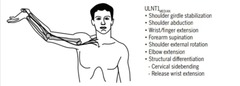
Nerve bias for ULTT 1
Median nerve, anterior interosseous nerve, C5, C6, C7
Think MAIN
ULTT 2
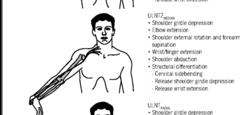
Nerve bias for ULTT 2
Median nerve
Axillary
Musculocutaneous
(MAM)
ULTT 3
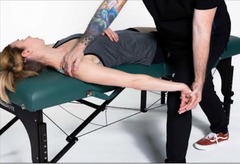
Nerve bias for ULTT 3
Radial nerve
ULTT 4
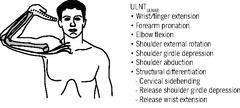
Nerve bias for ULTT 4
Ulnar nerve, C8 and T1 nerve roots
SLR 1
Hip flexion and ADD
Knee ext
Ankle DF
Nerve bias SLR 1
Sciatic and tibial
SLR 2
Hip flexion
Knee ext
Ankle DF
Foot EVER
Toes ext
Nerve bias for SLR 2
Tibial
SLR 3
Hip flexion
Knee ext
Ankle DF
Foot INV
Nerve bias for SLR 3
Sural
SLR 4
Hip flexion and MED ROT
Knee ext
Ankle PF
Foot INV
Nerve bias for SLR 4
Common peroneal
SLR 5 Cross
Hip flexion
Knee ext
Ankle DF
Nerve bias for SLR 5
Nerve root (disc prolapse)
Slump test 1
Cervical flexion
Thoracic and lumbar spine flexion
Hip flexion (90)
Knee extension
Ankle DF
Nerve bias for ST1
Spinal cord, cervical and lumbar nerve roots, sciatic nerve
Slump test 2
Cervical flexion
Thoracic and lumbar spine flexion
Hip flexion (90) and ABDUCTION
Knee extension
Ankle DF
Nerve bias for ST2
Obturator nerve
Slump test 3 side lying
Cervical flexion
Thoracic and lumbar spine flexion
Hip flexion (20)
Knee flexion
PF
Nerve bias for ST3
Femoral nerve
Slump test 4 long sitting
Cervical flexion and rotation
Thoracic and lumbar spine flexion
Hip flexion (90)
Knee extension
DF
Nerve bias for ST4
Spinal cord, cervical and lumbar nerve roots, sciatic nerve