art history exam 1
 Call Kai
 Learn
Learn Practice Test
 Spaced Repetition
 Match
Match Flashcards
 Knowt Play
1/65

There's no tags or description
Looks like no tags are added yet.
Name | Mastery | Learn | Test | Matching | Spaced | Call with Kai | Chat |
|---|
No analytics yet
Send a link to your students to track their progress
66 Terms
Who were the people of the Paleolithic time period, and what was their civilizations like?
Nomadic hunter-gatherers who moved with their food supplies in large groups/
Who were the people of the Mesolithic time period, and what was their civilizations like?
Still nomadic hunter-gatherers, but they can now kill larger animals (like mammoths) and can work in small group or individual hunts.
Who were the people of the Neolithic time period, and what was their civilizations like?
The appearance of the first permanent settlements and the development of agriculture and animal husbandry (farming).
What’s the order of the beginning time periods/
Paleolithic, Mesolithic, and Neolithic
What are the 2 predominant artifact types found during the Paleolithic period?
Small, portable sculptures to keep on-person. Usually in the form of hybrid part animal/part human and female Venus figures.
Cave paintings that seem to have had a ceremonial purpose found deep in the non-living quart of caves.
Venus figurines
Are considered to have totemic (holds deep symbolic or spiritual meaning) or fertility significance. Have been found across the land of Europe and beyond.
Anthropomorphic figure carvings
Vary in size, but are commonly carved as a combination of human and animal forms. Are considered to symbolize ideas about the supernatural and a connection to the spirit world.

What is the name of this figure?
The Venus of Willendorf
The Venus of willendorf:
Has emphasized reproductive features of the female body
The lion-man of hohlenstein-sadel
Was a deity/avatar of the spirit world that was part of a story or myth. Is made from mammoth tusk, was found in a dark cave, and symbolizes ideas about the supernatural.
Warty pig
Currently the earliest known representation of art in the world. Is a cave painting of an Sulawesi Indonesian pig.
Chauvet caves
Used in the Paleolithic period, is over a thousand feet long, has vast chambers. Has countless paintings of hand prints and animals ( over 60 percent of the animals depicted are bears, lions, mammoths, and rhinos).

What is this?
“Horse Heads” a painting section found in Chauvet that depicts 3 clear horse heads that face each other.
Lascaux cave
One of the earliest found caves. Was found by boys who were looking for their dog, wandered into the cave and were amazed by the paintings they found. At the time, scholars didn’t believe that it was real because the paintings seemed modern/in new condition.
What is twisted perspective?
A technique found in cave paintings where animals are depicted in a profile where we see the horns from a frontal viewpoint, and the rest of the body is in a normal profile angle.
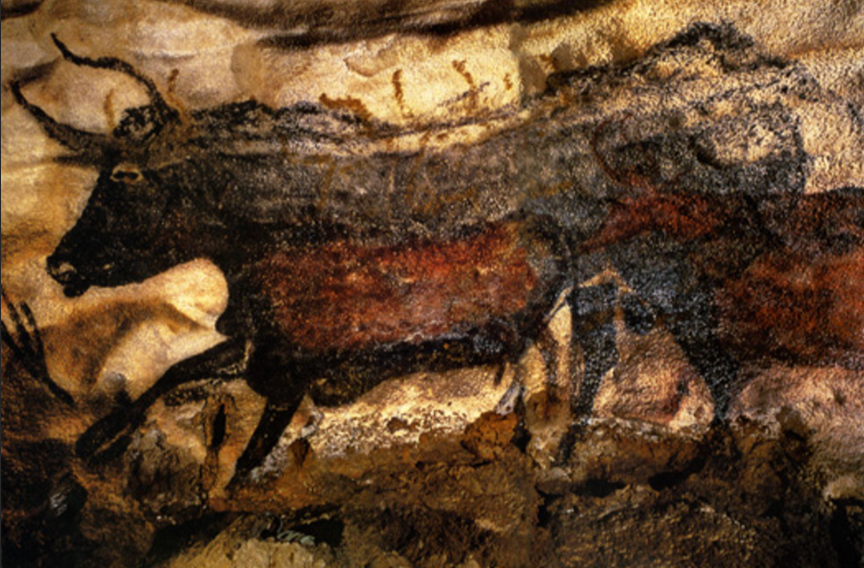
What is this?
The great black bull

What is this an example of?
Parietal art: a technique where an image is drawn, engraved, or sculpted directly onto cave walls.
What is sympathetic magic?
A concept which proposes that an image and what it represents are inextricably linked. If an image is manipulated, so is reality.
This explains the number of pregnate female animals found in Paleolithic caves; ensures food supply and hunting success. —manifesting
Catal Huyuk
One of the largest first settlements. Had gender equality, grain and legume farming, sheep and cattle herding, STILL SOME HUNTING.
What kind of art did catal huyuk have?
In-house murals, many bull heads and mother goddesses

What does this depict?
A reconstructed example of what a house in catal huyuk would’ve looked like

What is this?
The mother goddess of catal huyuk.
Is different from other fertility figures due to the throne she is sitting upon that consists of two lionesses.
lions are associated with deities (and kings later on)
Was found in a grain bin (purposefully) to possibly multiply or protect grain, and as a wish token/
Stonehenge—Salisbury plains
Neolithic (settlements)
Henge
Circle
Megalithic
Large stone structure
Post and lintel
A basic system of construction where 2 vertical elements (posts) are capped by a horizontal element (lintel).
Mortise and tendon
Mortise has a hole which tendon fits into
Trilithon
A pair of upright stones with a lintel stone spanning their tops
Bluestones
A stone henge mystery—what the henge itself used was only found in wales far away from Salisbury. Many believe that they used ox, and that a group from wales relocated and brought stones (symbolic for ancestors?l.
Optical adjustments of Stonehenge
Most weren’t done at the final location.curved incline to appear perfectly straight at a distance/from ground.
Stone henge’s function
A burial site, most likely for the elite.
Astronomical function: is oriented to capture suns rising over the heel and altar stones during the summer solstice (longest day). Its relationship with the solar and lunar calendar.
Recent theories about Stonehenge
There were evidence of fires between Stonehenge and durrington walls (professional route on the longest and shortest days).
Along with the wooden circle there, they believe that dw represented the land of the living and sh, the land of the dead.
Serpent mound
An effigy/ceremonial mound in the shape of a snake. Snakes were associated with earth and crop fertility.
Is aligned with summer solstice sunset and winter solstice sunrise.
Related to lunar phases in its curves.
Hailey’s comet might’ve been a reason for this mount?

What is this
Serpent mound
Mesa verde
Ancestral puebloan people’s cliffside settlement “palace”.


Example of a geometric mural in mess verde. Is believed that the bottom red band symbolizes the earth and the lighter portion: the sky.
Some represent animals and plants.
Cahokia mounds
Largest pre-columbian site north of Mexico. Metropolis stretched over 4k acres, encompassed 120 mounds, and had a population of around 20k.
Sumer/mesopotamia
Invented writing by cuneiform (its meticulous records provide a glimpse into the culture), irrigation, and methods of flood control.
Start of the Bronze Age. Composed Gilgamesh.
Consisted of independent citiy-states (Uruk and ur among)
Because this land was fertile, many civilizations conquered and then settled in Mesopotamia
Summer’s political and religious composition
Each city was dedicated to a deity to whom a temple was built. This deity played a central role in life of Sumerians.
Gov and religion are intertwined
Cuneiform
Means “wedge-shaped”
The earliest form of writing using clay pad and reed pen to indent, was most likely invented by the Sumerians. Earliest records represent the work of administrators, maybe from temple institutions, which record rations or movement of goods.
signs were put together to represent words
Ziggurat’s function
Raised temple closer to the heavens, protected against flooding, demonstrated dominance in the life of the city, and limited access to priestly classes only.
Votive
Means “vow”
An object that stand in place of the person represented to dedicate self to a deity. Objects are commissioned and vary in size (which indicated wealth/status)

Votive
Ancient Egypt
Civilization lasted for over 3k years, had a long lasting effect on the world (still use concepts from them today), separated into periods
What was the Egyptian view of order and chaos
Their longevity was due to their belief of creation, which only occurred when order triumphed over chaos brought their land to existence.
This divine order of order was known as ma’at (truth, righteousness, justice, and cosmic law—personified as a goddess).
The struggle between ma’at and the chaos is known as isfet.
Stylistic characteristics of Egypt
Hierarchical scale: size is relative to wealth/status/importance
Use of perspective: overlapping=farther when underneath
Preference for balance
Static positions, strangely abstract and blocky.
What is interesting about Egyptian art
Most of it was not meant to be seen and was for ceremonial practices.
3d representations of Egyptian art
Were the idealized version of an individual— usually a god, royalty, or elite.
Always static, arms to the side, minimally carved out?
How were scenes depicted in Egyptian art?
In parallel lines called registers. higher up=higher status + overlapping=underneath are farther away.
Hieroglyphics?
We’re often rendered as tiny works of art in themselves. Don’t always stand for what they depict; many are phonetic sounds, or logographic (stands for an object or concept).
What are the pre-relief techniques found in Egyptian art?
Generally, Surface is usually plastered then carved before painting, if not several layers of plaster would be applied to create a flat plane. Surface is then covered with gridded guidelines made by dust-coated string (for proportions)

Types of relief
Raised-relief: out from surface (first pic)
Sunken relief: carved into (this pic)

Mummification process
Lasts 70 days
nose broken and brain extracted(wasn’t important to them)
all organs—except the heart (intelligence)—removed and placed into jars
Coated with resin and painted
Wrapped in linens and magical amulets are inserted
If wealth, mask is placed.
EXTREMELY EXPENSIVE PROCESS!
The first pyramid
Made in the 3rd dynasty, “ stepped pyramid” multiple mastabas stacked, made of stone—not mud brick, this formed a stairway to the stars.
Additional: the destruction of s kings ka would result in the destruction of Egypt
Egyptians and the afterlife
Ka: the spirit
Ba:return to the body
The dead needs the same as they do in the living or they’d be lost
The great pyramids
Khufu (largest), khafre, menkaure.
Part of a necropolis
Made from roughly cut stone, covered in limestonewith precise measurements, capped with gold pyramidion
Town for paid workers— permanent and seasonal crews
Khufu’s pyramid
Boat for his final voyage, largest pyramid
Khafres oyramid
The sphinx is connected with him. Lion is a royal symbol and is connected with the sun
New kingdom
Pyramids are no longer used. Instead kings are buried in the valley of kings.
the belief that the ka will live on is no longer, as long as there is an appropriate dwelling place for it.—has to go through judgement (the weighing of the heart). Production of the book of the dead
Focus is moved from lower Egypt to upper.
New gods (ra: sun, titular: Memphis, Amun: patron of thebes0 temple building
The book of the dead
A collection of funerary spells and illustrations. For protection in afterlife.

Shabty of the priest nes-iswt
A small mummiform funerary figurine inscribed with a spell to invoke tasks in the underworld on behalf of the deceased.

Canopic jar
An essential for burial. Usually has four vessels that contain removed organs
King tuts history
Son of king who instituted a monotheistic religion and took power from priests.
Became king at age of 9, died at 18.
Had many illnesses due to inbreeding.
Reversed his father’s religion
Was a good military strategist, but was a minor king due to his age and his grandfather controlled.
We know so much about him because his tomb is the only one that is mostly intact upon discovery.
Tut’s tomb
Seems to have been very rushed: no order to his items, some things that are usually included are missing or small
Sarcophagi
Container/coffin.
Inner coffin made of solid gold (gods skin), outer two are wood and covered in gold leafing. Lapis and turquoise added.


Tut’s canopic shrine. A chest which contained his canopic jars with organs.
Detailed carvings show the goddess selket—who protects him.