Biochem CH 7: the behavior of proteins: enzymes, mechanisms, and control
 Call Kai
 Learn
Learn Practice Test
 Spaced Repetition
 Match
Match Flashcards
 Knowt Play
1/69

There's no tags or description
Looks like no tags are added yet.
Name | Mastery | Learn | Test | Matching | Spaced | Call with Kai | Chat |
|---|
No analytics yet
Send a link to your students to track their progress
70 Terms
feedback inhibition
process by which the first product of a series of reactions inhibits the first reaction in the series
prevents excess of final product
prevent accumulation of intermediates in the pathway
Ex) Asparte transcarbamoylase(ATCase) in catalyzing CTP

Carbomoyl phosphate + Aspartate--(ATCase +HPO4²- leaves)—>carbomoyl aspartate—> series of reactions—> nucleotide with CTP—> excess CTP inhibits first step of reaction
Cytidine triphosphate (CTP) reaction

ATP acts as the activator binds to the same regulatory site at CTP
ATP activates ATCase when CTP is low, making the enzyme work more efficiently and reducing cooperativity so the cell can produce more CTP.
reaction rate increases at lower aspartate concentrations
curve becomes more hyperbolic
explain the substrate/velocity curve for aspartate and ATCase when an activator is present

normal sigmoidal curve
explain the substrate/velocity curve for aspartate and ATCase when no A or I is present

Excess CTP inhibits reaction
curve shifts to right= higher concentration of Aspartate needed to reach the same reaction rate without an inhibitor
ultimately the Vmax is the same as the reaction without an I just takes more substrate to reach that
explain the substrate/velocity curve for aspartate and ATCase when I is present
K-systems
combinations of allosteric enzymes and inhibitors or activators, in which the presence of the inhibitor/activator changes the substrate concentration that yields Vmax
Vmax stays the same in both cases while K0.5 differs
lowers, less, raise, more
In K-systems activators ____ K0.5 meaning ___ substrate needed to reach K0.5 while inhibitors ____ K0.5 meaning ___ substrate needed to reach K0.5
V-systems
combinations of allosteric enzymes and inhibitors or activators in which the presence of the inhibitor/activator changes the maximal velocity of the enzyme but not the substrate level that yields one-half Vmax
K0.5 stays the same while Vmax differs
increase, more, decrease, less
In V-systems activators ____ Vmax meaning ___ enzymes active (R-state)to catalyze. Inhibitors ____ Vmax meaning ___ enzymes active to catalyze
quant, behavior
binding of substrates, inhibitors, and activators, change ___ structure of allosteric protein and thus ____
allosteric effector
a substance- substrate, activator, or inhibitor- that binds to an allosteric enzyme and affects its activity
homotropic effects
allosteric effects that occur when several identical molecules are bound to a protein
Ex) ATCase with aspartate
heterotopic effects
allosteric effects that occur when different substances are bound to a protein
Ex) ATCase wih ATP and CTP (activator/inhibitor)
concerted model
a description of allosteric activity in which the conformations of all subunits change simultaneously
R-state
relaxed confirmation, binds substrate tightly
T-state
tight/taut confirmation, binds substrate tightly
T/R, L is usually bigger meaning more enzymes exist in the T-state
what is L?
K
Dissociation constant of enzyme and substrate, enzymes affinity for substrate, how tightly substrate binds to enzyme
Kr<Kt
affinity for substrate is higher in R form that T form
Kr/Kt
what is c
Kr/Kt=c=0 meaning T’s affinity for the substrate is infinitely small so substrate will not bind at all
what happens when Kt= infinity
R-state higher affinity = holds onto substrate more tightly that T-state
as substrate binds R-state free form is removed
production of more R-form from T-form to replace what is “lost”
more R means more substrate binding is possible
explain the equilibrium state between R and T when a small amount of R-state is present
L, sigmoidal
Monod-Wyam_changeux model: As ___ increases, free form T is more highly favored the shape becomes more ___ (increase in T)
c, sigmoidal
Monod-Wyam_changeux model: as ___ decreases, higher affinity between substrate and R form, the shape becomes more ___ (increase in Kt)

activator binding R form and stabilize
equilibrium shifted in favor of R form
enzyme in active form mean less need for S to shift equilibrium in favor of R form
S binds easily b/c more binding sites
less cooperativity in the binding of S is seen= hyperbolic substrate curve
explain the Effects of binding activators with the concerted model graph
cooperative binding
the first substrate binding event makes the next one easier.

normal cooperativity S must shift equilibrium from T—>R= sigmoidal substrate curve
explain the Effects of no A or I with the concerted model graph

inhibitor stabilizes T form
T form is favored
more substrate needed to flip enzymes to R-state
curve is sigmoidal and shifted right b/c K0.5 increases and cooperativity increases
explain the Effects of an Inhibitor with the concerted model graph
K0.5
the substrate level at one-half Vmax in a K system

sequential model
description of the action of allosteric proteins in which a conformational change in one subunit is passed along to the other subunits
Ex) substrate binding— T—>R one subunit—→ other subunits turns to R
negative cooperativity
cooperative effect whereby binding of the first ligan to an enzyme or protein causes the affinity for the next ligand to be lower (less likely to bind next ligand)
Ex) Tyrosyl tRNA: binding of ligand to first unit inhibits binding of a second molecule to the other subunit
phosphorylation
phosphate group added to some substance
in enzymes can increase or decrease activity
allosteric sites
binding sites on a target molecule for allosteric effectors
protein kinases
class of enzymes hat modify a protein by attaching a phosphate group to it
kinase
class of enzyme that catalyze a transfer of a phosphate group to some substrate
zymogens
an inactive protein that can be activated by a specific hydrolysis of peptide bonds and become permanently (irreversible)

enteropeptidase activates trypsinogen to trypsin
trypsin activated chymotrypsin (cleave between Chym Arg 15 and Ile 16)
cleavage produces pie-chymotrypsin= fully active and two separate chains held together by 1 out of 2 S-S bonds
pie-chymotrypsin cleaves further by removing 2 dipeptides (ser14-Arg15 and Thr147 and Asn148)
final product = a-chymotrypsin, has 3 polypeptide chains held together by 2 S-S bonds
explain how trypsinogen and chymotrypsin are inactive in pancreas and become active in small intestine
caspases
family of homodimer cysteine proteases responsible for many processes including cell death (apoptosis)
first produced in inactive form, procaspases
which amino acids are present on enzyme active site
what is spatial relationship of these AAs
mechanism by which AA residues catalyze the reaction
what determines how the active site increase the enzyme rate of reaction
model systems
provides the essential features of a reaction in a simple form that is easier to work with than one found in nature
the hydrolysis of peptide bonds adjacent to aromatic amino acid residues in the protein being hydrolyzed; other residues are attacked at a lower frequency and hydrolysis of esters in model studies in the laboratory b/c the amide and ester bond are similar enough
what does chymotrypsin actually catalyze

step 1= burst of of p-nitrphenyl/ lag of acetate
step 2= steady formation of acetate
chymotrypsin catalysis of p-nitrophenyl
serine protease
class of proteolytic enzymes which a serine hydroxyl plays an essential role in catalysis
Ex) Chymotrypsin needs the serine exposed

DIPF forms a covalent bond with Ser195 R-groups, without available Ser195 it cannot function as a serine protease
How is chymotrypsin inactivated by DIPF
labeling
covalent modification of a specific residue on an enzyme
DIPF (Seri195) and TPCK(His57)
What inactivates chymotrypsin

TPCK forms a covalent bond with His57
How does His57 inactivate Chymotrypsin
nucleophile
donates electrons
electrophile
accepts electrons

Ser195 acts as a nucleophile His57 abstracts a proton from Ser95 OH group
Ser195 attacks carbonyl cation of peptide group
Mechanism of catalysis for Chymotrypsin Step 1

Carbonyl oxygen becomes an oxyanion, tetrahedral intermediate forms
Mechanism of catalysis for Chymotrypsin Step 2

tetrahedral intermediate collapses
His57 donates proton to leaving amino group
C-N bond breaks forming acyl-enzyme intermediate
Mechanism of catalysis for Chymotrypsin Step 3

water acts as new nucleophile H-bonds to His57
Mechanism of catalysis for Chymotrypsin Step 4

water attracts acyl carbon another tetrahedral intermediate forms
Mechanism of catalysis for Chymotrypsin Step 5

bond between Ser195 and carbonyl carbon breaks
product with carboxyl groups released and Ser195 and His57 return to original H-bonded state
Mechanism of catalysis for Chymotrypsin Step 6

nucleophilic substitution reaction
reaction in which one functional group is replaced by another as a result of a nucleophilic attack
Sn1 nucleophilic attack
unimolecular nucleophilic substitution reaction, rate of reaction follows 1st order kinetics
slow part= breaking between R and X
fast part= addition of nucleophile Z
only R-X matters for rate b/c R-X has to fall apart before the nucleophile can be added. So raising Z won’t matter because R-X has to break apart first
can lose stereospecificity(only 1 3D shape) because the nucleophile can attack from either side once the bond breaks
Sn2 nucleophilic attack
bimolecular nucleophilic substitution, rate of reaction follows second order kinetics
both R-X and Z matter for the rate
more R-X= more molecules available to be attacked
more Z= more nucleophiles attacks happen faster
Keeps stereospecificity b/c nucleophile must attack from opp side of the leaving group forcing a single orientation
general acid-base-catalysis
a form of catalysis that depends on transfer of protons (Bronsted Lowry definition)
acid=proton donor
base=proton acceptor
general acid catalysis
amino acid donates H to substrate

general base catalysis
amino acid takes H from substrate

metal-ion catalysis
form of catalysis that depends on the Lewis definition of an acid as an electron pair acceptor and base as an electron pair donor
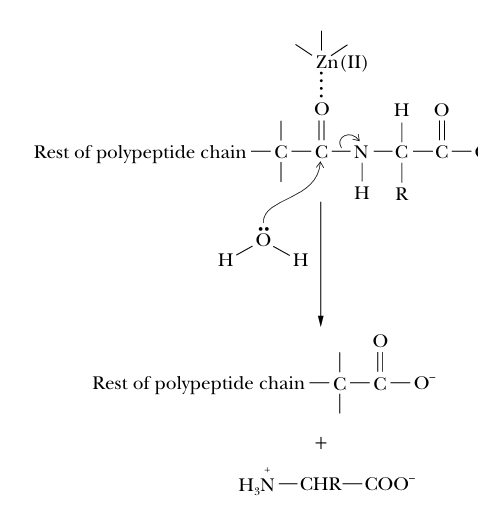
catalyzes hydrolysis of C-terminal peptide bonds of proteins
Zn polarizes the carbonyl group making it susceptible to attack by water and allowing hydrolysis to proceed more rapidly
how does Zn II work with metal ion catalysis
absolute specificity
catalyze reaction of only one substrate to a particular product (lock and key)
relative specificity
catalyzes reaction of structurally related substrates to related products more flexibility in active sites (induced fit model)
sterospecific enzymes
binding site shapes of stereospecific substrate and not its mirror image
transition state
intermediate structure between the substrate and the product

transition state analogues
synthesized compounds that mimic the form of the transition state of an enzyme reaction
Ex) L-proline (tetrahedral carbonyl)—> transition state p(planar carbonyl)—D-proline(tetrahedral carbony but H and COO- reverse) via proline racemase
coenzymes
nonprotein substance that take part in enzymatic reactions and are regenerated at the end of the reaction
cofactors
nonprotein helpers that participate in enzyme reactions and are regenerated afterwards
coenzyme
metal ions