Immune System
 Note
Note Call Kai
 Learn
Learn Practice Test
 Spaced Repetition
 Match
Match Flashcards
 Knowt Play
1/18

There's no tags or description
Looks like no tags are added yet.
Name | Mastery | Learn | Test | Matching | Spaced | Call with Kai | Chat |
|---|
No analytics yet
Send a link to your students to track their progress
19 Terms
What is the role of dendritic cells in the immune response?
Dendritic cells detect invading pathogens, capture their antigens, and present these antigens to Helper T Cells in the lymph nodes.
How do Helper T Cells contribute to the immune response?
Helper T Cells coordinate the immune attack by activating other immune cells such as Killer T Cells, Macrophages, and B Cells.
What is the function of Neutrophils in the immune system?
Neutrophils are the first line of defense that rush to the site of infection and attack pathogens directly with granules or traps (NETs).
What role do Macrophages play in the immune response?
Macrophages engulf and digest pathogens and dead cells, and send signals (cytokines) to recruit more immune cells if needed.
What mechanism do Killer T Cells use to eliminate infected cells?
Killer T Cells seek out and destroy infected cells by triggering them to undergo apoptosis.
What is the purpose of Plasma B Cells in the immune response?
Plasma B Cells produce antibodies specific to the pathogen's antigens, tagging the pathogen for destruction by other immune cells.
What do Memory B Cells do after an infection is cleared?
Memory B Cells retain information about the pathogen, ensuring a faster and more effective response if the same pathogen invades again.
What defines the Innate immune system?
The Innate immune system is the first response and general defense; it attacks anything considered bad and includes Dendritic Cells, Neutrophils, and Macrophages.
What is the role of the Adaptive immune system?
The Adaptive immune system responds after the Innate system and is activated by Dendritic Cells; it provides a specific immune response for one disease.
What is an antigen?
An antigen is a small piece of a pathogen.
What does the term pathogen refer to?
A pathogen refers to anything foreign that can cause harm.
What is the definition of an agent in disease context?
An agent is what must be present for the disease to occur, such as a virus, bacteria, chemical, or physical cause.
How do environmental factors influence disease?
Environment refers to extrinsic factors that impact the agent and opportunity for exposure, including climate, insects, and living conditions.
Who is referred to as the host in a disease scenario?
The host is the human that gets the disease.
What are Component Causes in epidemiology?
Component Causes are individual pie pieces or factors in the development of a disease.
What is a Sufficient Cause in disease causation?
A Sufficient Cause is the complete pie that leads to disease.
What distinguishes a Necessary Cause from other causes?
A Necessary Cause consists of pie pieces that are present in every pie related to that disease.
Why is Rothman’s Causal Pie considered better than the Epidemiology Triangle?
Rothman’s Causal Pie is better because it can also be used for non-infectious diseases, unlike the Epidemiology Triangle.
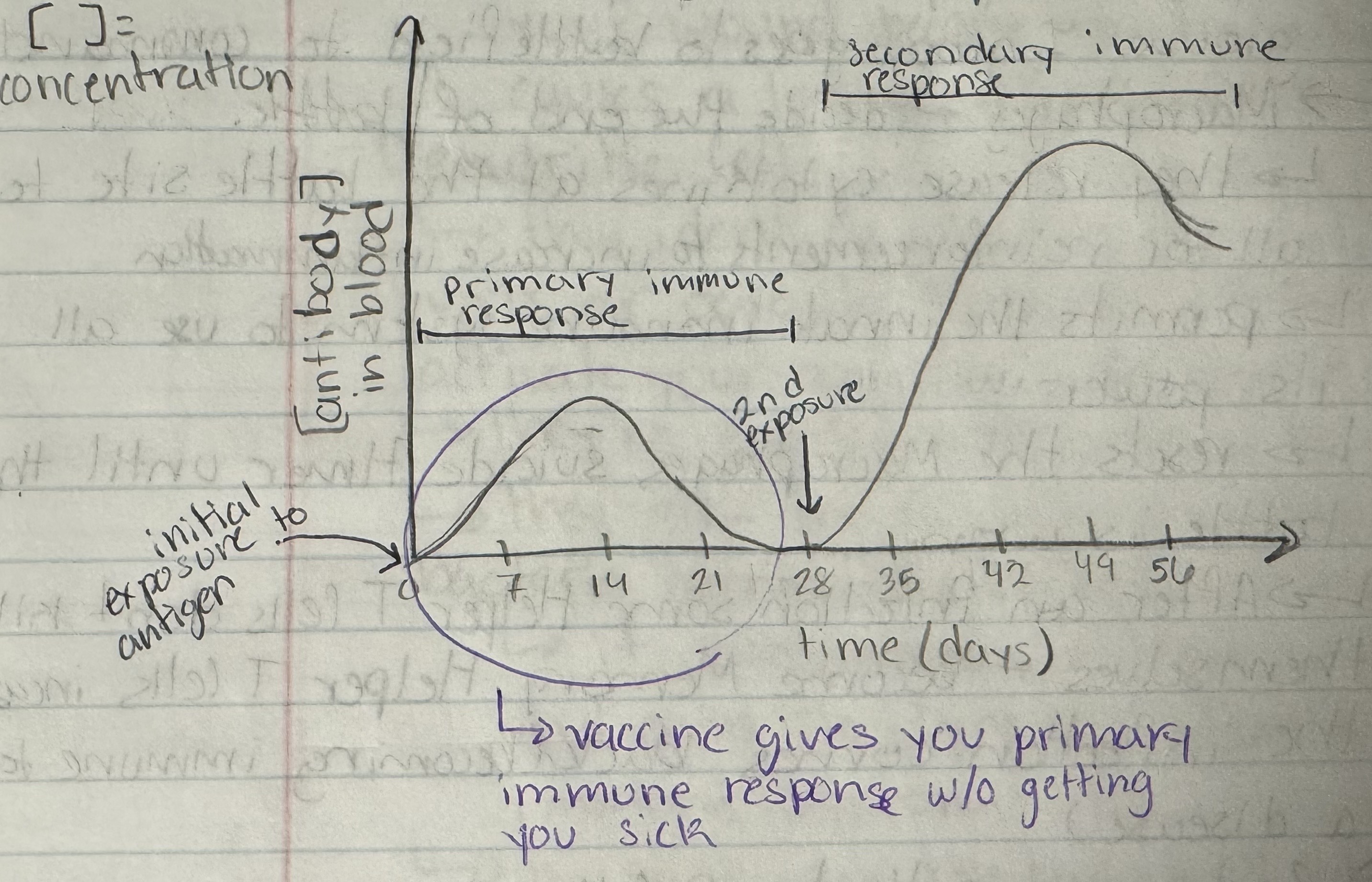
Antibody Production Graph