Xylem and phloem
 Studied by 2 people
 Call with Kai
 Learn
Learn Practice Test
 Spaced Repetition
 Match
Match Flashcards
 Knowt Play
1/29

There's no tags or description
Looks like no tags are added yet.
Name | Mastery | Learn | Test | Matching | Spaced | Call with Kai |
|---|
No study sessions yet.
30 Terms
structure of xylem
long tube like structures formed from dead cells joined end to end with no end walls
what are the strong walls made of?
lignin to prevent tube collapsing
what does the xylem transport?
water and mineral ions in solution
method of water transport in plants
cohesion-tension theory
cohesion tension theory
water evaporates from the leaves at the top of the xylem
creates tension which pulls more water into the leaf
water molecules are cohesive so when some are pulled into the leaf others follow, meaning whole column moves upwards - transpiration pull
water then enters stem through the roots
cohesion tension theory ms
Water lost from leaf because of transpiration / evaporation of water (molecules) / diffusion from mesophyll / leaf cells; OR Transpiration / evaporation / diffusion of water (molecules) through stomata / from leaves
Lowers water potential of mesophyll / leaf cells
Water pulled up xylem (creating tension)
Water molecules cohere / ‘stick’ together by hydrogen bonds
(forming continuous) water column
Adhesion of water (molecules) to walls of xylem;
what is cohesion?
water molecules form hydrogen bonds between one another and hence tend to stick together
what is adhesion?
force between different substances eg water molecules and xylem - aids resisting gravity
what is the transpiration pull?
a column of water is therefore pulled up the xylem as a result of transpiration
evidence to support the cohesion tension theory
when a xylem vessel is broken water doesn’t leak out (it would if under pressure) but instead air is drawn in suggesting tension
what is transpiration?
the evaporation of water from a plants surface
how does water leave the leaves?
water evaporates from the moist cell walls and accumulates in spaces between cells in leaf, then when stomata open they move out by water potential gradient
factors affecting transpiration rate?
light intensity, temperature, humidity and wind
how does light intensity affect transpiration rate?
increases because stomata open when it gets light to let in CO2 for photosynthesis
how does temperature affect transpiration rate?
higher the faster because water molecules have more energy so they evaporate from cells faster increasing water potential gradient between inside and out of leaf
how does wind and humidity affect transpiration rates?
affect the water potential
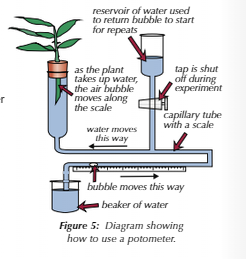
how is transpiration measured?
potometers
potometers
what does phloem transport?
organic solutes which are dissolved substances (usually sugars like sucrose)
what is the structure of phloem?
cells arranged in tubes with sieve tube elements and companion cells
why are there companion cells?
sieve tube elements have no nucleus and few organelles so the companion cells carry out living functions for them eg providing energy needed for AT of solutes
what is translocation?
movement of solutes to where they’re needed in a plant
where does translocation move solutes (assimilates)?
from source where they are produced to sink
what do enzymes do in translocation?
maintain a concentration gradient from the source to sink by changing the solutes at the sink (eg breaking them down) so lower conc
mass flow hypothesis
active transport loads solutes from companion cells into sieve tubes of phloem at source
lowers water potential of sieve tubes so water enters tubes by osmosis
creates high pressure at source end
at sink end solutes removed from phloem increasing water potential in sieve tubes water also leaves by osmosis
lowers pressure at sink end
results in pressure gradient from source to sink end
mass flow hypothesis ms
In source / leaf sugars actively transported into phloem
By companion cells
Lowers water potential of sieve cell / tube and water enters by osmosis
Increase in pressure causes mass movement (towards sink / root)
Sugars used / converted in root for respiration for storage.
supporting evidence of mass flow hypothesis
if section of bark removed that contains phloem, bulge above with high conc of sugars because can’t move so downward flow of sugars
aphids piece phloem and there is quicker fow out out leaves than stem showing pressure grad
radioactive tracker can track organic substances
metabolic inhibitor stops ATP production, translocation stops
objecting evidence for mass flow hypothesis
sugar travels to many sinks not just one with highest water potential
sieve plates would create a barrier to mass flow, lots of pressure would be needed for solutes to go through at reasonable rate
radioactive tracers
CO2 containing radioactive isotope 14C used as radioactive tracer pumped into leaf
radioactive carbon then incorporated into organic substances produced by leaf which then move by translocation
tracked using autoradiography
plant killed then placed on X-ray and if film goes black then radioactive present
ringing experiments
removing outer bark layers in section containing phloem not xylem
swells and sugars accumulate above, tissues below die
suggests phloem responsible for transport of sugar
correlation not causation?