pulse echo tecnique 1
 Call Kai
 Learn
Learn Practice Test
 Spaced Repetition
 Match
Match Flashcards
 Knowt Play
1/28

There's no tags or description
Looks like no tags are added yet.
Name | Mastery | Learn | Test | Matching | Spaced | Call with Kai | Chat |
|---|
No analytics yet
Send a link to your students to track their progress
29 Terms
What does a pulse echo instrument or US unit takes
Takes the following information known about reflections, and turns it into a visual display.
What are three things pulse echo instrument detect ?
Strength of the reflection
Direction of the reflection
Arrival time of the reflection
Components of a pulse echo system included
Signal processor
Image processor
beam former
Display
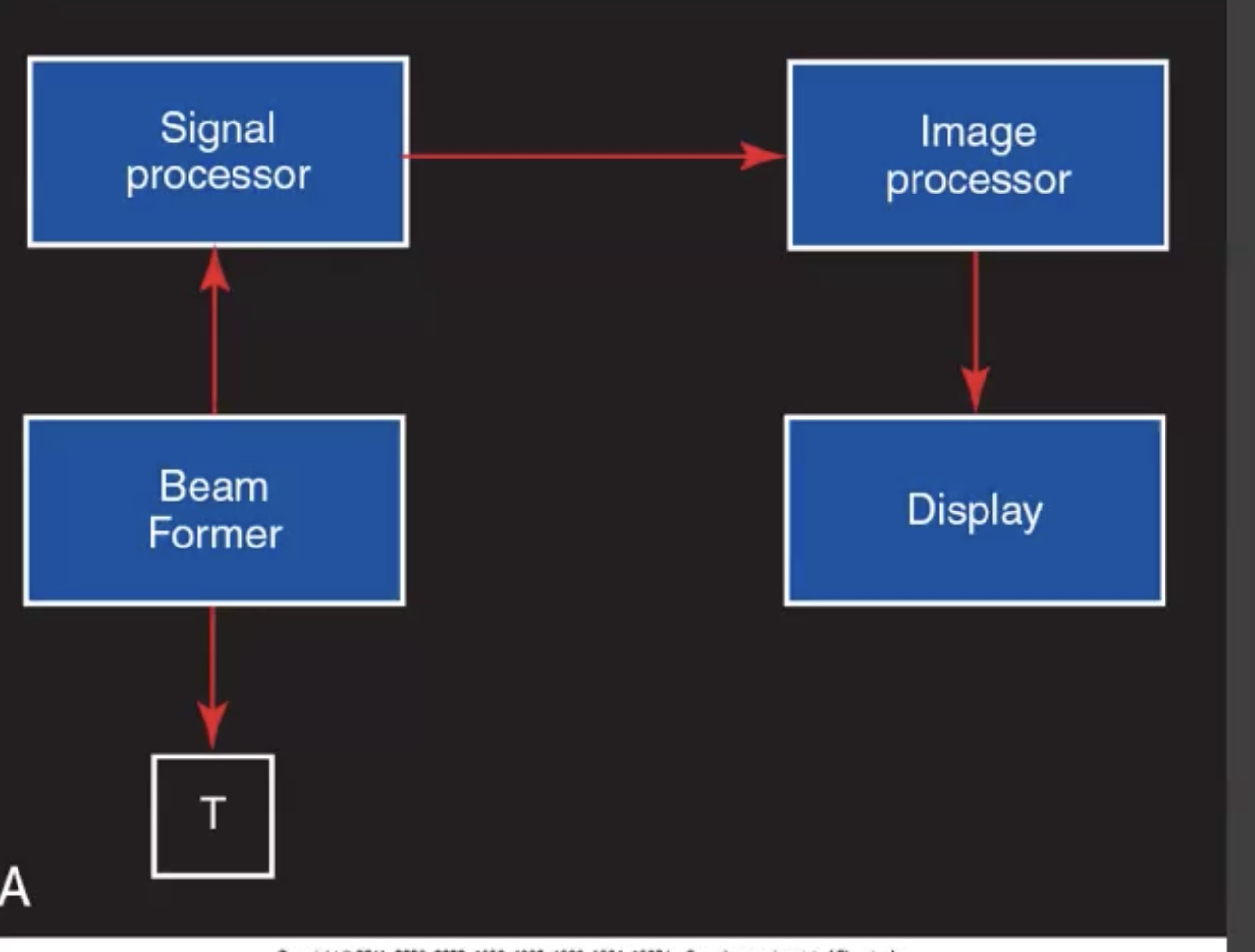
Produces electric voltage pulses that drive the transducer and tell the receiver and memory when the pulses are producer
Pulser
What does pulser determines
PRF: depending on how many times it fires, how many pulses we get.
PRP: which relates to the PRF
Pulse amplitude: the stronger the voltage sent to I the crystal, the higher the amplitude
Voltages pulses produced by the pulser=
US pulses from the transducer
The greater the voltage amplitude
The greater the amplitude and intensity of the US pulse.
For array transducers, the pulser and the beam former control the following.
sequencing
•phasing ( firing elements
•steering
•transmit focusing( when you can move your focal zone around)
•dynamic aperture ( changing the tire or the element to change the focal zone)
•apodization ( remove grading lobes)
what is a transducer use for for ?
converts voltage pulses from the pulser into US pulses
•receives reflection or echoes and converts echo information back into voltage pulse information
What is a signal processor (receiver)
receiver processes voltage information coming from the transducer for the memory and display
What is first receiver functions and what does it do?
Amplification:
conversion of small voltages into larger ones for further processing & storage
•making the signals returning from the transducer larger
•operator adjustable – overall gain
What is the second receiver function and what does it do?
Compensation
equalizes the differences in returning echo information due to depth and attenuation
•operator adjustable – TGC
What is the third receiver function and what do it do)
Compression
process of decreasing the differences between the smallest and largest amplitudes
•Dynamic Range
•ratio in dB of largest power to smallest power that the system can handle
•operator adjustable – , compression, log compression or dynamic range control
What is the fourth ?
Demodulation
process of converting the voltages to another form for easier processing
•done by rectification and smoothing
•not operator adjustable
What is the fifth receiver function
Rejection
eliminates the smaller amplitude voltage pulses produced by weak reflectors or electronic noise
•sometimes operator adjustable – suppression, rejection or threshold control
What is ADC?
Analog to digital converter
What does Scan converter do ?
formats echo data into image form for processing, storage and display
•properly locates each series of echoes corresponding to scan lines to build a frame
•rapid repetitive process to produce a sequence of frames stored in the memory and presented on the display
What is ADC
analog to digital converter
What is scan converter
formats echo data into image form for processing, storage and display
•properly locates each series of echoes corresponding to scan lines to build a frame
•rapid repetitive process to produce a sequence of frames stored in the memory and presented on the display
What is Image processor (memory)
converts the digitized, filtered, detected & compressed scan line data into images
•processed before and after storage in the image memory
What is Preprocessing?
functions performed on the image data before it is stored in the memory
•includes:
•pixel interpolation
•persistence
•panoramic imaging
•spatial compounding
•3D acquisition
What does pixel interpolation?
Assigns a brightness value to missing pixels based on average brightness of adjacent pixels
What does persistence
•averages several frames together
•reduces speckle
What does panoramic imaging do
•image with a wider field of view than an individual frame from the transducer
What do a spatial compounding do?
•scan lines are directed in multiple positions
What is a volume imaging
•acquire 2D slices then process as 3D volumes
•manual acquisition
•automated mechanically scanned transducer
•electronic scanning
What is a presentations?
•surface rendering
•2D slices through the 3D volume
•transparent views
What does a memory do
•storing an image in memory allows display of a single image (freeze-frame)
•a large memory capacity which can store many images for display is cineloop
What does a digital memory do
Computer memory which stores numbers
•each memory board consists of pixels
•usually 512 x 512
•binary number system
•if the memory is made up of a single matrix board, each pixel can store a 1 or 0 (on or off)
•one board = bistable imaging