Concept 23.2: The Hardy-Weinberg equation can be used to test whether a population is evolving
 Call Kai
 Learn
Learn Practice Test
 Spaced Repetition
 Match
Match Flashcards
 Knowt Play
1/8

Name | Mastery | Learn | Test | Matching | Spaced | Call with Kai | Chat |
|---|
No analytics yet
Send a link to your students to track their progress
9 Terms
Evolution
The changing of a species' genes over time, requiring genetic variation alongside other factors
Population
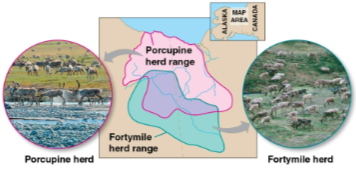
A group of individuals of the same species that live in the same area and interbreed
If geographically isolated, genetic material is rarely exchanged
Individuals typically only breed with members of their own population
Gene pool
All copies of every allele at every locus in all members of the population
Fixed locus
A locus that cannot change due to all individuals in a population being homozygous for the same allele; otherwise, individuals may be homozygous or heterozygous for two or more alleles
Genotype frequency
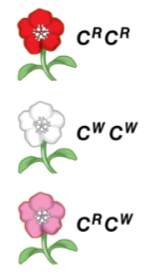
How frequent a specific genotype is in a population
Calculated through the frequency of an individual genotype (like CRCR or CRCW) over the entire population combined
Allele frequency
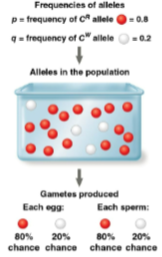
How frequent a specific allele is in a measured population
The total amount of alleles for diploid organisms is the amount of individuals times two
Count two recessive or dominant alleles for each homozygous individual, and one of each allele for each heterozygote
The frequency for each allele takes the number of each allele over the total amount of alleles, adding up to 1 when combining dominant (p) and recessive (q) alleles
p
The letter used to represent the allelic frequency of a dominant allele
q
The letter used to represent the allelic frequency of a recessive allele
Hardy-Weinberg Equation
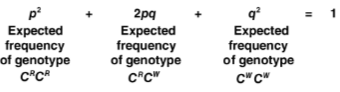
An equation that describes the expected genetic makeup for a population not evolving at a particular locus, resulting in constant frequencies
If the expected makeup differs from the population, evolution may be occurring — either through mutations, selective mating, natural selection, small population size, or gene flow
Expressed as p2 + 2pq + q2 = 1
p2 and q2 represent the expected frequency of homozygous genotypes
2pq represents the expected frequency of the heterozygous genotype
This is calculated separately from genotype frequency, only considering the allele frequency in an observed population