Ecology, Population Dynamics, and Biodiversity Flashcards
 Call Kai
 Learn
Learn Practice Test
 Spaced Repetition
 Match
Match Flashcards
 Knowt Play
1/40

Earn XP
Description and Tags
Vocabulary practice flashcards covering transfers of energy and matter, population dynamics, ecological niches, biodiversity conservation, and environmental adaptations based on the lecture material.
Name | Mastery | Learn | Test | Matching | Spaced | Call with Kai | Chat |
|---|
No analytics yet
Send a link to your students to track their progress
41 Terms

Chemoautotrophs
Organisms that fix inorganic carbon using chemical energy obtained through the oxidation of reduced compounds, supporting ecosystems such as deep-sea hydrothermal vents without relying on sunlight.

Open System
A system, such as an ecosystem, where both energy and matter can freely enter or exit across its defined boundaries.
Detritivore
A type of heterotroph that ingests non-living organic matter (detritus) first and digests it internally (e.g., earthworms, woodlice, and dung beetles).
Saprotroph
An organism that lives in or on non-living organic matter, secreting digestive enzymes into it and absorbing the digestive products (e.g., saprotrophic bacteria and fungi).
10% Rule of Energy Transfer
The principle that only approximately 10% of the energy stored as biomass in one trophic level is converted into biomass at the next trophic level per unit time, with 90% lost via heat, waste, or unconsumed parts.

Pyramid of Biomass
A graphical representation showing the total living dry weight of organic matter (kgm−2) present across different trophic levels within an ecosystem.
Carbon Flux
The movement or rate of exchange of carbon between different environmental reservoirs (such as the atmosphere, oceans, and fossil fuel deposits) within the biosphere.
Methanogenic Archaeans
Anaerobic microorganisms that produce methane gas (CH4) from organic matter in oxygen-free conditions, commonly inhabiting wetlands, marine sediments, and digestive tracts of ruminants.
Keeling Curve
A long-term graph recording atmospheric carbon dioxide (CO2) concentrations over time, displaying annual seasonal fluctuations due to plant growth alongside a steady overall upward trend driven by human fossil fuel combustion.
Population
A group of organisms belonging to the same species living in the same defined geographic area at the same time.
Community
An interacting group of multiple distinct populations of different species living together in a shared geographic location.

Mark-Recapture Method
A field sampling technique used to estimate the total population size of motile animals by capturing, tagging, releasing, and recapturing a subset of individuals.
Carrying Capacity (K)
The maximum population size of a species that a given environment can sustainably support over a period of time based on the availability of limiting biotic and abiotic resources.

Density-Dependent Factors
Environmental factors whose influence on population growth strengthens as population density increases, such as disease, competition for resources, accumulation of waste, and predation.
Density-Independent Factors
Environmental factors that impact population growth and mortality regardless of population density, such as natural disasters, extreme weather, and human habitat destruction.
Top-Down Control
Ecosystem regulation where apex predators manage population dynamics and densities of lower trophic levels through an oscillating cascade effect.
Bottom-Up Control
Ecosystem regulation where population sizes of higher trophic levels are constrained by the availability of energy, nutrients, and primary producers at the base of the food web.

Logistic Growth
A population growth pattern depicted by a sigmoid (S-shaped) curve, characterized by rapid early growth, a transitional slowdown, and an eventual stabilization at carrying capacity (K).
Intraspecific Competition
Competition for limited resources, such as food, water, or territory, occurring between members of the same species.
Mutualism
A symbiotic relationship between two or more different species in which both or all species derive ecological or survival benefits.
Chi-Square Test (χ2)
A statistical hypothesis test evaluated with degrees of freedom df=(r−1)(c−1) to determine if a significant association exists between the distributions of two species sampled in quadrats.
Allelopathy
The release of chemical substances into the environment by plants or microbes that suppress or inhibit the growth, development, or survival of neighboring species (e.g., juglone released by Juglans nigra).
Fundamental Niche
The complete range of environmental conditions and resources under which a species could theoretical survive and reproduce in the complete absence of competition or limiting species interactions.
Realized Niche
The actual set of environmental conditions and resources utilized by a species when constrained by limiting factors, competition, and predation in its ecosystem.
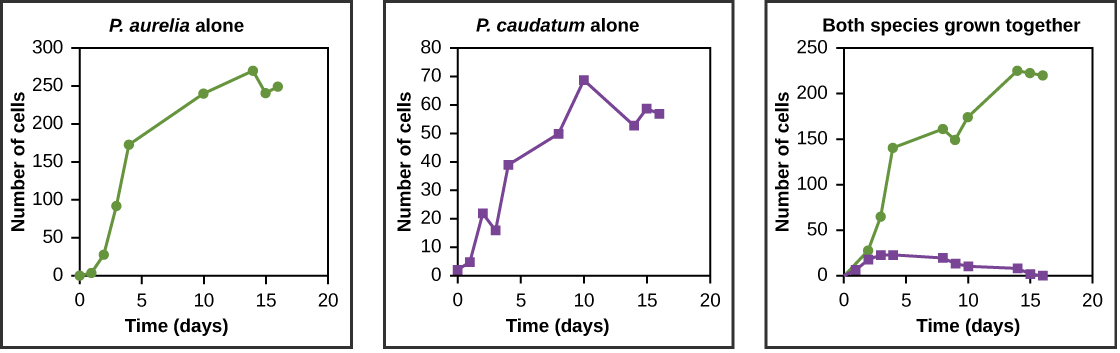
Competitive Exclusion Principle
The ecological concept that two species competing for the exact same limited resources cannot stably coexist if their ecological niches are identical.
Obligate Aerobes
Organisms that rely strictly on oxygen gas (O2) to carry out cellular respiration and cannot survive in oxygen-deprived environments (e.g., Mycobacterium tuberculosis).
Obligate Anaerobes
Organisms that live exclusively in oxygen-free environments because oxygen byproducts are toxic to them (e.g., Clostridium difficile).
Facultative Anaerobes
Organisms capable of producing ATP and surviving in both oxygenated (aerobic) and oxygen-free (anaerobic) environments (e.g., Escherichia coli).
Holozoic Nutrition
A mode of heterotrophic nutrition where organisms take in solid or liquid food internally through ingestion, digestion, absorption, and assimilation.
Mixotrophic Nutrition
A flexible nutritional mode combining autotrophic (photosynthetic) and heterotrophic feeding mechanisms depending on environmental light and resource availability (e.g., Euglenoids).
Diastema
A distinct gap between the front incisors and the cheek teeth (premolars/molars) found in many herbivorous skulls, providing space for manipulating plant matter during feeding.

Stylet
A sharp, straw-like piercing-sucking mouthpart used by specialized herbivorous insects to pierce plant structures and suck sap directly from the phloem.
Epiphytes
Plants that grow on top of host trees solely for physical elevation and structural support to gain sunlight, without taking water or nutrients from the host plant.

Anthropogenic Species Extinction
The loss of biological species directly or indirectly caused by human activities, including resource overexploitation, habitat destruction, pollution, and species introductions.
Lumpers and Splitters
Two taxonomy approaches where lumpers group organisms into broader, fewer categories unless clear differences exist, whereas splitters divide organisms into multiple smaller categories based on fine distinctions.
In Situ Conservation
Conservation approaches focused on protecting species, genetic diversity, and ecosystems within their natural, original habitats (e.g., Masai Mara National Reserve).
Ex Situ Conservation
Conservation strategies executed away from an organism's natural habitat, such as in botanical gardens, seed banks, aquariums, and captive breeding facilities.
EDGE Species
Species targeted by the EDGE of Existence program that are Evolutionarily Distinct and Globally Endangered, often representing unique evolutionary histories with few close relatives.
Biome
A large regional or global biological community classified primarily by its distinctive climate patterns (temperature and precipitation ranges) and characteristic plant vegetation.
Convergent Evolution
The independent evolution of similar physical characteristics or survival adaptations in unrelated species occupying similar biomes and facing comparable selection pressures (e.g., Agave vivipara and Aloe vera).
Zooxanthellae
Photosynthetic unicellular algae that form a crucial mutualistic symbiosis inside the tissues of reef-building corals, providing nutrients and organic compounds in exchange for shelter and carbon.