BIO 1120 EXAM 2
 Call Kai
 Learn
Learn Practice Test
 Spaced Repetition
 Match
Match Flashcards
 Knowt Play
1/41

Earn XP
Description and Tags
Ch. 23, 20, & 17
Name | Mastery | Learn | Test | Matching | Spaced | Call with Kai | Chat |
|---|
No analytics yet
Send a link to your students to track their progress
42 Terms
How has life on Earth changes over time?
Fossil record documents how groups of organisms arise, diversify, and fall over time. Shows macroevolution.
Large scale processes that cause change include continental drift, mass extinction, and adaptive radiation
Examples:
Emergence & speciation of groups of organisms
The impact of mass extinctions on diversity
The origin of key adadptations, such as flight in birds
Adaptive radiation
A single ancestral species rapidly diversifies into a multitude of new forms as they adapt to different ecologocial niches
The fossil record
Sedimentary rock layers, caled strata, are a rich source of fossils
The fossil record is an incomplete record of evolution as most organisms dont fossilize, and we lose many fossils
The fossil record if baised in favor of species that existed for a long time, were abundant and widespread, had shells, skeletons (hard parts).
How rocks and fossils are dated
Radiometric dating determines the absoulte fossil age (measuring the decay of unstable radioactive isotopes into stable daughter products)
Radioactive parent isotopes decay to daughter isotopes at a constant rate
Each isotope has a known half-life, the time required for half the parent isotope to decay
We date ash in the rocks that surround fossils
Geologic record (4 eons)
A standard time scale dividing Earths history into four eons
The Hadean, Archaean, and Proterozoic eons collectively
lasted about 4 billion years
• The Phanerozoic eon captures the last half billion years,
most of the time that animals have existed on Earth
Carbon-12 & Carbon-14 Dating
Carbon-12 content does not change after the death of an
organism; radioactive carbon-14 decays rapidly
• The ratio of carbon-14 to carbon-12 is used to age fossils
up to 75,000 years old
• Isotopes with longer half-lives are used to date volcanic
rock strata above and below older fossils
The Phanerozoic eon
Means visual life
Divided into the Paleozoic, Mesozoic , and Cenozoic eras
• Boundaries between eras correspond to major extinction
events and transitions in the life forms inhabiting Earth
Stromatolites
Layered rock-like structures built by microscopic organisms, primarily photosynthetic bacteria called cyanobacteria
• These are the oldest known fossils (3.5 bya)
• Prokaryotes, including cyanobacteria, were alone on Earth for over 1.5 billion years
Atmospheric oxygen
Photosynthetic prokaryotes released oxygen, which started accumulating in the atmosphere (2.7 bya)
• Many organisms went extinct, but eukaryotes arose (1.8 bya) and flourished in the oxygen-rich atmosphere
• Multicellular eukaryotes arose (1.3 bya) followed later by plants, fungi, and animals that eventually moved to land
Tetrapods
Named for their four (tetra) limbs (pod, foot)
Amphibians
Repitiles
Mammals
Traits distinguishing mammals from other tetrapods
Single lower jaw bone (many in tetrapods)
Different bones form the jaw hinge
Three inner ear bones (one in tetrapods)
Specialized teeth (undifferentiated in tetrapods)
Origin of mammals
Mammals originated gradually over 120 million years ago from tetrapod ancestors called synapsids
• Many fossil organisms have morphological features intermediate between living mammals and synapsids
• Mammals are the only surviving lineage of the synapsids
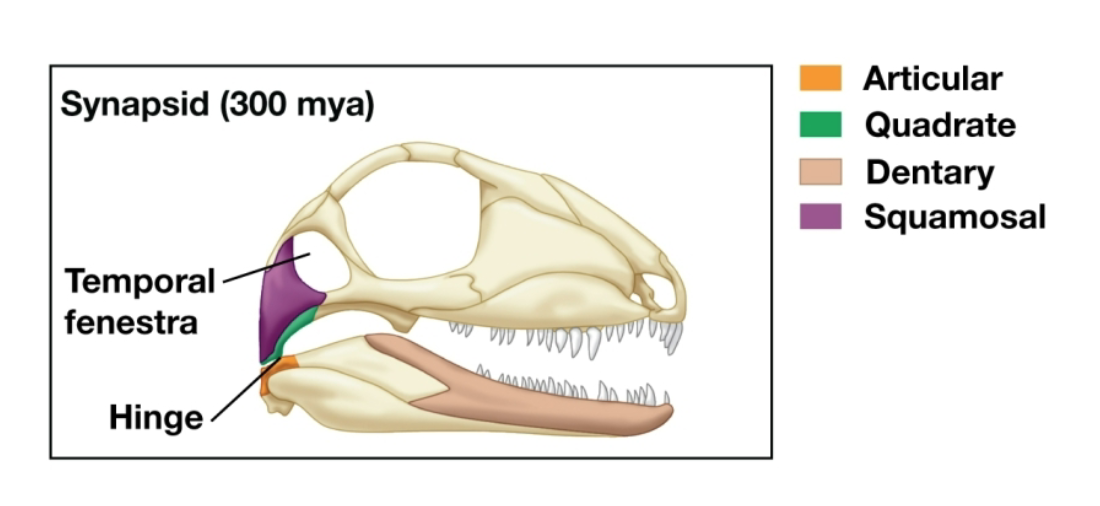
Synapsids (300 mya)
Multiple bones fromed from the lower jaw
Jaw hinge formed by articular and quadrate bones
Temporal fenestra, holes behind the eye sockets (provided space for cheek muscles controlling the jaw)
Single pointed teeth

Therapsids (280 mya)
Large dentary bones and long faces
Articular-quadrate jaw hinge
Englarged temporal fenestra moved in front of the jaw hinge (larger cheeck muscles moved further away from jaw hinge increased bite strength and precision)
First specialized teeth, including large canines

Early cynodonts (260 mya)
Dentary bone largest in lower jaw
Articular-quadrate jaw hinge
Large temporal fenestra further forward of the jaw hinge
First teeth with several cusps

Later cynodonts (220 mya)
Lower and upper jaws hinged in two locations (Original articular-quadrate jaw hinge retained, new hinge formed by dentary and squamosal bones)
Temporal fenestra retained
Teeth with complex cusp patterns
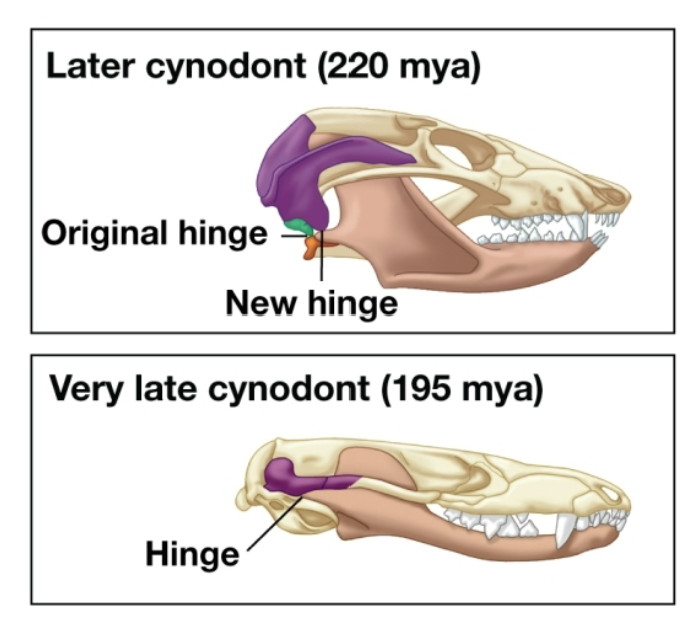
Very late cynodonts (195 mya)
The original articular-quadrate jaw hinge was lost in some (Living mammals have only dentary-squamosal hinges)
Articular and quadrate bones moved to the inner ear, forming the hammer (malleus) and anvil (incus) bones
These bones function in sound transmission
Plate tectonics
The continents of Earth move over time (ex: three times they have joined to form a supercontinent that later broke apart)
Describes continents as plates of Earths crust floating on the hot, underlying portion of the mantle (the mechanism that tells us how the continents move)
Continental drift occrs when movements of the mantle cause movements of the overlying plates
Oceanic and continental plates can separate, slide past eachother, or collide
Interactions between plates can cause earthquakes and the formation of mountains and islands
Consequences of continental drift & Pangaea effects
Alters habitats, triggering extinctions and speciation
The formation of the supercontinent Pangaea about 250 million years ago had many effects
- A deeping of ocean basins
- A reduction in shallow marine habitat
- A colder and drier climate inland
Climate change as a consequence of continental drift
Climate changes on continents as they drift between higher and lower latitudes.
It drives adaptation, movement to new locations, and extinction of organisms.
Allopatric speciation as a consequence of continental drift
Allopatric speciation can occur when land masses separate and populations become isolated
– For example, frog subfamilies Mantellinae and Rhacophorinae diverged after Madagascar separated from India
Geographical distributions of organisms as a consequence of continental drift
Continental drift helps to explain puzzling geographic distributions of organisms in the fossil record
– For example, fossils of the same species can be found on continents divided by whole oceans
– This can be explained if the continents were joined together in the past
Mass Extinctions
In each mass extinction, 50% or more of marine species became extinct
The fossil record shows that most species that have ever lived are now extinct
Extinction can be caused by habitat destruction, unfavorable environmental change, or biological factors
Disruptive global environmental change can cause mass extinctions and rapid extinction of many species worldwide
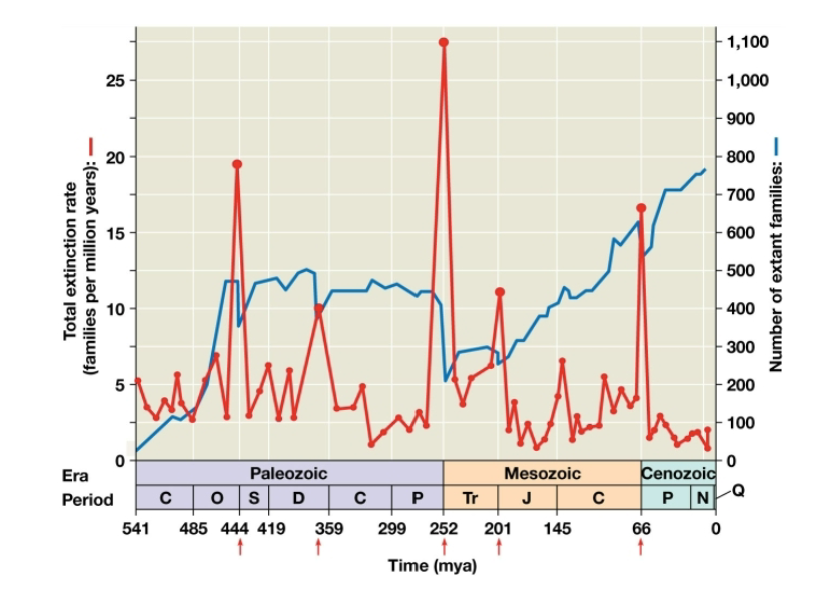
The big five mass extinction events
There have been 5 mass extinctions over the past 500 million years, in each, 50% or more marine species became extinct
The Permian mass extinction (252 mya)
The great dying
The Permian mass extinction (252 mya) marks the bondary between the Paleozoic and Mesozic eras (96% or marine animal species and 8 out of 27 known insect orders were lost)
Catastrophic events triggered by extreme volcanism likely contributed to the Permian mass extinction
Volcanic eruptions emitted CO2 triggering rapid warming and the loss of temperature-sensitive species
Ocean acidification reduced the calcium carbonate required to support reef- and shell-building organisms
Oxygen depletion and the rise of poisonous hydrogen sulfide producing anaerobic bacteria killed marine life
The Cretaceous Mass Extinction (66 mya)
Marks the boundary between the Mesozoic and Cenozoic eras (killed dinosaurs)
More than half of all marine species and many terrestrial plants and animals, including all dinosaurs (except birds), went extinct
The presence of iridium in sedimentary rocks suggests an asteroid impacted Earth about 66 million years ago
Debris clouds caused by the impact would have blocked sunlight and disturbed the global climate
The chicxulub crater off the coast of Mexico is evidence of a large asteroid collision that dates to the same time
Consequences of Mass Extinctions
Dramatically alters ecological communities and permanently removes evoluntionary lineages
Typically takes 5-10 million years for diversity to recover
The types of organisms can change with mass extinction
Unknown spikes in predators after mass extinctions
Can removed lineages with novel and advantageous features (they may return slowly or be permanantly lost)
-EX: shell drilling gastropods went extinct at the end of the Triassic period, and 120 million years passed before shell drilling evolved again
Adaptive Radiations
Periods of rapid evolution in which groups of organisms form many new species, the new species have adaptations favoring different ecological roles.
Adaptive radiations have occurred following mass extinctions, the evolution of major innovations, and the colonization of new regions.
Mammal Adaptive Radiation
Mammal fossils older than 66 million years are mostly small and lacking morphological diversity
An adaptive radiation occurred in mammals after the Cretaceous Mass Extinction of terrestrial dinosaurs (66 mya)
Mammals expanded in both diversity and size, filling the ecological roles once occupied by the dinosaurs

Notable worldwide adaptive radiations
Rise of photosynthetic prokaryotes
Evolution of large predators in the early Cambrian
Colonization of land by plants, insects, and tetrapods
Evolutionary innovations that facilitated life on land accompanied the radiation of terrestrial organisms
Adaptive radiations in one group of organisms can provide new food sources, causing radiations in other groups (ex: the diversification of plants on land stimulated radiations in insects that fed on plants)
Regional Adaptive Radiations
Adaptive radiations can occur when organisms colonize new environments with little competition
The Hawaiian archipelago has many examples of this type of adaptive radiation (ex: silverswords diversified following colonization by an ancestral tarweed about 5 mya)
Effects of development genes
Developmental genes alter the rate, timing, and spatial pattern of changes during an organisms development
Heterochrony
An evolutionary change in the rate or timing of developmental events
Adult body shape is partly dependent on the relative growth rates of different body parts (in humans the jaw grows slowly relative to the rest of the skull, minimizing shape change)
Increased growth rates of finger bones produce the skeletal structure for wings in bats
Paedomorphosis
The development of reproductive organs accelerates relative to other organs
A form or heterochrony (alterned timing of reproductive organs)
In paedomorphosis, the sexually mature stage retains body features typical of juveniles in an ancestral species
Homeotic genes
Determine the organization of body structures during development
Ex: where wings and legs will develop on a bird or a how flower parts are arranged on a plant
Alteration of these master regulatory genes can cause substantial evolutionary change
Hox genes
Affect the position of body parts in animals
Changes to Hox genes or their expression can produce body parts in atypical locations
MAD S-box genes have a similar positional effect on flower formation in plants
Changes in Gene Sequence
New developmental genes likely facilitated the origin of novel morphological forms (EX: six-legged insects likely evolved from many-legged crustacean ancestor through changes to the Hox gene Ubx that turns off leg development)
Changes in developmental gene regulation also likely played an important role in the evolution of body form (EX: the reduction of spines in freshwater threespine sticklebacks is due to differences in gene regulation compared to marine sticklebacks)
Evolutionary Novelties (Eyes)
Many complex structures evolved incrementally from simpler versions that performed the same basic function (EX: different types of complex eyes evolved from simple clusters of photoreceptor cells)
The simplest eyes are patches of light-sensitive photoreceptor cells that can distinguish light from dark (EX: limpets (molluscs) have photoreceptors that trigger behavioral defenses when they fall under a shadow)
Complex eyes have evolved independently from simple photosensitive cells many times (some mollusc eyes are as complex as humans and other vertebrates)
Exaptations
Structures that evolved in one context but became co-opted for another function
Doesnt imply that structures evolve in anticipation of future use
Natural selection can only improve a structure in the context of its current utility
Evolutionary Trends
Extracting a single evolutionary progression from the fossil record can be misleading
Apparent trends must consider all fossils, even the extinct lineages (EX: a trend towards large, single-toed species is appararent in the horse lineage, but only if extinct species are excluded)
Evolutionary trends do not imply an intrinsic drive toward a particular phenotype
Systematics
Used to reconstruct phylogenies and classify organisms based on evolutionary relationship
Phylogeny
The evolutionary history of a species or a group of related species.
Phylogenies show how traits are shared due to common ancestory. Classifies organisms into groups that reflect their evolutionary history.
A phylogeny shows that glass lizards and snakes evolved from different-legged lizards.