physical injuries-asphyxia
 Call Kai
 Learn
Learn Practice Test
 Spaced Repetition
 Match
Match Flashcards
 Knowt Play
1/67

There's no tags or description
Looks like no tags are added yet.
68 Terms
Definition and types of physical injuries
• Injuries from physical agents • Heat (local→burn, systemic→heat illness), Cold, Electricity, Pressure, Radiation, Starvation
Definition of burn & manner of infliction
• Tissue injury of external body surface from heat, radiation, chemicals, or electricity • Manner: Mostly accidental > homicidal (battered child/concealing death) > suicidal
Types of burns
• Dry: Flame (contact w/ flame), Contact (hot object ≥70°C), Radiant heat (no contact) • Moist (scalds): hot liquid/steam • Chemical (corrosions) • Microwave • Electric (electrocution)
Factors determining severity/prognosis of burns
• Age (extremes worse)
• Sex (females more neurogenic shock)
• General health (chronic disease = worse)
• Intensity of heat
• Duration of exposure
• Site (neck/chest/abdomen bad; perineum worst)
• Depth
• Extent (TBSA) – most important
Rule of Nines (adult)
• Head & neck = 9% • Each upper limb = 9% • Anterior torso = 18%, Posterior torso = 18% • Each lower limb = 18% • Perineum = 1% • 33% TBSA = grave prognosis; 50% = expected fatal
1st degree burn
• Epidermis only • Blister-free, dry, painful, red (e.g., sunburn) • Heals 3–6 days
2nd degree burn
• Epidermis + part of dermis • Painful, swollen, red, blistering • Superficial partial: 7–20 days • Deep partial: >21 days
3rd degree burn
• Full thickness (epidermis + entire dermis), reaches subcutaneous tissue • White/leathery/blackish, necrotic, painless (nerve destruction) • Heals in months; needs skin graft
4th degree burn
• Penetrates muscle/bone • No sensation (nerve destruction) • Heals in months; needs skin graft
Important note on burn depth
• Surface appearance does NOT necessarily indicate depth of injury
Jackson's burn zones (1947)
• Zone of coagulation (center, irreversible)
• Zone of stasis (can be saved with adequate resuscitation, or lost if inadequate)
• Zone of hyperemia (outermost, recovers)
• Zones are 3D; tissue loss in stasis zone → wound deepens & widens
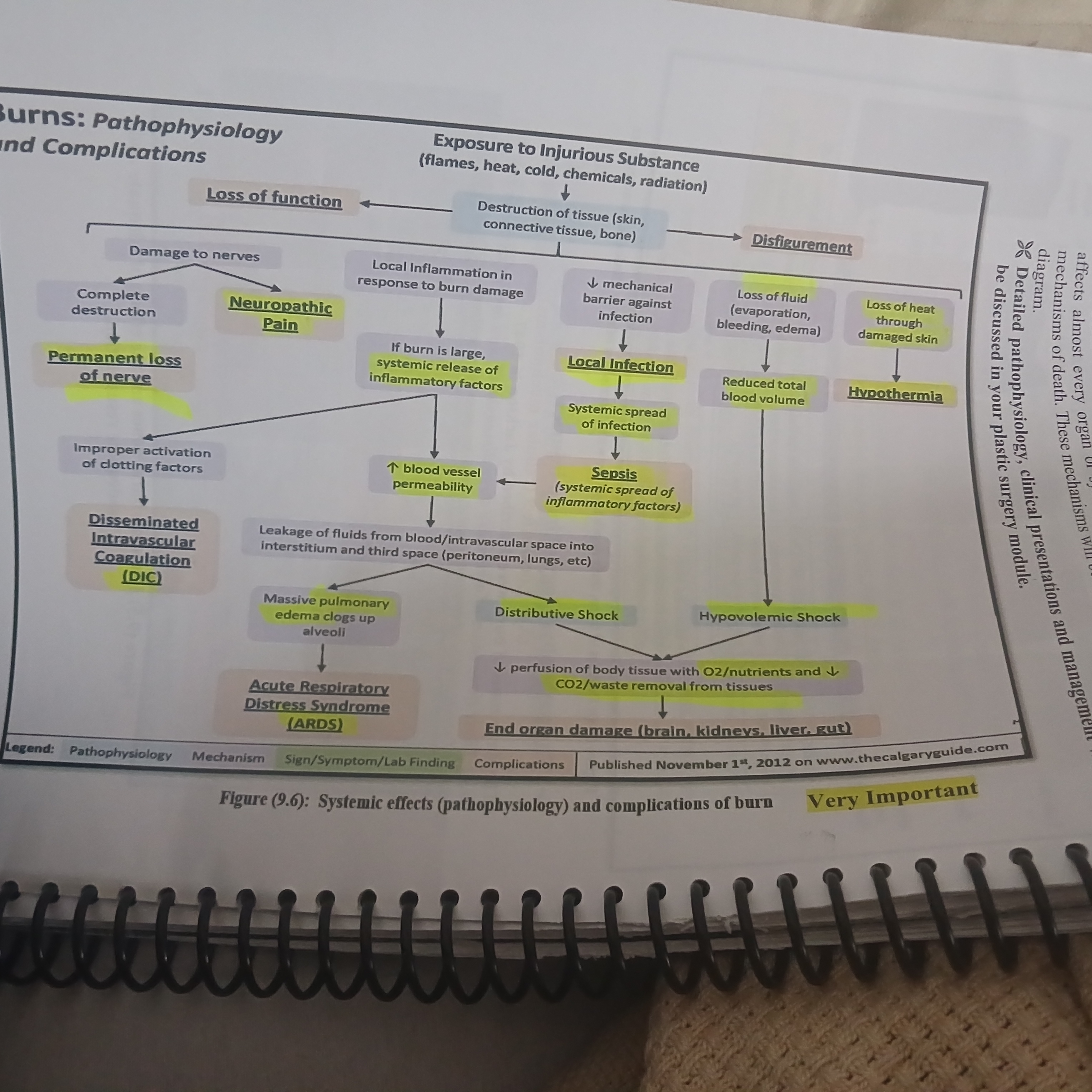
Systemic effects of burns (>20% TBSA)
• Loss of fluid → hypovolemic shock
• ↑ vascular permeability → fluid leakage → ARDS/pulmonary edema
• Local infection → sepsis → distributive shock
• DIC from clotting factor activation • Heat loss through skin → hypothermia
• Nerve damage → neuropathic pain or permanent loss
• End organ damage (brain, kidney, liver, gut)
Scalding burn definition & types
• Definition: injury from steam or liquid >60°C • Types: Immersion, Splash/spill, Steam burns (may cause laryngeal/tracheal/respiratory burns → ARDS)
Scalding burn manners & distribution
• Homicidal: child abuse, domestic homicide
• Accidental: splash = multiple/varying depth; spill = face, neck, upper chest, arms (children pulling hot liquid)
• Water at 70°C → full thickness burn
• Clothing protects skin
• Fluid cools as it flows down → less severe distal burns
Heat-related illness definition & types
• Definition: disorders from overexposure to heat/exertion causing thermoregulation dysfunction
• Heat cramps: muscle cramps + profuse sweating + Na/Cl loss
• Heat exhaustion: sweating, water/salt depletion, cold clammy skin, nausea, headache
• Heat syncope: dizziness/fainting, pale moist cool skin, weak pulse, rapid HR, normal temp
Heat stroke definition & risk factors
• Definition: body overheating, core temp ≥40°C, most serious heat illness, needs emergency care
• Risk factors: hot/humid environment, age (>65, infants), obesity/dehydration/exertion/poor clothing/sleep deprivation, chronic disease, anticholinergic medications
Heat stroke pathophysiology stages
• Compensatory: ↑metabolic rate → ↑core temp → sweating → ↑cardiac output
• Noncompensatory: hypovolemia → ↓central venous pressure → ATP depletion, cellular anoxia, systemic inflammation, BBB breakdown → CNS derangement → heat stroke → death
Heat stroke symptoms
• Core temp ≥40°C
• Mental status change (confusion, seizures, coma)
• Sweating change (hot dry skin in weather-induced; profuse sweat in exertional)
• Nausea/vomiting
• Flushed skin
• Rapid breathing
• Tachycardia
• Headache
Heat stroke complications
• Multiorgan failure within 24–48h
• DIC, ARDS, renal/cardiac/hepatic failure
• Rhabdomyolysis
• Electrolyte disturbances (hypocalcemia, hyperkalemia, acidosis)
Electrocution definition & manner
• Definition: passage of electric current through body → pain, muscle contraction, burns, cardiac arrest, respiratory failure, death • Manner: Accidental (most common), Homicidal (rare/torture), Suicidal (rare), Judicial (electric chair)
- Factors related to affected person (electrocution)
• Two-point contact needed (entry/exit) • Resistance: bone/cartilage/skin high; blood/muscle/nerve low; dry/thick skin = more resistance (irrelevant in high voltage) • Age: children more susceptible • State of health: comorbidities ↑ complications
Mechanisms of electricity-induced injury
• Depolarization of nerves/muscles → abnormal cardiac/brain rhythms, muscle tetany
• Conversion to thermal energy → tissue destruction, coagulative necrosis
• Mechanical injury from falls or violent contractions
Clinical picture of electrocution - Shock & burns
• Shock: unconsciousness, weak rapid pulse, hypotension, dyspnea, cold clammy skin
• Low-voltage burn: entry (palms/fingertips), exit (soles); central collapsed blister/crater, chalky white, yellow/black; 1-1.5cm; absent in 50% of low-voltage cases
• High-voltage burn: destroyed skin/subcutaneous tissue, exposed vessels/nerves/bone, charred, possible limb loss/organ rupture
muscle spasm
Muscular spasm effects in electrocution
• Gripping the conductor
• Propelling the body
• Fractures (scapula, humerus, femoral neck, thoracic vertebrae)
• Rhabdomyolysis
• Respiratory paralysis
Mechanisms of death due to electrocution
• Direct: Central asphyxia (brainstem)
, violent asphyxia (chest spasm)
, cardiac arrhythmias
, cardiac arrest (VF=low voltage AC; asystole=high voltage AC/DC)
, electric burns
• Indirect: Trauma, fire-related burns
ML responsibilities in thermal/electric injury cases
• Emergency management considering age/comorbidities/pathophysiology
• Consent may be waived in emergencies
• Treat as MLC, especially suspected suicide/homicide/torture/abuse; full body exam for entry/exit points
• Photograph patterned burns •
Detailed MLR: degree, extent (TBSA), distribution, prognosis, death mechanism
Types of shock (overview)
• Hypovolemic
• Neurogenic •
Sympathetic storming
• Septic
Hypovolemic shock
Definition: reduced tissue perfusion from inadequate O2/nutrient delivery •
Causes: hemorrhagic shock (most common), large burns (2nd/3rd/4th degree)
Timing: depends on age/health/rate; fatal if blood loss ≥1.5L; pericardial >200-250cc = tamponade; pleural/peritoneal >500cc = fatal
• Clinical: restless/agitation, pale cool skin, hypotension, tachycardia, oliguria, death
Neurogenic shock
Definition: hemodynamic instability from sympathetic disruption with preserved parasympathetic
• Causes: spinal cord injury, severe fear/anxiety, vagus stimulation
• Timing: manifests within 2h of trauma
• Clinical: bradycardia/arrhythmias, profound hypotension, cold clammy skin
Sympathetic storming
Definition: episodes of increased sympathetic activity •
Causes: acute multiple trauma, traumatic brain injury
• Timing: as early as first 24h, often delayed
• Clinical: hypertension, tachycardia, arrhythmias, hyperthermia, pupillary dilation, profuse sweating
Sepsis & septic shock
Definition: sepsis-induced hypotension persisting despite fluid resuscitation
• Causes: trauma-impaired immunity, infections •
Timing: within first 48h
• Clinical: altered mental status, fever >38°C or <36°C, hypotension, tachycardia, tachypnea, oliguria/anuria, WBC>12,000 or <4000
• Diagnosis: suspected infection + ≥2 above criteria
Pulmonary thromboembolism
Definition: clot from elsewhere lodges in lung vessels, restricts blood flow, ↑pulmonary arterial pressure
• Timing: immediate, early (within 3 days), or late (day 5-7)
• Predisposing: pelvic/long bone fractures, hypercoagulable states (shock/sepsis/hypoxia), immobility
• Clinical: sudden dyspnea, sharp chest/arm/shoulder/neck/jaw pain, cough ± blood, pale/cyanotic skin, tachycardia, sweating
Fat embolism
Definition: intravascular fat blocks blood flow; common after long bone fractures (femur, tibia, pelvis)
• Timing: gradual onset 12-72h after injury •
Predisposing: orthopedic trauma/surgery, soft tissue damage/burns, crush injury
Clinical: dyspnea, neurologic changes (confusion/headache/seizures), petechial rash (eyes/axilla/chest), tachycardia, fever, jaundice
Arterial gas (air) embolism
Definition: bubbles in artery block organ blood supply → ischemia; more serious than venous
• Causes: penetrating/blunt chest trauma (bronchopulmonary venous fistula), migration via right-to-left shunt
• Clinical: rapid LOC/neurological impairment, coronary embolism → arrhythmia/cardiac failure/arrest
Venous air embolism (VAE)
Definition: air enters vein → travels to pulmonary circulation
• Causes: blunt head trauma w/ open cranial fractures, penetrating/blunt chest trauma, cut-throat (uncommon but consider) •
Clinical: chest pain, cyanosis, dyspnea, shock, hemoptysis/bloody froth (PE)
Curling's ulcer
Causes: severe trauma, massive burns
• Site: esophagus, stomach (fundus/body), duodenum
• Timing: early OR late (>2 weeks, duodenum, chronic signs)
• Mechanism: splanchnic hypoperfusion → mucosal ischemia;
↓bicarbonate → acid mediated damage
excess bile with burn toxins → breaks mucosal barrier allowing H+ ions to backflow and harm mucosa
• Complication: perforation & bleeding
Cushing ulcer
Causes: ↑intracranial tension from traumatic brain injury •
Site: stomach & duodenum
• Timing: 3rd stage of Cushing triad
• Mechanism: ↑ICP stimulates vagus → ↑gastric acid → mucosal ulceration
• Complication: deep perforation & bleeding
DIC (disseminated intravascular coagulopathy)
• Definition: systemic coagulation activation → fibrin deposition → microthrombi → multiorgan dysfunction; consumes clotting factors → hemorrhage
• Causes: crush injury, head injury, burns/heat stroke, sepsis, fat embolism
• Timing: fibrinolytic phase = acute trauma (bleeding/death); late phase = multiorgan dysfunction in 24-48h
• Clinical: recent severe infection/trauma/obstetric history, bleeding from multiple sites, indicates site of hemorrhage or occlusion
ARDS (adult respiratory distress syndrome)
Definition: acute diffuse lung injury - poor oxygenation, pulmonary infiltrates
• Causes: shock, fat embolism, gastric aspiration (comatose), near drowning
• Timing: begins 24-48h after injury
• Clinical: dyspnea, tachypnea, tachycardia, chest pain, low BP, confusion
ML responsibilities - trauma complications
Strong suspicion + understanding pathophysiology essential •
Prevention, early diagnosis, timely intervention = standard of care
evaluate patient Consider age and comorbidities
l Protocol adherence protects against malpractice
• PTCs don't remove MLC status
Asphyxia definition & types of anoxia
• Asphyxia: inadequate O2 to tissues • Anoxic anoxia: O2 not entering/lungs can't oxygenate • Anaemic anoxia: reduced O2 carrying capacity of blood • Stagnant anoxia: slowed circulation • Histotoxic anoxia: cells can't use delivered O2
- Causes of anoxic anoxia
• Ambient: high altitude, irrespirable gas (CO2/N2) • Central: CNS depressant overdose (morphine), electrocution • Paralytic: botulism, poliomyelitis • Mechanical (violent asphyxia): smothering, strangulation/throttling/hanging, traumatic asphyxia, choking, drowning, glottic edema • Vascular: pulmonary embolism
- Causes of anaemic anoxia
• Chemically combined Hb: CO poisoning, methemoglobinemia • Hemolysis: naphthalene, arsine gas, viper venom, favism, incompatible transfusion • Hemorrhage
- Causes of stagnant & histotoxic anoxia
• Stagnant: advanced heart failure, vagal/histaminic shock • Histotoxic: cyanide poisoning, extreme cold exposure
- Violent mechanical asphyxia classification
• Compressional: on mouth/nose (smothering); on neck (hanging/ligature strangulation, manual strangulation/throttling); on chest/abdomen (traumatic/positional asphyxia) • Obstructive: solid foreign body (choking); liquid (drowning)
- Classic external signs of asphyxia
• Cyanosis: bluish discoloration (lips, nose tip, nailbeds, ear lobes, tongue tip); needs ≥5g reduced Hb/100mL • Petechial hemorrhages: pinpoint (0.1-2mm), from acute venous pressure rise, in lax tissue (eyelid, pleura, epicardium) • Dark blue hypostasis: from deficient oxygenation
- Hanging definition & types
• Definition: violent death by suspending body with ligature around neck; constricting force = body weight (whole or part) • Complete: body suspended, not touching ground, full body weight • Incomplete/partial: body part touches ground, partial weight (sitting/kneeling/lying)
Hanging - facial signs
• Face pale (complete hanging - both carotid & vertebral occluded) or congested (incomplete - only carotid occluded, vertebral still supplies)
• Subconjunctival petechiae + prominent eyeballs •
Tongue protrudes, swollen, cyanotic
• Dribbling saliva at mouth angle (antemortem sign)
• Head tilted opposite to suspension point
Hanging - neck & other body signs
• Other: cyanosis of fingernails, partial penile erection, involuntary urination/defecation, glove-and-stocking lividity (if prolonged suspension)
Mechanisms of death in hanging
• Cerebral ischemia (most important): carotid/vertebral artery stretch from body weight •
Anoxic anoxia: larynx lifted, tongue root presses palate
• Reflex cardiac inhibition: carotid sinus/body stimulation → vagal shock
• Spinal cord-brainstem disruption: C2-C3/C3-C4 fracture-dislocation (judicial hanging, 4-10ft drop)
Manner of death & sequelae - hanging
• Suicidal: most common
• Accidental: children w/ ropes/banisters, workmen falling from scaffold
• Homicidal: very rare (postmortem to conceal crime, or antemortem on senile/unconscious victim)
Ligature strangulation - definition & clinical picture
• Definition: violent asphyxia by ligature constriction without suspension •
Face: markedly congested/cyanosed, petechiae, proptosis, subconjunctival hemorrhage, bloody discharge from nose/mouth/ears (absent if death = reflex cardiac inhibition) •
Ligature mark: low (below thyroid), transverse, complete, deep; area below ligature paler
Manual strangulation (throttling) - clinical picture
• Facial signs as in ligature strangulation, except pale face if reflex cardiac inhibition
• Neck signs: crescentic fingernail abrasions and contusions (may be absent if interfering material e.g. collar)
Strangulation - mechanisms of death & manner
• Ligature: anoxic anoxia (most important), reflex cardiac inhibition, cerebral ischemia (strong force), delayed glottic edema
• Manual/throttling: reflex cardiac inhibition (most important, vagal shock), anoxic anoxia, delayed glottic edema
• Manner - Ligature: homicidal (most common, struggle evidence), accidental (children/ropes, umbilical cord), suicidal (very rare)
• Manner - Manual: often homicidal
Smothering - definition & external picture
• Definition: mechanical occlusion of nose/mouth (hand, cloth, pillow, plastic bag)
• External: classic asphyxia signs WITHOUT facial venous congestion; multiple fingernail contusions/abrasions around nose/mouth (absent if soft object used); lip/gum/tongue contusions; lacerated inner lips from teeth pressure
Smothering - mechanism & manner
• Mechanism: anoxic anoxia
• Manner: Homicidal (infants/elderly/unconscious), Accidental (plastic bag/sheet over child's head, infant prone in pillow), Suicidal (plastic bag, very rare)
Choking - definition, mechanism & manner
• Definition: asphyxia from internal airway obstruction •
Mechanism: reflex cardiac inhibition (laryngeal trauma), anoxic anoxia (complete/partial obstruction + laryngospasm + mucus)
• Manner: Accidental (dust/sand inhalation, foreign body impaction - food/coin/teeth/vomit/blood), Homicidal (infanticide, pushing cloth into mouth/pharynx of unconscious adults)
Traumatic asphyxia
• Definition: mechanical fixation of chest preventing respiratory movements
• Mechanism: anoxic anoxia + injury to vital organs
• External: congestion of head/neck/upper trunk with petechiae, chest/abdomen contusions, line of demarcation •
Manner: Accidental (building collapse, crush under car, crowd/riot crush), Homicidal (Burke & Hare "burking")
Positional asphyxia
• Definition: body confined in position/restricted space impairing breathing •
Mechanism: anoxic anoxia
• External: classic asphyxia signs, body confined/wrapped restricting movement
• Manner: Accidental (entrapment, esp. children), Homicidal (forced position limiting lung expansion)
Drowning - definition & types
• Definition: asphyxia from submersion of mouth/nose in fluid; complete body submersion not necessary
• Typical wet drowning: classical, water inhaled/swallowed/lodged in lungs
• Atypical dry drowning: laryngospasm prevents water entry; best for resuscitation
True drowning mechanism - anoxic anoxia
• Accidental submersion → loss of breathing pattern → panic/struggle/laryngospasm → pulmonary aspiration/apnea → hypoxemia → hypoxia/hypercarbia/acidosis → end-organ damage & circulatory arrest
Drowning in fresh water - mechanism
• Hypotonic water absorbed from lungs → enters circulation → hemodilution → heart overload
• Also lysis of RBCs → release of potassium → hyperkalemia → cardiotoxic effect → death
Drowning in salt water - mechanism
• Hypertonic water → withdraws fluid from circulation into lungs → pulmonary edema + asphyxia
• Hemoconcentration → hypovolemia → circulatory shock → myocardial anoxia → shock → cardiac standstill → death
Non-drowning mechanisms of death
• Death before water entry: natural (convulsion/heart attack) or unnatural (body disposal to conceal cause/identity)
• Traumatic injuries: faulty diving, striking objects, boat accidents
• Reflex vagal inhibition: cold water rush into nasal sinuses/pharynx/larynx, sudden cold immersion •
Dry drowning (<10%): laryngospasm before lung entry, lungs appear dry
• Delayed bronchopneumonia (near/secondary drowning): initial recovery then deterioration from pulmonary edema/aspiration pneumonia/electrolyte imbalance
Drowning - sure signs (drowning process)
• Cyanosis • Froth: abundant, white (or bloody), odorless, recurs after chest pressure; from violent respiration mixing water+exudate+surfactant
• Dark blue hypostasis
• Cadaveric spasm: ATP depletion in hand muscles → firmly clutched weeds/mud/sand/gravel; fingernail abrasions in palms
Drowning - probable signs (body in water)
• Wet, muddy skin/clothes • Cutis anserina (goose skin)
• Palms/soles: 1-2.5h = corrugated/pale/sodden (washerwoman's skin); weeks = peeling in glove/stocking pattern
• Postmortem injuries: fish bites, propellers, rocks
• PM changes in water: cooling 2x faster; hypostasis dark blue in head/neck/shoulders; adipocere in 3wks-6months; putrefaction takes double time
Drowning - manner of death
• Accidental: most common (drunk, narcotic, epileptic in shallow water)
• Suicidal: next common (may tie feet/weights) •
Homicidal: rare (infants/children, pushing unaware person); absence of sure signs if concealing murder
ML responsibilities - violent asphyxia victims
• Provide treatment per presentation (neuro symptoms, ischemia, anoxia, arrhythmia, electrolytes)
• Monitor 48h for delayed death (hanging, strangulation, near-drowning)
• Written consent from non-emergency conscious adults/relatives
• Preserve evidence (ligature, cloth) - air dry, hand to authorities •
Detailed diagrammed MLR • All cases = MLC, notify police of admission/discharge/death
• If death: no death certificate, no body release, keep in