7.1 Adaptations, Interdependence & Competition
 Call Kai
 Learn
Learn Practice Test
 Spaced Repetition
 Match
Match Flashcards
 Knowt Play
1/48

There's no tags or description
Looks like no tags are added yet.
Name | Mastery | Learn | Test | Matching | Spaced | Call with Kai | Chat |
|---|
No analytics yet
Send a link to your students to track their progress
49 Terms
Define an individual.
Single organism of specific species
Define a population.
All organisms of same species living together in habitat
Define a community.
All populations of different species living together in habitat
Define competition.
Different organisms compete for same resources in ecosystem
Limits population sizes + stimulates evolutionary change
![<ul><li><p>The image shows what the extinct Siberian rhinoceros (<em>Elasmotherium sibiricum</em>) might have looked like.</p></li><li><p>The horn of the Siberian rhinoceros is estimated to have been 150 cm long.</p></li></ul><p>Suggest one advantage of this adaptation to the Siberian rhinoceros. [1 mark]</p>](https://assets.knowt.com/user-attachments/d05a94a2-f957-4836-98ea-c2b3c9dd9276.png)
The image shows what the extinct Siberian rhinoceros (Elasmotherium sibiricum) might have looked like.
The horn of the Siberian rhinoceros is estimated to have been 150 cm long.
Suggest one advantage of this adaptation to the Siberian rhinoceros. [1 mark]
Competing for food
What are the levels of organisation in an ecosystem?
individual → population → community → ecosystem
What is the definition of an ecosystem?
Interaction of a community of living organisms (biotic) w/ the non-living (abiotic) parts of their environment
To _________ and ___________, organisms require a supply of materials from their _______________ and from the other ___________ _____________ there.
survive
reproduce
surroundings
living organisms
What do plants in a community or habitat compete for?
Light
Space
Water
Mineral ions
What so animals compete for?
Food
Mates
Territory
Within a ____________ each species depends on other species for ______, shelter, ___________, seed dispersal etc.
If one species is ___________ it can affect the whole _____________.
This is called __________________.
community
food
pollination
removed
community
interdependence
What is the definition of interdependence?
The dependence of different organisms on each other for survival.
What is meant by a stable community?
One where all the species and environmental factors are in balance — population sizes remain fairly constant.
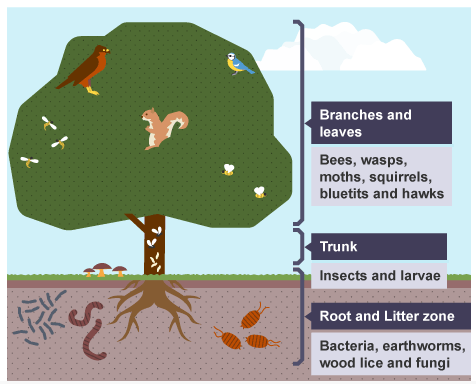
What are examples of stable communities? (3)
Tropical rainforests
Oak woodlands
Coral reefs
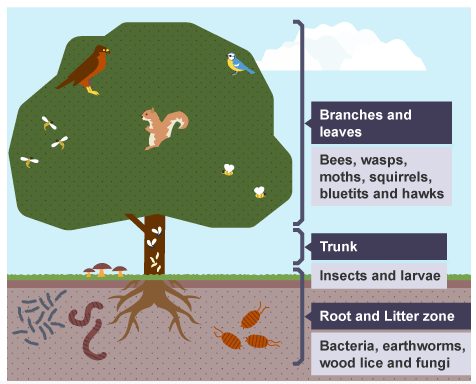
What is the definition of an abiotic factor?
The non-living aspects of an ecosystem.
What are some abiotic (non-living) factors which can affect a community? (7)
light intensity
temperature
moisture levels
soil pH and mineral content
wind intensity and direction
carbon dioxide levels — plants
oxygen levels — aquatic animals
Explain the effect of a change in light intensity on a community.
Light — needed for photosynthesis
Rate of photosynthesis — affects plant growth rate
Plants = food sources/shelter for other organisms
Explain the effect of a change in temperature on a community.
Temperature — affects rate of photosynthesis
Rate of photosynthesis — affects plant growth rate
Plants = food sources/shelter for other organisms
Explain the effect of a change in moisture levels on a community.
Animals and plants need water to survive.
Explain the effect of a change in soil pH and mineral content on a community.
Soil pH — affects rate of decay → speed that mineral ions return to soil (taken up by other plants)
Different species of plants thrive in different nutrient concentration levels
Explain the effect of a change in wind intensity and direction on a community.
Wind — affects rate of transpiration (movement of water from roots → leaves) in plants
Transpiration — affects temperature of plant and rate of photosynthesis (transports water and mineral ions → leaves)
Rate of photosynthesis — affects plant growth rate
Plants = food sources/shelter for other organisms
Explain the effect of a change in carbon dioxide levels on a community.
CO2 — affects rate of photosynthesis
Rate of photosynthesis — affects plant growth rate
Plants = food sources/shelter for other organisms
Affects distribution of organisms — some thrive in high CO2 environments
Explain the effect of a change in oxygen levels (aquatic animals) on a community.
O2 levels vary greatly in water
Most fish need high concentration of O2 to survive
What is the definition of a biotic factor?
The living aspects of an ecosystem.
What are the biotic factors which can affect a community? (4)
availability of food
new predators
new pathogens
one species outcompeting another — numbers are no longer sufficient to breed
Explain the effect of food availability on a community.
More food = organism breed more successfully → population increase
Explain the effect of new predators on a community.
New predator = decrease in prey population
Existing predators — less food → have to compete → decrease in predator population
Explain the effect of new pathogens on a community.
New pathogen — population has no resistance to it → decrease in population
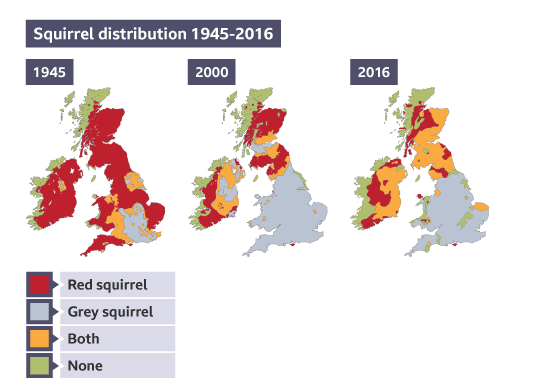
Explain the effect of competition on a community.
If one species is better adapted to the environment — it will outcompete
Until numbers of lesser adapted species are insufficient for breeding
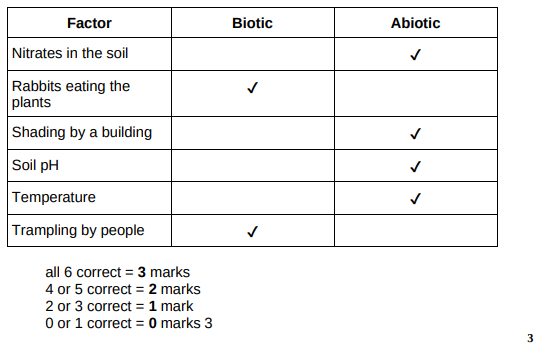
The growth of daisy plants on a lawn is affected by biotic factors and by abiotic factors.
The table below shows six factors.
Factor | Biotic | Abiotic |
A — Nitrates in the soil | ||
B — Rabbits eating the plants | ||
C — Shading by a building | ||
D — Soil pH | ||
E — Temperature | ||
F — Trampling by people |
Choose one box in each row to show whether the factor is biotic or abiotic. [3 marks]
A — abiotic
B — biotic
C — abiotic
D — abiotic
E — abiotic
F — biotic
What is the definition of an adaptation?
A feature of an organism — increases its chance of survival in its environment.
Organisms have features (___________) that enable them to ___________ in the conditions in which they normally live.
adaptations
survive
What can adaptations be? (3)
Behavioural
Structural
Functional
What is meant by a structural adaptation?
Shape or colour of a part of an organism
What are examples of structural adaptations? (3)
Sharp teeth (carnivore) — tear meat apart
Camouflage — avoid predators/prey spotting them
Thick layer of fat (insulation) — keep warm in cold environments
What is meant by a behavioural adaptation?
The way an organism behaves.
What are examples of behavioural adaptations? (3)
Playing dead — avoiding predators
Basking in sun — absorb heat
Courting behaviour — attract a mate
What is meant by a functional adaptation?
Involved in processes — e.g. reproduction and metabolism
What are examples of functional adaptations? (2)
Late implantation of embryos
Producing little sweat — conserves water
What are extremophiles?
Organisms that live in environments that are very extreme.
Some organisms live in environments that are very ________ — such as:
high _____________
high _________
high ______ ____________
These organisms are called _____________.
Bacteria living in _____ ____ _______ are ______________.
extreme
temperature
pressure
salt concentration
extremophiles
deep sea vents
extremophiles
What are some examples of adaptations for cold climates? (2)
Smaller SA:V — reduces heat loss
Lots of insulation — e.g. blubber, fur coat
What are some examples of adaptations for dry climates? (4)
Adaptations to kidneys — retain lots of water → produces very concentrated urine
Being active in early mornings and evenings — it is cooler
Larger SA:V — increases heat loss
Resting in shady areas
What are some examples of plant adaptations? (4)
Curled leaves — reduces water loss
Extensive root systems — takes in lots of water
Waxy cuticle — stops water evaporating
Water storing tissue in stem
![<ul><li><p>The stone plant, <em>Lithops bromfieldi,</em> is adapted to live in very dry deserts. </p></li><li><p><strong>Figure 1</strong> shows several stone plants.</p></li><li><p>The stone plant has many adaptations that help it to survive in the desert. </p></li></ul><p>Draw <strong>one</strong> line from each adaptation to how the adaptation helps the stone plant to survive. [4 marks]</p>](https://assets.knowt.com/user-attachments/ef05fe61-5472-4a3b-ade9-74667b7c13e0.png)
The stone plant, Lithops bromfieldi, is adapted to live in very dry deserts.
Figure 1 shows several stone plants.
The stone plant has many adaptations that help it to survive in the desert.
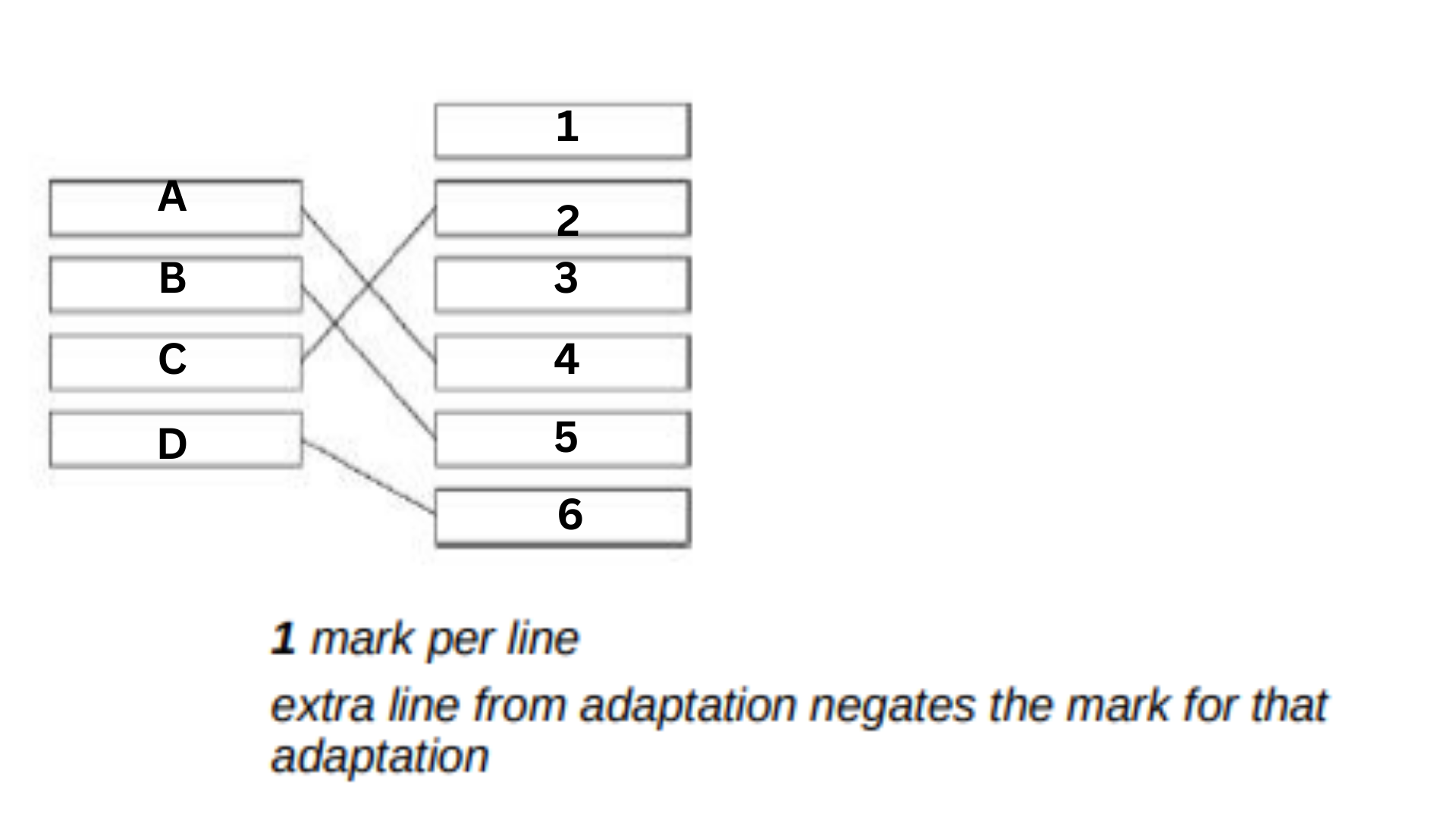
Draw one line from each adaptation to how the adaptation helps the stone plant to survive. [4 marks]
A — 4
B — 5
C — 2
D — 6
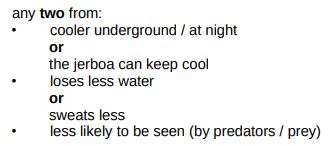
![<ul><li><p>The jerboa is a small desert animal.</p></li><li><p><strong>Figure 2</strong> shows a jerboa.</p></li><li><p>The jerboa is adapted for survival in the desert. </p></li><li><p>The jerboa spends the daytime in its underground burrow. </p></li><li><p>The jerboa only leaves its burrow to look for food during the night.</p></li></ul><p>Describe how these adaptations help the jerboa to survive in the desert. [2 marks]</p>](https://assets.knowt.com/user-attachments/8b5c773e-eb6c-46c7-a2d9-e60ccda3c7e3.png)
The jerboa is a small desert animal.
Figure 2 shows a jerboa.
The jerboa is adapted for survival in the desert.
The jerboa spends the daytime in its underground burrow.
The jerboa only leaves its burrow to look for food during the night.
Describe how these adaptations help the jerboa to survive in the desert. [2 marks]
The jeroba can keep cool
It loses less water as it sweats less
![<ul><li><p>The jerboa is a small desert animal.</p></li><li><p><strong>Figure 2</strong> shows a jerboa.</p></li><li><p>The jerboa is adapted for survival in the desert. </p></li><li><p>The jerboa spends the daytime in its underground burrow. </p></li><li><p>The jerboa only leaves its burrow to look for food during the night.</p></li></ul><p>What type of adaptations are described? [1 mark]</p><p>Choose <strong>one</strong> box.</p>](https://assets.knowt.com/user-attachments/f05e6c96-90d5-4955-9ef5-a87e8d344d73.png)
The jerboa is a small desert animal.
Figure 2 shows a jerboa.
The jerboa is adapted for survival in the desert.
The jerboa spends the daytime in its underground burrow.
The jerboa only leaves its burrow to look for food during the night.
What type of adaptations are described? [1 mark]
Choose one box.
Behavioural
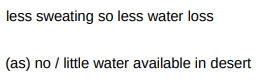
![<ul><li><p><strong>Figure 1</strong> shows a type of camel called a dromedary (<em>Camelus dromedarius</em>). </p></li><li><p>The dromedary lives in hot, dry deserts.</p></li><li><p>One adaptation of the dromedary is ‘temperature tolerance’. </p></li><li><p>This means that the animal’s body temperature can rise by up to 6 °C before it starts to sweat. </p></li></ul><p>Explain how temperature tolerance can help the dromedary to survive in the desert. [2 marks]</p>](https://assets.knowt.com/user-attachments/5dc6ab46-a259-458d-93ba-7fce876466fc.png)
Figure 1 shows a type of camel called a dromedary (Camelus dromedarius).
The dromedary lives in hot, dry deserts.
One adaptation of the dromedary is ‘temperature tolerance’.
This means that the animal’s body temperature can rise by up to 6 °C before it starts to sweat.
Explain how temperature tolerance can help the dromedary to survive in the desert. [2 marks]
Less sweating so less water loss
As there is little water available in the desert
![<ul><li><p><strong>Figure 1</strong> shows a type of camel called a dromedary (<em>Camelus dromedarius</em>). </p></li><li><p>The dromedary lives in hot, dry deserts.</p></li><li><p>One adaptation of the dromedary is ‘temperature tolerance’. </p></li><li><p>This means that the animal’s body temperature can rise by up to 6 °C before it starts to sweat. </p></li><li><p>Three more adaptations of the dromedary are given in <strong>Figure 1</strong>. </p><ul><li><p>Fat store</p></li><li><p>Hard mouth</p></li><li><p>Produces little urine and dry faeces</p></li></ul></li></ul><p>Give a reason why each adaptation helps the animal survive in the desert. [3 marks]</p>](https://assets.knowt.com/user-attachments/7138e8e0-8ec2-4e00-8908-631492b70af6.png)
Figure 1 shows a type of camel called a dromedary (Camelus dromedarius).
The dromedary lives in hot, dry deserts.
One adaptation of the dromedary is ‘temperature tolerance’.
This means that the animal’s body temperature can rise by up to 6 °C before it starts to sweat.
Three more adaptations of the dromedary are given in Figure 1.
Fat store
Hard mouth
Produces little urine and dry faeces
Give a reason why each adaptation helps the animal survive in the desert. [3 marks]
Fat store — can be metabolised to water
Hard mouth — not damaged by spines on plants
Produces little urine and dry faeces — conserves water