Botany Exam 1
 Call Kai
 Learn
Learn Practice Test
 Spaced Repetition
 Match
Match Flashcards
 Knowt Play
1/138

There's no tags or description
Looks like no tags are added yet.
Name | Mastery | Learn | Test | Matching | Spaced | Call with Kai | Chat |
|---|
No analytics yet
Send a link to your students to track their progress
139 Terms
What kingdom are plants in?
Plantae
Are plants Eukarotic or Prokaryotic?
Multicellular Eukaryotes
Are plants Autotrophs?
Yes, also some are photo autotrophic (photosynthesis)
How do plants store carbohydrate energy?
As starch
What are plants cell walls composed of?`
Cellulose
Do plants lack locomotion?
Yes, plants are sedentary
Plants produce _____
Embryos
Where did plants originate from?
Aquatic organisms
What were the ancestors of plants and how many years ago?
Green Algae (Phylum Chlorophyta), 450 MYA
What features do plants have that help them colonize land and water?
Roots, Conductive Tissue, Cuticles, Stomata
How many species of flowering plants are there? Where are most of them located?
300,000-450,000; most are in tropics.
Plants form the basis for most _______ ecosystems
Terrestrial
Plants are used to define what?
Terrestrial Biomes
What two things do Bryophytes lack?
Lack seeds and vascular tissue
How do bryophytes reproduce?
Reproduce through spores
What generation is dominant in bryophytes?
Gametophyte (1n=Haploid)

Which generation here is dominant?
Gametophyte
What size are bryophytes traditionally?
Small (short) plants
Where are bryophytes traditionally found?
Moist environments (Forests, Wetlands, Arctic)
Can bryophytes withstand dry cycles?
Some bryophytes can withstand dry cycles (desert, rocks)
What are bryophytes the transitional between
Green algae and vascular plants
Who are the typical earliest land plants
Bryophytes
What sexual factor do bryophytes have?
Motile Sperm
What trait do bryophytes have that are shared with with all plants (embryo-bytes)?
Retain multicellular embryo
What type of pollen do bryophytes have that are the protective coating on its spores?
Sporopollenin - the most resistant biochemical known
Liverwarts are a type of _____
Bryophyte
How many species of liverworts are there?
6000
Liverwortd are classified as _____ and _____ plants
Thalloid or Leafy
Liverworts have a Thallus. What is a thallus
Undifferentiated plant body
What two things do liverworts lack
Leaves and Stems
What is attached to liverworts?
Rhizoids
Do liverworts have a stomata?
No
Livereworts have a _______ _______ with pores
Rudimentary Cuticle
Do liverworts have a stomata?
Yes, Liverworts have a stomata
The system of branching of Riccia gametophytes is __________
Dichotomous
Liverworts achegoniophores?
The female reproductive structure of liverworts, located elevated on stalks
Liverwort Antheridiophores
The male reproductive structure of liverworts, located elevated on stalks.
What are Gemma cups used for in liverworts?
Asexual reproduction They contain Gemma which are splashed out of the cup during rain, which then reproduce new gametophytes which are genetically identical to the parent plant.
Do mosses have a stomata (sporangia)?
Only some of them have a stomata!

What is this structure?
Archegonia in mosses - Female reproductive organ.
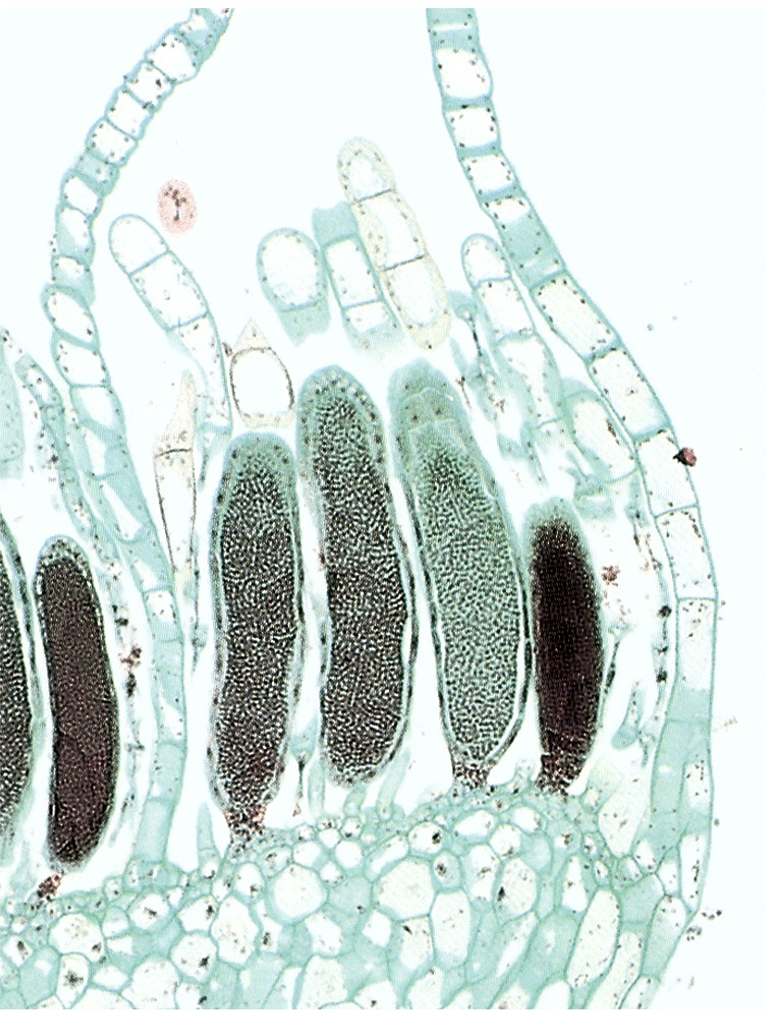
What is this structure?
Antheridia in mosses - male reproductive structure.
Who are Sphagnidae similar to?
Similar to permian fossils around 290 MYA
What is the operculum and what does it do?
sporangium lid blows out launching spores
What % of earth does sphagnum cover?
1% = half the US
What is a unique characteristic of sphagnum?
Decays very slowly and stores CO2, also forms peat
What do granite mosses look like?
–Small blackish green or dark red brown tufted mosses
Where do granite mosses live?
mountainous or arctic regions on rocks
How do granite mosses discharge spores?
Through slits in moisture driven capsules
What is the common name for Bryidae?
True Mosses
What do Bryidae protonema resemble?
Green Algae
DO bryidae have a precursor conduting tissue (sporophyte)?
Yes, bryidae have a sporophyte.
What structure do capsules have in bryidae?
Peristome teeth
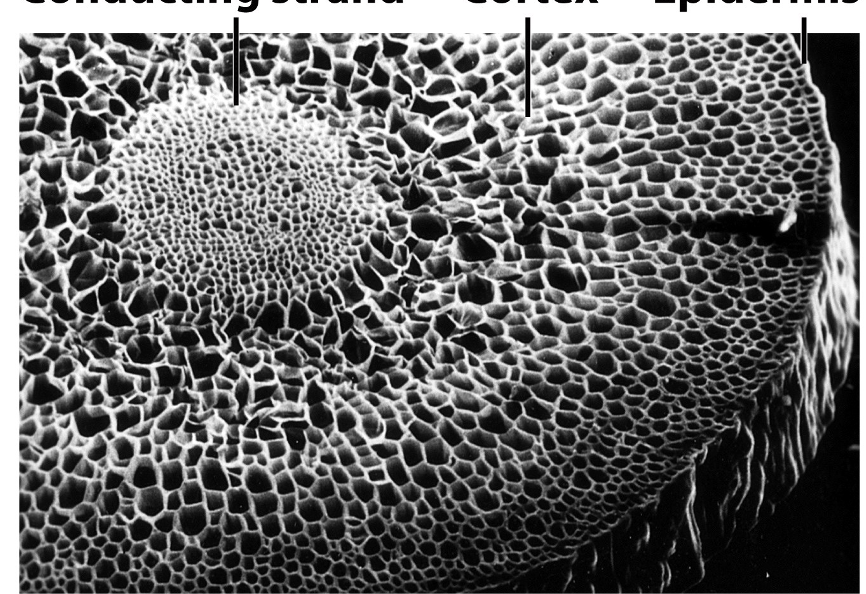
What three structures are depicted in this image of a cross section of a bryidae? from left to right?
Conducting strand, cortex, epidermis
What is the purpose of peristome teeth in mosses?
To open and release spores.
What species of bryophyte have internal cavities inhabited by Nostic?
Hornworts
What are hornworts known for in the environment?
Nitrogen fixation
What do hornworts resemble?
Thalloid liverworts
What traits to sporophyte hornworts have?
Sporophytes have a stomata with guard cell
In hornworts, is the sporophyte elongated (horns)?
Yes, the sporophyte is elongated in hornworts.
In hornworts, sporophytes may grow _______
indeterminately
What are the evolutions for terrestrial life in Vascular Plants?
Sporophytes have cuticles, stomata
Evolution of efficient conducting tissues
Xylem & Phloem
Evolution of structural support
Secondary cell walls with lignin
Evolution of differentiated organs for photosynthesis and acquisition of water & nutrients
Stems, Leaves, Roots
What did vascular plant sporophytes start as?
Basic, undifferentiated axis (stems)
What enabled indeterminate growth and differentiation of the plat body in vascular plants?
Apical meristem enabled indeterminate growth and differentiation of the plant body in vascular plants
When did secondary growth of vascular plants begin?
280 MYA
Mycorrhiza formed mostly ______ symbioses with plants
Mutualistic
What is the etymology of mycorrhizae?
Fungus-Root
Mycorrhizae is found in what percent of plant families?
90%
When did mycorrhizae highly coevolve?
>400MYA
What aspects of mycorrhizae were crucial to land colonization?
Provision of P, other nutrients, and water,
Vascular tissue
Apical Meristem
–Found in early vascular plant fossils, extant bryophyte thalli
Which tissue was preserved the best in in vascular tissue evolution?
Xylem
Which tissue was 1st in origination for mycorrhizae?
Tracheids
Vessels originated in _____ ______ in vascular plants
Multiple Lineages
In the development of vascular tissue in vascular plants, which is like the vascular cylinder?
Stele
What are some characteristics of protostele?
Evolved first
Found in some seedless vascular plant shoots
Found in most roots
What are some characteristics of Estelle
(discrete strands around pith)
•Evolved directly from protostele
•Found in the seed plant shoots
What are some characteristics of siphonostele?
•Evolved independently from protostele
•Found in the other seedless vascular plant shoots

What are the types of vascular tissue shown in this cross section of vascular plants from left to right?
Protostele, siphonostele with no leaf gaps, siphonostele with leaf gaps, and eustele
What do we known about the evolution of roots and leaves in vascular plants?
Roots are more like ancestral stems, leaves are appendages of stems
Microphylls
–Predominantly with protosteles, no gaps
–Single strand of vascular tissue
Megaphylls
–With siphonosteles or eusteles
–Complex vascular system
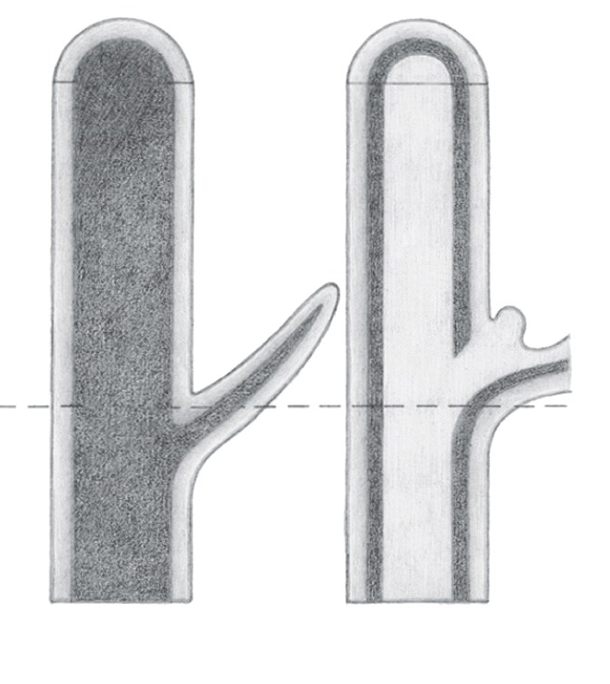
What are the cross sections of these vascular plants?
Protostele with microphyll and Siphnostele with megaphyll

What is this image depicting?
(A)microphylls evolved as outgrowths, called enations, of the main axis of the plant., (B)Megaphylls evolved by fusion of branch systems.
In vascular plants, there was a shift of dominance in what?
Sporophyte became dominant, larger and independent. Gametophytes became reduced, but still independent as well.
Vascular plants shifted from homosporous to what?
Heterosporous
What are the names of the phyla of vascular plants and how long are?
(375-290MYA)
–Lycopodiophyta
•Club mosses, Selaginella, Quillworts
–Monilophyta
•Ferns, Psilotum, Horsetails
–Progymnosperms
Ancestors of seed plants
In Gymnosperms, what was the major advancement in the colonization of land?
Seeds
What developed in some seedless vascular plants
Heterospory with microgametophytes and megagametophytes
Seeds evolved as dispersal unit for new sporophytes and gave plants a huge ______ ________
Competitive advantage
With seeds, what were some of the competitive advantages
Protected embryo and provided nutrition at a critical developmental stage.
What is some general information about megagametophtyes in Gymnosperms
•Megagametophyte is retained on sporophyte
–Develops in ovule (integuments, megasporangium, megaspore)
megagametophyte develops in megasporangium
–New sporophyte develops in the megagametophyte
–Megagametophyte & megasporangium (nucellus) becomes nutritive tissue
What is some general information about megasporangium in Gymnosperms
Megasporangium doesn’t open
Megasporangium produces only one functional megaspore
What developed from intugements in gymnosperm?
Seed coat
In seed coats in gymnosperms, where is the sporophyte tissue from and what allows the entry of male gametes?
Previous generation, micropyll
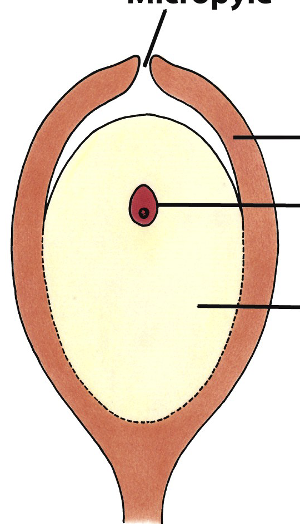
Label this seed in gymnosperms in clockwise order
Micropyll, integument, functional megaspore, megasporangium (nucellus)
In reproduction of gymnosperms, where is the megagametophyte retained?
Sporophyte
In reproduction of gymnosperms, can there be multiple archegonia?
Yes, there can be polyembryony
What is dispersed in reproduction of gymnosperms?
Microgametophytes
What delivers delivers male gametes through micropyle in some gymnosperms
Pollen tubs
In gymnosperm, they transition from Flagellated to ______ gametes
Unflagellated, no extra moisture required.
What was the transitional between SVP and seed plants?
Progymnosperm
When were pro gymnosperm around?
Devonian period 400MYA
What do pro gymnosperm produce?
Spores, NO seeds