Reproduction and Development
 Call Kai
 Learn
Learn Practice Test
 Spaced Repetition
 Match
Match Flashcards
 Knowt Play
1/179

There's no tags or description
Looks like no tags are added yet.
Name | Mastery | Learn | Test | Matching | Spaced | Call with Kai |
|---|
No analytics yet
Send a link to your students to track their progress
180 Terms
Asexual Reproduction
Def
A organism that produces genetically identical offspring
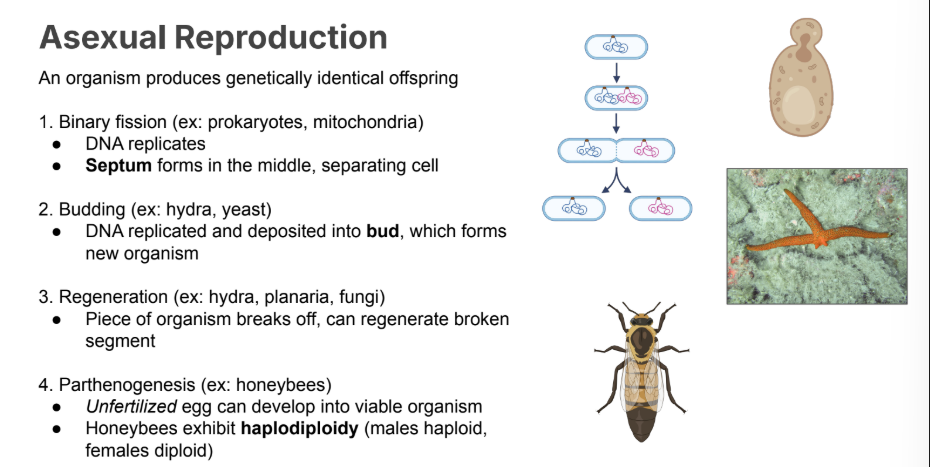
Types of Asexual Reproduction
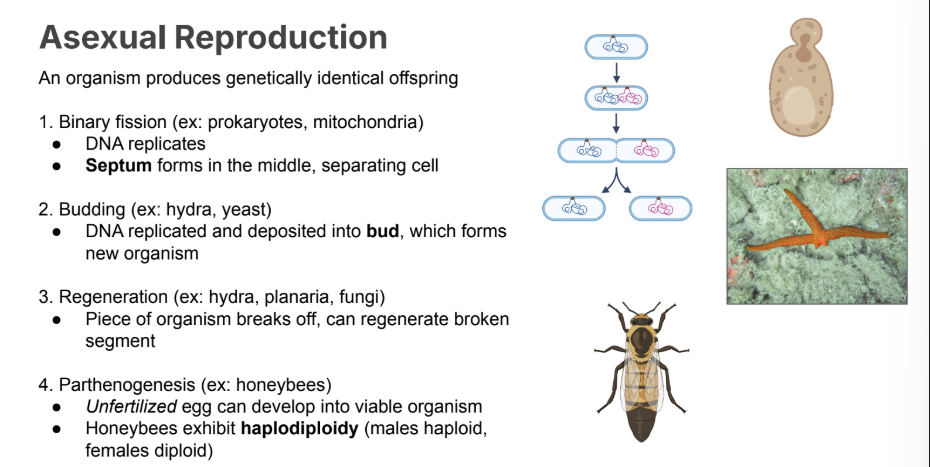
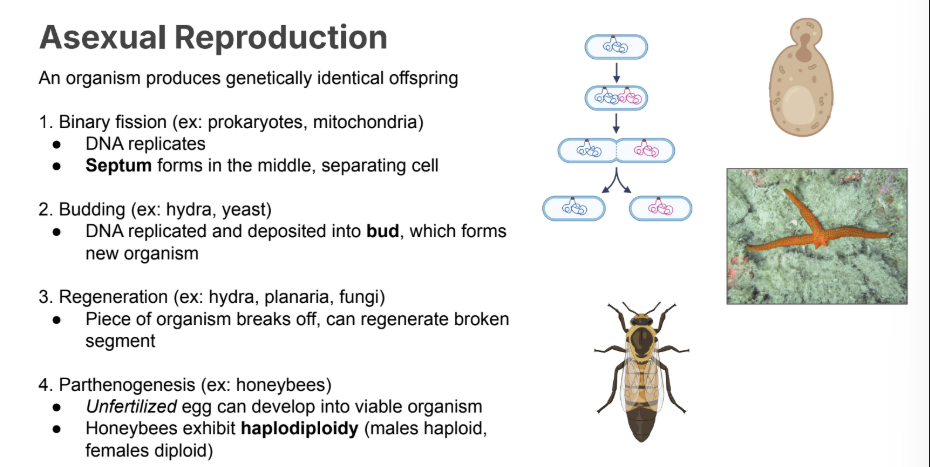
Binary Fission
Budding
Regeneration
Parthenogenesis
Binary Fission
Examples
How does it work
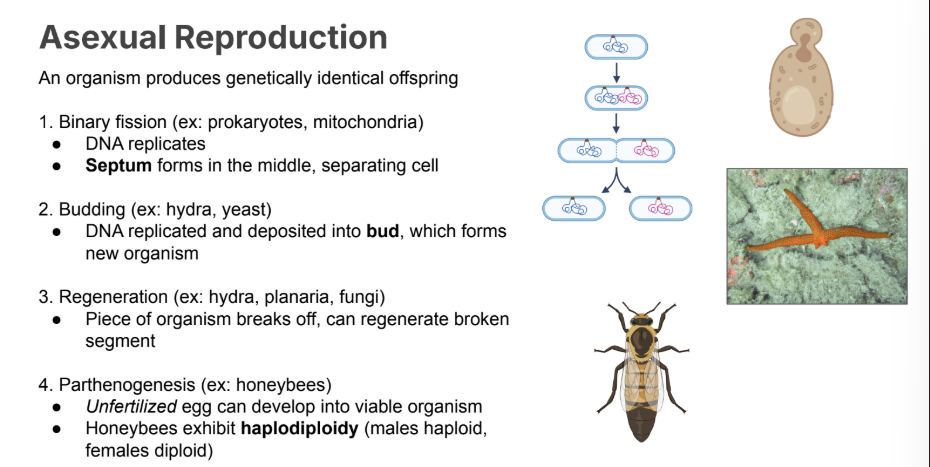
Binary Fission
DNA replicates
Septum forms in the middle and splits the organism in two
EX: Prokaryotes, Mitochondria
Budding
Examples
How does it work
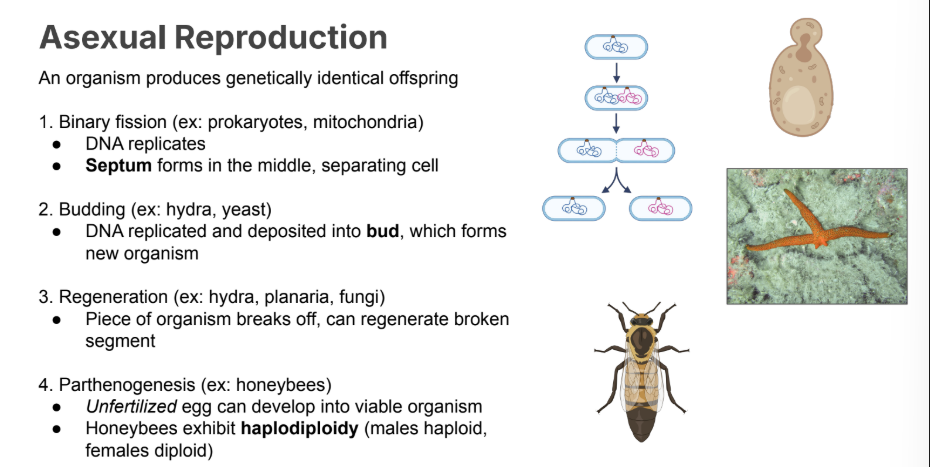
Budding
DNA replicated and deposited into bud which forms into a new organism
EX: Hydra, Yeast
Regeneration
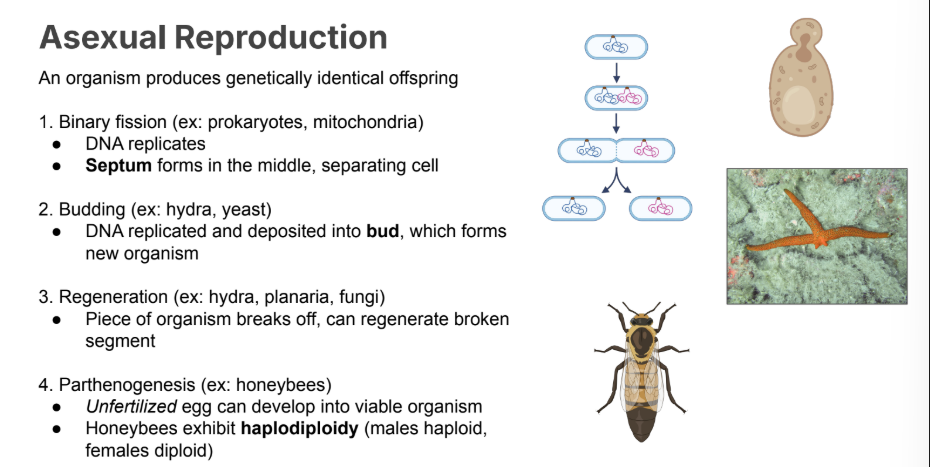
Piece of organism breaks off, can regenerate broken segment.
EX: Hydra, Planaria, Fungi
Parthenogeneis
Unfertilized egg can develop into a viable organism.
Honeybees exhibit haplodiploidy (males are haploid, and females are diploid)
Sexual Reproduction
What does it entail?
What kind of offspring is created genetically?
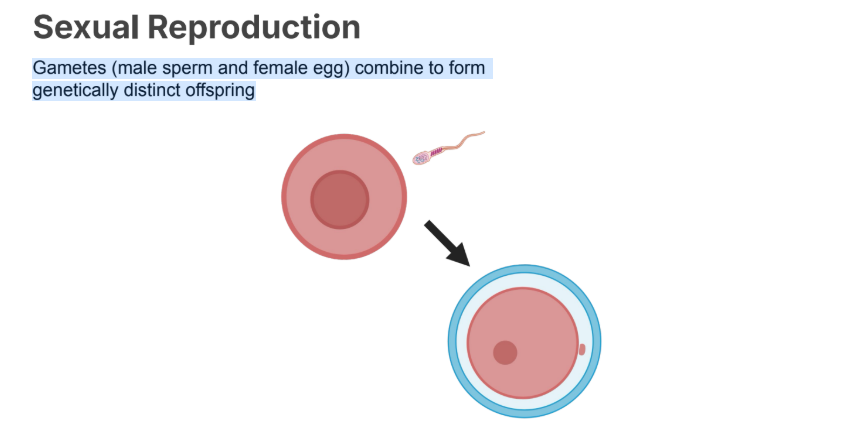
Gametes (male sperm and female egg) combine to form genetically distinct offspring
Germ Cells
What are they
How are they different throughout organisms
They are cells that produce gametes via meiosis
The opposite of somatic cells.
Spermatogenesis
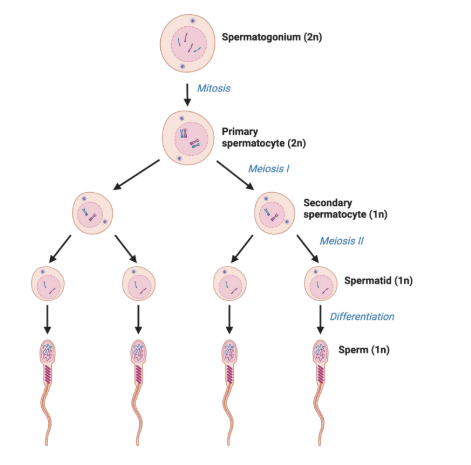
Formation of haploid spermatozoa (sperm cells) from diploid germ cells (spermatogonia)
Spermiogenesis
Final Stage of Spermatogenesis
Spermatid differentiates into spermatozoa
Sperm Structure
What are the main parts of the sperm
Head
Midpiece
Tail
What is the head of the sperm for?
Head: Nucleus and acrosome
What is the midpiece of the sperm for?
Mitochondria (ATP production)
What is the tail of the sperm for?
Flagellum for motility.
Sperm Pathway Mneumonic
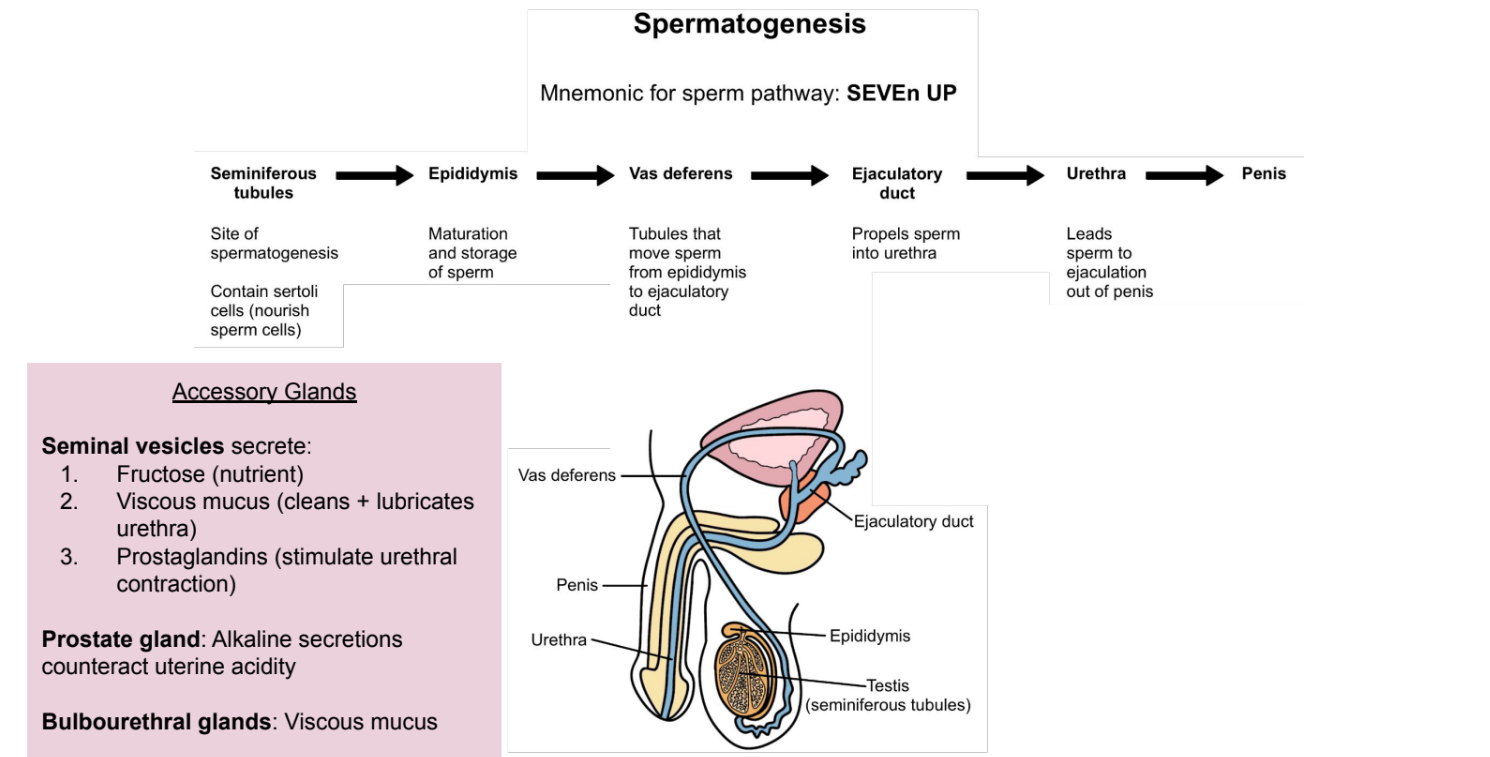
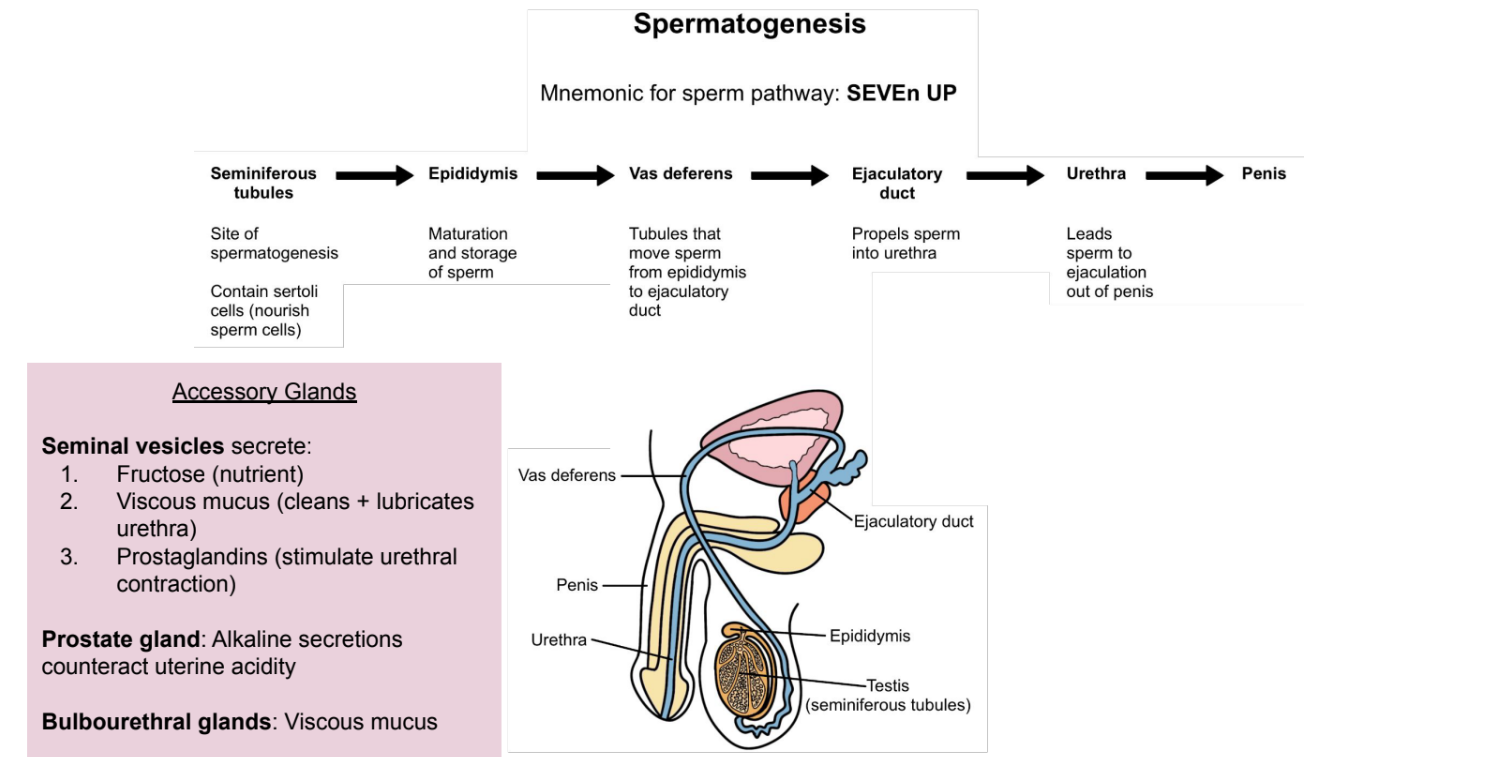
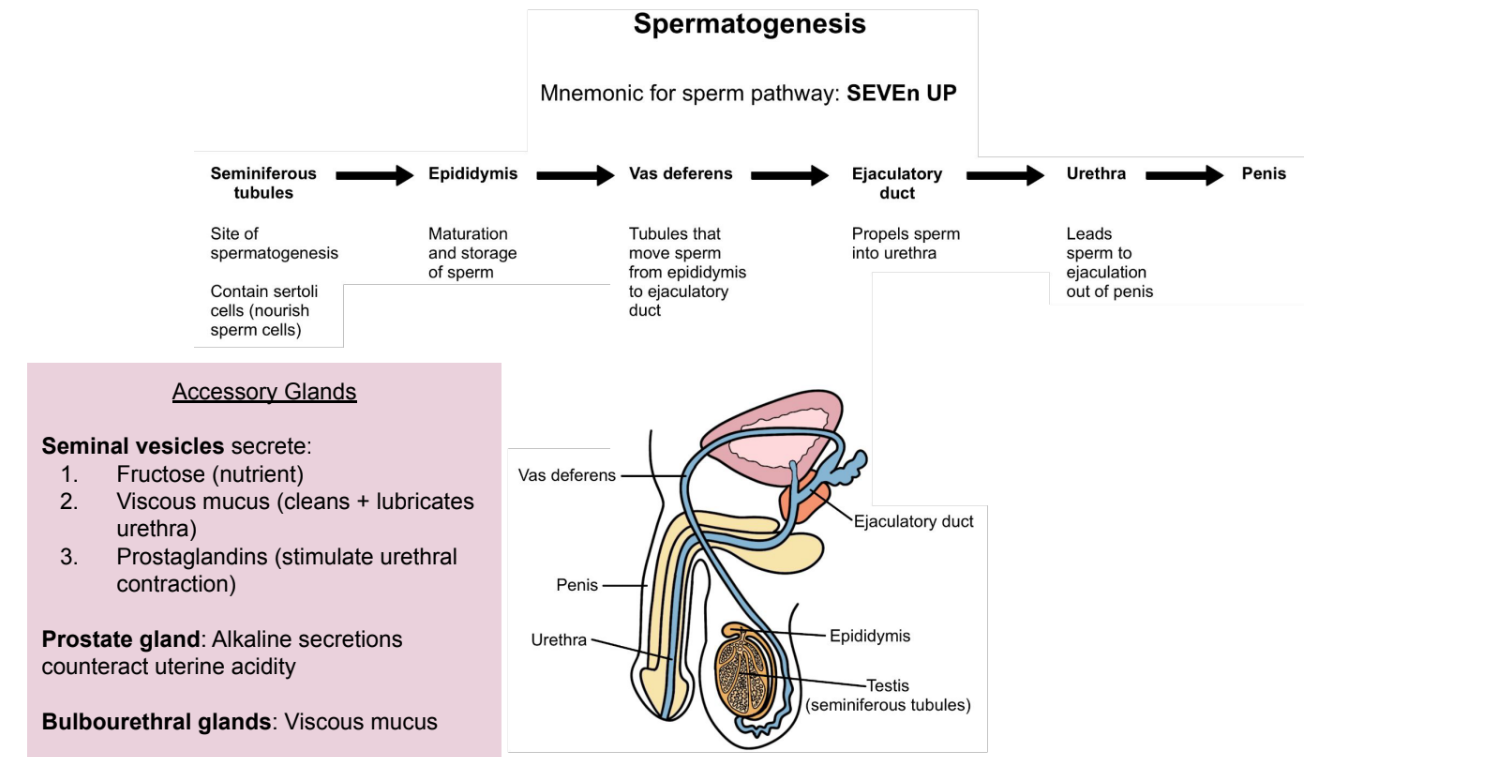
SEVEn UP
Semiferous Tubules
Epididymis
Vas Deferens
Ejaculatory Duct
Urethra
Penis
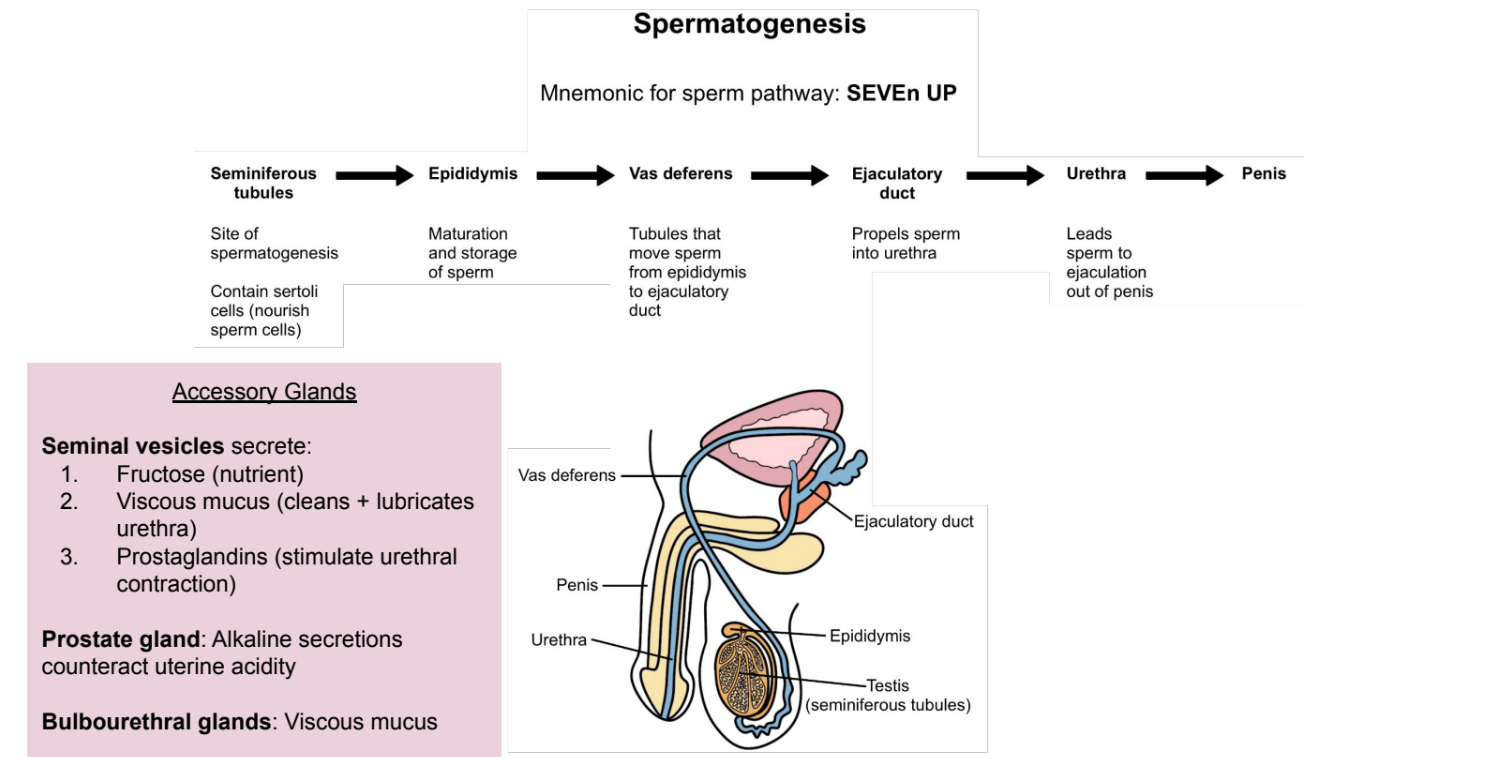
Semiferous Tubules
What occurs here
What is at the location
Site of Spermatogenesis
Contain Sertoli cells.
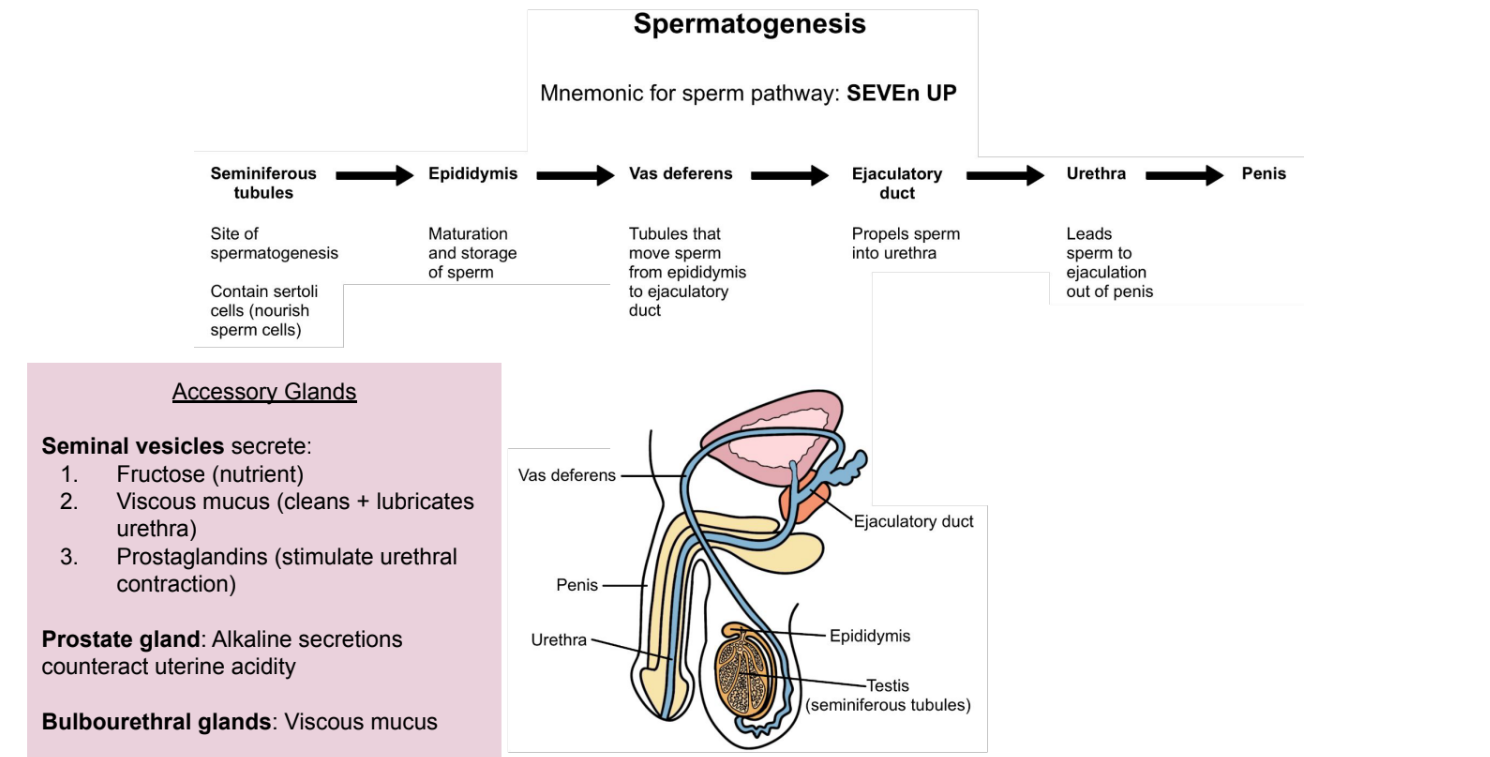
Epiddiymis
Maturation and storage of sperm.
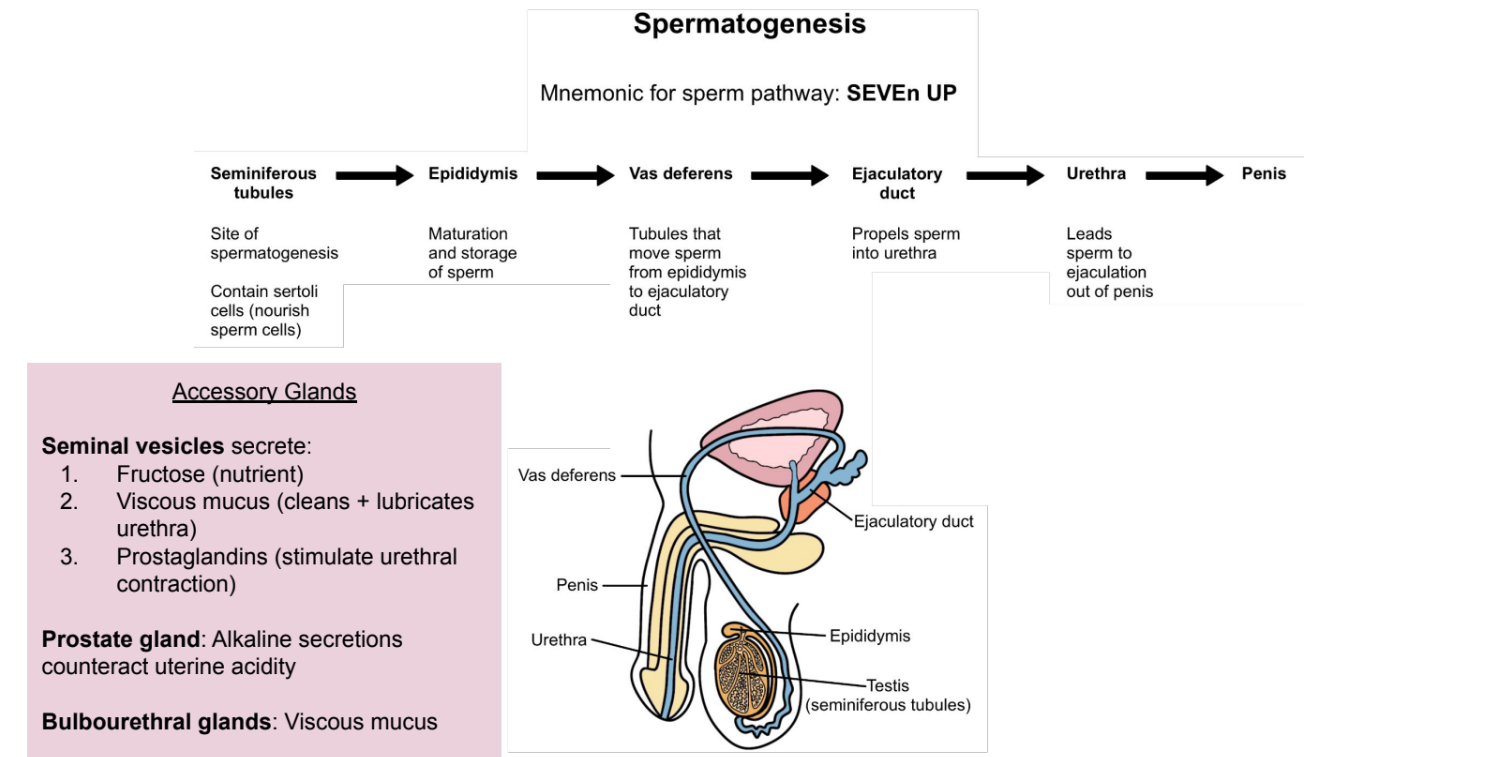
Vas Deferens
Ejaculatory Duct
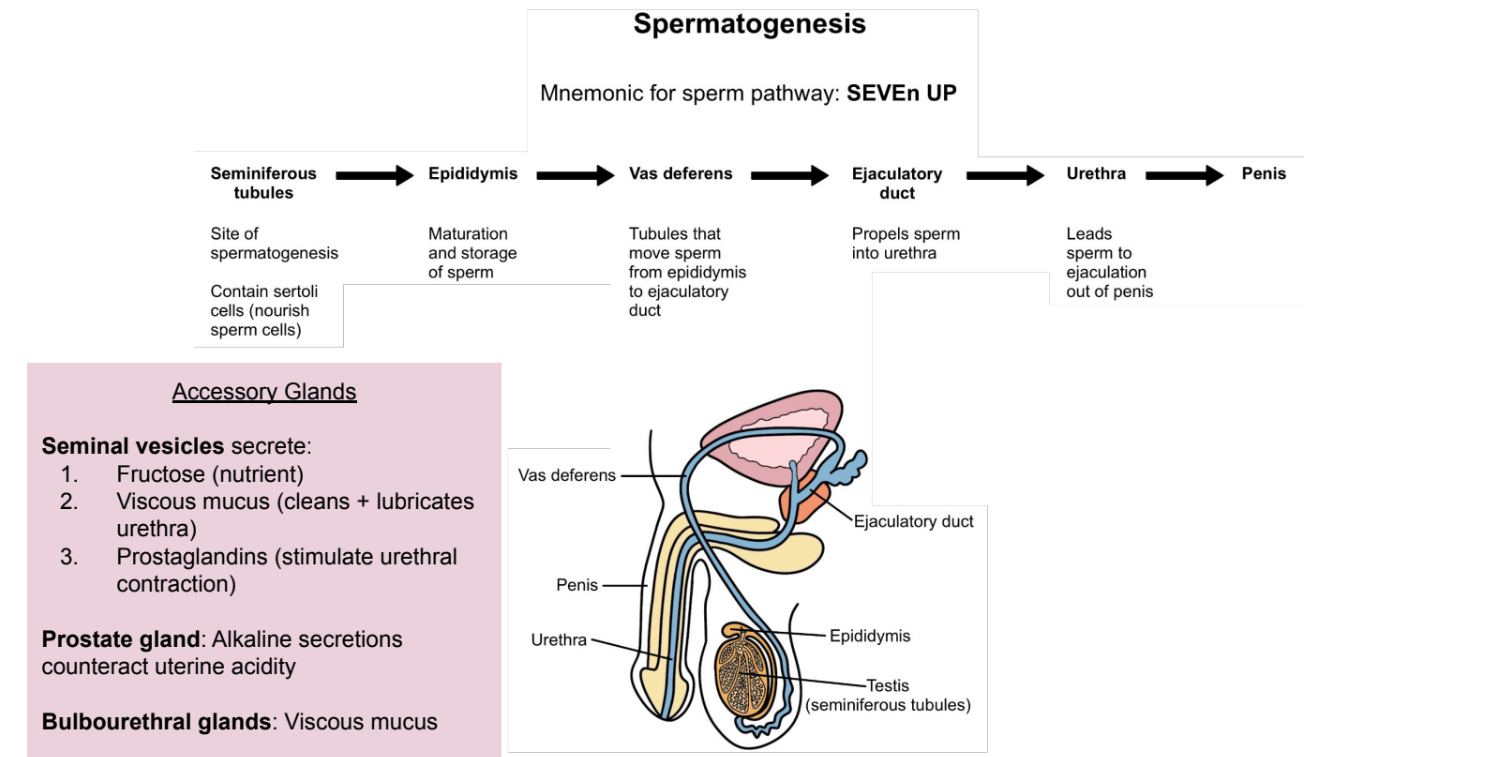
Urethra
Leads sperm to ejaculation out of penis.
Penis
the outer extremity that removes sperm. Ac
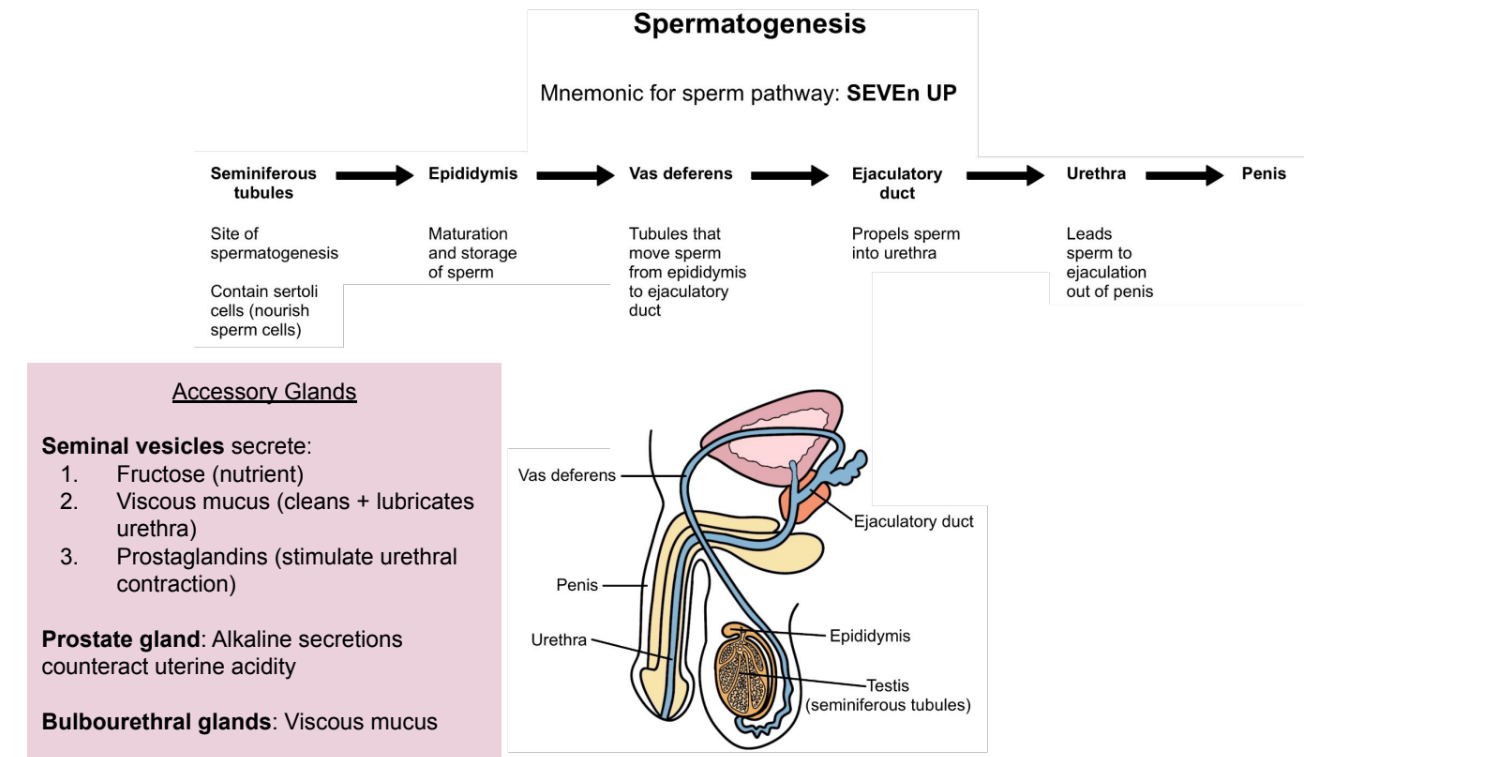
Accessory Glands of the male anatomy
Seminal Vesicles
Prostate Gland
Bulbourethral Glands
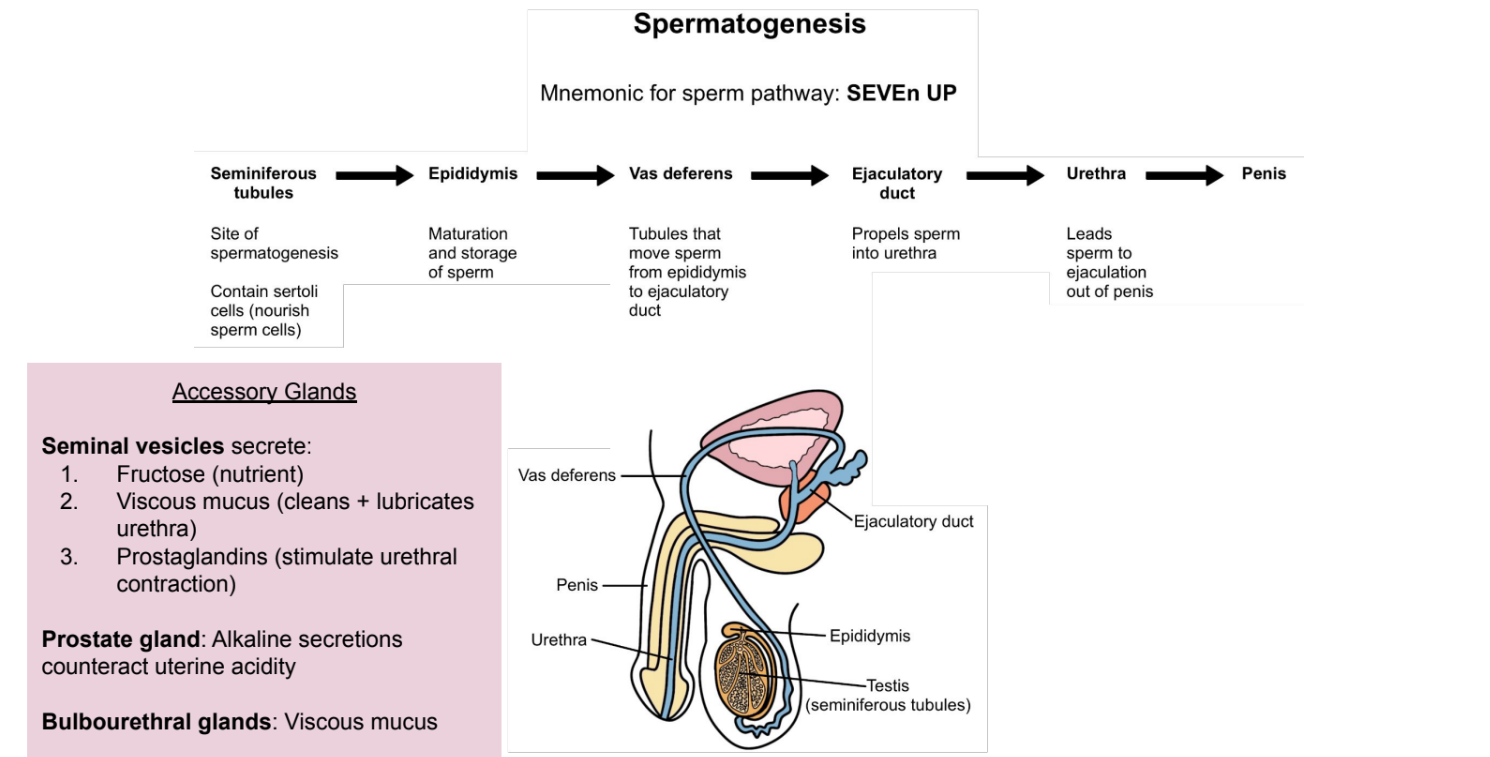
Where are the accesory glands that feed into the sperm pathway located?
Ejaculatory Duct
What do seminal vesicles secrete?
Fructose
Viscous Mucus (cleans and lubricates urethra)
Prostaglandins (stimulate urethral contraction)
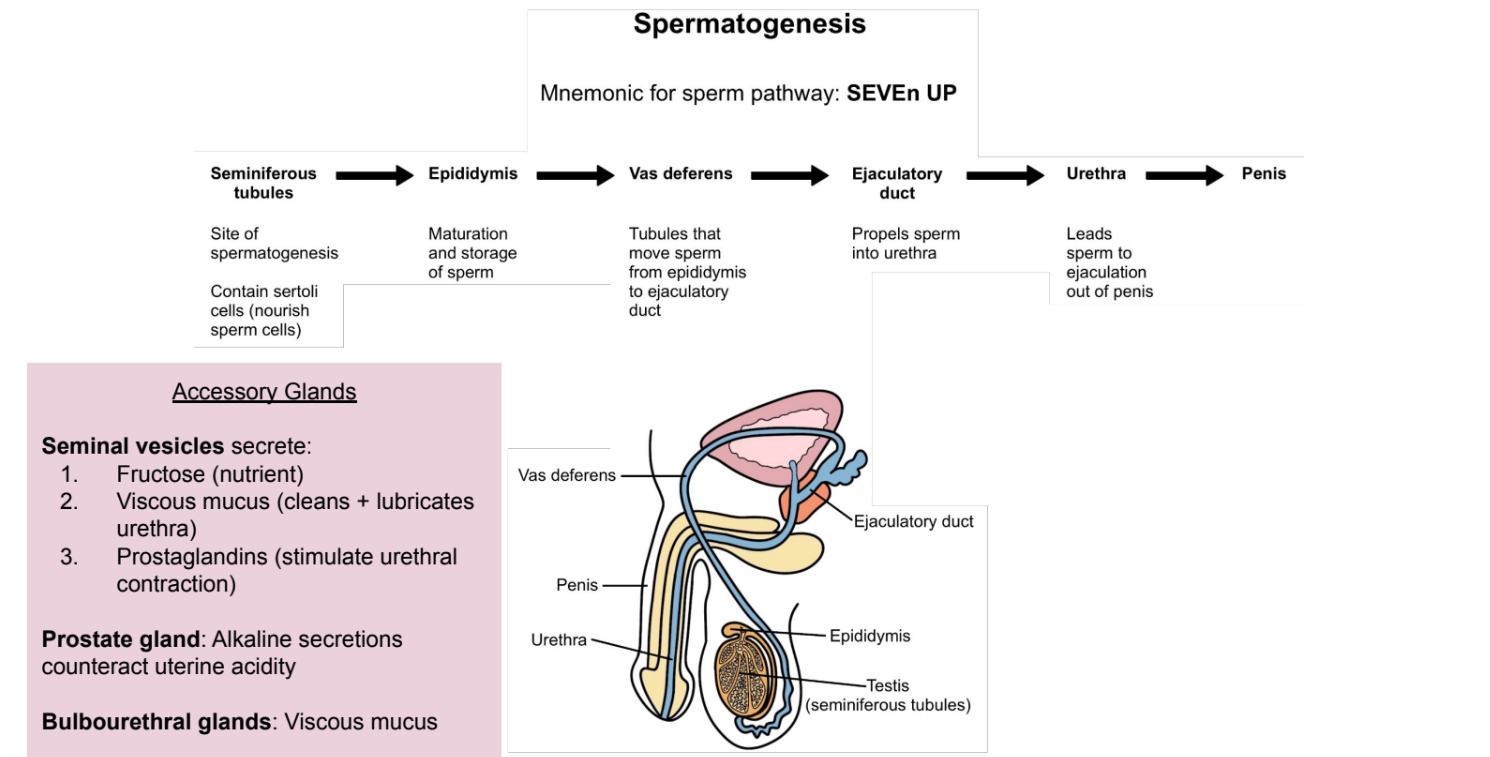
What do bulbourethral glands secrete?
Viscous mucus
What do Prostate glands secrete
Alkaline secretions to counteract uterine acidity.
Sertoli Cells
Nourish sperm cells
Hormones in males
Main 2
Lutenizing Hormones
Follicle Stimulating Hormones
What does Follicle stimulating hormone (FSH) do?
What does it affect?
Stimulates sperm production in seminiferous tubules.
It activates Sertoli (FSH) cells
Have a negative feedback loop on FSH, by releasing inhibin
What does Lutenizing Hormone Do?
Stimulates Leydig Cells.
This helps produce testosterone.
What does Testosterone do?
Helps with sperm maturation and male secondary sex characteristics.
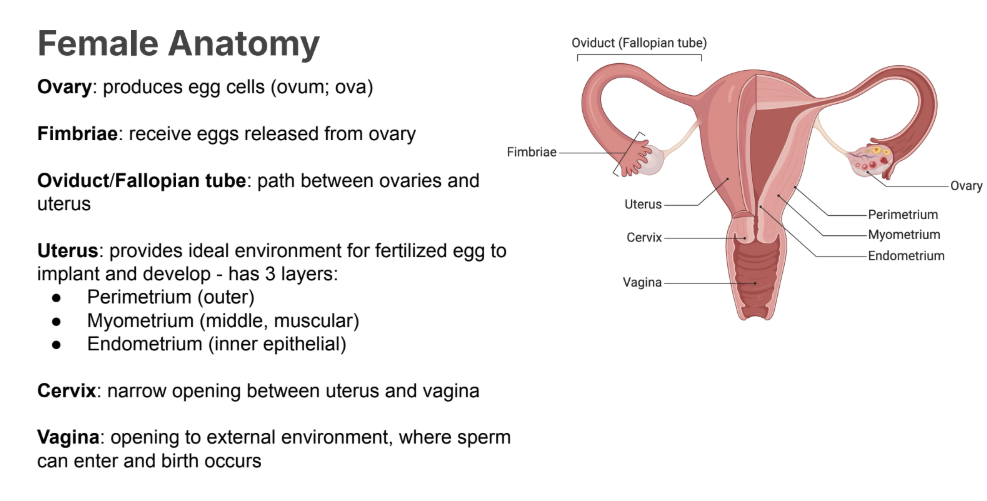
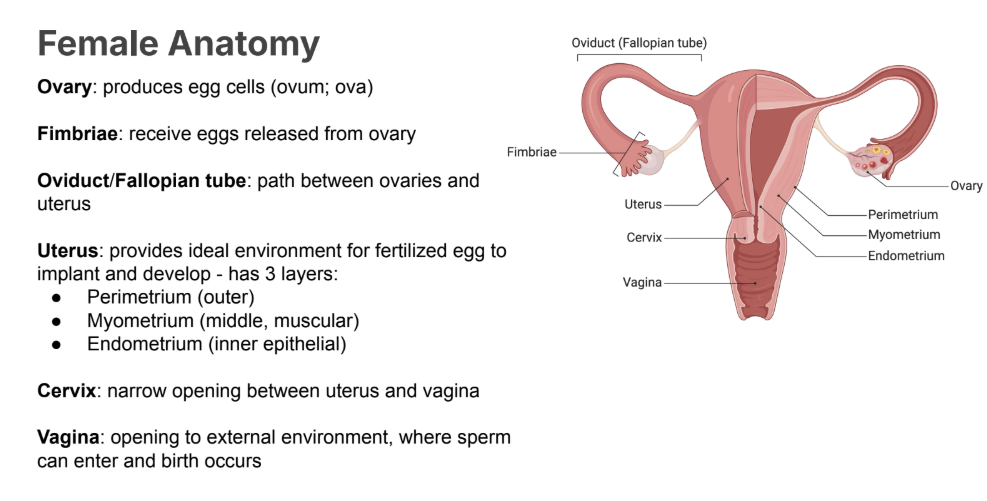
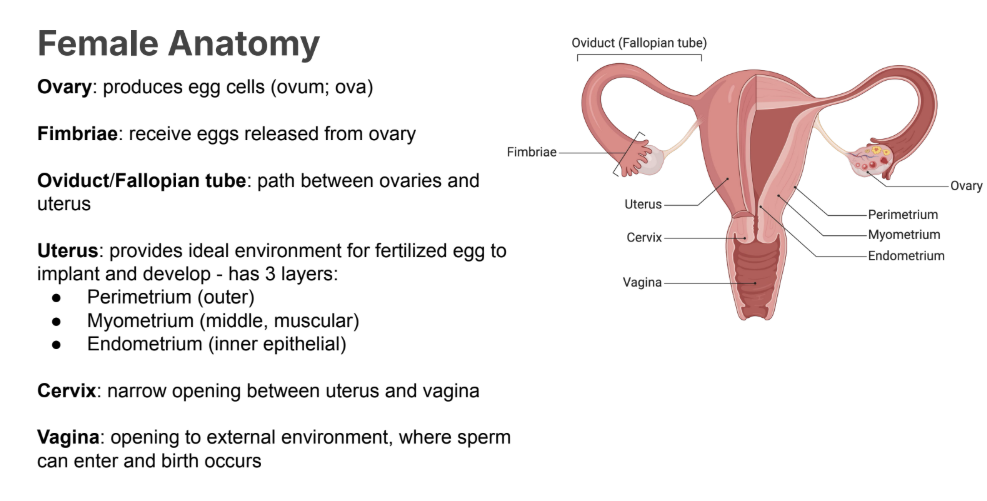
What is the ovary
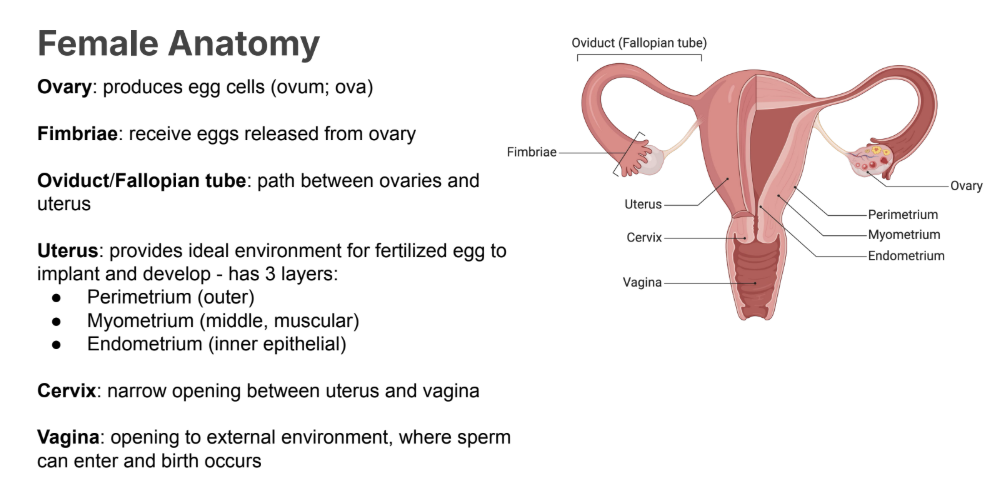
Ovary: Produces egg cells
Fimbriae:
Receives Eggs released from ovary
What is the Oviduct / Fallopian tube
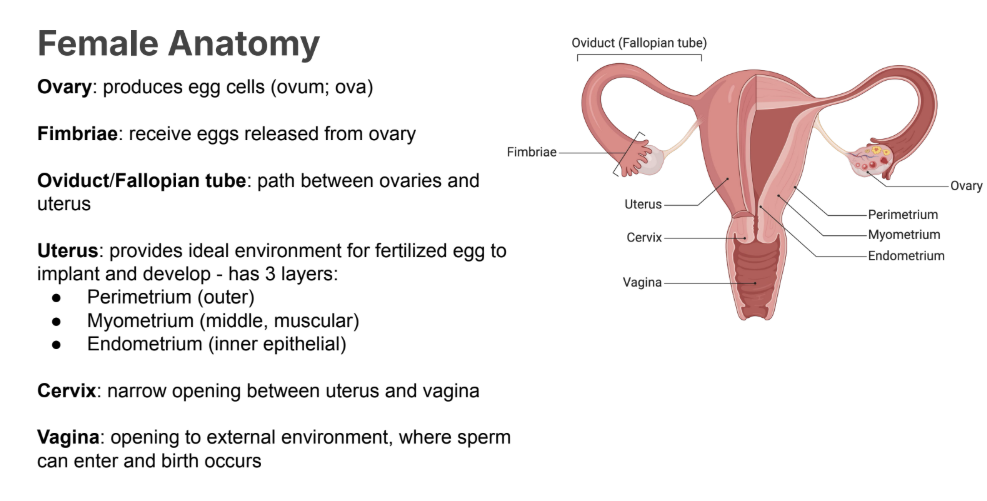
Path between ovaries and uterus
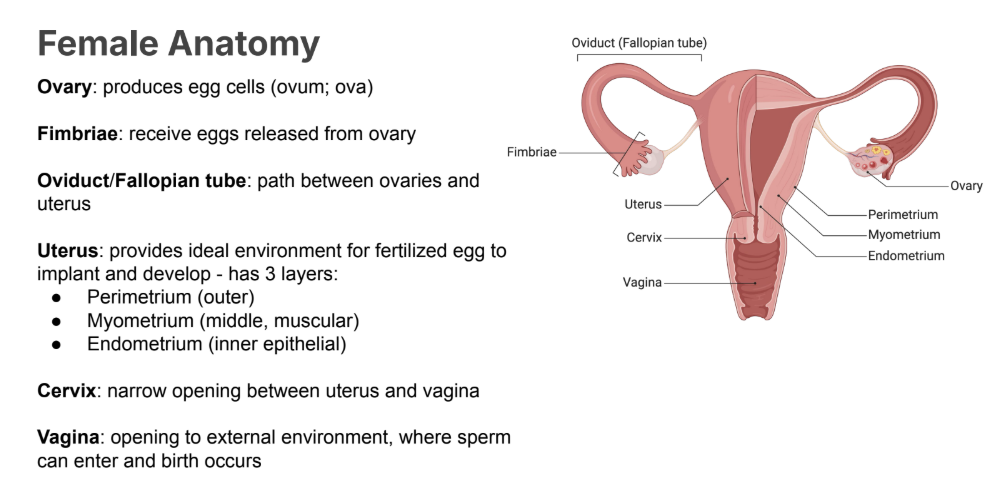
What is the uterus used for?
Provides ideal environment for fertilized egg to implant and develop
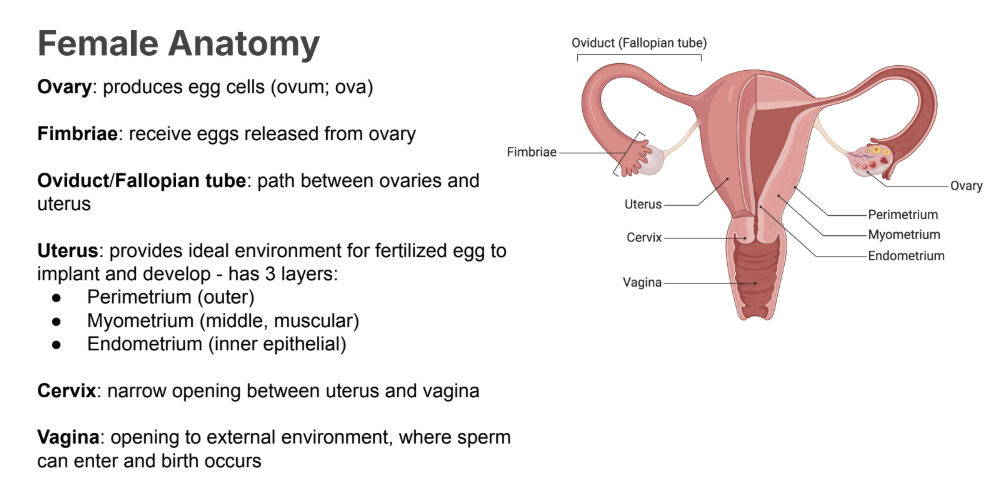
What are the layers of the uterus
● Perimetrium (outer)
● Myometrium (middle, muscular)
● Endometrium (inner epithelial)
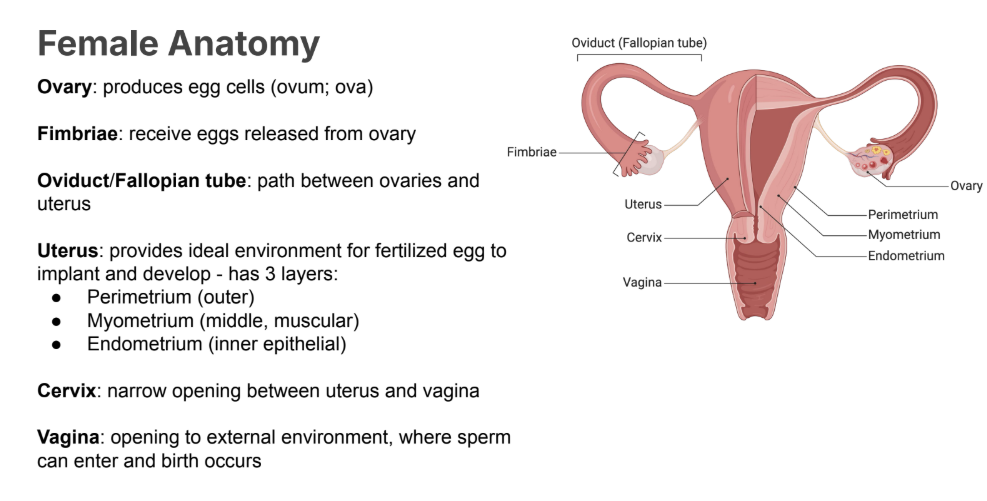
What is the myometrium made of, what layer is it?
Middle layer, muscular
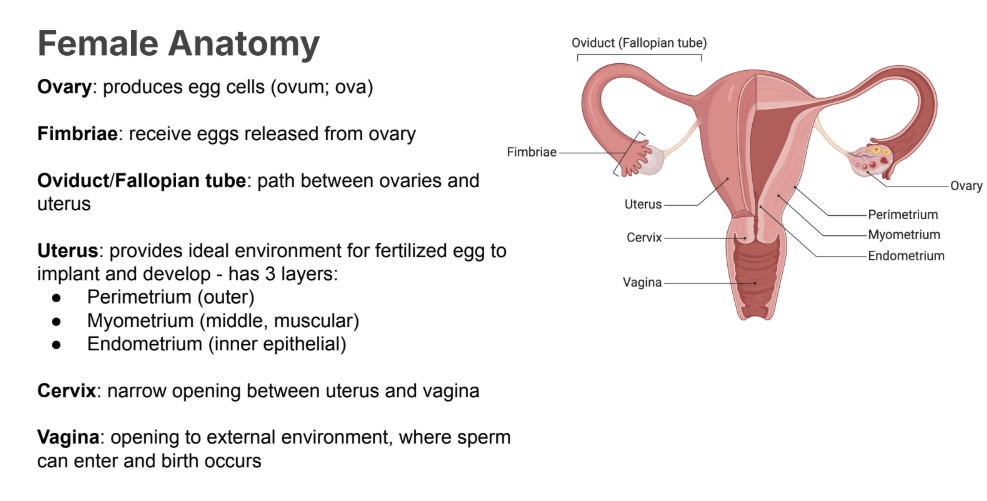
What is the endometrium made of?
Endometrium (inner epithelial), is also the inner part.
What is the purpose of the Cervix
Narrow opening between the uterus and the vagina.
What is the purpose of the vagina?
opening to external environment, where sperm can enter and birth occurs
Oogenesis
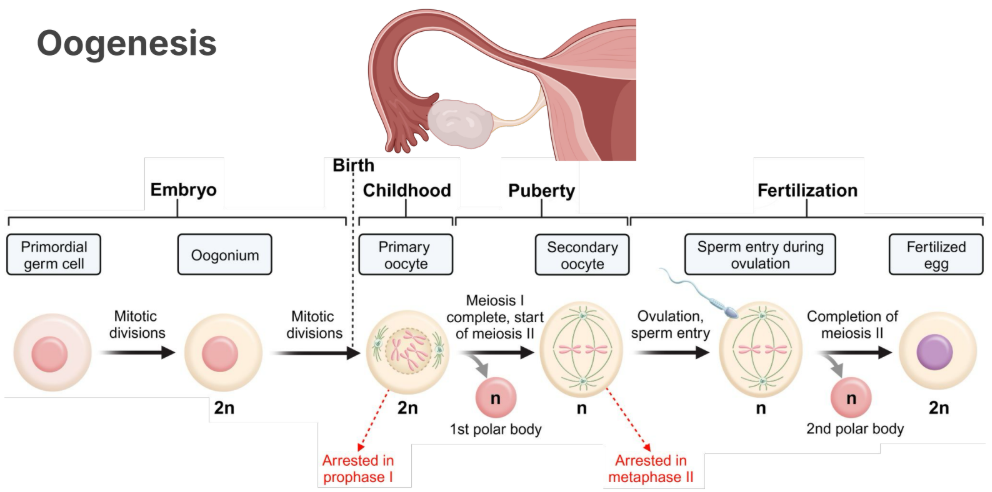
Embryo
Starts with primordial germ cell
Turns into an oogonium (2n)
Undergoes mitotic divisions
Birth
Primary Oocyte (2n)
Cell is arrested in prophase I
Puberty:
Undergoes meiosis I and completes it, start of Meiosis II
creates first polar body
We start a secondary oocyte.
We arrest in metaphase II.
Fertilization
Ovulation sperm entry sees the completion of meiosis II
Creation of a second polar body
Then you create a fertilized egg.
Hormones in Females
Lutenizing Hormone
Follicle Stimulating Hormone
Estrogen and Progesterone
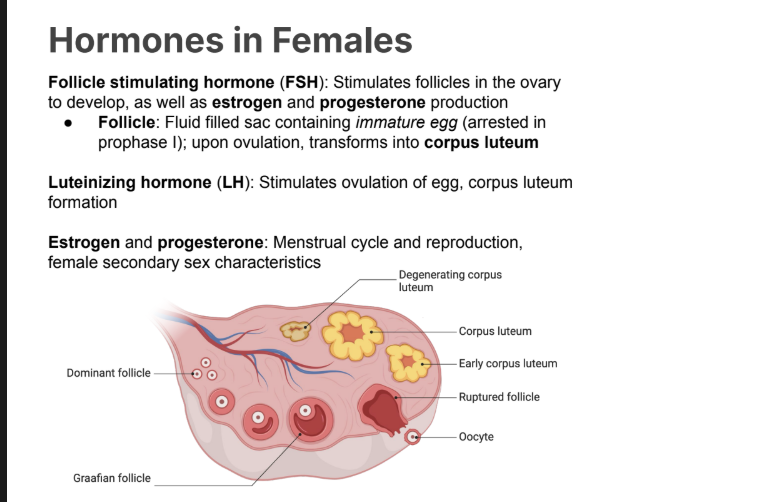
Follicle Stimulating hormone in women
Stimulates follicles in the ovary to develop, as well as estrogen and progesterone production
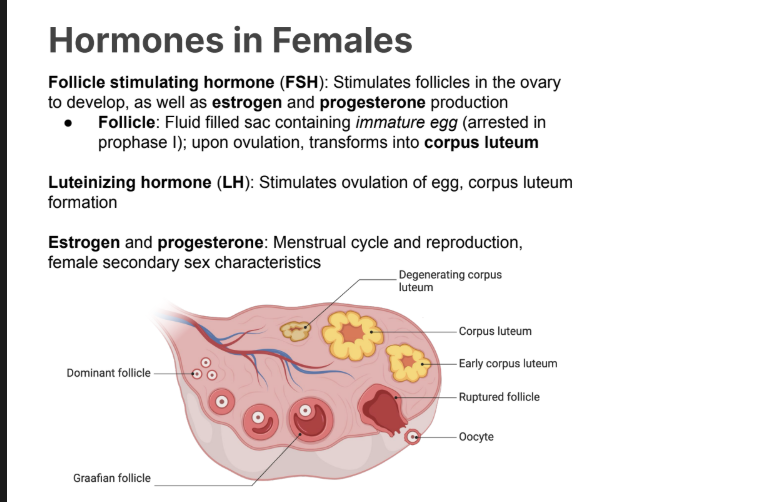
What is a follicle (women)
● Follicle: Fluid filled sac containing immature egg (arrested in
prophase I); upon ovulation, transforms into corpus luteum
The little sac with the egg in it, this will turn into the corpus luteum upon rupture.
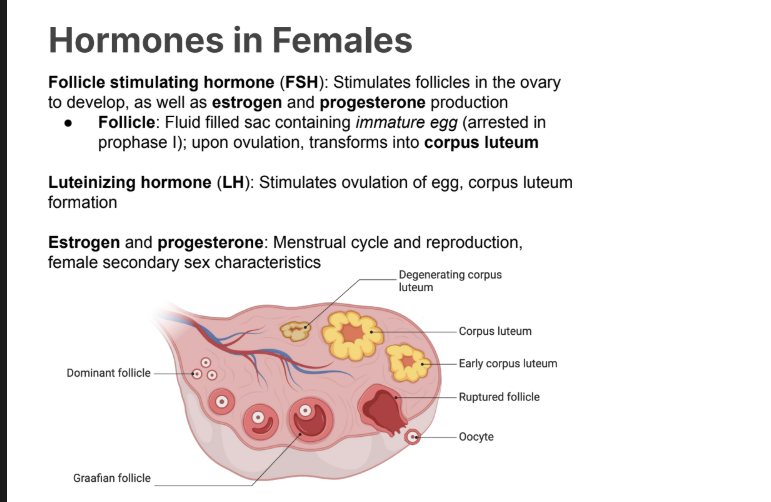
Lutenizing Hormone
Stimulates ovulation of egg, corpus luteum formation
Estrogen and Progesterone in women
Menstrual cycle and reproduction. These also are in charge of secondary sex characteristics.
Hormone Feedback Loops (positive and negative)
Examples of each
Positive feedback loops stimulate biologic pathways
Lactation
Childbirth
Negative feedback loops inhibit biologic pathways
Menstrual Cycle
Lactation
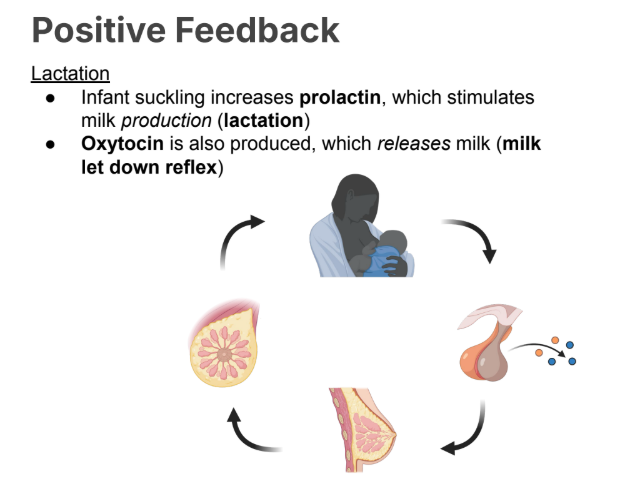
Infant suckling increases prolactin, which stimulates milk production (lactation)
Oxytocin is also produced, which releases milk (milk let down reflex)
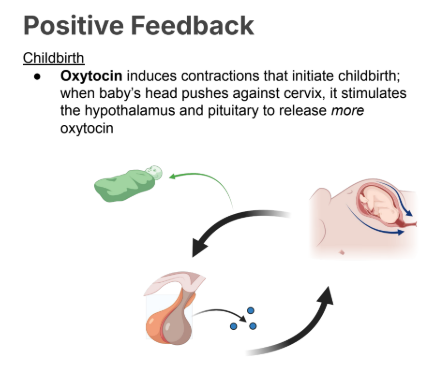
Childbirth (as a feedback loop)
Oxytocin induces contractions that initiate childbirth; when baby’s head pushes against cervix, it stimulates the hypothalamus and pituitary to release more oxytocin
Menstrual Cycle
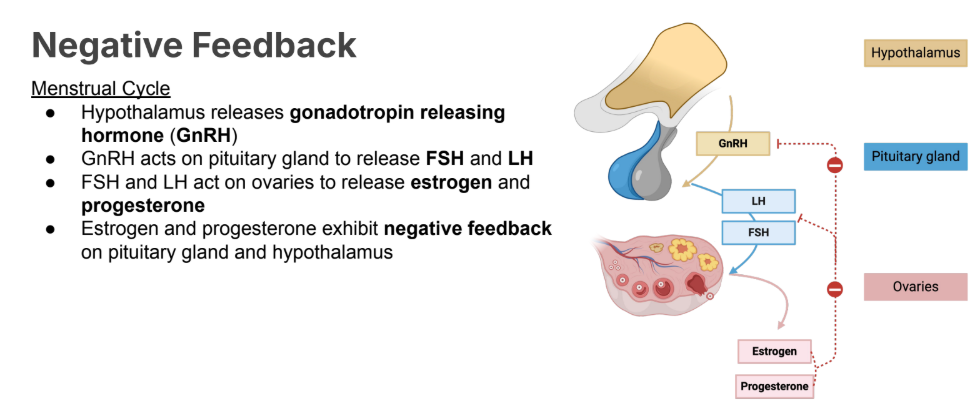
Menstrual Cycle
Hypothalamus releases gonadotropin releasing hormone (GnRH)
GnRH acts on anterior pituitary gland to release FSH and LH
FSH and LH act on ovaries to release estrogen and progesterone
Estrogen and progesterone exhibit negative feedback on pituitary gland and hypothalamus
Ovulation meaning
Egg is released from the graafian follicle
Fimbriae receive egg, cilia sweep egg travels through oviduct awaiting fertilization.
Luteal Phase
Follicle develops into corpus luteum
Corpus luteum releases progesterone and some estrogen, and is maintained by FSH and LH
Estrogen and progesterone exhibit negative feedback
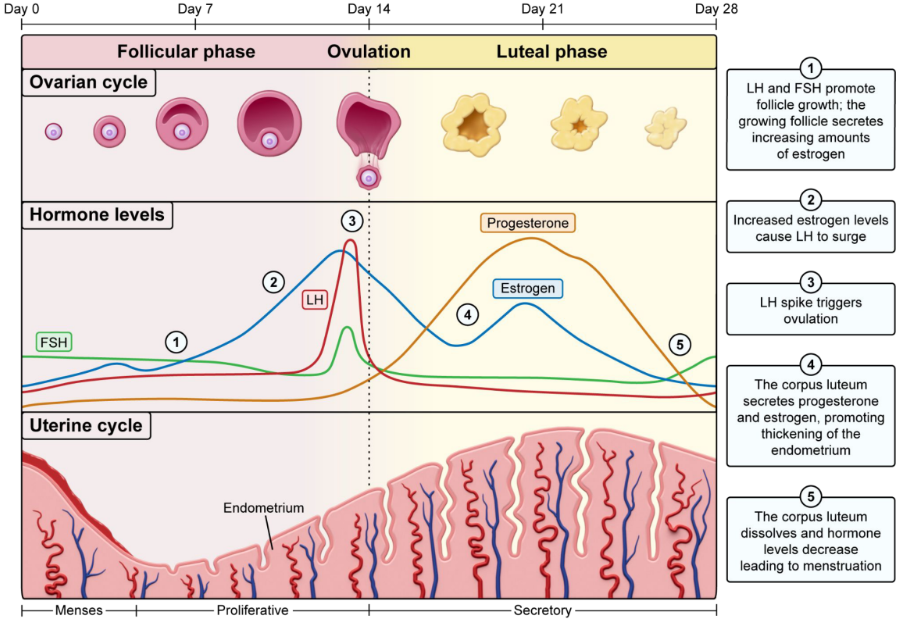
Steps of the menstrual cycle
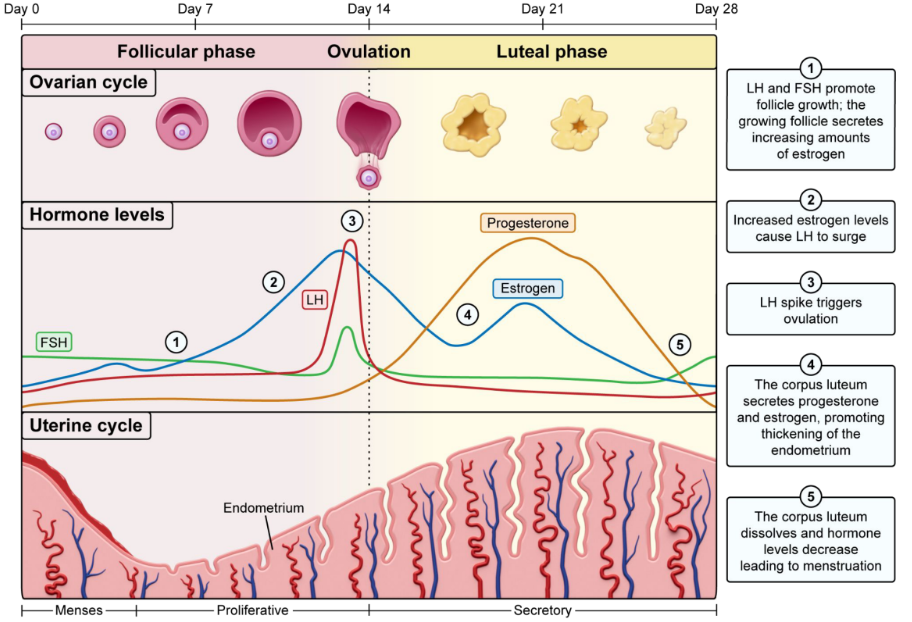
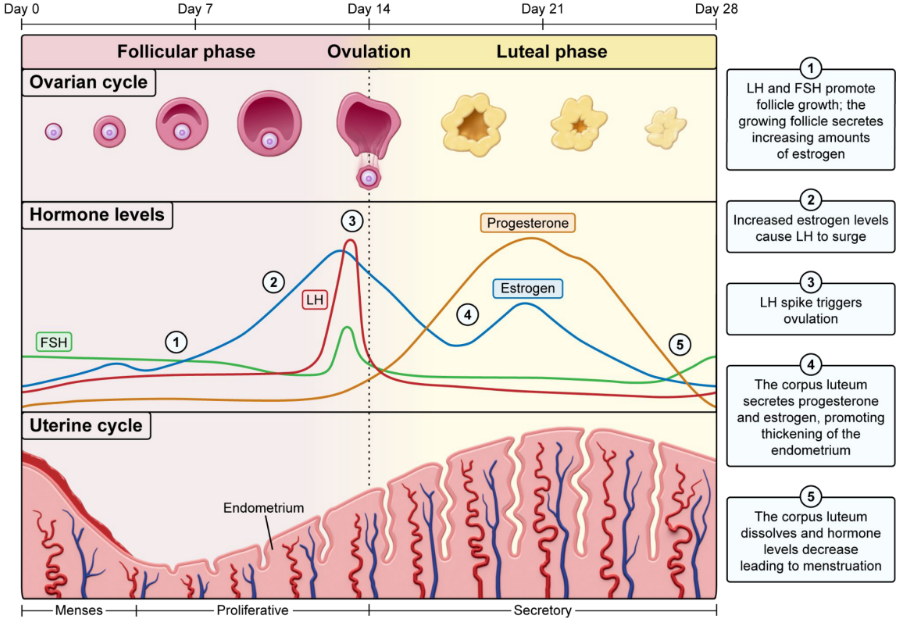
LH and FSH promote follicle growth. The growing follicle secretes increasing amount of estrogen.
Estrogen leads to the thickening of the endometrium
Increased estrogen causes LH to surge
LH spike triggers ovulation
Corpus Luteum secretes progesterone and estrogen, which causes the thickening of the endometrium.
Causes the luteal phase
The corpus Luteum dissolves and hormone levels decrease leading to menstruation.
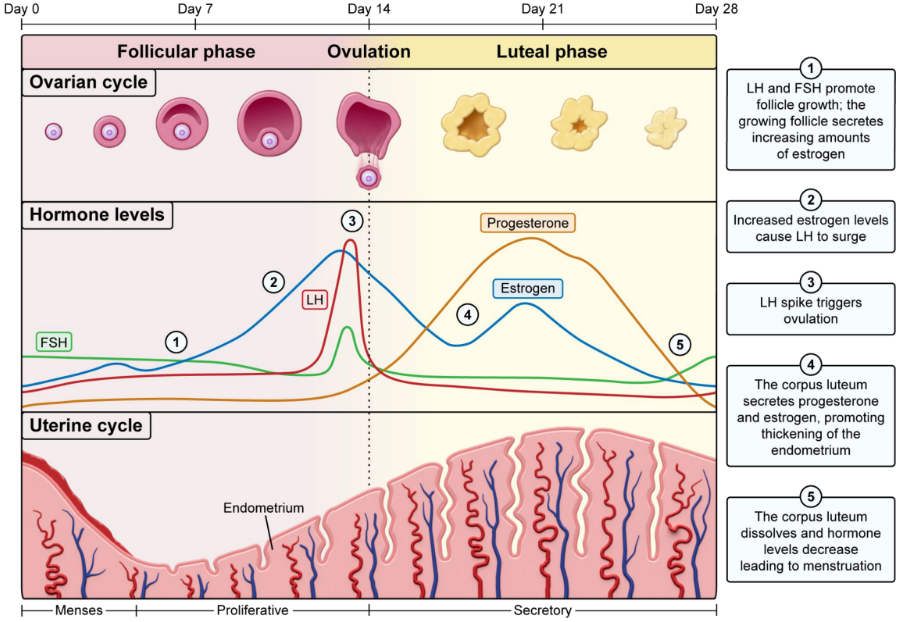
What happens if implantation does not occur.
FSH and LH decrease until corpus luteum can no longer be maintained
Estrogen and progesterone drops
Endometrium sloughs off (menstruation), cycle repeats
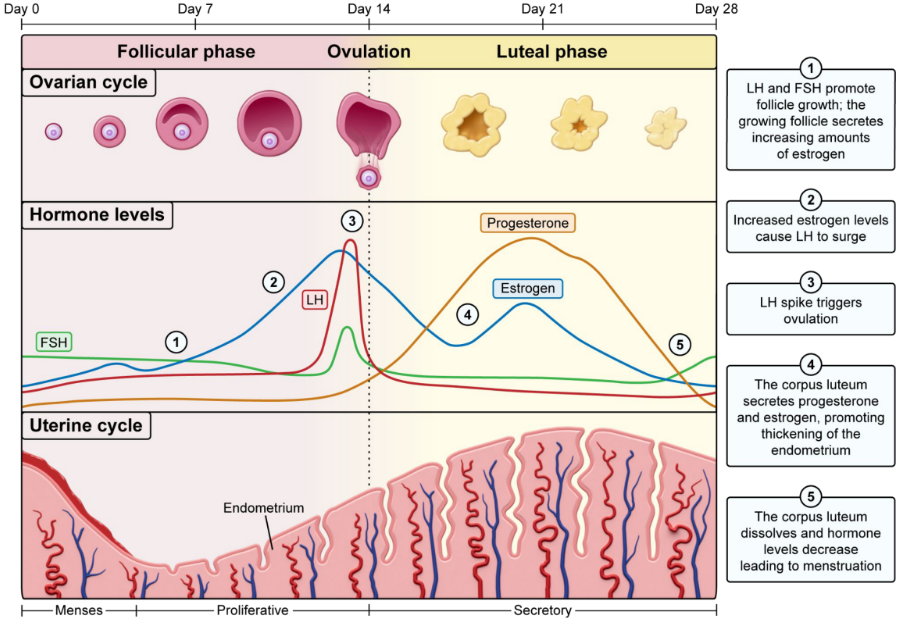
If implantation occurs
Outer layer of placenta produces human chorionic gonadotropin (hCG), which aids in maintaining corpus luteum
Progesterone and estrogen levels maintained, endometrium thickens (no menstruation)
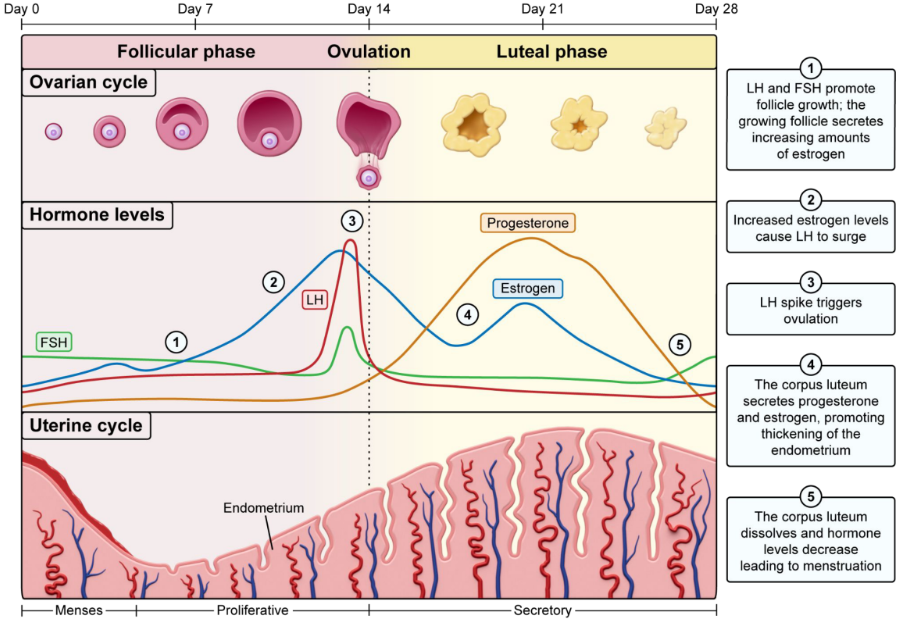
Human Choroinic Gonadotropin (hCG)
Aids in maintaining corpus luteum when it is implanted.
Progesterone and estrogen levels become maintained, and the endometrium thickens. (no menstruation)
Fertilization
Meaning
The joining of a haploid sperm and haploid egg cell to form a diploid zygote
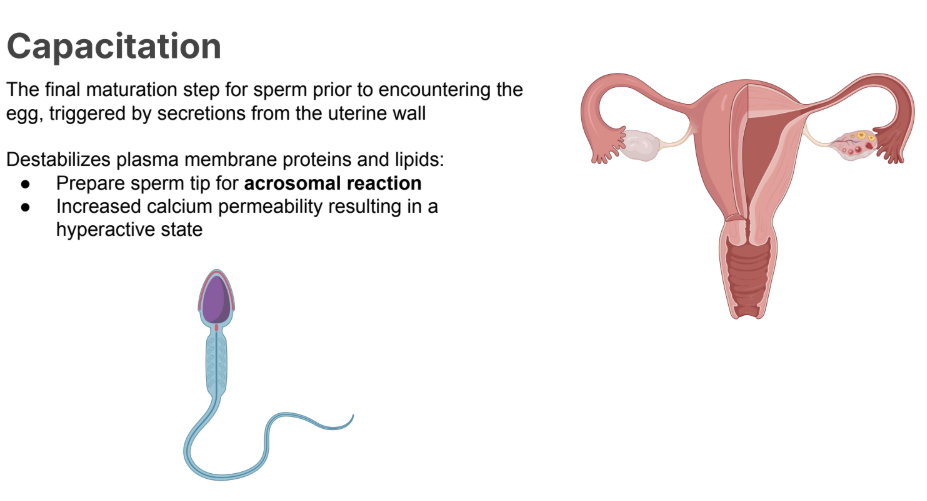
Capacitation
The final maturation step for sperm prior to encountering the egg, triggered by secretions from the uterine wall
Destabilizes plasma membrane proteins and lipids:
Prepare sperm tip for acrosomal reaction
Increased calcium permeability resulting in a hyperactive state
MORE CALCIUM MEANS MORE FAST YIPEE
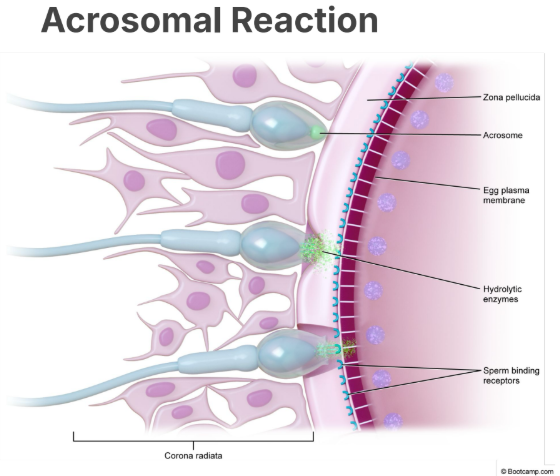
Corona Radiata
Outermost layer, nourishes the developing egg
Vitelline Layer
Layer of glycoproteins (jelly coat) above the plasma membrane.
Named the zona pellucida in mammals.
Acrosomal Reaction
1. Sperm break through corona radiata to approach zona pellucida
2. Sperm actin recognizes zona pellucida ZP3 protein (same-species fertilization), triggering acrosomal reaction:
Releases hydrolytic enzymes, breaking down zona pellucida’s glycoprotein membrane to access plasma membrane
3. Sperm and egg plasma membranes fuse, genetic material combines
Total Sperm and Egg binding reaction + Polyspermy blocks
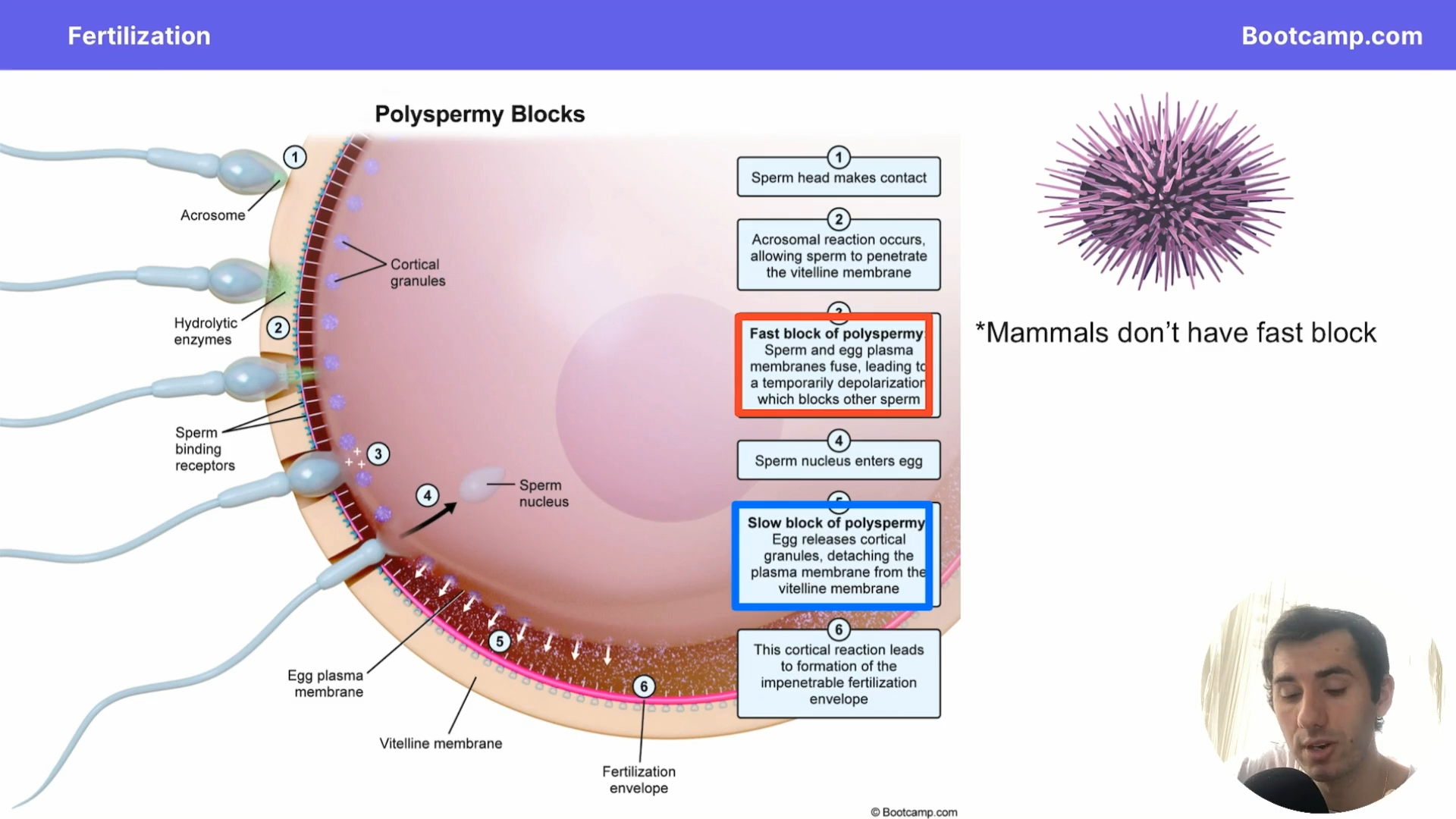
Sperm head makes contact
Acrosomal Reaction occurs, allowing sperm to penetrate into the viteline membrane
Fast Block of polyspermy: Sperm and egg plasma membranes fuse, leading to a temporariy depolarization which blocks sperm from entering. (Na+ influx)
Sperm nucleus enters the egg
Slow Block of Polyspermy: egg releases cortical granules, dethatching the plasma membrane from the vitelline membrane.
Cortical reaction leads to the formation of impenetrable fertilization envelope.
How does the formation of twins work: Monozygotic
A sperm and an egg are fertilized, and once fertilized, the zygote splits into two, causing identical genetic material.
How does the formation of twins work: Dizygotic
Two different eggs are fertilized, which causes twins with different genetic material
What is cleavage
What does it result in?
Rapid cell divisions without changing the total mass of cells
Resulting cells = blastomeres
What are cleavages categorized on?
Axis of cleavage
Fate of cells
Evenness of embryo division
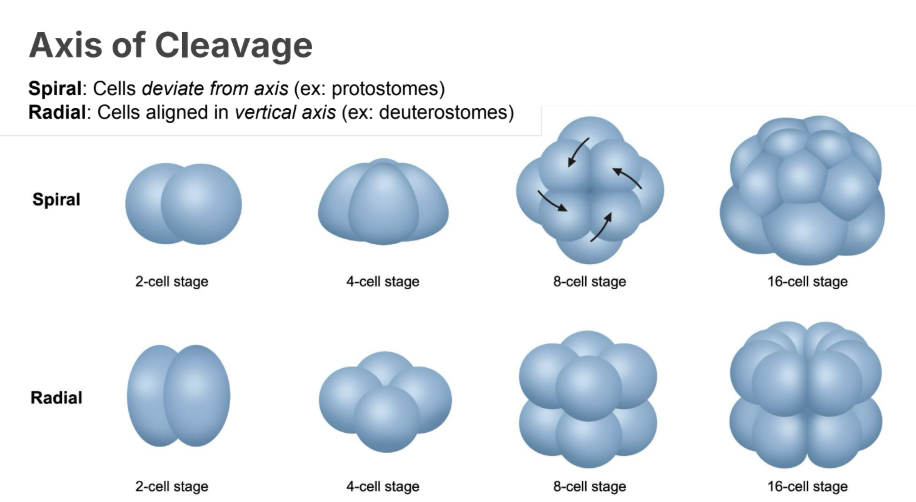
Spiral Cleavage
what does it look like
Examples of cells
Cells that deviate from the axis.
EX: Protostomes
Radial Cleavage
what does it look like
Examples of cells
Cells aligned in vertical axis (ex: deuterostomes)
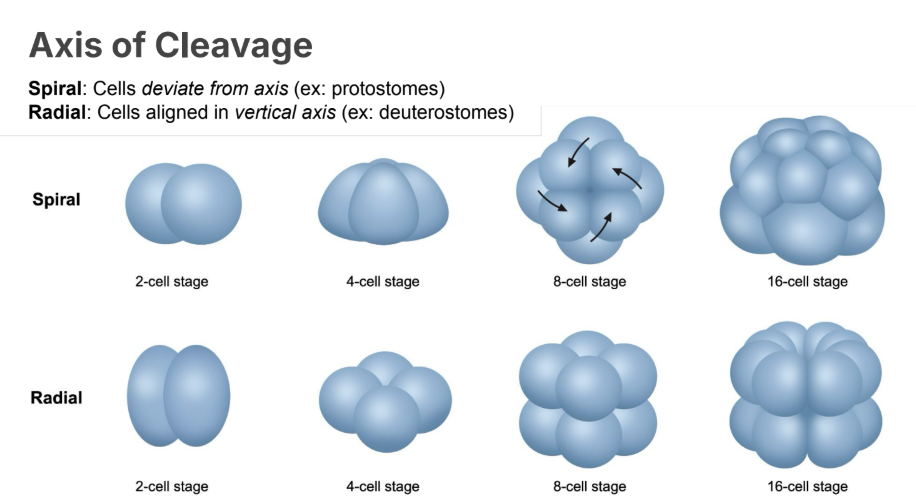
Regulative fate of a cell.
what does that mean for it’s fate?
Example
(Indeterminate)
blastomeres are totipotent, do not have pre-determined fate (ex: deuterostomes)
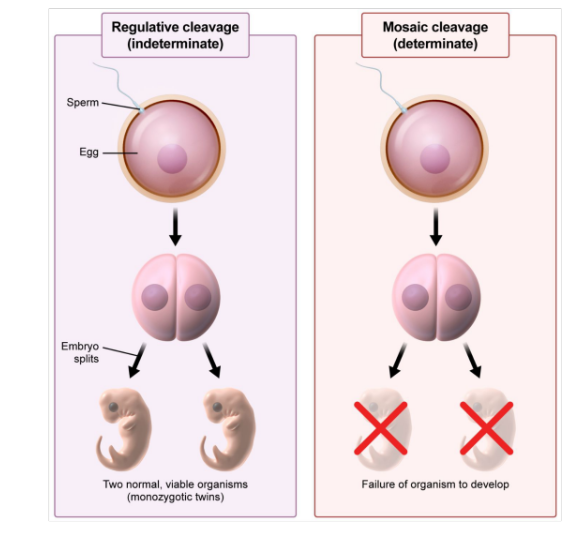
Mosaic fate of a cell
what does that mean for it’s fate?
Example
Mosaic (determinate): blastomeres have decided fate (ex: protostomes)
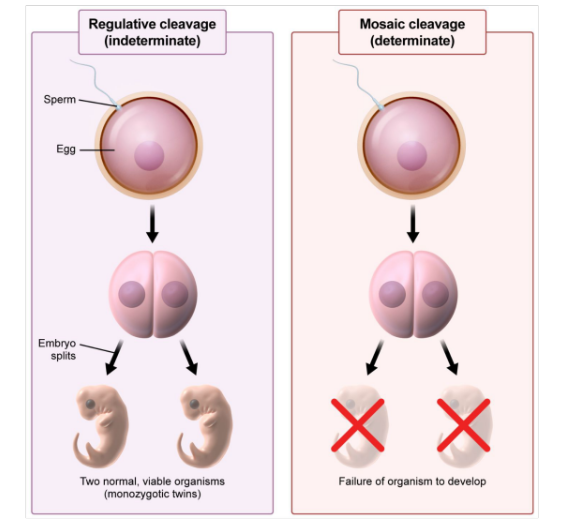
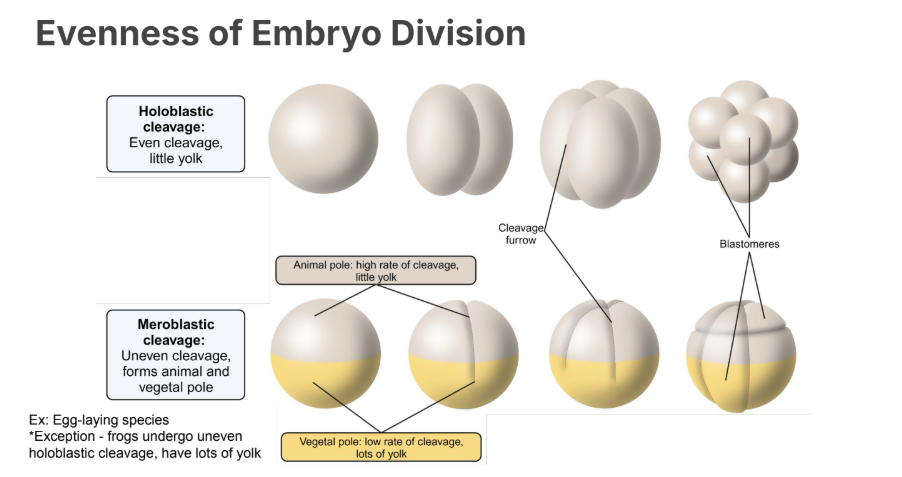
Evenness of Embryo division:
What are the types?
Can be Holoblastic Cleavage
or
Can be Meroblastic cleavage
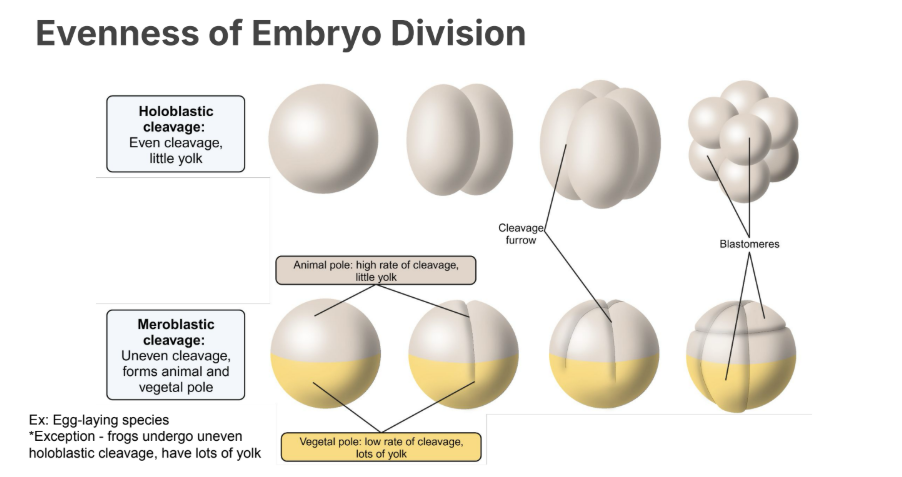
Holoblastic Cleavage
What undergoes it, and what is the distribution of materials inside?
Even cleavage with little yolk
Non egg laying species (humans)
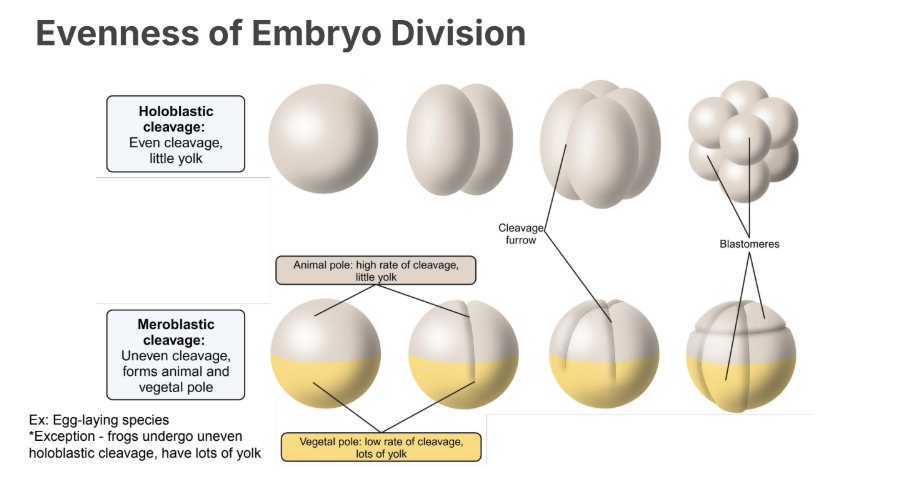
Meroblastic cleavage
Uneven cleavage that forms the animal and vegetal pole.
Egg laying species (not frogs)
Animal Pole
High rate of cleavage
Little yolk
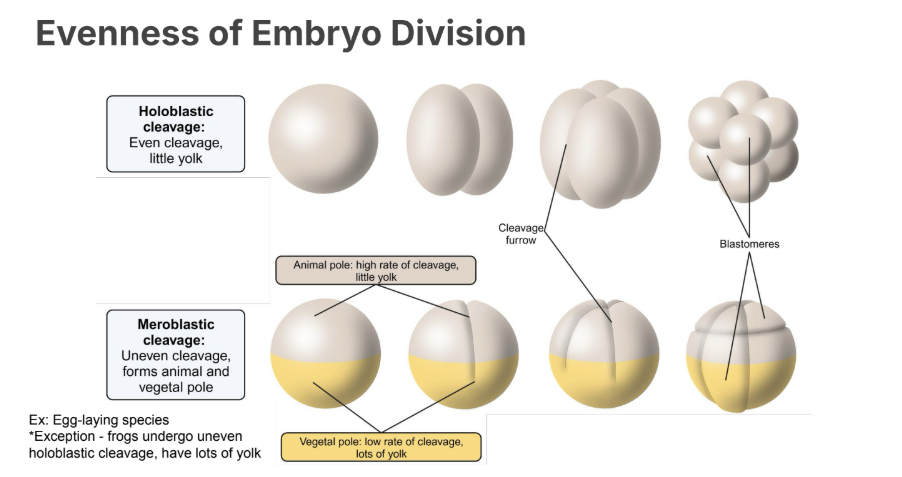
Vegetal Pole
Low rate of Cleavage
Lots of yolk
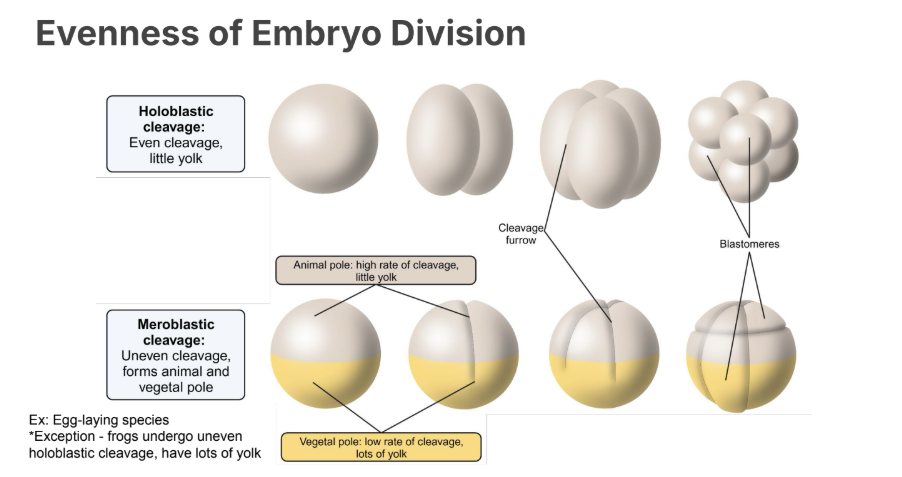
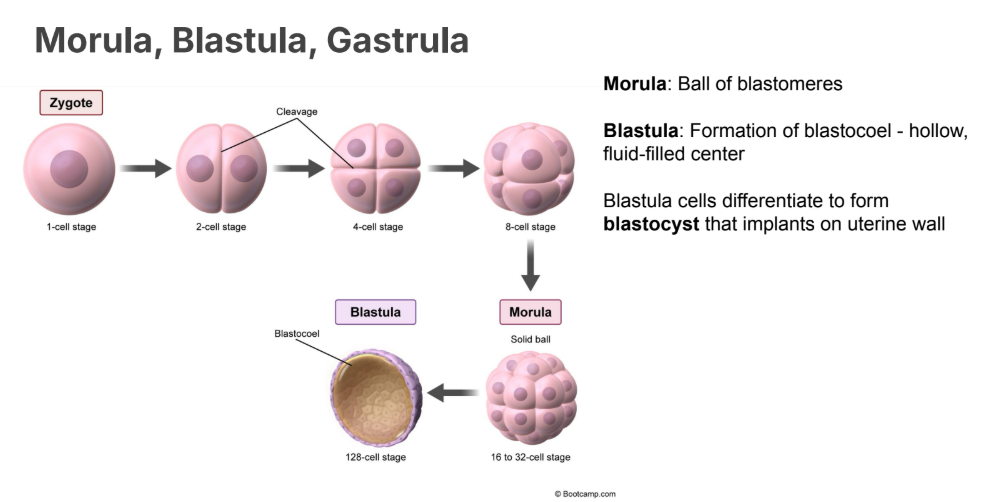
Morula
Ball of blastomeres
16-32
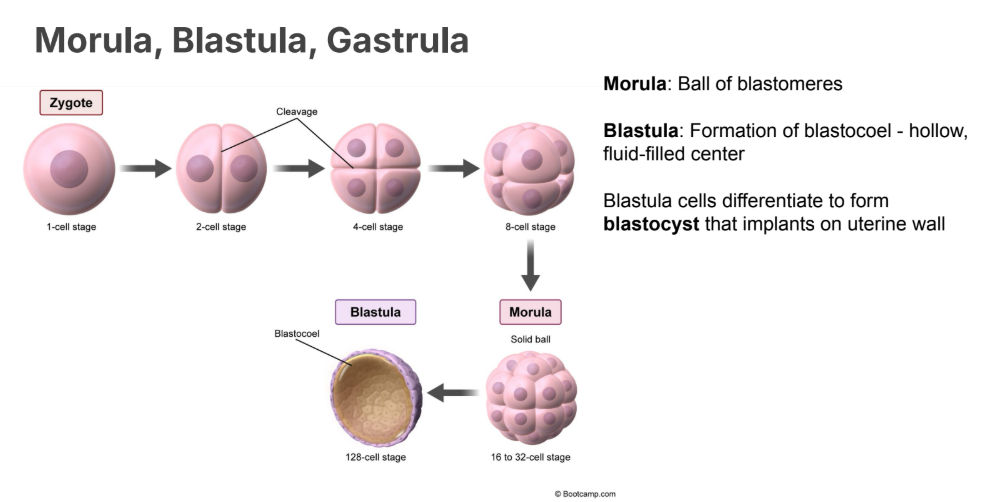
Blastula
Cell mass that has a hole.
Formation of blastocoel, a hollow fluid filled center
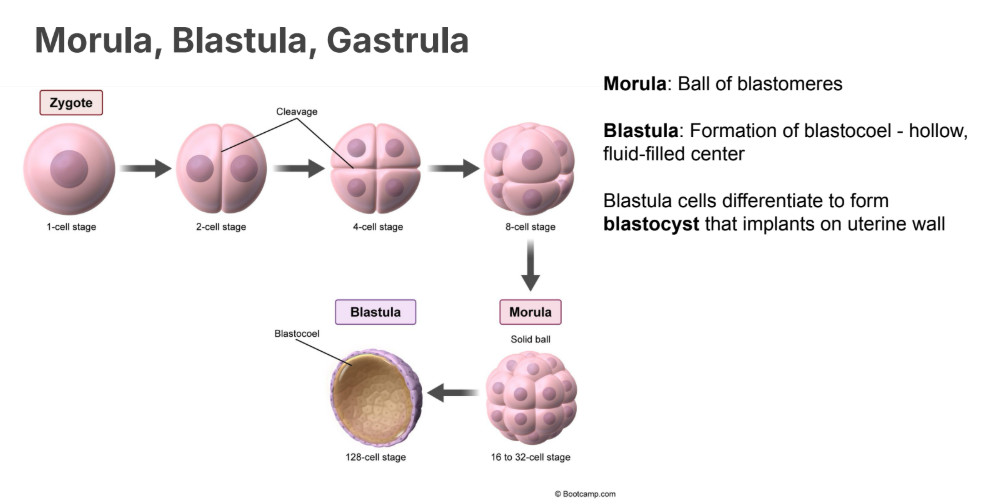
Blastocyst
Blastula cells differentiate to form blastocyst which implants into the uterine wall.
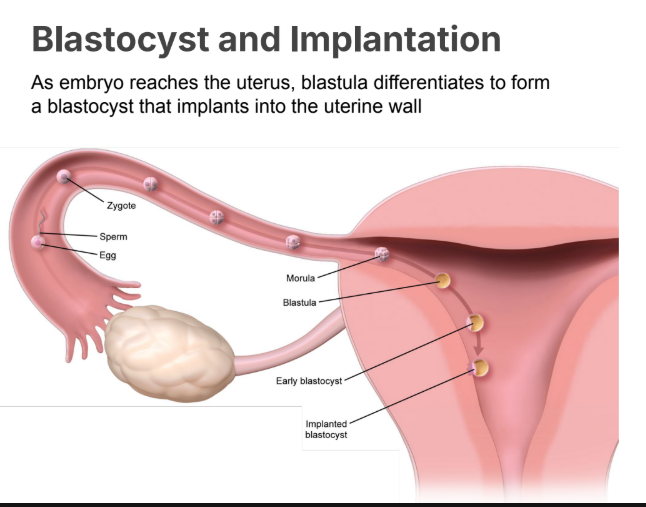
Blastocyst Implantation
As embryo reaches the uterus, blastula differentiates to form a blastocyst that implants into the uterine wall
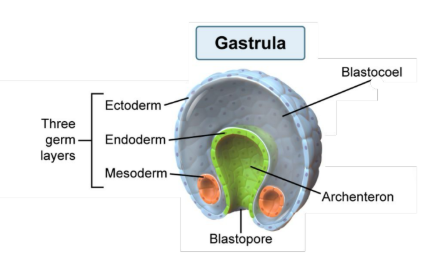
What is the gastrula?
What are it’s parts?
Formation of the trilaminar embryo
3 germ layers: Endoderm, mesoderm, ectoderm
What is the blastopore?
What does it develop into
Cells in the gastrula that invaginate to form blastopore, which will develop into gut tube (archenteron) that forms eventual digestive tract
Ectoderm gives rise to what?
Nervous system
Sensory parts of ear, eye, nose
Epidermis of skin, hair and nails
Mammary and sweat glands
Pigmentation cells
Enamel of teeth
Adrenal medulla
Attract-oderm
Want to look good, good appearances.
Mesoderm forms what?
Bones and skeleton
Muscles
Cardiovascular system
Gonads
Adrenal Cortex
Spleen
Notochord (induces spinal cord formation from ectoderm)
Means-oderm
Endoderm forms what?
Epithelial lining of digestive, respiratory and excretory systems
PLTT (pancreas, liver, thyroid/parathyroid, thymus)
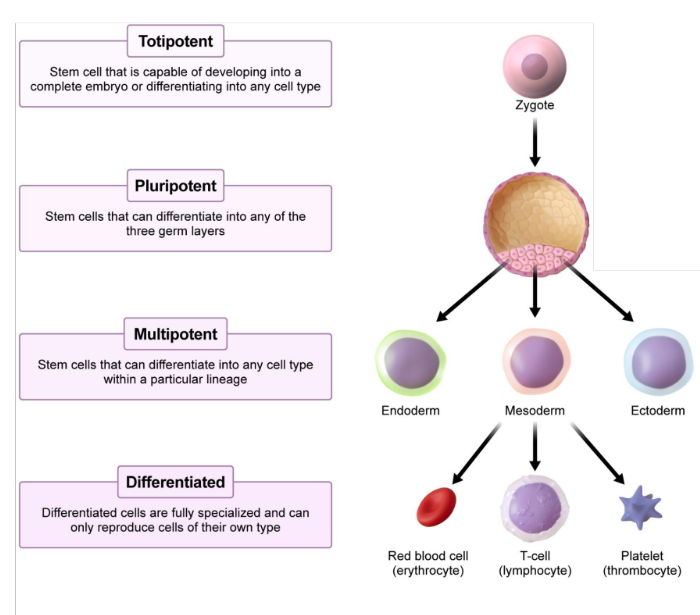
What are stem cells?
Undifferentiated Cells that have the potential to develop into different things.
Totipotent cells
Stem cells capable of developing into a complete embryo or any cell type
Pluripotent cells
Stem cells that can differentiate into any of the 3 germ layers
Multipotent cells
Stem cells that can differentiate into any cell type within a particular lineage.
Endoderm
Mesoderm
Ectoderm
Differentiated cells
Cells that are fully specialized and can only reproduce cells of their own type
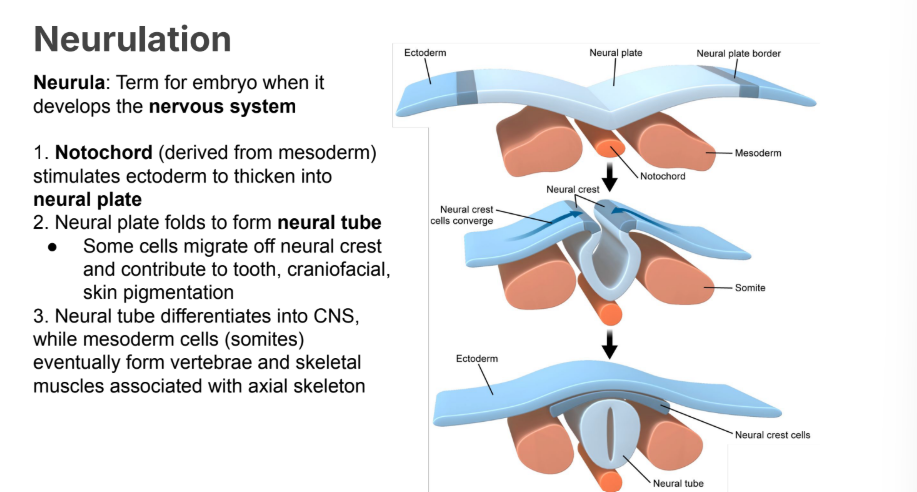
Nuerula
Neurula: Term for embryo when it develops the nervous system
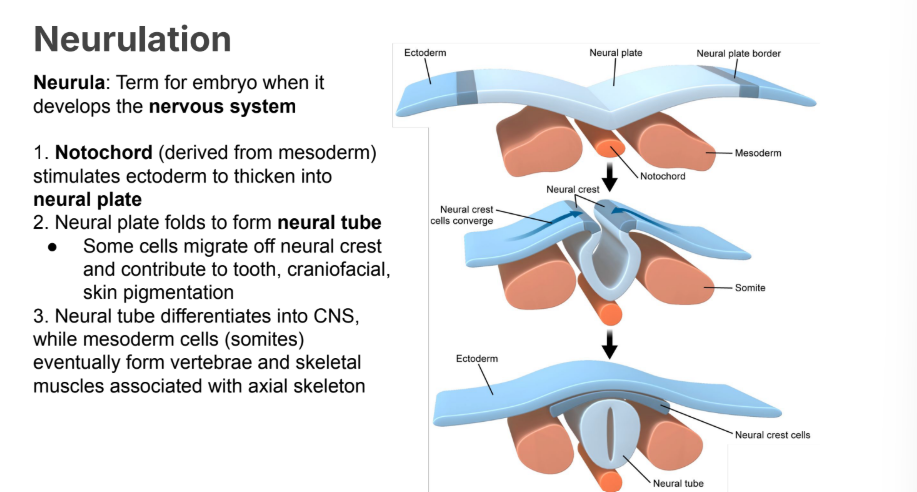
Neurulation Process
3 main steps
1. Notochord (derived from mesoderm) stimulates ectoderm to thicken into neural plate
Neural plate folds to form neural tube
Some cells migrate off neural crest and contribute to tooth, craniofacial, skin pigmentation
Neural tube differentiates into CNS, while mesoderm cells (somites) eventually form vertebrae and skeletal muscles associated with axial skeleton
Extraembryonic Development
Def
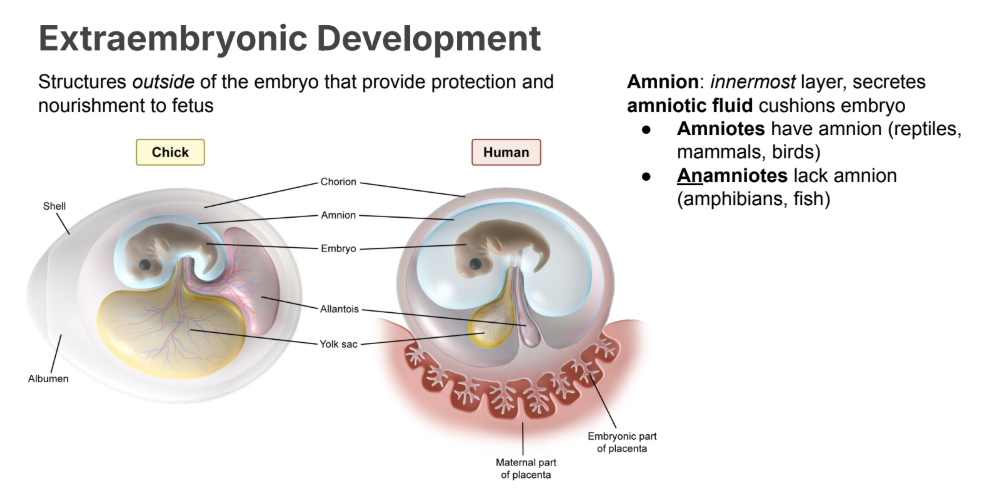
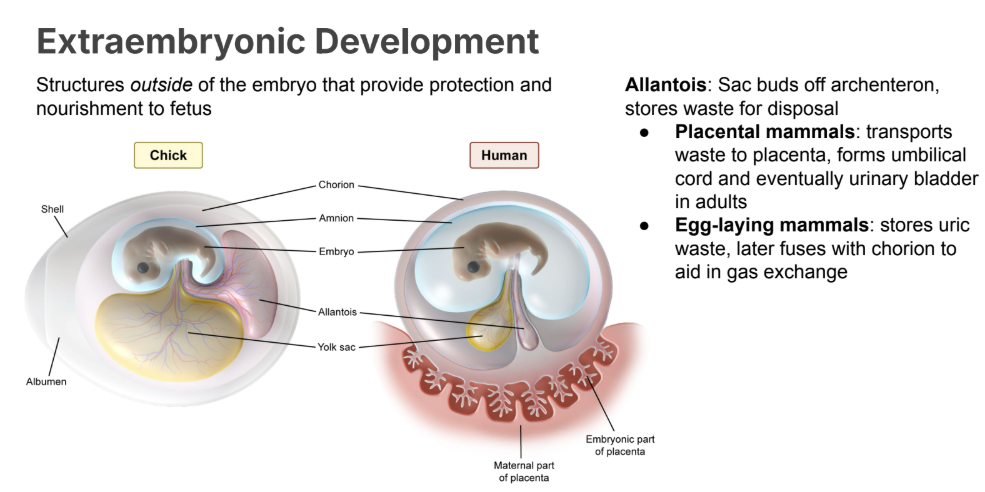
Structures outside of the embryo that provide protection and nourishment to fetus
Amnion meaning
What has it?
What do not?
Innermost layer which secretes amnionic fluid. It cushion embryo
Amniotes
What animals represent this
have amnion (reptiles, mammals, birds)
reptiles, mammals birds
Anamniotes
What animals represent this
Lack amnion
(amphibians, fish)
Choiron
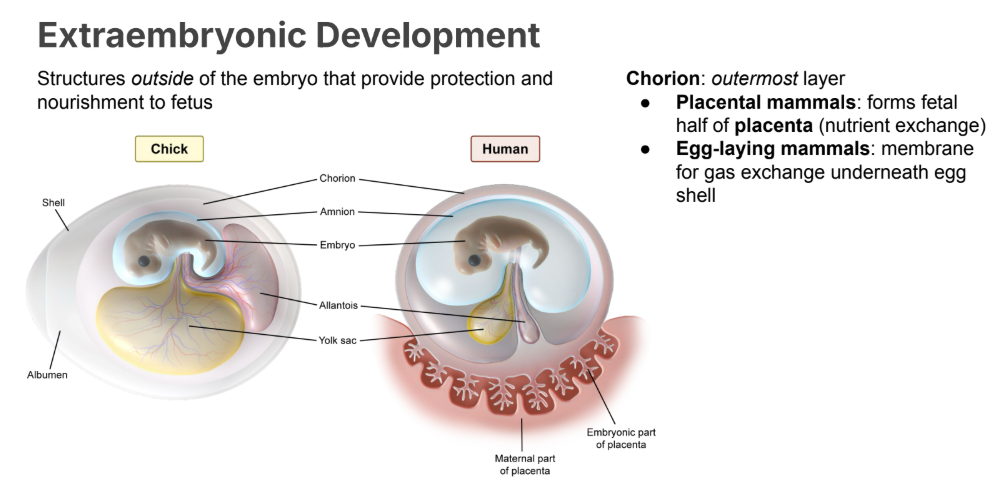
Outermost protective layer
Placental Mammals: Choroin
Forms fetal half of placenta (nutrient exchange)
Egg laying mamals: Choroin
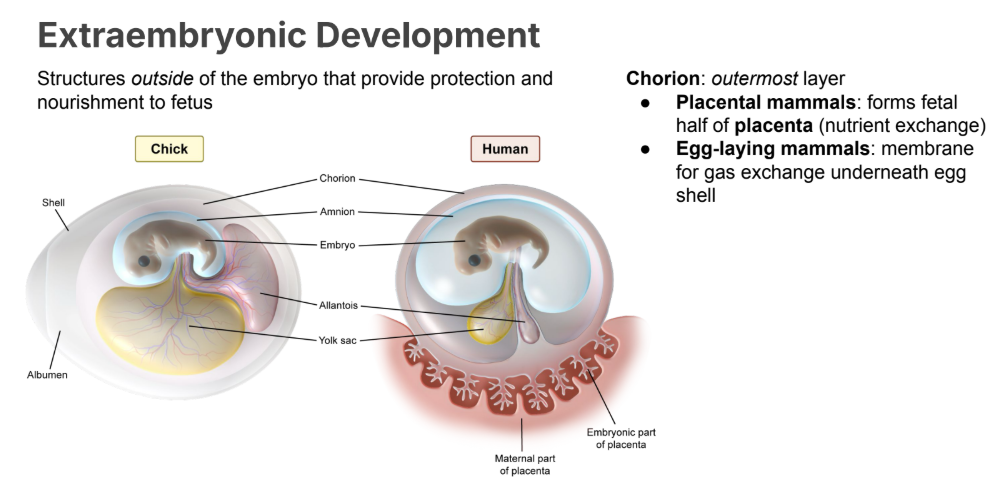
Membrane for gas exchange underneath egg shell.
membrane for gas exchange underneath egg shell
Allantois
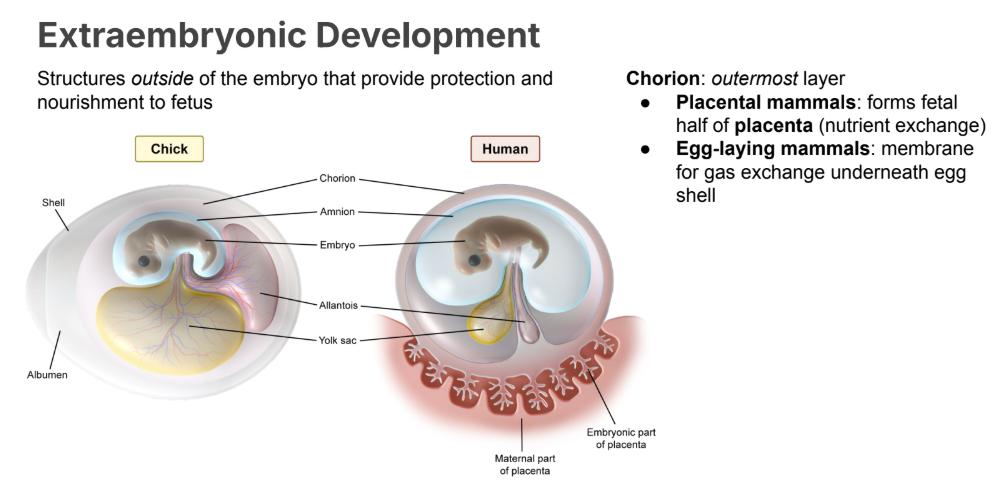
Allantois: Sac buds off archenteron, stores waste for disposal
Placental mammals: transports waste to placenta, forms umbilical cord and eventually urinary bladder in adults
Egg-laying mammals: stores uric waste, later fuses with chorion to aid in gas exchange
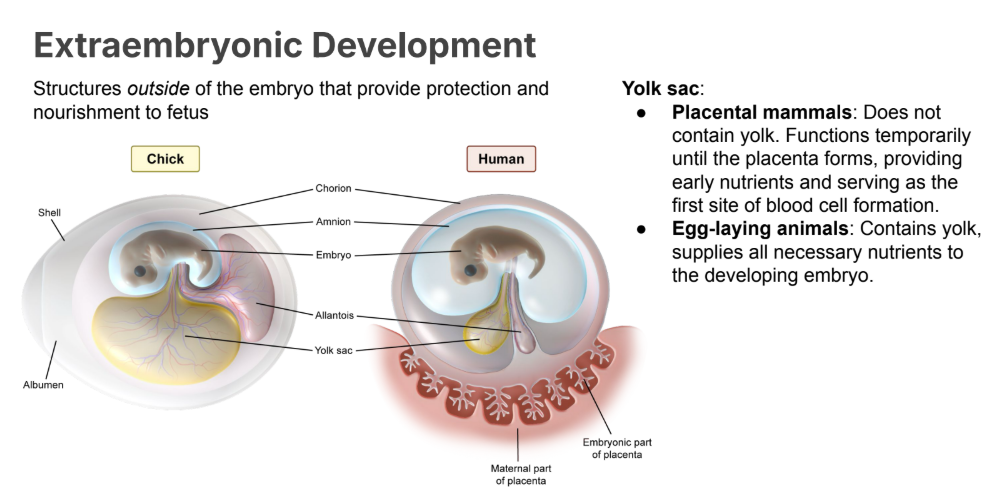
Yolk Sac
Placental mammals
Egg - laying animals
Yolk sac:
Placental mammals: Does not contain yolk. Functions temporarily until the placenta forms, providing early nutrients and serving as the first site of blood cell formation.
Egg-laying animals: Contains yolk, supplies all necessary nutrients to the developing embryo.
Factors that influence development (4)
Embryonic Induction
Homeotic genes
Apoptosis
Temperature dependent sex determination