Intervention - Oral Comps - Alyssa Joy
 Call Kai
 Learn
Learn Practice Test
 Spaced Repetition
 Match
Match Flashcards
 Knowt Play
1/61

There's no tags or description
Looks like no tags are added yet.
Name | Mastery | Learn | Test | Matching | Spaced | Call with Kai | Chat |
|---|
No analytics yet
Send a link to your students to track their progress
62 Terms
SELECTING AN INTERVENTION
The MAP clinical decision-making framework indicates that evidence driving a decision for an intervention should be as follows:
General Services Research: Evidence-Based Treatments & Research
Case-Specific Historical Information: Client’s Personal Experiences; Past Treatments
Presenting Problems: What is the data telling you about the problem? What is the family telling you?
Client Characteristics (e.g., age, gender, race, etc.)
Priority of Concerns
Cultural Considerations
Feasibility/Acceptability/Accessibility
Causal Mechanisms Research: Evidence About the Causes of Disorders
Local Aggregate Evidence: Local Evidence; What Works for Kids in Certain Contexts
HOW COULD “EVIDENCE BASED” INTERVENTIONS OR ASSESSMENTS EXACERBATE SOCIAL INJUSTICE IN THE PSYCHOLOGICAL SERVICE SYSTEMS?
The scientific evidence is mostly normed on white populations, so it affects the impact of the help we are providing to minoritized groups…
Even if a sample is nationally representative, the underrepresented groups, the average effect size will not tell you how it’s benefitted
For whom is the evidence based on???
We have no clue if an intervention is helpful or harmful for other populations…
Evidence-based interventions may be seen as a “claim of superiority”
Devalues indigenous helping community practices…
Cultural attunements
additions or modifications that are intended to boost engagement and retention of subcultural group members. They involve changes to increase reach and engagement, but they do not modify core treatment components. SURFACE LEVEL! (i.e., when you tune an instrument, you are not changing the instrument, you are only making tweaks!)
Employing bilingual and bicultural materials and staff
Translating materials
Incorporating culturally familiar formats & activities
Delivering the intervention in group settings
Siting the intervention in safe locations familiar to participants
Providing hands-on or fun activities
Including role models of the same race or ethnicity
SURFACE-LEVEL!!!!
Tune an instrument; not changing an instrument, only making tweaks
cultural adaptations
Modifies the core components of the intervention to reflect cultural differences that can be targeted or tailored. CORE COMPONENTS!
Incorporating cultural values in intervention design or implementation
Involving the family or support groups in interventions
Adjusting the materials to the literacy level of participants
5 Step Model
5 step model for cultural adaptations
Gathering Information: Acceptability; Feasibility; Literature Review
Preliminary design: Pilot Study
Preliminary testing: Evaluating Difficulties for Staff & Participants
Refinement: Editing based on preliminary testing
Final Trial: Full Trial to Test Efficacy
Gathering Information - 5 Step Model - Cultural Adaptation
Acceptability; Feasibility; Literature Review
In the initial effectiveness/efficacy trail of the intervention, what was the cultural make-up of the population?
When do conditions justify a cultural adaptation?
Differences in acceptability/feasibility between cultures?
Differences in outcomes between cultures?
Do core components target culturally defined mechanisms of change?
What treatment elements should be modified when cultural adaptation is justified?
Search the literature for evidence of group differences to determine whether previous applications of an evidence-based intervention show deficient engagement & whether there are sizable mismatches between the features of the original efficacy research
preliminary design - 5 step model - cultural adaptation
Pilot Study
Train staff for preliminary version of adaptation
Use case studies or pilot studies for first version testing
preliminary testing - 5 step model - cultural adaptation
Evaluating Difficulties for Staff & Participants
Implementation difficulties
Difficulties with content or activities
Satisfaction with treatment…including cultural features
Suggestions for improvement
refinement - 5 step model - cultural adaptation
Editing Based on Preliminary Testing
Integrate feedback to revise the intervention
Check exclusion of initial components/mechanisms with cultural modifications
final trial - 5 step model - cultural adaptation
Full Trial to Test Efficacy of revised intervention to determine if it leads to desired effect
how can cultural adaptations be targeted?
This is a deductive approach, which includes prior modifications based on expectations for cultural groups.
Makes assumptions & changes before implementing the intervention in anticipation of needs & preferences
Assumes homogeneity of individuals within the culture; one single adapted intervention will be adequate to serve members of this group
E.g., You might change the program curriculum for a particular demographic group to include culturally relevant examples. This allows for customization for groups but does not include within-group variances.
E.g., If you know the new population you are implementing a mentoring program with will be primarily Latin youth, then you may make assumptions and changes before implementing the intervention in anticipation of their needs and preferences…such as hiring translators to translate materials, removing certain modules that appear to not fit Latin culture, etc.
how can cultural adaptations be tailored?
This is an inductive approach, which creates a structure for anticipating and responding to individual differences within expected cultures
Occurs in response to particular events/information from consultees (e.g., incorporating spirituality into the intervention after learning that this is a value of the family)
E.g., Modifying treatment materials for one individual in your intervention group based on information collected during an intake interview…such as integrating themes of spirituality if they note this as a main value
E.g., Based on a person’s age, prior mammogram status, or inclination to religion, you may provide someone with a particular pamphlet. This is what social media advertisements do. There is opportunity for individualization; however, it may be considered manipulative…
Use an empowerment evaluation to allow the emic culture to steer the ship!
WHAT WOULD YOU SAY TO PEOPLE WHO ARE SKEPTICAL OF ADAPTING THE INTERVENTION? Be able to address straw-man arguments against the adaptation of evidence-based programs (e.g., it could compromise the fidelity)
People who think that adaptations are harmful are assuming that they are made thoughtlessly and carelessly. However, those who are adapting interventions are often experts in the populations they are working with. They do not make adaptations carelessly…
Some may be concerned that intervention may be less potent or watered down on core components which would cause less change…HOWEVER, while some might think that making cultural adaptations negatively impacts implementation fidelity, existing research indicates that interventions are more effective when they are adapted
Number of adaptations and effect size have a linear relationship!
The vast majority of adaptations are to periphery materials which are not central to the intervention. Of those changes which are made to core components, the majority are additions, not subtractions from material.
ALSO, it might also be unethical to implement an intervention that you know is inconsistent with a client’s cultural beliefs/values & adaptations make interventions more accessible
WHAT INDICATORS DO WE EVALUATE TO DETERMINE IF A MODIFICATION/ADAPTATION WAS SUCCESSFUL OR UNSUCCESSFUL? WHY DO WE MODIFY INTERVENTIONS TO ACCOMMODATE CULTURES?
Intervention Accessibility
Intervention Acceptability
Intervention Dosage
Intervention Effectiveness
CONCERNS SURROUNDING UNNECESSARY OR POTENTIALLY HARMFUL TREATMENT ADAPTATIONS
Some adaptations are low risk, high reward. Whereas other adaptation are high risk with unknown rewards…
While existing research indicates that adaptations increase effect sizes, we have limited studies.
Due to a lack of replication, there is some concern that adaptation panacea has grown and will compromise services for underrepresented population
EFFICACY VS. EFFECTIVENESS
Efficacy: Can an intervention work under ideal circumstances?
Ideal being defined as the conditions that one can generalize results from a controlled evaluation
Does not mean optimal…
Effectiveness: Does an intervention work in regular clinical practice and/or routine implementation?
INSTRUCTIONAL HIERARCHY (ACADEMIC INTERVENTIONS)
Why is a student having difficulty with reading comprehension?
Acquisition/Accuracy: the student is able to complete the skill accurately, but is not yet fluent
Is the student reading the words accurately? Do they know the correct meaning of the words?
Fluency: the student is able to complete the skill quickly & accurately
Is the student reading the words quickly & accurately?
Generalization: the student is able to complete the skill quickly & accurately, and is able to use the skill across different settings & situations
Is the student able to read the words embedded in passages?
Adaptation: the student is able to modify and adapt the skill to fit new situations & settings
Is the student able to read novel words in new situations & figure out the meaning of the words?
MASTERY LEARNING VS. CURRENT EDUCATIONAL SYSTEM
Mastery learning is learning that ensures that each student masters each part of the curriculum before progressing and moving on to the next one by providing formative feedback.
Our current educational system does not employ mastery learning, and quickly progresses through content even if students did not master prerequisite knowledge.
This approach sets students up to fail as their foundation of knowledge is not stable before trying to build up higher levels of knowledge.
Higher levels of knowledge will collapse or may not even be able to be built…
DALY’S HYPOTHESES FOR ACADEMIC DEFICITS & CORRESPONDING INTERVENTIONS
they do not want to do it
they have not spent enough time doing it
they have not had enough help to do it
they have not had to do it in that way before
it is too hard
daly’s hypothesis: they do not want to do it (student lacks motivation)
Increase interest in curricular activities…
Provide incentives for using the skill
Teach the skill in the context of using the skill
Provide choices of activities
Daly’s hypothesis: they have not spent enough time doing it (insufficient active student responding
Increase active student responding…
Estimate the current rate of active responding & increase the rate during allocated time
daly’s hypothesis: they have not had enough help to do it
insufficient prompting & feedback for active responding; poor accuracy; poor fluency; lack of generalization to natural settings and/or to other materials/settings
how to target insufficient prompting & feedback (daly’s hypothesis)?
Implement response cards
Encourage choral responding
Provide flash cards with praise & error correction
how to target poor accuracy in target skills (daly’s hypothesis)?
Increase modeling & error correction
Read passages to the student
Use cover-copy-compare
Have student repeatedly practice correct response in context of errors
how to target poor fluency in target skills (daly’s hypothesis)?
Increase practice, drills, & incentives
Have the student repeatedly read the passages
Offer incentives for beating the student’s last score
how to target lack of generalization (daly’s hypothesis)?
Teach multiple examples of use of the skill
Teach use of the skill in the natural setting
Capture natural incentives
Teach self-monitoring
daly’s hypothesis: they have not had to do it in that way before
instructional demands do not promote mastery of the curricular objective
Change instructional materials to match the curricular objective…
daly’s hypothesis: it is too hard
(student’s skill level is poorly matched to the difficulty of the instructional materials)
Increase student responding using better matched instructional materials to the level of understanding the student is at…
CRITIQUES
Does not explain why a child is poorly matched with the difficulty of the materials…
Maybe there is a cognitive component for why the material is too hard?
Daly’s recommendation is to lower the instructional materials to the child’s level
Interventions may be different based on the underlying reason for why someone is having difficulty or it is too hard for them.
E.g., a child with ADHD who is struggling to complete an assignment may have very different educational needs than a child with a LD in reading. But Daly would treat these the same way…
FUNDAMENTAL SKILLS OR CONTEXTUAL FACTORS THAT MAY HELP PARENTS SUPPORT ACADEMIC INTERVENTION SERVICES
Fundamental Skills
Make a Context Conducive for Learning
Remove Distractions; Increase Proximity
Maintain Eye Contact
Remain Quiet & Calm
Give One Instruction at a Time
Requests! Not Don’ts!
Prompt in a Calm & Direct Manner
Keep Things Positive
Contextual Factors
Access to School-Based Services
VALUE & IMPORTANCE OF NONBEHAVIORAL CONSTRUCTS (ACADEMIC INTERVENTIONS)
important to academic instruction and acquisition of academic skills
Self-Efficacy: A student’s belief about their capacity to perform mathematics is one of the most important things about mathematics development.
Self-Fulfilling Prophecy: Teacher perceptions of a child’s abilities directly shapes student performance
Motivation: Even behaviorists (e.g., Daley) recognize that motivation is important (e.g., “they don’t want to do it”)
Academic Mindsets, Attitudes, & Beliefs: Interventions that target academic mindsets, attitudes, and beliefs can lead to improved academic outcomes through changes in student disposition toward academic work and increased academic effort.
Student academic mindsets drive academic perseverance and, therefore, academic behaviors, such as attending class, paying attention in class, completing homework, and studying.
Growth vs. Fixed-Ability Mindsets
Students who have a growth mindset have more reason to believe that their performance can improve with effort.
In contrast, students who hold a fixed-ability mindset are more likely to engage in performance avoidance.
EFFECTIVE CLASSROOM MANAGEMENT STRATEGIES
Be organized!
Crowded & cluttered classrooms create environments of disorder & disruption
Minimize distance from all students
The closer a student is to the teacher, the easier it is for the teacher to manage behavior
Set expectations as globally stated rules of conduct
Set rules as behavioral definitions that define the expectations
Provide consistent behavioral routines
Predictable
Structured
Well-defined
Implement pre-corrections
Statements that prompt the correct response before an opportunity
Engage in active supervision
Proximity + Performance Feedback
You need to be close to a child & when they behave, provide feedback
Provide noncontingent interactions
Provide OtR (opportunities to respond)
Provide contingent behavior specific praise
Provide group contingencies & token economies
Implement behavior contracts
Respond to inappropriate behavior
Planned ignoring
Explicit reprimands
Differential reinforcement
Response cost & time out
Classroom check-up (consultation) Steps
Assess Classroom (Problem Identification)
Provide Feedback (Problem Analysis)
Develop Menu of Options (Problem Analysis)
Choose Interventions (Plan Implementation)
Action Planning & Encourage Teacher Self-Monitoring (Plan Implementation)
Provide Ongoing Monitoring (Plan Evaluation)
What goes into assessing the classroom (problem identification) in consultation classroom checkup?
Teacher Interview
Classroom Ecology Checklist
10 & 5-Minute Observation Forms
Overall Classroom Rating Form
What goes into providing feedback (problem analysis) for classroom check-up (consultation)?
Summarize Objective Data from Observations
Mean Rate of OtR
Mean % of Student Accuracy
Mean Rate of Classroom Disruptions
Mean Rate of Praise
Mean Rate of Reprimands
Ratio of Positive-to-Negative Interactions
Number of Behavior-Specific Praise Statements to General Praise
Number of Explicit Reprimands vs. Critical Harshness
Conceptualize the Problem
What is the most necessary need?
What resources are minimally sufficient to produce an impact on this need?
Provide Objective Feedback
Classroom Check-Up Feedback Form
Present Strengths & Areas of Concern
Provide specific data!
Elicit Change Talk
What goes into action planning for classroom checkup consultation?
Develop SMART GOALS
Specific
Measurable
Attainable
Realistic
Timely
What improves fidelity to recommendations for classroom checkup consultation?
Monitoring
Antecedent and consequence strategies
Consequence strategies work best, feedback that is consistent from the behavior
Feedback and monitoring
What factors would you consider when choosing an intervention? (classroom checkup consultation)
Feasibility/acceptability/accessibility
Presenting problem
Priority of concerns
Client characteristics
Cultural considerations
Evidence based assessment or intervention for a young child vs. teenager?
Consider the client’s current levels
Need for visuals/activities vs. conversation/learning
Ability to access the information
*How would you tell a parent they are the target of an intervention vs. the child?
Summarize and reflect what the parent is currently experiencing
Creating the environment for the child
Based on where your child is right now - xyz
Interventions for populations of differing cultural backgrounds
Open and receptive during interview to understand the populations background and values
Research the cultural background to gain a better understanding and learn about already adapted interventions
Seek consultations from an experienced clinician in this background or cultural adaptation to understand the appropriate interventions and risk/benefits of the changes
Speaking a second language
Test selection: is there a disability or is there an inability to access appropriate instruction?
Be aware of the schools/district's resources and access to appropriate instruction
Test sensitivity
Be able to address straw-man arguments against the adaptation of evidence-based programs (e.g. it could compromise the fidelity).
straw-man argument: someone misrepresents or oversimplifies a position to make it easier
Example: If you adapt an evidence-based program, you're no longer doing the actual program. It won’t work if you change anything
Adaptation doesn’t mean throwing out the evidence, it means adjusting the delivery to better fit the students, context, or culture while maintaining the program’s core components
Researchers are often experts in the population they are adapting, and adaptations actually increases effect sizes because of increased effectiveness of the intervention for the population
Be able to describe legitimate concerns surrounding unnecessary or potentially harmful treatment adaptations.
Some adaptations are low risk, high reward. Whereas other adaptation are high risk with unknown rewards.
Due to a lack of replication and limited studies, there is some concern that “adaptation panacea” has grown and will compromise services for underrepresented population
Be able to describe how racism has impacted access to psychological services and have specific examples of systems that perpetuate inequalities in health and education.
Major areas: assessment, testing, interventions, higher ed being a white institution, health care and medical services also being white institutions, and the inequalities for discipline for Black & Latinx boys. review below and see individual flashcards.
Scientific research and evidence in primarily normed with majority white populations that can impact how we can support minoritized groups
Testing, evaluations, interventions have all been studied with primarily white samples – so from who the evidence is based has been influenced by racism
Even if a sample is nationally representative, the underrepresented groups, the average effect size will not tell you how it’s benefitted
Evidence-based interventions may be seen as a “claim of superiority” and devalues indigenous helping community practice or practices out of the norm that are beneficial to minoritized groups
The field is trying to diversify and as a result likely underserved minority populations as well as a lack of representation of diverse therapists, perpetuated by things like higher ed being a white institution
Leads to a cycle of minoritized groups less likely to receive services, therefore less likely to have diverse therapists and vice versa (something we can do on our end)
Health care and medical services also experiencing the same thing – also the cost of health care in the united states can contribute to this, with low income communities with less access
systemic inequities through funding disparities, biased disciplinary practices, and curricular omissions that marginalize non-dominant perspectives, reinforcing cycles of academic disengagement and opportunity gaps.
Minority students, particularly Black & Latinx boys, are much more likely to be disciplined for minor behavioral infractions, often resulting in suspension or expulsion from school.
Schools are much more likely to escalate disciplinary issues to the juvenile justice system for these students, as well…putting them in contact with the criminal justice system at an early age
Black students are suspected 3x more than White students
how have testing, evaluations, and intervention been affected by racism?
Scientific research and evidence in primarily normed with majority white populations that can impact how we can support minoritized groups
Even if a sample is nationally representative, the underrepresented groups, the average effect size will not tell you how it’s benefitted
Evidence-based interventions may be seen as a “claim of superiority” and devalues indigenous helping community practice or practices out of the norm that are beneficial to minoritized groups
how are systems and organizations impacted by racism?
The field is trying to diversify and as a result likely underserved minority populations as well as a lack of representation of diverse therapists, perpetuated by things like higher ed being a white institution
Leads to a cycle of minoritized groups less likely to receive services, therefore less likely to have diverse therapists and vice versa (something we can do on our end)
Health care and medical services also experiencing the same thing – also the cost of health care in the united states can contribute to this, with low income communities with less access
systemic inequities through funding disparities, biased disciplinary practices, and curricular omissions that marginalize non-dominant perspectives, reinforcing cycles of academic disengagement and opportunity gaps.
how are school discipline systems impacted by racism?
Minority students, particularly Black & Latinx boys, are much more likely to be disciplined for minor behavioral infractions, often resulting in suspension or expulsion from school.
Schools are much more likely to escalate disciplinary issues to the juvenile justice system for these students, as well…putting them in contact with the criminal justice system at an early age
Black students are suspected 3x more than White students
How does systemic racism influence the socialization of young people?
Systemic racism shapes the environment, expectations, and opportunities of young people
Socialization: how young people understand themselves and others, often reinforcing stereotypes and limiting cross-cultural understanding
Example: students of color often seeing portrayals of people who look like them in textbooks, movies, or the news
Example: stereotype that black males are perceived as violent and more threatening, thus authority figures treating them more harshly
How does systemic racism influence the learning of young people?
Learning: impacts quality of education, resources, and amount of support for youth that impacts their academic achievement
Example: More funding for schools in predominantly white or affluent communities
Systemic inequities through funding disparities, biased disciplinary practices, and curricular omissions that marginalize non-dominant perspectives, reinforcing cycles of academic disengagement and opportunity gaps.
school-to-prison pipeline - racially minoritized students face disproportionate punitive measures, fostering alienation and increased risk for long-term socioeconomic disadvantage.
How does systemic racism impact the mental health of young people?
chronic exposure to racism can lead to trauma, stress, and feelings of isolation
Example: microaggressions or witnessing of racisms can lead to depression and anxiety
Example: increased youth mental health concerns when there are leess culturally competent mental health providers available
What are structural barriers that young people face as a result of racism?
Structural barriers: stigma, lack of cultural competencee, SES contraints that often preclude access to services
What are overall needs for change in the field of psychology when it comes to racism?
Overall we need a multilevel approach to integrate policy reform, culturally responsive education, and accessible services (mental health) to mitigate disparities and promote resilience
Fidelity
Define: faithful and consistent implementation of a process, program, or intervention exactly as it was designed or intended
What improves fidelity?
Monitoring
Antecedents and Consequences strategies
Consequences strategies work best because it is feedback that is consistent with the behavior
Feedback
How might your approach to intervention with disruptive behavior change from early childhood to later adolescence?
Difference that my impact what intervention is used on children vs late adolescence
Developmental stage
Social context – role of others
Autonomy – choice ability
Communication – language/conversation modem or style
Early childhood
More structure: consistencies and routines
Skill building: learning self-regulation
Adult guided: rely heavily on modeling and observation
Immediate feedback: rewards are closely tied to desired behavior
Late adolescence
Relationship building focus on repairing relationships and restorative practices
Collaborative problem solving: they want autonomy and independence
Goal setting: own values to guide solutions and change
Intervention Logic
Prevent: (Antecedent) change what comes before the behavior
Teach: (Behavior) focus on behavioral skills training
Reinforce: (Consequence) reinforce expected behavior & ignore problem behavior
Be able to identify a biological basis of behavior and explain its relevance to therapy, trauma, behavior management, etc. Take a look at Siegel’s hand model.
Biological basis of behavior: thoughts, emotions, and behaviors are deeply rooted in the structure and function of the nervous system, as well as in genetic and biochemical processes; biological substrates contribute to cognition and behavior but also reinforces the necessity of a biopsychosocial model. know the limbic system. see individual flash cards.
how does the limbic system relate to behavior?
involved in emotion regulation, memory processing, and threat detection
Amygdala: fight or flight
Hippocampus: memory formation
Prefrontal Cortex: executive functioning
When the system is under stress or dysregulation, the amygdala often becomes hyperactive, leading to heightened fear responses, while the prefrontal cortex may be underactive, making it harder to regulate emotions or behavior
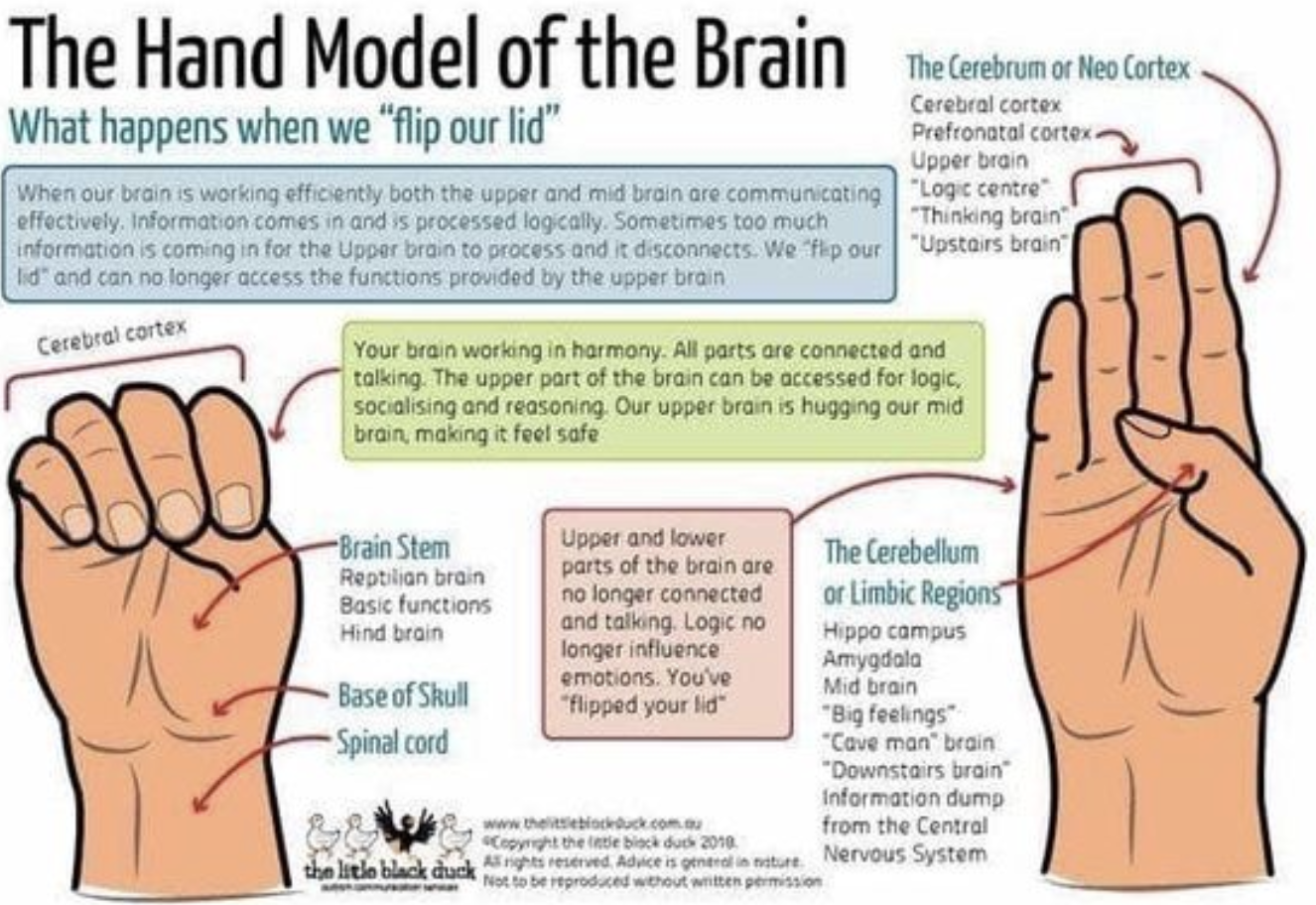
How is the biological basis of behavior relevant to therapy?
Trauma informed therapy: works to calm the overactive amygdala and reintegrate traumatic memories
CBT: strengthens the prefrontal cortex’s ability to regulate negative thoughts and behaviors
How does the biological basis of behavior relate to trauma
impacts brain development, leading to difficulties with memory, emotional regulation, and attention
tailor interventions to support healing
How does the biological basis of behavior relate to behavior management.
challenging behaviors are often neurologically driven
Behavior support plans rooted in neuroscience and interventions that support their nervous system
Why do students underachieve?
Daly’s hypothesis:
they don’t want to achieve
they haven’t spent enough time practicing
they have not had to do it in a particular way
it is too hard
other reasons (teacher skills, classroom routine/ambiance/distractions, internal conditions/mental health concerns)