wastewater treatment systems exam 2
 Studied by 0 people
 Call Kai
 Learn
Learn Practice Test
 Spaced Repetition
 Match
Match Flashcards
 Knowt Play
1/34

There's no tags or description
Looks like no tags are added yet.
Name | Mastery | Learn | Test | Matching | Spaced |
|---|
No study sessions yet.
35 Terms
Understand why secondary treatment is needed what contaminants need to be removed in secondary treatment
Prelim and Primary treatment do not remove enough TSS and BOD to meet the Federal 30/30 requirement
What is the Federal 30/30 requirement?
TSS and BOD5 may not exceed 30 mg/L
What is the electron donor and acceptor in secondary treatment
BOD = electron donor, O2 = electron acceptor, cBOD & NOD being oxidized
What is another name for the NOD to be oxidized (Reduced N)
TKN
Be aware of how secondary treatment is achieved, i.e., using microorganisms that do oxidation and cell synthesis.
Feed the effluent from primary treatment to microorganisms that oxidize BOD/organics and synthesize more cells (including TSS)
Know the general pathway with which cBOD is converted to CO2 by heterotrophic bacteria
Particulate cBOD → hydrolysis → soluble cBOD → oxidized by heterotrophic bacteria using O2 as e⁻ acceptor → converted to CO2 + NH₃ for energy, with some N & P used for new cell synthesis.
Know the general pathway with which NOD is converted to nitrate by autotrophic bacteria.
Autotrophic bacteria oxidize NH4+ using O2 as the e⁻ acceptor → form NO₃⁻ + H⁺ for energy, using CO₂ + nutrients for new cell synthesis (consumes alkalinity).
Where would ammonia be more common, cBOD consumption or NOD consumption
cBOD consumption
What is another name for NOD consumption
Nitrification
What is the faster form of consumption, heterotrophic (cBOD consumption) or autotrophic (NOD consumption)
NOD is SLOWER because you need to wait for the one of the products of cBOD consumption (CO2) for Nitrification
Understand the fundamental operational concept of secondary treatment of keeping microorganisms in the tank longer than the wastewater.
Microorganisms suspended in WW, settled, returned to tank
Microorganisms attach to surface of some medium (plastic sheets, rocks)
What is the magnitude of solids retention time?
Days
What is the magnitude of hydraulic retention time?
Hours
Know the typical ranges of SRTs and HRTs for activated sludge systems
SRT’s (3-15 days)
Removal of soluble BOD (1-2 days)
Removal of particulate BOD + good flocculation for domestic WW (2-4 days)
Nitrification (2-15 days)
Biological phosphorus removal (2-3 days
HRT’s (3-8 hours)
Understand and be able to interpret the Monod equation of microbial growth.
Monod equation = relationship between substrate conc and growth
HAVE to know how fast your microbes grow when designing tank
μ = specific growth rate (d⁻¹)
μm = maximum specific growth rate (d⁻¹)
Ks = half-saturation constant (mg BOD5/L)
S = substrate concentration (mg BOD5/L)
Equation for BOD removal efficiency
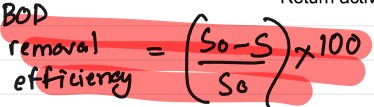
Know how the Monod equation forms the basis for microbial growth in suspended growth secondary treatment systems.
SRT >>> HRT due to large population of microbes and not enough food (F/M ratio)
understand yield (Y) and its use in the mass balance over the substrate.
Yield is the mass of biomass formed divided by the mass of substrate consumed
Mg VSS/ mg BOD5: practical
Mg COD in biomass/mg COD in substrate: fundamental
Modify the SRT calculated to include a safety margin and sensitivity to oxygen

Note why there is a limit on biomass concentration (X) that can be used in suspended growth systems.
There are two limitations to how high X can be set:
1) At >5,000 mg TSS/L, activated sludge settles too slow → 2° clarifiers have to be very large.
2) Irrespective of V, O₂ demand is set by substrate consumed → if V is too small, you still need the same mass of O₂ → higher air flow rates → shears flocs.
Memorize the typical range of biomass concentrations used.
X' = 2,000 – 5,000 mg TSS/L
X = 1,400 – 3,500 mg VSS/L
What is the conversion from mg TSS (X’) to mg VSS (X)
1 mg TSS/L = 0.7 mg VSS/L
How to calculate for tank volume
Once SRT and X are set, use the X equation to solve for HRT, and then use HRT=V/Q
Understand how to calculate for sludge wasting rate
sludge wasting rate is the amount of solids LEAVING per day (Px)
Understand how to calculate for flow rate of waste activated sludge
Qr = (between 0.2 and 1) * Q
Xr = typically up to 10,000 mg VSS/L
→ Once θc is set, you can’t change Xr or X.
→ Xr can only be changed by Qr.
→ If Xr decreases, you do need to change Qw to maintain PX/θc.
Conversion from cBOD to BOD5
1kg cBOD = 0.68kg BOD5
Know the different ways in which air is provided to activated sludge systems, paying special attention to which methods are more efficient in terms of oxygen delivery and energy consumption and why.
Methods to Provide Air
Two approaches for providing air:
Diffused air:
coarse bubble
fine bubble (more efficient)
Mechanical aeration:
surface aerationhorizontal axis aeration
Know ALK relations and equation
cBOD consume little to no ALK, nitrification consumes large amounts of ALK
ALK is equal to 7.14 g CaCO3 per g N
Nox = (gN/L)
ALK concentration is equal to ALK*Nox
Know which approaches are typically used if the alkalinity consumed in nitrification will be larger than in the influent wastewater.
Two approaches to add alkalinity:
→ Add base (NaOH, NaHCO3, lime)
→ Incorporate denitrification
Be aware of the general concept of a PFR and the pros and cons vs. a CSTR approach for secondary treatment.
CSTR: Continuous Stirred Tank Reactor
Entire tank is at S, lowest conc of cBOD (NH4+)
PFR: plug flow reactor
Tend to be smaller, no mixer in tank
S conc dec over length
Can still design like CSTR in series, do inverse
What is the acceptable range of F/M ratios
0.04-2 (mgBOD5/d)/(mg MLVSS)
Understand the importance of non-filamentous and filamentous bacteria in activated sludge flocs and what happens if there is an overgrowth of one or the other.
Good settling sludge: mix of filamentous and non-filamentous
Filamentous – not much mass so float more, skinny lines
Too many = poor settling sludge “bulking sludge”
Non-filamentous – won’t settle as well, more clumpy
Too many = “pinpoint sludge”
Be aware of the general differences in non-filamentous and filamentous bacteria growth parameters.
Non-filamentous:
– Very high aerobic growth rate (μm)
– Can grow using nitrate
– Require higher DO concentrations than filamentous organisms
Filamentous:
– Lower aerobic growth rate (μm)
– Cannot grow using nitrate
– Grow well at low DO concentrations
Know which other members of microbial community apart from filamentous and non-filamentous bacteria are needed for activated sludge system functioning and why.
Protozoa and rotifers
Microorganisms that eat other microorganisms
Reduced TSS in effluent
Improve coliform removal & clarity with grazing activity
Know the definition of sludge volume index (SVI) and the range of acceptable and problematic values.
Measure of how well activated sludge settles
SVI = (mL of settled sludge at 30 min per L of sludge)/MLSS
Good SVI = <100 mL/g TSS
Bad SVI = >150 mL/g TSS, bulking sludge
100 > SVI < 150 = just chillin