APK CH 3 (must finish adding)
 Call Kai
 Learn
Learn Practice Test
 Spaced Repetition
 Match
Match Flashcards
 Knowt Play
1/56

There's no tags or description
Looks like no tags are added yet.
Name | Mastery | Learn | Test | Matching | Spaced | Call with Kai | Chat |
|---|
No analytics yet
Send a link to your students to track their progress
57 Terms
Metabolism
The sum of all chemical reactions occurring inside cells.
Catabolic Reactions
Breakdown of larger molecules into smaller molecules.
Examples: Breaking proteins down into amino acids, breaking glycogen down into glucose.
Generally release energy (exergonic).
Anabolic Reactions
Synthesis (building) of larger molecules from smaller molecules.
Examples: Synthesizing proteins from amino acids, making glycogen from glucose.
Require energy input (endergonic).
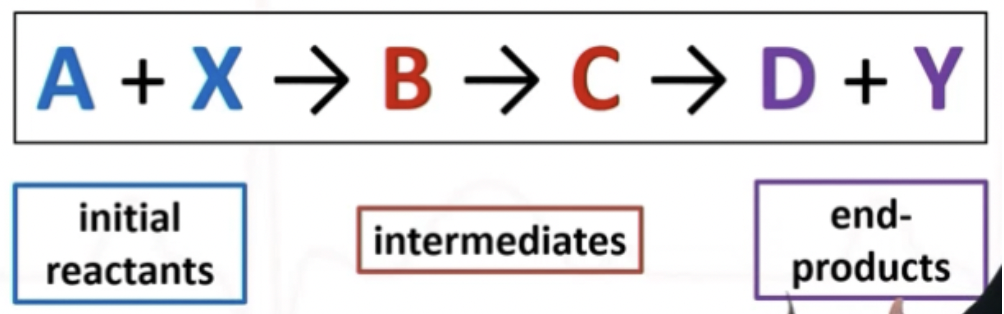
Metabolic Pathways + Sequence/components
Sequences of interconnected chemical reactions where the product of one reaction serves as the reactant for the next.
Hydrolysis
Breaking a chemical bond using water ("splitting with water").

Condensation
Joining two molecules together, forming a water molecule as a byproduct.
Reverse of hydrolysis

Phosphorylation
Addition of a phosphate group (P) to a molecule.
A condensation type reaction (produces water)

Dephosphorylation
Removal of a phosphate group from a molecule.
Example: Removal of phosphate from ATP to form ADP.
ATP Hydrolysis

Oxidation
The removal of electrons or hydrogen atoms from a molecule.
Mnemonic: LEO (Loss Electrons = Oxidation)

Reduction
The addition/acceptance of electrons or hydrogen atoms by a molecule.
Mnemonic: GER (Gain Electrons = Reduction
Oxidation and reduction always occur together as paired
redox reactions
Hydrogen atoms act as reducing equivalents because
they carry an electron
Energy
The capacity to do work
Work is driven by
metabolic reactions
Kinetic Energy
Energy associated with motion
Potential Energy
Stored energy
First Law of Thermodynamics
Energy cannot be created or destroyed, only transformed from one form to another (e.g., potential energy in chemical bonds converted into kinetic energy).
Second Law of Thermodynamics
Processes proceed spontaneously from states of higher order/concentration to lower order/concentration (spreading out).
Aka proceed in the direction that spreads energy, orange scent example
All chemical reactions involve
energy exchange
If a reaction releases energy, it's because
the reactant molecules had more energy than the products.
Energy Change Formula

Exergonic Reactions
Reactants have higher energy than products (Delta E < 0).
Release energy; proceed spontaneously.
Endergonic Reactions
Products have higher energy than reactants (Delta E > 0).
Require energy input; do not proceed spontaneously.
Energy Coupling
Exergonic reactions (such as catabolism of glucose) are coupled to endergonic reactions (such as synthesis of ATP or driving ion pumps) to fuel cellular work. Uncoupled energy is released as heat.
Calorie
amount of energy/heat necessary to raise the temp of 1g of water 1 degree C
Equilibrium
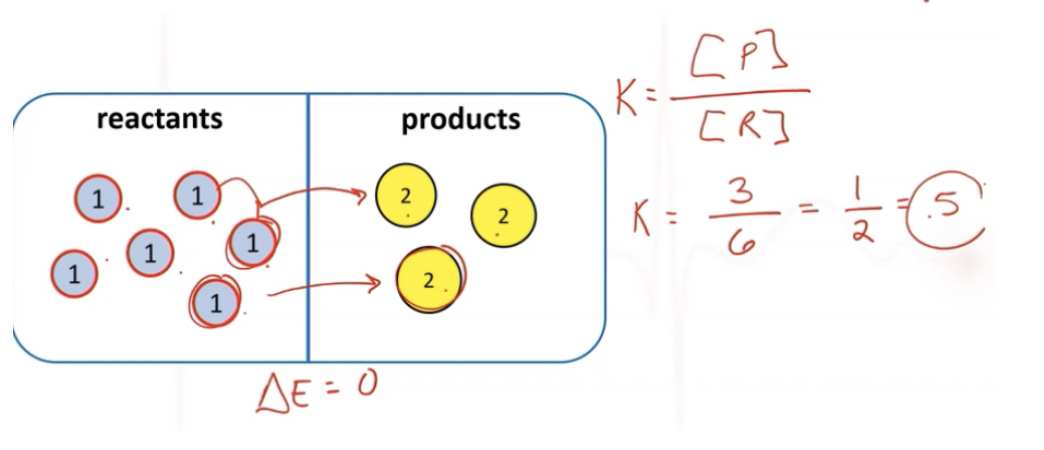
reactant is converted to product at the same rate product is converted to reactant
Delta E = 0
Chemical Equilibrium Defined: Chemical equilibrium occurs when the forward reaction rate equals the reverse reaction rate, meaning the net concentrations of reactants and products remain constant, and the total energy of reactants equals the total energy of products.
Concentrations Do Not Need to Be Equal: Equilibrium does not mean that concentrations of reactants and products must be equal—only that their concentrations are no longer changing over time. Thus, the second option ("No, the concentration is different...") is incorrect.
Despite being at equilibrium, the CONCENTRATION of products and reactants will not necessarily be equal. (only same rate of energy)
Which necessarily means that if the energy of a reactant molecule is pretty close to the energy of a product molecule, there will be less of a difference in concentration between reactants and products
if the energy difference is large between the reactants and products, then the concentration difference at equilibrium will also be large.

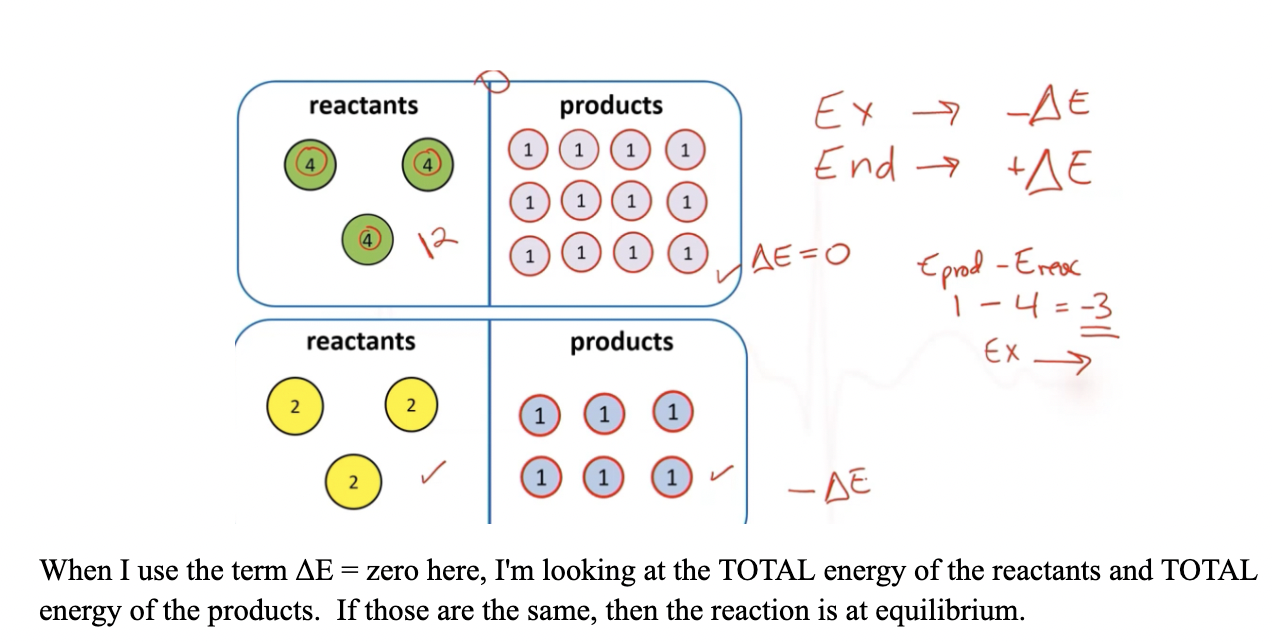
When we look at the energy per mole of the reactants and products, that will give us the positive or negative change of energy needed to determine if the reaction is endergonic or exergonic.
The Law of Mass Action
An increase in [reactants] relative to [products] tends to push a reaction forward
An increase in [products] relative to [reactants] tends to push a reaction reverse

Enzymes act as biological catalysts that lower the
activation energy required to initiate a reaction without being consumed themselves.
Substrates bind to the enzyme’s active site forming an enzyme-substrate complex, inducing a conformational change that facilitates bond cleavage or formation.
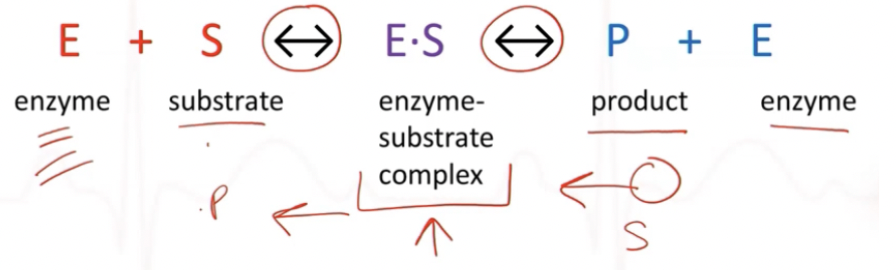
Enzymes do not
change the nature of the reaction or the final product.
only increase reaction rate.
Factors Influencing Enzyme-Catalyzed Reaction Rates
Substrate Concentration
Enzyme Concentration
Affinity
Temperature
pH
Cofactors & Coenzymes
Substrate Concentration
Increasing substrate concentration increases reaction rate up to a saturation point (where all active sites are occupied).
Enzyme Concentration
Increasing enzyme concentration increases the maximum reaction rate.
Affinity
Higher binding affinity between enzyme and substrate increases reaction rate at lower substrate concentrations.
Temperature
Increases rate up to an optimal temperature; extreme heat denatures the enzyme.
pH
Optimal activity occurs within a narrow pH range; deviations reduce rate due to denaturation. Increasing acidity = decreasing ph = lowered enzyme activity.
Vitamin and mineral cofactors make
enzymes work. Without the cofactor, the reaction can’t take place.
Many enzymes require a cofactor, which functions to
lock the reacting substance into its active site.
Important Metabolic Coenzymes
FAD, NAD, CoA
3 Ways to Regulate enzyme activity
Allosteric regulation
Covalent Regulation
Feedback Inhibition (end product inhibition)
Allosteric Regulation
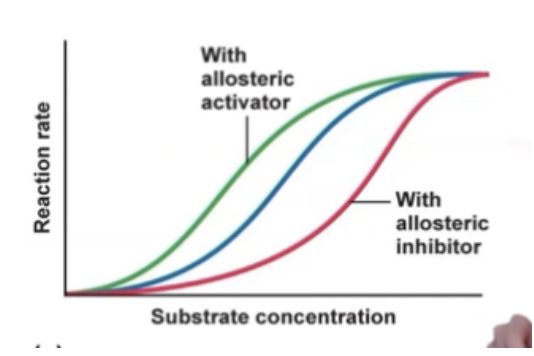
Covalent Regulation

Feedback Inhibition

Adenosine Triphosphate (ATP)
serves as the primary temporary energy storage molecule in cells
ATP Hydrolysis (Exergonic)
ATP+H2O→ADP+Pi+Energy
Breaking the high-energy phosphate bond releases energy directly used to perform cellular work.
ATP Synthesis (Endergonic)
ADP+Pi+Energy→ATP+H2O
Uses energy derived from nutrient breakdown (catabolism of glucose, fats, proteins) to rephosphorylate ADP back to ATP.
Glycolysis
Location? Event Summary? Products? Byproducts?
Cytosol | 10-step anaerobic breakdown of 1 glucose molecule into 2 pyruvate molecules. | • 2 Pyruvate • 2 net ATP (substrate-level) • 2 NADH |
Linking step
Location? Event Summary? Products? Byproducts?