Chem Chapter 3: Molecules, compounds, and chemical equations
 Call Kai
 Learn
Learn Practice Test
 Spaced Repetition
 Match
Match Flashcards
 Knowt Play
1/58

There's no tags or description
Looks like no tags are added yet.
Name | Mastery | Learn | Test | Matching | Spaced | Call with Kai | Chat |
|---|
No analytics yet
Send a link to your students to track their progress
59 Terms
How can elements and compounds be mixed in a mixture?
In a mixture, elements can mix in any proportions whatsoever (hydrogen, H2, and oxygen O2)
In a compound, elements combine in fixed, definite proportions (water, H2O)
What are ionic bonds? Explain them
Ionic bonds, which occur between metals and nonmetals, involve the transfer of electrons from the metal atom to the nonmetal atom.
The metal atom then becomes a cation while the nonmetal atom becomes an anion.
These oppositely charged ions attract one another by electrostatic forces and form an ionic bond.
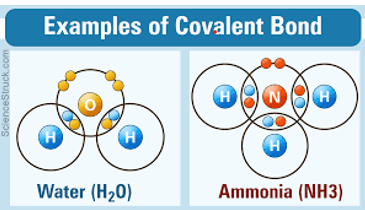
What are covalent bonds? Explain them
•Covalent bonds occur between two or more nonmetals. The two atoms share electrons between them, composing a molecule.
•Covalently bonded compounds are also called molecular compounds.
Diagram of examples of covalent bonds
Example for you to do

What is an empirical formula
An empirical formula gives the relative number of atoms of each element in a compound
What is a molecular formula
A molecular formula gives the actual number of atoms of each element in the molecule of a compound.
What’s is the greatest common factor and empirical formula for H2O2, (HO) B2H6, (BH3) B2H6
•For H2O2, the greatest common factor is 2. The empirical formula is therefore HO.
•For B2H6, the greatest common factor is 2. The empirical formula is therefore BH3.
•For CCl4, the only common factor is 1, so the empirical formula and the molecular formula are identical.
What is a structural formula
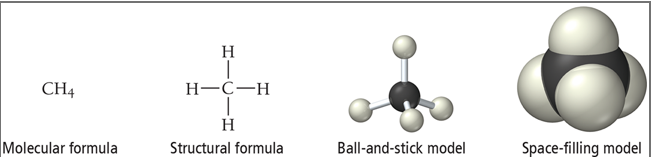
•A structural formula uses lines to represent covalent bonds and shows how atoms in a molecule are connected or bonded to each other.
•It can also show the molecule’s geometry.
•The structural formula for H2O2 can be shown as either of the following.

Why do atoms fill a space in space-filling molecular model?
In a space-filling molecular model, atoms fill the space between each other to more closely represent a best estimate for how a molecule might appear if scaled to visible size.
Diagram of molecular models
What are atomic elements?
•Atomic elements exist in nature with single atoms as their basic units. Most elements fall into this category.
Examples include Na, Ne, K, Mg, etc.
What are molecular elements?
•Molecular elements do not normally exist in nature with single atoms as their basic units; instead, they exist as molecules—two or more atoms of the element bonded together.
•There are only seven diatomic elements and they are H2, N2, O2, F2, Cl2, Br2, and I2.
•Also, P4 and S8 are polyatomic elements.
Diagram of molecular elements

What are molecular compounds composed of?
•Molecular compounds are usually composed of two or more covalently bonded nonmetals.
•The basic units of molecular compounds are molecules composed of the constituent atoms (ex: water = H2O and dry ice = CO2).
What are iconic compounds composed of?
•Ionic compounds are composed of cations (usually a metal) and anions (usually one or more nonmetals) bound together by ionic bonds.
•The basic unit of an ionic compound is the formula unit, the smallest, electrically neutral collection of ions (Ex: NaCl).
How do you name ionic compounds?
Ionic compounds can be categorized into two types, depending on the metal in the compound.

How do I name type I ionic compounds?
•Type I ionic compounds contain a metal whose charge is invariant from one compound to another when bonded with a nonmetal anion
•The metal ion always has the same charge.
Diagram of metals whose change is invariant from one compound to another

What are binary compounds?
Binary compounds contain only two different elements. The names of binary ionic compounds take the following form:
name of cation (metal) -base name of anion (nonmetal) +ide
Examples include:
•The name for KCl consists of the name of the cation, potassium, followed by the base name of the anion, chlor, with the ending -ide.
•KCl is potassium chloride.
•The name for CaO consists of the name of the cation, calcium, followed by the base name of the anion, ox, with the ending -ide.
•CaO is calcium oxide.
How do you name type II binary ionic compounds?
•The full name of compounds containing metals that form more than one kind of cation have the following form:
•The charge of the metal cation can be determined by inference from the sum of the charges of the nonmetal.
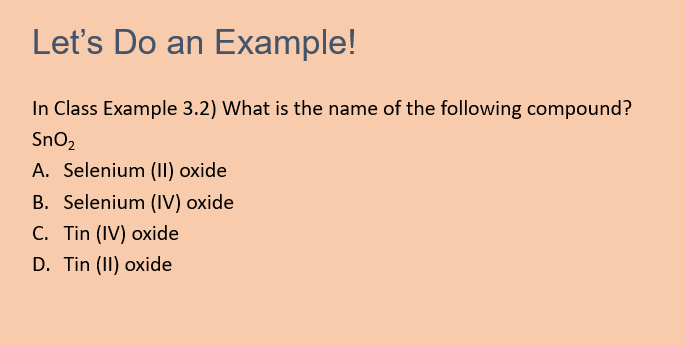
•An example is Fe2O3 à Iron Oxide → Iron (III) oxide

An example for you to do
What do many common ionic compounds contain?
•Many common ionic compounds contain ions that are themselves composed of a group of covalently bonded atoms with an overall charge.
This group of charged species is called polyatomic ions.
NaNO3 contains Na+ and NO3− (nitrate).
CaCO3 contains Ca2+ and CO32− (carbonate).
Mg(ClO3)2 contains Mg2+ and ClO3− (chlorate).
How do we name ionic compounds that contain polyatomic compounds
•We name ionic compounds that contain a polyatomic ion in the same way as other ionic compounds, except that we use the name of the polyatomic ion whenever it occurs.
For example:
•NaNO2 is named according to its cation, Na+, sodium, and its polyatomic anion, NO2–, nitrite.
Hence, NaNO2 is sodium nitrite.
A table of some common polyatomic ions

What are most polyatomic ions?
•Most polyatomic ions are oxyanions, anions containing oxygen and another element.
•Notice that when a series of oxyanions contains different numbers of oxygen atoms, they are named according to the number of oxygen atoms in the ion.
•If there are two ions in the series,
•the one with more oxygen atoms has the ending -ate, and
•the one with fewer has the ending -ite.
•For example,
•NO3– is nitrate.
•SO42– is sulfate.
•NO2– is nitrite.
SO32– is sulfite.
What happens if there are more than two ions in the series?
•If there are more than two ions in the series, then the prefixes hypo-, meaning less than, and per-, meaning more than, are used.
•ClO− hypochlorite
•ClO2– chlorite
•ClO3– chlorate
•ClO4– perchlorate
•BrO– hypobromite
•BrO2– bromite
•BrO3– bromate
•BrO4– perbromate
What are hydrates?
•Hydrates are ionic compounds containing a specific number of water molecules associated with each formula unit.
•For example, the formula for epsom salts is MgSO4 ٠ 7H2O
•Its systematic name is magnesium sulfate heptahydrate.
•CoCl2 ٠ 6H2O is cobalt (II) chloride hexahydrate.
•Common hydrate prefixes include:
hemi = ½
mono = 1
di = 2
tri = 3
tetra = 4
penta = 5
hexa = 6
hepta = 7
octa = 8
•Other common hydrated ionic compounds and their names are as follows:
•CaSO4 ٠ ½ H2O is called calcium sulfate hemihydrate.
•BaCl2 ٠ 6H2O is called barium chloride hexahydrate.
•CuSO4 ٠ 6H2O is called copper sulfate hexahydrate.
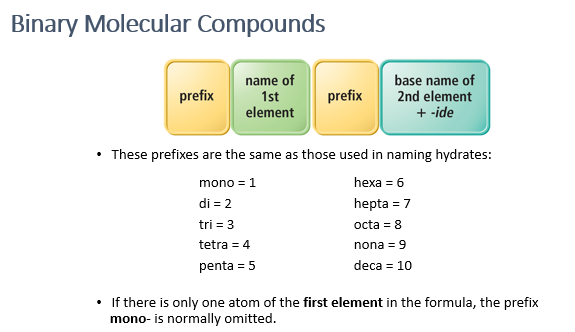
How to name binary molecular compounds
What are acids?
•Acids are molecular compounds that release hydrogen ions (H+) when dissolved in water.
What are acids composed of?
Acids are composed of hydrogen, usually written first in their formulas, and one or more nonmetals, written second.
What are other qualities of acids?
•Sour taste
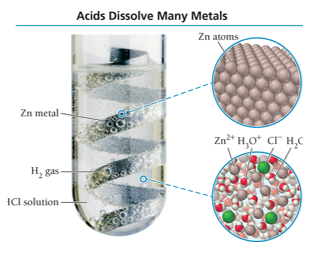
•Dissolve many metals
•such as Zn, Fe, and Mg; but not Au, Ag, or Pt
•Formulas generally start with H,
•e.g., HCl, H2SO4
HCI is a molecular compound that, when dissolved in water, forms H+(aq) and Cl−(aq) ions, where aqueous (aq) means dissolved in water
Diagram of acids dissolved in many metals
What cation and anions do binary acids and oxyacids have?
•Binary acids have H+ cation and nonmetal anion.
•Oxyacids have H+ cation and polyatomic anion.
Diagram of acid types

Diagram of naming binary acids
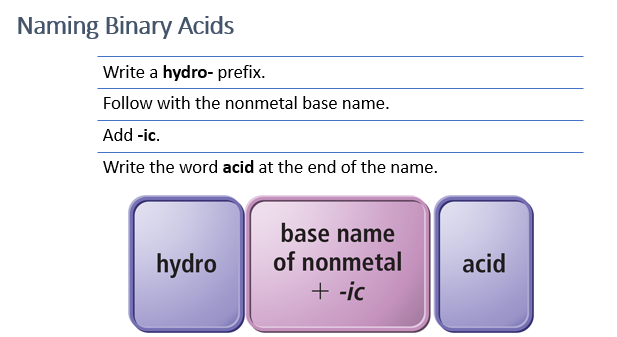
Diagram of naming oxyacids

How to write formulas for acids
•When the name ends in acid, the formula starts with H followed by an anion.
•Write the formula as if it is ionic, even though it is molecular.
•Hydro- prefix means it is binary acid; no prefix means it is an oxyacid.
•For an oxyacid,
•if the ending is -ic, the polyatomic ion ends in -ate.
•if the ending is -ous, the polyatomic ion ends in -ite.
Practice naming an acid

Diagram of inorganic nomenclature flowchart

What is formula mass?
•Formula mass is the mass of an individual molecule or formula unit
•also known as molecular mass or molecular weight
•Sum of the masses of the atoms in a single molecule or formula unit
•whole = sum of the parts!

Diagram: review of using molar mass to count molecules by weighing

Example for you to try

What does a chemical formula in combination with the molar masses of its constituent elements indicate?
A chemical formula, in combination with the molar masses of its constituent elements, indicates the relative quantities of each element in a compound.
What can a mass percentage of each element in a compound be determined from?
•Mass percentage of each element in a compound can be determined from:
1.the formula of the compound
2.the experimental mass analysis of the compound.
•The percentages may not always total to 100% due to rounding.
Formula for calculating mass precent of element X

an example to do

Determining a chemical formula from experimental Data
Empirical Formula
Simplest, whole-number ratio of the atoms or moles of elements in a compound, not a ratio of masses
Can be determined from elemental analysis
Percent composition
Masses of elements formed when a compound is decomposed, or that react together to form a compound
Another example to do
What is a common technique for analyzing compounds?
•A common technique for analyzing compounds is to burn a known mass of compound and weigh the amounts of products.
•This is generally used for organic compounds containing C, H, and O.
•By knowing the mass of the products and composition of the constituent element in the product, the original amount of the constituent element can be determined.
•All the original C forms CO2, the original H forms H2O, and the original mass of O is found by subtraction.
•Once the masses of all the constituent elements in the original compound have been determined, the empirical formula can be found.
Diagram of combustion analysis

What did early chemists divide compounds into?
Early chemists divided compounds into two types: organic and inorganic.
Explain organic and inorganic compounds
•Compounds originating from living things were called organic; compounds originating from the earth were called inorganic.
•Organic compounds were considered easily decomposed and could not be made in the lab.
•Inorganic compounds were very difficult to decompose but could be synthesized.
Diagram for carbon bonding
What are hydrocarbons?
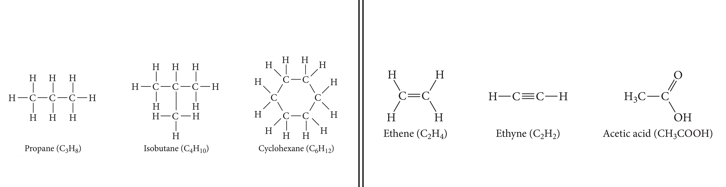
•Hydrocarbons are organic compounds that contain only carbon and hydrogen.
•Hydrocarbons compose common fuels such as
•oil,
•gasoline,
•liquid and natural gas.
•propane gas,
How do you name hydrocarbons?
•Hydrocarbons containing only single bonds are called alkanes.
•Those containing double or triple bonds are alkenes and alkynes, respectively.
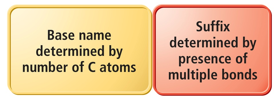
•Hydrocarbons consist of a base name and a suffix.
•alkane (-ane)
•alkene (-ene)
alkyne (-yne)
•The base names for a number of hydrocarbons are listed here:
1.meth-
2.eth-
3.prop-
4.but-
5.pent-
6.hex-
7.hept-
8.oct-
9.non-
10.dec-
Diagram on naming hydrocarbons
an example for you to do

another example
