L2- Intra-abdominal infections
 Call Kai
 Learn
Learn Practice Test
 Spaced Repetition
 Match
Match Flashcards
 Knowt Play
1/127

There's no tags or description
Looks like no tags are added yet.
Name | Mastery | Learn | Test | Matching | Spaced | Call with Kai | Chat |
|---|
No analytics yet
Send a link to your students to track their progress
128 Terms
Approximately how many microorganisms inhabit the gastrointestinal tract?
More than 100,000 billion microorganisms, representing approximately 36,000 species.
What 4 important bacterial groups are examples of normal gastrointestinal flora?
Enterobacterales, e.g. E. coli
Enterococci
Streptococci
A wide variety of anaerobes
What are the two main functions of gut microbiota?
inhibit colonisation by pathogenic species
metabolic products are supplied by the gut microbiota
How does normal gut flora inhibit colonisation by pathogenic species? Give 2 ways
Competition for nutrients and receptors
Production of bacteriocins and fermentation acids
What 2 useful metabolic products are supplied by the gut microbiota?
Energy, particularly butyrate
Essential vitamins including:
Biotin
Folate
Vitamin K

What overall principle should you learn from this diagram for intra-abdominal infection?
The GI tract contains a large endogenous microbial population; therefore, when the normal anatomical barrier is disrupted, organisms that are harmless within the lumen can become the source of intra-abdominal infection.
Are gastroenteritis infections mainly intraluminal or extra-luminal?
Mainly intraluminal.
What are the four categories of causes of gastroenteritis?
Bacterial
Viral
Protozoal/parasitic
Anaerobes
What 6 bacterial pathogens are listed as causes of gastroenteritis?
Campylobacter
Salmonella
Shigella
Pathogenic strains of E. coli, e.g. VTEC
Listeria
Vibrio cholerae
Others
What 3 viral causes of gastroenteritis are listed?
Norovirus
Rotavirus
Adenovirus
Others
What 3 protozoal/parasitic causes of gastroenteritis are listed?
Cryptosporidium
Giardia lamblia
Entamoeba histolytica
Give 2 examples of Gram-positive anaerobic bacilli.
Clostridium perfringens
Clostridium difficile
Give an example of Gram-positive anaerobic cocci.
Peptococcus
Give 3 examples of Gram-negative anaerobic bacilli.
Bacteroides
Prevotella
Fusobacterium
Give an example of Gram-negative anaerobic cocci.
Veillonella
Which 2 anaerobes are normal flora of the skin?
Propionibacterium
Peptostreptococcus
Where are a variety of anaerobic flora found in the body? (2)
upper respiratory tract & GIT
Which 5 organisms are listed as vaginal flora?
Lactobacillus
Propionibacterium
Prevotella
Peptostreptococcus
Veillonella
Are anaerobic infections usually monomicrobial?
No. Anaerobes are often part of a polymicrobial aetiology.
What 6 infections commonly involve anaerobes?
Intra-abdominal infections
Liver abscesses
Dental abscesses
Brain abscesses
Empyema
Chronic suppurative soft-tissue infections
Which 4 antibiotics have good/reliable activity against anaerobes?
Metronidazole
Amoxicillin-clavulanate
Piperacillin-tazobactam
Carbapenems, e.g. meropenem
Which 2 antibiotics have more limited or conditional anaerobic activity?
Clindamycin
Vancomycin
What are each of these antibiotics active against?
Clindamycin —
Vancomycin —
Clindamycin — active against certain anaerobes.
Vancomycin — active against Gram-positive anaerobes only.
What are the microbiological characteristics of C. difficile?
Gram pos/neg
Aerobic/anaerobic
Sporeforming or non-sporeforming
It is a:
Gram-positive
Anaerobic
Spore-forming bacillus
In 1978, what was C. difficile identified as the cause of?
pseudomembranous colitis
What C. difficile account for Approximately 20–30% of?
antibiotic-associated diarrhoea
How common is recurrent C. difficile infection?
15–30% of patients.
What epidemiological setting is particularly associated with CDI?
predominantly healthcare-associated
CDI is an infection requiring X , and that X have evolved over time.
national and international surveillance; surveillance systems
What is the major modifiable risk factor for CDI?
Exposure to antibiotics.
What age increases CDI risk?
Advanced age, particularly >65 years.
How does prolonged hospitalisation affect CDI risk?
Longer hospitalisation increases risk; after >4 weeks, approximately 40–50% colonisation is noted.
Which 2 acid-suppressing drugs are CDI risk factors?
Proton-pump inhibitors
Other antacids
Which GI interventions are CDI risk factors?
GI surgery
Nasogastric (NG) intubation
Summarise the 5 risk factors for CDI

Which 4 antibiotics are classified as high risk for CDI?
Cephalosporins
Carbapenems
Fluoroquinolones
Clindamycin
Which 3 antibiotics are moderately associated with CDI?
Penicillins
Trimethoprim
Macrolides
Which 2 antibiotics are rarely associated with CDI?
Tetracycline
Aminoglycosides
What is the sequence of C. difficile pathogenesis?
Healthcare workers/patients/environment → acquisition of C. difficile → antibiotics inhibit normal gut microflora → proliferation of toxigenic strains and toxin production → diarrhoea/pseudomembranous colitis → toxic megacolon, perforation and shock.
What are 3 potential sources for acquisition of C. difficile?
Healthcare workers (HCWs)
Other patients
The healthcare environment

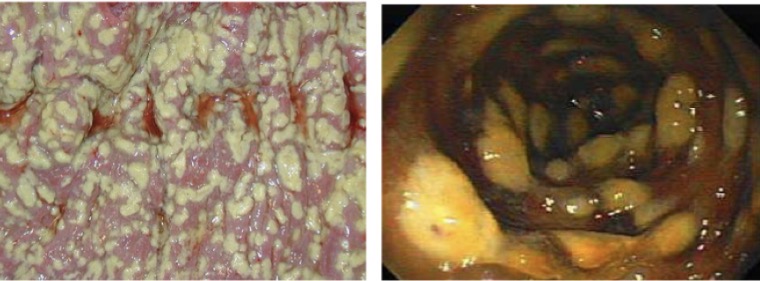
What do the clinical/pathological photographs demonstrate?
The characteristic appearance of pseudomembranous colitis, with raised adherent yellow/white plaques or pseudomembranes over inflamed colonic mucosa.
What happens to inflammatory cells during CDI?
Inflammatory cells, particularly neutrophils, are recruited from the bloodstream into the affected mucosa.
What normally protects against C. difficile infection?
A healthy normal microbiota, which provides colonisation resistance.
How do antibiotics establish susceptibility to CDI?
Antibiotics cause loss of colonisation resistance, producing a susceptible microbiota.
What happens after C. difficile spores enter a susceptible gut?
Spores germinate, producing vegetative C. difficile.
What can vegetative C. difficile do?
It can produce toxins, initiating symptomatic disease.
Does exposure to C. difficile always produce symptomatic infection?
No
Why can CDI recur?
If normal colonisation resistance has not been adequately restored, patients remain susceptible and can enter a recurrence cycle.
What 2 treatments are shown within the recurrence/recovery pathway?
CDI antibiotic treatment
Faecal microbiota transplantation in the recovery pathway

What ultimately promotes recovery?
Restoration of colonisation resistance and return toward normal microbiota.
What is the first requirement and the two categories of methods used to diagnose CDI?
An appropriate index of clinical suspicion
Lab methods
Radiological investigations
What three lab methods can diagnose CDI?
C. difficile toxin testing, e.g. enzyme immunoassay
PCR of toxin-producing genes
Other methods such as culture
What is the stated treatment duration for CDI in the treatment?
10 days.
What 3 clinical features are given as indicators of severe CDI?
Any of:
Fever
Rigors
Abdominal pain
What first-line treatment is listed for mild CDI without features of severe CDI?
Metronidazole PO/NG 400 mg every 8 hours.
What treatment is listed for other/all patients?
Vancomycin PO/NG 125 mg every 6 hours

What 2 other Abx therapeutic options are available for treatment of CDI?
tapered/pulsed oral vancomycin regimen
Fidaxomicin
What tapered/pulsed oral vancomycin regimen is shown?
125 mg every 6 hours for 1 week, then
125 mg every 12 hours for 1 week, then
125 mg once daily for 1 week, then
125 mg every second day for 1 week, then
125 mg every 3 days for 2 weeks
What are two adjunctive treatment for severe CDI?
intracolonic vancomycin
intravenous immunoglobulin
What is an option for recurrent, refractory CDI?
Faecal transplantation.
How should patients with CDI be managed from an infection-control perspective?
Isolate or cohort CDI patients and institute contact precautions For the duration of diarrhoea.
How long should contact precautions be maintained?
For the duration of diarrhoea.
What basic infection-control behaviour is essential?
Compliance with hand hygiene (soap and water), wear PPE gloves and gown
What environmental measures are required?
Scrupulous and regular cleaning of:
Healthcare environment
Patient-use equipment
is handwashing particularly important for C. difficile spores?
Spores are physically removed through the friction involved in washing, rinsing and drying the hands.
Alcohol-based hand rub produced very little reduction in spores in the study shown, reinforcing the importance of soap-and-water handwashing in relevant CDI situations.

Can symptoms begin while taking antibiotics or after the antibiotic course?
Yes. CDI may become apparent during or after antibiotic exposure.
What 3 symptoms occurred in Bordeaux botulism outbreak, 2023 in affected people caused by Contaminated sardines served at a local wine bar resulting in some patients requiring intensive-care admission.?
Respiratory distress
Weakness
Paralysis (descending)
What food was implicated in Botulism cluster in Southern Paris/Central France involving 5 family members in 2024 resulting in admission for respiratory support?
Wild garlic pesto, sold in small cans at local markets/fairs
What organism causes botulism?
Clostridium botulinum.
Does C. botulinum form spores?
Yes; it is spore-forming.
Where is C. botulinum found?
In organic matter in the environment.
What mediates human disease in botulism and what is the mechanism?
Neurotoxins (A–G) produced by C. botulinum- botulinum neurotoxin interfering with the presynaptic machinery required for acetylcholine release, thereby preventing normal neuromuscular transmission
What are four clinical features of botulism?
Paralysis
Respiratory difficulty
Limb weakness
Constipation
How may infant botulism present? (6)
Constipation
Floppy movements
Poor feeding
Drooling
Drooping eyelids
Weak cry
Other manifestations
What is the characteristic pattern of paralysis in botulism?
Flaccid descending paralysis that is bilateral and symmetrical.
What neurological structures are affected early and what 9 symptoms arises as a result?
Cranial nerves, producing cranial neuropathies.
Blurred vision
Diplopia
Ptosis
Facial weakness
Dysphagia
Dry mouth
Difficulty speaking
Slurred speech
Hoarse voice
List the 4 forms of botulism
foodborne botulism
wound botulism
infant botulism
iatrogenic botulism
(Potential use in bioterrorism)
What 4 foods are typically associated with foodborne botulism?
Contaminated:
Fruit
Vegetables
Fish
Meat
particularly when kept in low-oxygen environments, e.g. improperly canned/preserved foods usually in home environments
How soon after ingestion of preformed botulinum toxin do symptoms typically appear?
12–36 hours.
What causes wound botulism?
Wound contamination with C. botulinum, followed by toxin production.
What 2 situations are associated with wound botulism?
Injection drug use, particularly black-tar heroin
War
What is the incubation period for wound botulism?
Symptoms appear approximately 7–10 days after wound contamination.
How does infant botulism develop? (3 steps)
Infant ingests C. botulinum spores.
Spores germinate in the infant's gut.
C. botulinum subsequently produces toxin
What is iatrogenic botulism?
A rare complication of Botox treatment.
Why can botulism be difficult to diagnose?
Diagnosis is challenging and requires a high index of clinical suspicion.
What clinical pattern can help diagnose botulism?
Its distinctive progression of paralysis.
How can laboratory diagnosis be established?
Relevant specimens are tested in specialist laboratories for:
Specific botulinum toxins
± toxin-producing C. botulinum strains
What specific treatment should be given for botulism?
Botulinum antitoxin as soon as possible with Mechanical ventilation and appropriate wound management where needed.
What broader interventions are required when botulism occurs?
Public-health interventions.
What 3 types of pathology can be complicated by intra-abdominal infection?
Perforated viscus
Perforated appendix/diverticulum/ duodenum
GI ischaemia/gangrene
Gangrenous/ischaemic appendix/ Incarcerated inguinal hernia
Diverticular disease

How can intra-abdominal infection occur iatrogenically? (2)
Following surgery, e.g.:
Extension of a wound infection
Anastomotic leak
Name 2 infections of the biliary system
cholecystitis
cholangitis
What is cholecystitis?
Infection/inflammation involving the gallbladder.

What is cholangitis?
Infection involving the bile duct/biliary tree

What 3 complications can occur with biliary infection?
Bacteraemia
Liver abscesses
Gallbladder perforation
What technique is used to visualise the common bile duct?
ERCP- Endoscopic retrograde cholangiopancreatography.
See Multiple lucencies within the common bile duct → Gallstones

What are the 5 major causes of acute pancreatitis?
Gallstones
Alcohol
ERCP
Drugs/toxins
Infections
What 2 infectious examples can cause pancreatitis?
Mumps
Ascaris roundworm
What 4 infective complications can occur following acute pancreatitis?
Infected necrosis
Pancreatic abscess
Pseudocyst
Bacteraemia
What is primary peritonitis?
Spontaneous bacterial peritonitis, usually occurring in the presence of ascites.