Topic 4 — Bioenergetics
 Call Kai
 Learn
Learn Practice Test
 Spaced Repetition
 Match
Match Flashcards
 Knowt Play
1/67

There's no tags or description
Looks like no tags are added yet.
Name | Mastery | Learn | Test | Matching | Spaced | Call with Kai | Chat |
|---|
No analytics yet
Send a link to your students to track their progress
68 Terms
What is the word equation for photosynthesis?
carbon dioxide + water → glucose + oxygen
What is the balanced symbol equation for photosynthesis?
6CO2 + 6H2O → C6H12O6 + 6O2
Is photosynthesis an exothermic or endothermic reaction?
endothermic
What is an endothermic reaction?
Takes in energy from surroundings
temperature of surroundings decreases
In photosynthesis how is energy transferred?
environment → chloroplasts by light
What are the factors that affect the rate of photosynthesis? (4)
Temperature
Light intensity
Carbon dioxide concentration
Amount of chlorophyll
What adaptations do the leaves of plants have that makes them well equipped for photosynthesis? (6)
Broad leaves — large SA
Thin leaves — short diffusion distance
Chlorophyll in chloroplasts — absorbs light
Veins:
water in xylem → cells
remove sugars made in photosynthesis in phloem
Air spaces:
CO2 → cells → O2 by diffusion
Guard cells — open and close stomata — gas exchange
What is meant by a limiting factor?
Factor that limits amount of photosynthesis a plant carries out
What is the effect on photosynthesis when you increase the light intensity?
Increases rate until another factor is limiting
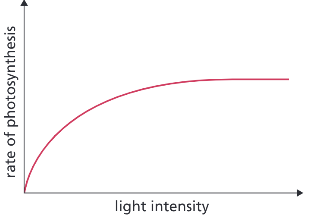
Why does this graph of light intensity against the rate of photosynthesis level off?
Light no longer limiting
another factor is limiting → plant can’t photosynthesise faster
What is the effect on photosynthesis when you increase the temperature?
Photosynthesis controlled by enzymes
Rate increases until enzymes denature
What happens to the rate of photosynthesis when the temperature is too high (beyond the optimum)? Why?
Enzymes denature
Rate of reaction decreases
What effect does increasing carbon dioxide concentration have on the rate of photosynthesis?
Increases rate until another factor is limiting
Why do the carbon dioxide concentrations around a plant rise at night?
Plant respires but no photosynthesis
Light intensity and temperature increase in morning — CO2 around plant used up
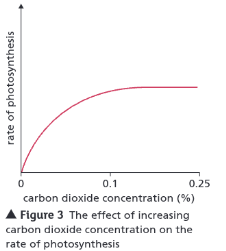
Why does this graph of carbon dioxide concentration against the rate of photosynthesis level off?
Another factor is limiting — plant can’t photosynthesis faster
What happens if a plant doesn’t have enough magnesium?
Can’t produce chlorophyll — needed for photosynthesis
Leaves turn yellow — chlorosis
Rate of photosynthesis decreases
As the distance of the light from the plant __________, the light intensity __________.
That is an _________ relationship — as one goes ____, the other goes _____.
increases
decreases
inverse
up
down
What is the inverse square law for light intensity in the context of photosynthesis?
light intensity∝ 1 / distance2
Outside, there is a constant interaction between the different factors that affect the rate of photosynthesis. For example:
Early in the morning, ______ ________ and ______________ often limit the rate of photosynthesis.
As light levels and the temperature rise, ________ ________ levels become limiting.
On a bright, cold winter day, ___________ probably limits the rate of the process.
light intensity
temperature
carbon dioxide
temperature
Why would big commercial greenhouses control the temperature, the levels of light and carbon dioxide?
Fastest rates of photosynthesis
Plants grow quicker
What are the advantages of growing crops in greenhouses? (5)
Fewer staff are needed — reduces costs
Turnover is fast
Time from seed → harvest is shorter — more crops are possible
Final crop is larger, cleaner, and often soil free — worth more money
Bad/unseasonal weather doesn’t affect crops or harvesting
No need for ploughing — crops may be grown where soil is poor
What are the disadvantages of growing crops in greenhouses? (2)
Electricity and gas used to maintain narrow conditions is expensive
light
temperature
carbon dioxide levels
Diseases could spread rapidly through the entire crop
What are the 3 ways of measuring the rate of photosynthesis in the lab?
Rate of oxygen output
number of bubbles in a given time
measuring cylinder or gas syringe
Rate of carbon dioxide uptake
data logger and carbon dioxide probe
Rate of carbohydrate production
test plant leaves for starch using iodine
measure overall increase in the plant’s biomass
What is the independent variable in RP 6?
Light intensity
What is the dependent variable in RP 6?
Rate of photosynthesis
What are the control variables in RP 6?
Temperature of the water
Carbon dioxide concentration — concentration of sodium hydrogencarbonate solution
Type of pondweed
What are the sources of error in RP 6?
Bubbles vary in size and can form too quickly to count accurately
Temperature changes (water or using a standard lamp) — affects the rate of photosynthesis
What are 3 ways to get a more accurate value of the oxygen produced in RP 6?
Measuring cylinder or gas syringe — measure exact volume of gas produced
Inverted filter funnel over pondweed — ensures all gas bubbles are caught and directed into measuring equipment
Repeat, remove anomalies, and calculate a mean — reduces the effect of random error
Why do we use a LED light source in RP 6?
Releases very little heat — won’t affect the rate of photosynthesis
If we used a light source that emitted too much heat, what effect would it have on the experiment?
Increases the temperature of the water
Temperature affects the rate of photosynthesis
Affects the results
Why do we use sodium hydrogen carbonate solution in RP 6?
Releases carbon dioxide
Allows pondweed to photosynthesise — carbon dioxide concentration is not a limiting factor
Why do we leave the piece of pondweed in the boiling tube for 5 minutes in RP 6?
Gives the pondweed time to acclimatise to the conditions in the boiling tube
What happens to the number of bubbles of oxygen produced per minute if you double the distance?
Number of bubbles produced per minute falls by a factor of four
In RP 6, if we double the distance, then the number of bubbles per minute falls by a factor of four.
What is this called?
Why does this happen?
Inverse square law
When the plant is moved twice as far away from the lamp, the light energy spreads out over four times the area → light intensity falls by a factor of four.
Plant has four times less light to photosynthesise → the rate of oxygen bubbles it produces falls by four times.
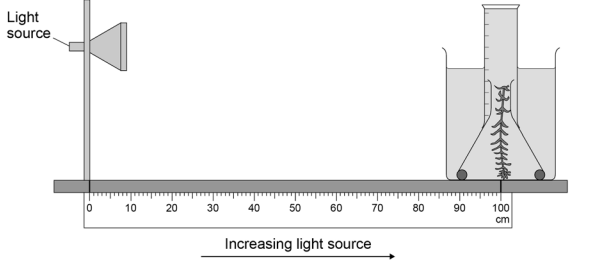
Required Practical 6 — Photosynthesis:
1. Place a boiling tube 10 cm away from an ______ light source.
2. Fill the boiling tube with ________ ____________________ solution.
3. Put a piece of __________ in the boiling tube with the cut end at the ____.
Leave this for 5 minutes
4. Once you see bubbles of _______, start a __________ and count the number of bubbles produced in one minute.
5. Repeat steps 1 - 4 two more times, remove _________, and calculate the ______ number of bubbles produced in one minute.
6. Repeat steps 1 - 5 for different ___________ (20 cm, 30 cm, 40 cm).
LED
sodium hydrogencarbonate
pondweed
top
oxygen
stopwatch
anomalies
mean
distances
What can glucose produced in photosynthesis be used for? (5)
Respiration
Converted into insoluble starch → storage
Produce fat or oil → storage
Produce cellulose → strengthens cell wall
Produce amino acids → protein synthesis
To produce proteins, plants also use _______ _____ that are absorbed from the ____.
nitrate ions
soil
What is the test for glucose (sugars)?
Benedict’s solution
What is the test for starch?
Iodine
What is the test for proteins?
Biuret reagent
Is cellular respiration an exothermic or endothermic reaction?
Exothermic
What is aerobic respiration?
Uses oxygen to release energy from glucose
What is anaerobic respiration?
Releases energy from glucose without using oxygen
How can respiration take place in cells to transfer energy?
Aerobically
Anaerobically
What do organisms need energy for? (3)
Chemical reactions — build larger molecules
Movement
Keeping warm
What is the word equation for aerobic respiration?
glucose + oxygen → carbon dioxide + water
What is the balanced symbol equation for aerobic respiration?
C6H12O6 + 6O2 → 6CO2 + 6H2O
What is the equation for anaerobic respiration in muscles?
glucose → lactic acid
Why is less energy transferred in anaerobic respiration than in aerobic respiration?
Incomplete oxidation of glucose
What is the equation for anaerobic respiration in plant and yeast cells?
glucose → ethanol + carbon dioxide
What does fermentation have economic importance in the manufacture of?
Bread
Alcoholic drinks
What is fermentation?
Anaerobic respiration in yeast cells
What does the number if mitochondria in a cell tell you?
How active the cell is
How are mitochondria adapted for aerobic respiration?
Folded inner membrane → large SA
for enzymes
During exercise the human body reacts to the increased demand for energy.
What increases during exercise and why?
Heart rate
Breathing rate
Breath volume
provide muscles with more oxygenated blood
During exercise, what happens if insufficient oxygen is supplied to the muscles?
Anaerobic respiration
During anaerobic respiration in muscles, what does the incomplete oxidation of glucose cause?
A build up of lactic acid → oxygen debt
What happens during long periods of vigorous activity?
Muscles become fatigued → inefficient contraction
What does the body do to reduce the build up of lactic acid from anaerobic respiration?
Blood flowing through muscles transports lactic acid to the liver — converted back into glucose
What is oxygen debt?
Amount of extra oxygen needed after exercise → reacts with lactic acid and removes from cells
What is the equation for oxygen debt repayment?
lactic acid + oxygen → carbon dioxide + water
Fully explain the increase in heart rate during exercise. (5)
Heart rate increases — pumps greater volume of oxygenated blood → muscles
Delivers faster and greater supply of oxygen + glucose
Increased rate of aerobic respiration
Releases more energy — used for muscle contraction
Faster blood flow:
removes carbon dioxide from muscles more quickly
removes lactic acid more rapidly — prevents oxygen debt + muscle fatigue
Fully explain the increase in breathing rate during exercise.
Breathing rate + breath volume increase — brings more air and oxygen to lungs
Allows more oxygen to enter blood → delivered to muscles
Muscles use extra oxygen to increase rate of aerobic respiration
Increased respiration releases extra energy — muscle contraction
Faster breathing rate — removes carbon dioxide from blood more quickly
carbon dioxide must be removed — waste product continuously produced by increased rate of respiration
During exercise, why is the glycogen stored in the muscles converted back to glucose?
Muscles need lots of extra energy to contract
Glycogen converted back to glucose — extra energy
Increases rate of respiration
What is metabolism?
Sum of all reactions in a cell or the body
How is the energy transferred by respiration in cells is used by the organism?
Continual enzyme controlled processes of metabolism — synthesise new molecules
What does metabolism include? (5)
Conversion of glucose → starch, glycogen, and cellulose
Formation of lipid molecules from molecule of glycerol and three molecules of fatty acids
Use of glucose and nitrate ions to form amino acids — used to synthesise proteins
Respiration
Breakdown of excess proteins — forms urea for excretion
![<ul><li><p><strong>Figure 8</strong> shows an axolotl.</p></li></ul><p>Explain why an axolotl may die in water with a low concentration of oxygen. [4 marks]</p>](https://assets.knowt.com/user-attachments/fe5fef97-eff1-4fe1-9d9e-118e5cc0396b.png)
Figure 8 shows an axolotl.
Explain why an axolotl may die in water with a low concentration of oxygen. [4 marks]
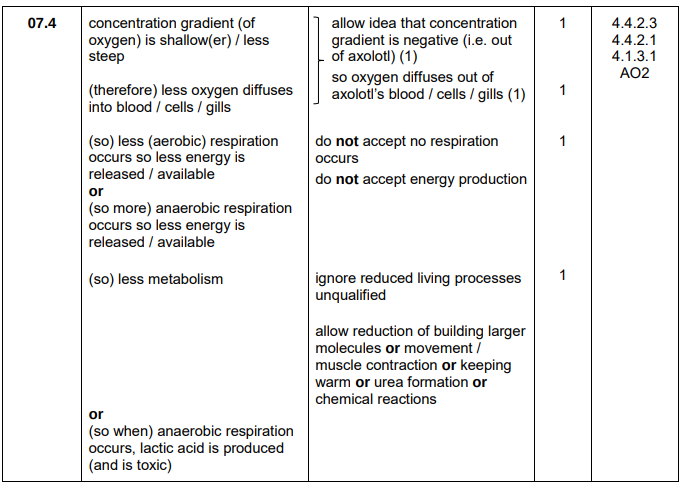
Concentration gradient of oxygen is shallower
Less oxygen diffuses into blood
Less aerobic respiration occurs → less energy released so less metabolism