Intro to Biomaterials and Biocompatibility and Overview of Materials Science
 Call Kai
 Learn
Learn Practice Test
 Spaced Repetition
 Match
Match Flashcards
 Knowt Play
1/73

There's no tags or description
Looks like no tags are added yet.
Name | Mastery | Learn | Test | Matching | Spaced | Call with Kai | Chat |
|---|
No analytics yet
Send a link to your students to track their progress
74 Terms
Biomaterial
a material intended to interface with biological systems to evaluate, treat, augment or replace any tissue, organ of funnction of the body
Biomaterials Science
the study of biomaterials and their interactions with the biological environment; includes material science/engineering, immunology, toxicology, wound healing, anatomy, industrial involvement, and ethics/regulations
Biomaterial Scientist
both the material properties and the biological reaction to ensure that the chosen material is appropriate for the given application (will it properly function in the body)
Biocompatibility
the ability of a material to perform with an appropriate host response in a specfic application (defined by application otherwise hard to define)
Biocompatibility Appropriate Host Response
resistance to blood clotting or to bacteria colonization (can lead to infection), normal healing, calicification (desired for bone grafts but not good if happens on a breat implant or something bc soft tissues), and fibrosis (can help some degree to fix implant in place but can also create unhelpful barriers - glucose sensor)
Tissue Engineering
the application of the principles of life sciences and engineering to develop biological substitutes for the restoration or replacement of tissue or organ function (ex. scaffolds, cells, and chemicals like gfs)
Biomaterial Examples
hard/soft tissue replacement and others
Hard Tissue Replacement Biomaterials
metals and ceramics like orthopedic and dental materials; ex. bones and teeth
Soft Tissue Replacement Biomaterials
polymer like vascular grafts, nerve grafts, and general plastic surgey; ex. neural and vascular tissue
Other Biomaterials
surgical materials like sutures and adhesion prevention, bioelectrodes, and sensors (ex. fixation, monitoring, and prevention)
Skeletal System Biomaterial Applications
joint replacements (hip/knee) - titanium, Ti-Al-V alloy, stainless steel, polyethylene
bone plate for fracture fixation - stainless steel, cobalt-chromium alloy
bone cement - poly(methyl methacrylate)
bony defect repair - hydroxylapatite (ceramics)
artificial tendon/ligament - teflon, dacron
dental implant for tooth fixation - titanium, alumina, calcium phosphate
Cardiovascular System Biomaterial Applications
blood vessel prosthesis - dacron, teflon, polyurethane
heart valve - reprocessed tissue, stainless steel, carbon
cathetar - silicone rubber, teflon, polyurethane
all have polymers bc don’t want them that stiff
Organ Biomaterial Applications
artificial heart - polyurethane
skin repair template - silicone-collagen composite
artificial kidney (hemodialyzer) - cellulose, polyacrylonitrile
heart-lung machine - silicone rubber
Senses Biomaterial Applications
cochlear replacement - platinum electrodes
intraocular lens - poly(methyl methacrylate), silicone rubber, hydrogel
contact lens - silicone-acrylate, hydrogel
comeal bandage - collagen, hydrogel
Cardiovascular System Devices - Occulded Artery
thrombolytic therapy - meds to dissolve blood clots
balloon angioplasty - opens/clears vessel/artery
stent placement - keeps blood vessel and helps keep it open
these 3 help reestablish coronoary patency, salvage the myocardium, and improve survival
Cardiovascular System Devices - Pacemaker
sensor detects low/adnormal BPM and sends out electrical stimulation to get the heart back on track; cons - insulation coudl fail so electrical charges end up in wrong areas
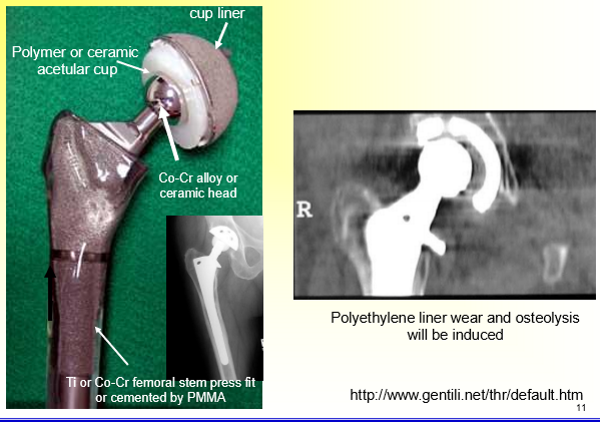
Skeletal System Device - Total Hip Joint Replacement
usually very successful but can have complications because of the polymer material wearing out
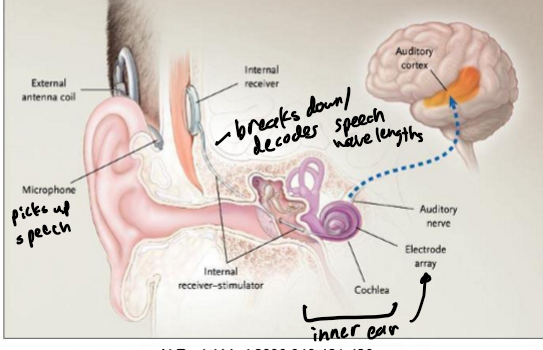
Nervous System Device - Cochlear Implants
lower f - inner ear and higher f - outer ear; cons - electrodes can have fibrosis which can decrease the stimulation and regeneration of nerve cells and the sounds sound artifical
HIstory of Biomaterials
before/early civilization - dental implants (sea shells, iron), sutures (linen and metallic), prostheses
before WWII - basic concepts of biocompatibility
post WWII (surgeon/physician hero era) - high performance metal ,ceramic, and polymeric material became available. intraocular lenses, hip/knee prosthese, dental implants, artificial kidney, vascular grafts, stents, pacemakers (wars = bad but promote technology advancements) → no regulations
since 1960s - materials/devices are specifically designed for biomedical applications
contemporary era - modern biology/materials
Development of Biomaterials
inert materials → bio-active and degradable materials → smart materials (can detect changes) and nanotechnology
Smart Materials/Nanotechnology
can detect changes like temp., pH, solvent responsive, electric activity, piezoelectric.ferroelectric (ion balance), and nanostructured
Clinical Need to Medical Device Time Line - Full Details
identify a need (treat a condition, replace organ, cosmetic) - physician/dentist, researcher, inventor, entreprenuer
device design - physician consults and engineer implements
material synthesis - ceramicist, metalurgist, polymer chemist
materials testing (mechanical properties, toxicology, bioreaction to material (protein interactions, cell activiation, or tissue reaction), biostability (mechanical or chemical)) - bio or mechanical engineer, biochemist, cell biologist, veterinary surgeon
fabrication - engineer or machinist
sterilization/packaging - bioengineer or industrial designer
device testing (toxicology, in vitro, animal testing) - bioengineer, vet surgeon, physician/dentist
regulatory (pre-market approval, limited clinical studt, clinical studies, long-term follow-up) - regulatory specialist/agency or legislators
clincial use - physician, dentist, or optometrist
explant anaylsis (explant registry, pathological examination testing to understand failure) - pathologist or bioegineer
Clinical Need to Medical Device Short Timeline
identify a need → device design → materials synthesis → materials testing → fabrication → sterilization and packaging → device testing → regulatory → clincial use → explant analysis
Material Science Basics
processing → structure —> properties —> performance
Processinf
the way be making a material into a device; ex. heat treatment, mechanical forces, electrical field, etc.
Structure
this determines properties; can atomic, microscopt, or macroscopic
Properties
determined by structure; ex. mechanical and chemical (always important), electrical (pacemaker), magnetic (MRI), thermal, and optical (intraocular lenses)
Subatomic Species
nucleus, electron, atomic #, and atomic mass
Nucleus of an Atom
combination of protons (+ 1.67 × 10^-19 C) and neutrals (no charge)
Electrons
have a negative charge of - 1.67 × 10^-19 C
Atomic #
the # of protons in an atom
Isotope
same element but have different #’s of neutrons; ex. C12, C13, and C14
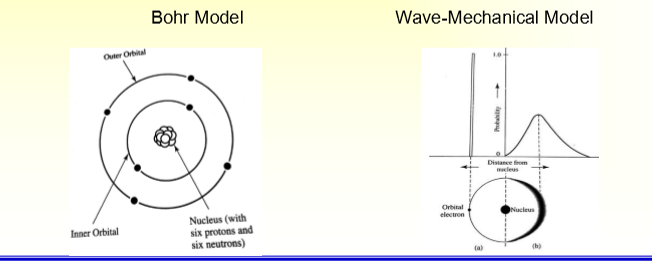
Atomic Models
Bohr and wave-mechanical
Atomic Orbitals
have shells (n) and subshells (orbitals, s, p, d, and f) → 1 energy state for s, 3 for p, 5 for d, and 7 for F; lower energy states filled first; must follow Pauli exclusion principle and Hund’s rule
Pauli Exclusion
no energy state can be occupied by more than 2 e- and they must be a different orientation (have opposite spins)
Hund’s Rule
when filling subshells with more than one energy state, fill each subshell with one e’ first then add a 2nd with opposing spin
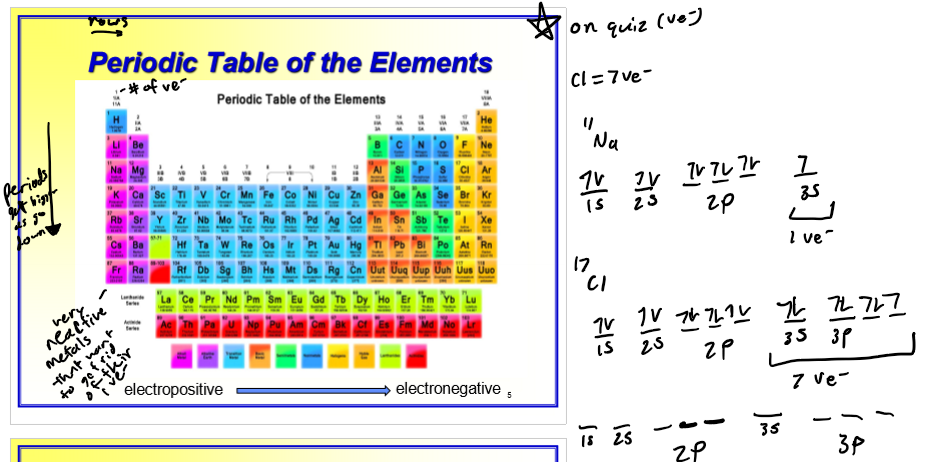
Valenc Electrons
electrons that occupy the outermost filled shell; participate in bonding between atoms; physical/chemical properties of solids are based on these
Periodic Table Picture
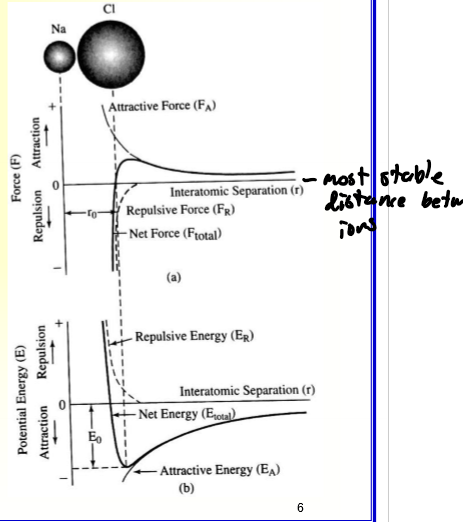
Ionic Bonds
type of primary bond that involves sharing/transferring ve-; occure between atoms with large differences in electronegativity; non-directional (jave the same magnitude in all direction); each ion must be surrounded by oppsoitely charged ions in all direction → constraints on crystal structure → brittle and hard
Ionic Bond Picture
Covalent Bond
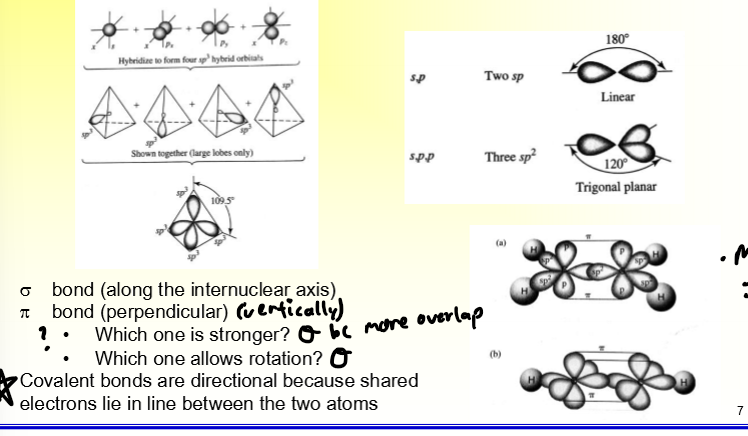
formed through the sharing of ve-; both atoms are electronegative; has hyridization; have sigma and pi bonds; directional bc shared e- lie in line between the 2 atoms
Hybridization
the spatial orientation of the hybrid orbital that determines where bonding occurs and the bond angle
Covalent Bond Picture
Sigma Bond
type of covalent bond that is along the internuclear axis; stronger bc more overlap; allows for rotation
Pi Bond
type of covalent bond that is perpendicular (vertical)
Metallic Bond
bond between electropositive elements with attractive force between ion cores and the e sea; non-directional; bc of the mobility of e- in the “sea”, these are electrical conductors

Primary Bondings
ionic - betwen cation/anion, strongly attracted by electrostatic effect; 150-370 kccal/mol; poor electrical conductors; intrinsicially brittle; low chemical reactivity
metallic - atoms arranged in order with ve- cloud floating around; 25-200 kcal/mol; high electrical/thermal conductivity; undergo more plastic deformation (change shape w/o breaking); varies a lot in reactivity
covalent - ve- from 2 atoms make a pair; 75-300 kcal/mol; poor electrical conductors (usually); have a higher chemical reactivity
Secondary Bondings
bondings betwene molecules that are usually weaker than primary bonds; ex. Van de Waals and hydrogen (H) bonds
Van der Waals
secondary bonds that form from atomic/molecular dipoles (either permanent, polar molecule-induced, or fluctation induced); 10 kcal/mol
Hydrogen Bonds
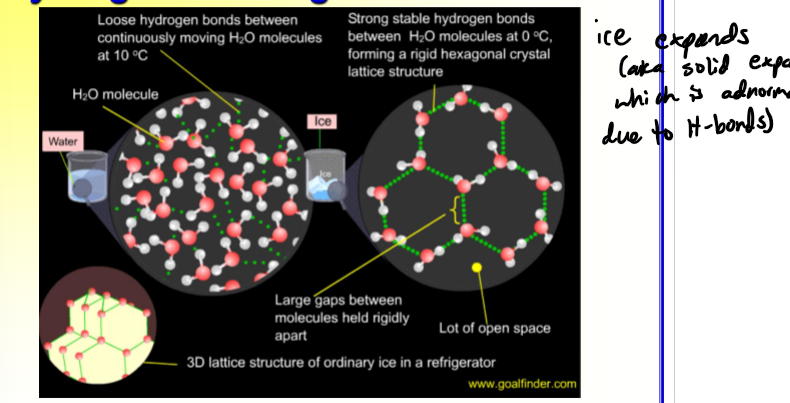
secondary bonds that are formed between H-F, H-O, or H-N (X~H-Y where X/Y are F, O, or N); important for synthetic polymers and biomocules
H Bonds in Water Picture
adnormal because of the structure of these bonds so that is why ice expands
Crystalline and Noncrystalline Materials
single crystals, polycrystalline materials, and amorphous materials
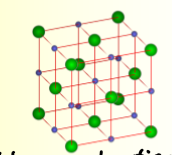
Single Crystals
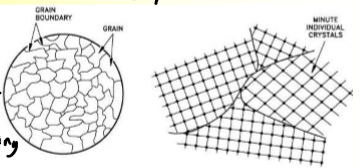
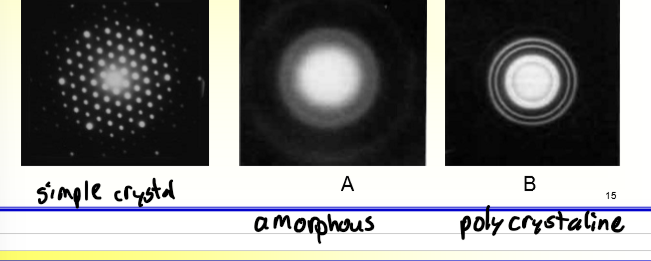
the periodic and repeated arrangement of atoms is perfect or extends throughout the entirety of the specimen w/o interruption
Polycrystalline Materials
collection of many small crystals or grains that have order but not a perfect/repeated structure
Amorphous Materials
do not have a systemic or regular arrangement of atoms over a relatively large atomic distance
Bragg’s Law and Diffraction
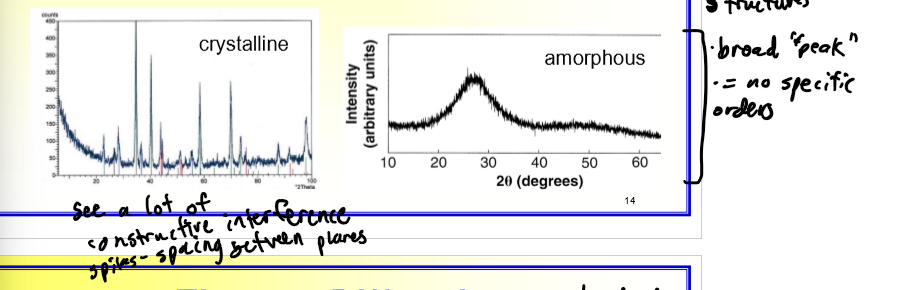
explains where constructive interference happens

X-ray Diffraction
helps determine interference type; crystalline if see a lot of spikes (constrauctive interference) and amorphous if just a broad peak and no specific orders
Electron Diffraction
use this instead of an X-ray because it is a much smaller wavelength so more precise picture of interference
Classification of Material Types
metal, ceramics, polymers, carbon materials, glass, and composite materials
Metals
have metallic bonding and a simple crystal structure
Ceramics
have a combo of ionic and covalent bonding and a complicated crystal structure or amorphouse
Polymers
use primarily covalent bonding; can be amorphous or polycrystalline or a mixture
Structure-Property Relationship
the arrangement of atoms in diff. ways (diff. crystal type like graphite vs. diamond); polycrystalline vs. amorphouse → opaque vs. translucent and a smaller grain size = higher mechanical strength

Stress and Strain - Mechanical Properties
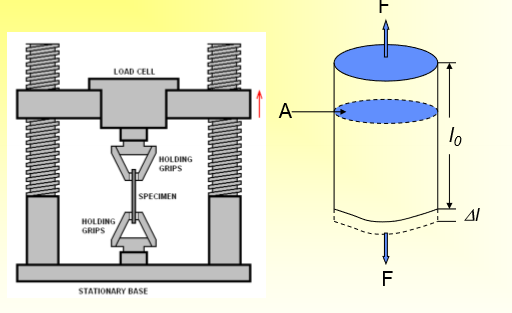
tensile stress (sigma = F (load) / A (area)) → N/m² = pascal (Pa)
tensile strain (epsilon = delta L (change in length) / (lo) initial length) → no units
Elastic Constant
sigma = Ee (tension or compression)
E - Young’s modulus (slope of stress-strain curve) and represents the inherent properties of the materials
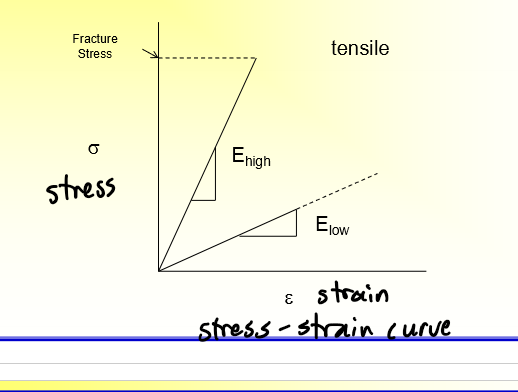
Stress-Strain Curve Pictures
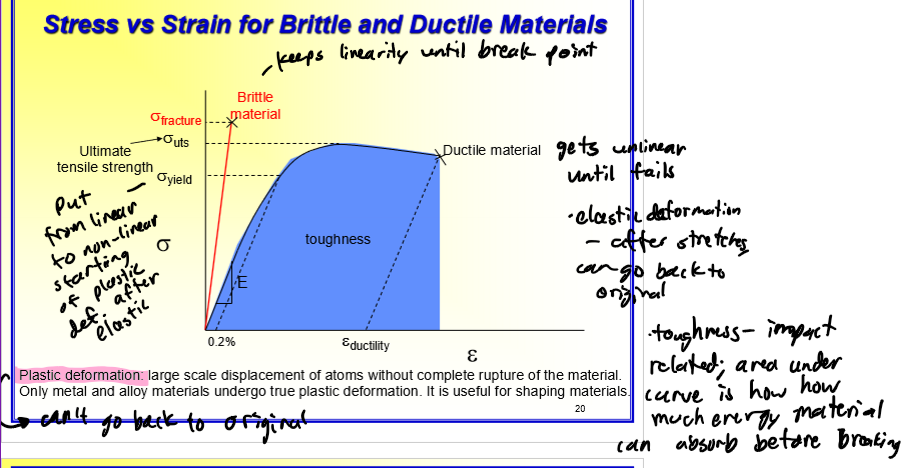
Plastic Deformation
large scale displacement of atoms w/o the complete ruptire of the material’ only metals and alloy materials can truly undergo this; useful for shaping materials; can’t go back to original shape
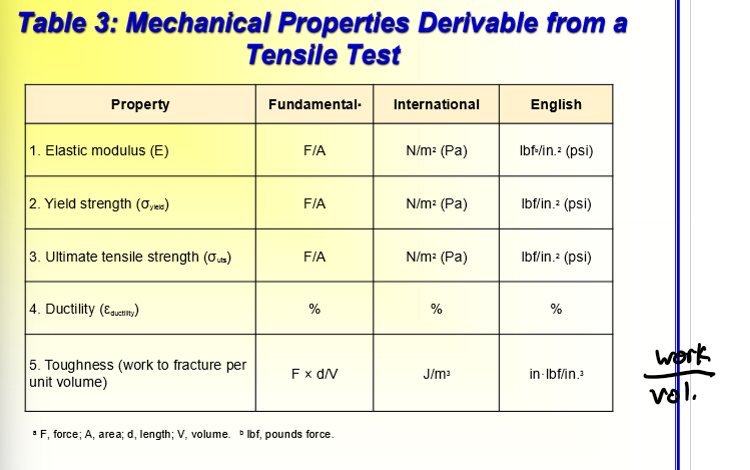
Mechanical Properties Table Picture
Fatigue
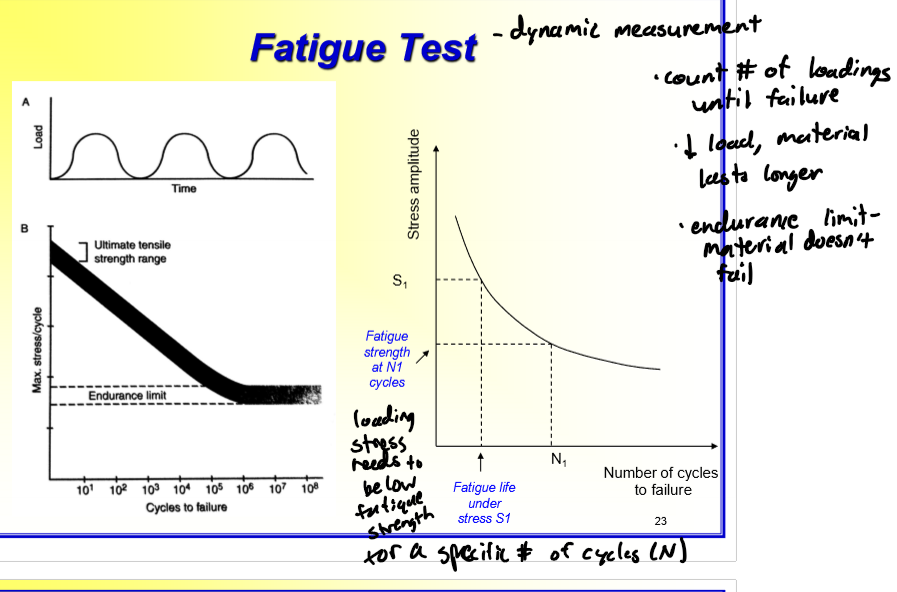
a process by which structures fail as a result of cyclic stresses that may be less than the ultimate tensile stress; this type of failure is one of the major challenges in many prosthetic devices (ex. heart valve, prosthetic joint); many factors influence this; can’t test staticallt
What can repetitive loading do to a material?
can produce microscopic cracks that then can propagate by small steps at each load cycle
Factors that Influence Fatigue Life
stress and cycle rate
internal isses like stress conc. at crack tip, surface scratch, or a sharp corner
environmental issues like temp., corrosion, or deterioration
Fatigue Test
a dynamic measumrent that counts the # of loadings until failure
Mechanical Property Considerations for Load-bearing Biomaterials
at all time points, stress needs to be safely below the yield strength and if cyclic loads are involved, the service stresses must be kept below the fatigue strength
Mechanical Property Considerations for non-load-bearing Biomaterials
these should match those of the host tisse to minimize foreign body reaction